FMCSA Hours of Service regulations under 49 CFR Part 395 are the federal rulebook that governs every commercial driver's day — and they're the most frequently violated set of rules in commercial trucking. FMCSA data identifies driver fatigue as a factor in approximately 13% of CMV crashes, which is why HOS violations carry civil penalties up to $16,000 per violation, 7 CSA points per major violation, and can immediately place drivers and vehicles out of service at the roadside. The 2025 CVSA International Roadcheck placed 1,076 drivers OOS for HOS violations in just 72 hours of focused enforcement — and that's only the enforcement window when carriers know inspections are coming.
The 2026 regulatory landscape brings several important updates to HOS administration. The eDVIR Final Rule (published February 19, 2026) explicitly confirmed that Driver Vehicle Inspection Reports may be created, signed, and maintained electronically alongside HOS records — modernizing the documentation stack drivers must produce at roadside. The FMCSA revoked several ELD devices in late 2025 and early 2026, with the PSS ELD, Black Bear ELD, and RT ELD Plus grace periods ending February 7, 2026 (drivers using these devices are now subject to immediate out-of-service orders). The Drug and Alcohol Clearinghouse-II expanded enforcement throughout 2026 with the SDLA enforcement that may downgrade CDLs for drivers in prohibited status. The HOS rules themselves remain unchanged from the 2020 Final Rule — but the enforcement landscape around them tightened significantly.
This guide explains every FMCSA Hours of Service rule for 2026: the 4 core driving limits, the sleeper berth provisions, the exemptions, the ELD requirements, the most-cited violations, and the documentation workflow that keeps fleets compliant. Start your free trial of our truck inspection and maintenance software to keep HOS, DVIR, and PM compliance audit-ready on one platform — live in 10 minutes, free for up to 3 trucks.
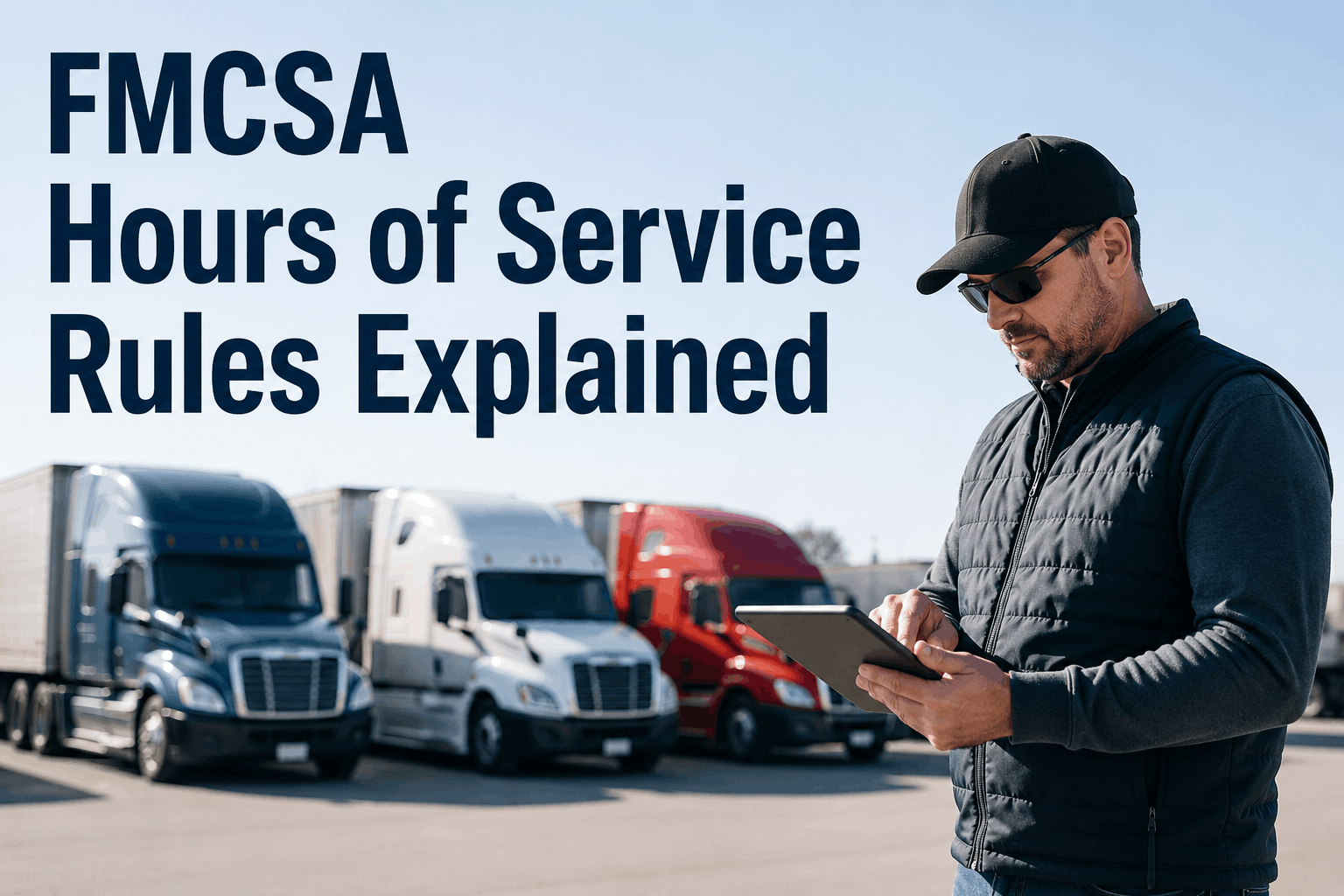
FMCSA Hours of Service Rules Explained [2026 Update]
Every FMCSA HOS rule explained for 2026 — 11-hour driving limit, 14-hour window, 30-minute break, 60/70-hour weekly caps, sleeper berth splits, ELD requirements, exemptions, and the violations that trigger $16,000 penalties plus immediate out-of-service orders.
Quick Answer: FMCSA HOS Rules for Property-Carrying Drivers
FMCSA Hours of Service rules under 49 CFR Part 395 limit commercial driver duty cycles to prevent fatigue-related crashes. Property-carrying CMV drivers may drive a maximum of 11 hours after 10 consecutive hours off duty (the 11-Hour Driving Limit), cannot drive beyond the 14th consecutive hour on duty (the 14-Hour Window), must take at least a 30-minute break after 8 consecutive driving hours, and cannot drive after accumulating 60 hours on duty in 7 days or 70 hours in 8 days. The 34-hour restart is optional. Sleeper berth splits allow 7+2 configurations (7 consecutive hours in berth, plus 2 consecutive hours off-duty or berth). Passenger-carrying drivers face slightly different limits (10-hour driving, 15-hour on-duty). Electronic Logging Devices (ELDs) registered with FMCSA are mandatory for most carriers. Violations carry penalties up to $16,000 per occurrence plus 7 CSA points for major violations like driving beyond limits or false logs.
The 4 Core HOS Rules — Property-Carrying Drivers
These four limits work together as a system. Every property-carrying CMV driver must comply with all four simultaneously — exceeding any one triggers an HOS violation. Contact our sales team for help configuring HOS-compliant workflows for your fleet.
70
Property-Carrying vs Passenger-Carrying — Side by Side
HOS rules differ between drivers hauling property and drivers hauling passengers. Knowing which set applies to your operation is essential — most fleets only deal with one, but mixed-operation carriers must handle both.
The Sleeper Berth Split — Two Configurations
Sleeper berth provisions allow drivers to split the required 10-hour off-duty period into two qualifying segments — providing operational flexibility while preserving the rest required for safety. Two configurations are permitted.
Both configurations together equal at least 10 hours. The two qualifying periods can be taken in any order. Sleeper berth split flexibility is a critical operational tool — and a common source of compliance errors when logged incorrectly.
The 5 Most Common HOS Violations
FMCSA enforcement data shows these five violations account for the overwhelming majority of HOS citations. Each one is preventable with disciplined ELD use and structured fleet management workflows. Sign up free to add HOS compliance tracking alongside your inspection and maintenance workflows.
2026 HOS Regulatory Updates — What Changed
The HOS rules themselves haven't changed since the 2020 Final Rule. But the enforcement landscape and documentation requirements tightened significantly through 2026. Here's what fleet managers need to know.
HOS Exemptions — When the Rules Don't Apply
Several built-in exceptions modify HOS rules for specific operations. Most fleets encounter at least one. Knowing which applies to your operation is essential.
Frequently Asked Questions
Property-carrying CMV drivers in 2026 must comply with four core limits under 49 CFR §395.3: (1) the 11-Hour Driving Limit — maximum 11 hours of driving after 10 consecutive hours off duty; (2) the 14-Hour Window — cannot drive beyond the 14th consecutive hour on duty; (3) the 30-Minute Break — required after 8 consecutive driving hours; and (4) the 60/70-Hour Weekly Limit — cannot drive after 60 hours in 7 days or 70 hours in 8 days. A 34-hour restart resets the weekly clock. The rules have not changed from the 2020 Final Rule. Contact our sales team to integrate HOS-compliant workflows with your inspection and maintenance platform.
Civil penalties run up to $16,000 per HOS violation. Major violations (driving beyond 11-hour, 14-hour, or 60/70-hour limits; false logs) carry 7 CSA points each. Driving more than 3 hours past a driving limit can trigger an immediate out-of-service order at the roadside — the truck stops where it is until the driver has 10 consecutive hours off. The 2026 CSA SMS overhaul doubled the severity weight of OOS violations to 2 (vs 1 for non-OOS) — meaning HOS-driven OOS findings now hit carrier scores twice as hard as they used to.
Most drivers required to keep records of duty status (RODS) must use an FMCSA-registered Electronic Logging Device (ELD). Exemptions include drivers using the short-haul 150 air-mile exception, drivers operating CMVs manufactured before model year 2000, driveaway/towaway operations, and drivers required to keep RODS only 8 days or less in any 30-day period. As of 2026, several previously-registered ELD devices have been revoked — PSS ELD, Black Bear ELD, and RT ELD Plus grace periods ended February 7, 2026. Verify your device monthly on the FMCSA registered ELDs list. Start your free trial to integrate ELD data with your inspection and maintenance workflow.
Property-carrying drivers using a sleeper berth may split the required 10-hour off-duty period into two qualifying segments. Two configurations are permitted: 7+3 (7 consecutive hours in the sleeper berth plus 3 consecutive hours off-duty or in the sleeper berth) or 8+2 (8 consecutive hours in the sleeper berth plus 2 consecutive hours off-duty or in the sleeper berth). Neither period counts against the 14-hour driving window — providing operational flexibility for long-haul operations. The two periods can be taken in any order. Common source of compliance errors when logged incorrectly.
The 34-hour restart is an optional provision allowing drivers to reset the 60/70-hour weekly clock back to zero by taking at least 34 consecutive hours off duty. After completing the restart, the driver may begin accumulating hours fresh from zero. No specific time-window restrictions apply to when the 34-hour restart must occur. The restart is optional — drivers can simply continue waiting for hours to roll off the 7/8-day rolling window naturally. Most drivers use the restart strategically to maximize available driving hours within tight delivery schedules. Talk to our sales team for help configuring HOS tracking integrated with your maintenance workflow.
Under §395.1(e)(1), drivers operating within 150 air-miles of their normal work-reporting location and returning to that location within 14 hours may use timecards instead of full RODS — eliminating the need for an ELD. The driver cannot drive more than 11 hours within the 14-hour window, must take at least 10 consecutive hours off duty between shifts, and the 30-minute break requirement does not apply. This exception is heavily used in regional delivery, local construction, and short-haul agriculture. Switching between short-haul-exception days and long-haul ELD days within the same week is where most compliance errors occur. Sign up free to manage mixed-exception fleets on one platform.
Unify HOS, DVIR & Maintenance Compliance on One Platform
500+ fleets keep FMCSA compliance audit-ready on our truck inspection and maintenance software: §396.11 DVIRs, multi-trigger PM scheduling, work orders, parts inventory, vendor performance tracking, and audit-ready records. eDVIR-compliant from day one. Pairs natively with your existing ELD for unified compliance documentation.