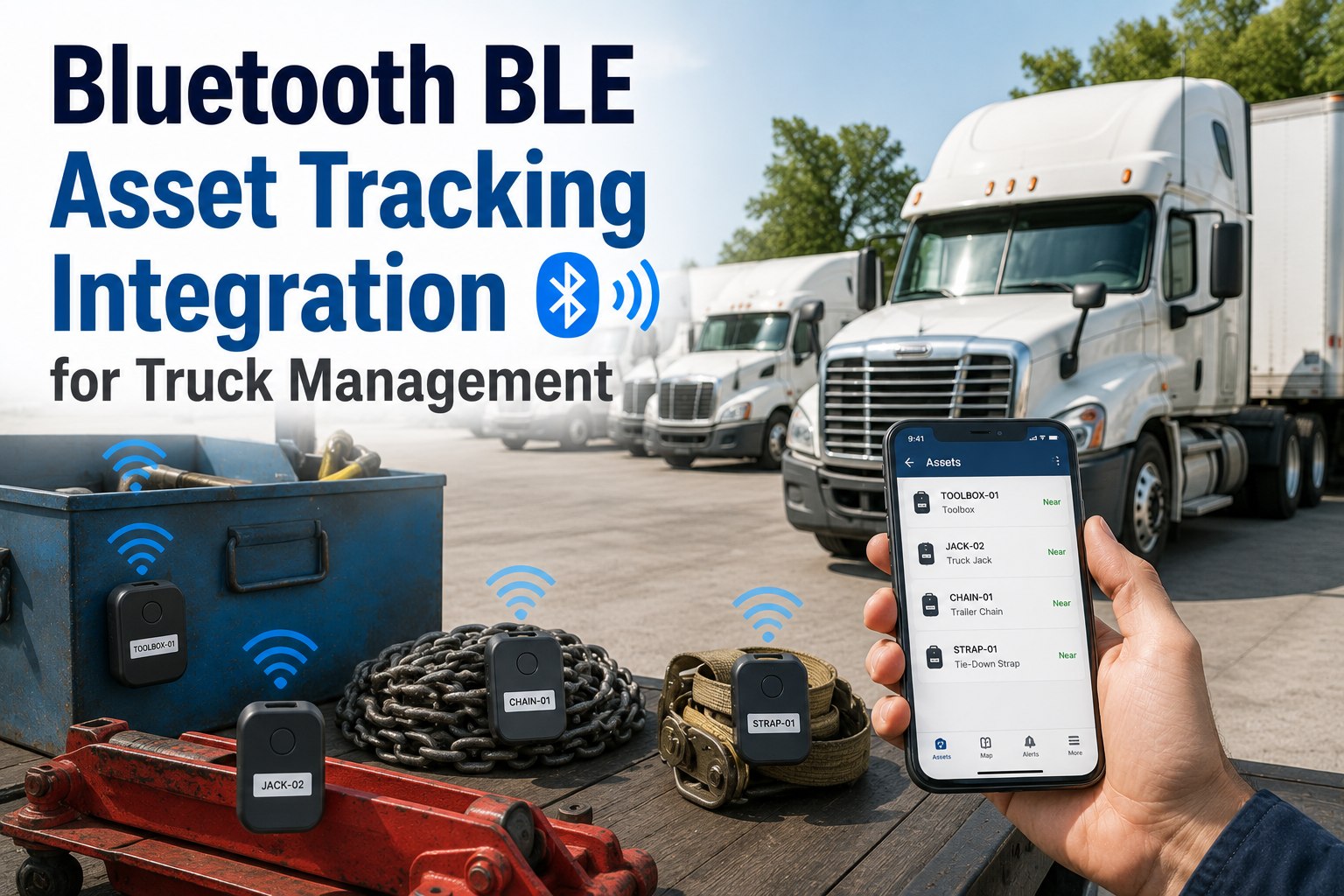
Ask a yard manager where the torque wrench is and you'll get a shrug. Ask which of the twelve generators went out on Tuesday's job and never came back, and you'll get a longer shrug. A typical worksite carries seven to ten thousand dollars of loose equipment — tools, pumps, scaffolding, pallets, jacks — and almost none of it is tracked, because bolting a $120 cellular GPS unit with a monthly SIM fee onto a $200 tool makes no economic sense. So the small stuff walks. It gets left at a site, loaded on the wrong trailer, or quietly disappears, and nobody notices until the day someone needs it. Tag your equipment and see it free. Bluetooth BLE tags solve exactly this gap: under $30, no SIM, a battery that lasts years, and small enough to zip-tie to anything. Integrated with Truck Inspection & Maintenance, each tag turns a nameless piece of equipment into a tracked asset with a last-seen location, a service history, and its own inspection schedule. This guide explains how BLE actually works, which assets deserve a tag versus a GPS unit, and why proximity beats position for everything in your yard.
Bluetooth BLE Asset Tracking Integration for Truck Management
Track the equipment GPS can't justify. Clip a sub-$30 BLE tag to any tool, generator, or pallet and Truck Inspection & Maintenance gives it a last-seen location, zone alerts, and its own maintenance and inspection record — no SIM, no charging, for years.
Proximity, Not Position
This is the mental shift that makes BLE click. A GPS tracker answers "where is this on a map?" — and pays for that answer with a SIM, a subscription, and a hungry battery. A BLE tag answers a cheaper, often more useful question: what's near my reader right now, and when did I last see it? For everything that lives in a yard, that's the answer you actually need.
Every Truck Is Also a Reader
Here's the part most people miss. Fixed gateways cover your yard — but any GPS-equipped truck in your fleet doubles as a mobile scanner. When it rolls within Bluetooth range of a tag, it hears the beacon, stamps it with its own GPS position, and reports it. Your coverage grows every time a truck moves.
Mounted at the shop or gate, it continuously inventories everything within range — a live roll-call of what's home and what isn't.
A telematics-equipped truck scans as it drives. Pass a tagged asset at a job site and it's logged with a GPS fix — no infrastructure at that site at all.
A technician's app can detect nearby tags too, so a walkaround doubles as an inventory sweep without anyone scanning barcodes.
Which Asset Gets Which Tracker
BLE isn't a GPS replacement — it's the other half of the answer. Get this split right and you cover the whole yard without overspending on either side.
The strongest deployments run both in one platform: BLE for yard inventory and near-asset visibility, GPS for anything over the road. Because satellite signals don't penetrate concrete, steel, or a metal-walled trailer, BLE also covers exactly where GPS goes blind — a tag stays locatable inside a shop, a warehouse, or a loaded box trailer.
A Tag Turns Equipment Into a Managed Asset
This is where tracking stops being a map exercise. Once a tool or generator carries a tag, Truck Inspection & Maintenance treats it like any other asset — its own service history, inspection schedule, usage record, and PM triggers. You don't just know where the generator is; you know when it was last serviced and what it costs you to run.
From Tag to Maintenance Record
A location alone is trivia. The value comes from what the platform does with it once the asset exists as a record — and that's the difference between an asset tracker and an asset management system.
What the Tags Can Tell You
Beyond presence, modern BLE tags carry sensors — so a tag can report on the condition of the asset, not just its whereabouts.
The core signal: what's in range now, and a timestamp for anything that isn't.
An asset leaving the yard without a work order fires an alert — the theft and left-behind catch.
Motion detection shows what's actually being used versus what's sat idle for a month.
Sensor tags report environmental conditions for sensitive parts, fluids, or stored inventory.
Rugged tags flag removal attempts, so a tag coming off an asset is itself an event.
Presence, condition, and service history per asset — in the same platform as your trucks.
Start free →Why Fleets Tag Everything
BLE's economics are what make it different. The cost per asset is low enough that tagging everything stops being a budget decision and starts being obvious.
Frequently Asked Questions
A GPS tracker carries its own satellite receiver and SIM card, so it reports live map position anywhere with cell signal — but it's bulky, costs far more per unit plus a monthly fee, and burns battery quickly. A BLE tag simply broadcasts a small Bluetooth identifier that nearby readers hear, which makes it cost under $30, run two to five years on one battery, and need no SIM at all. It gives you last-seen location and zone alerts rather than continuous map position. For anything living in your yard, that's the more useful and far cheaper answer. Start a free trial to tag your equipment.
A tag is typically detected within roughly 75 to 150 feet of a compatible gateway, though rugged long-range tags can reach considerably further in open conditions. Range depends on the environment — walls, racking, and metal all reduce it. That said, range matters less than most people expect, because coverage comes from having readers where assets are: a gateway at your shop or gate, plus every telematics-equipped truck acting as a mobile scanner as it drives. Mobile hubs on vehicles and forklifts extend coverage as they move, which reduces how many fixed gateways you need to install. Ask about coverage for your yard.
Yes — and that's one of BLE's biggest advantages. GPS depends on satellite signals that can't penetrate concrete, steel, or multi-level structures, so a GPS-only tracker goes blind inside a shop, a warehouse, or a metal-walled trailer, losing the asset entirely. BLE doesn't have that problem: as long as a tag is within range of a gateway or a passing reader, it's heard. That's why the strongest deployments pair the two — BLE for indoor and near-asset visibility, GPS for the outdoor over-the-road segment — giving continuous visibility as an asset moves between environments, which standalone GPS cannot provide.
Most tags run two to five years without any intervention, and rugged deploy-once tags on containers or trailers can last far longer. Battery life depends on how often the tag broadcasts — the interval is configurable, so you can trade update frequency for longevity depending on the asset. Many tags use replaceable coin cells, which keeps total cost of ownership low across a large fleet because tags get refreshed rather than thrown away. Practically, this means you tag an asset and forget about it for years, which is exactly what makes tagging hundreds of small items feasible. Start free and tag your first assets.
That's the whole point of integrating tags with a maintenance platform rather than a standalone tracking app. Once a generator, compressor, or pallet jack exists as a tagged asset in Truck Inspection & Maintenance, it gets everything a vehicle gets: an inspection checklist, a preventive-maintenance schedule, a service history, and cost tracking. Movement data from the tag shows which equipment is actually being used and which has sat idle for a month, so you can right-size what you own. And because the record is complete, an asset's real cost of ownership — purchase, service, downtime — finally becomes visible instead of vanishing into a general expense line. Start free and manage every asset.
Stop Losing the Things Too Small to Track
Truck Inspection & Maintenance turns sub-$30 Bluetooth tags into full asset records — last-seen location from yard gateways and passing trucks, zone-exit alerts when something walks, and the same inspections, PM schedules, and cost tracking your vehicles get. No SIM, no charging, no infrastructure project. Just visibility on everything you own.