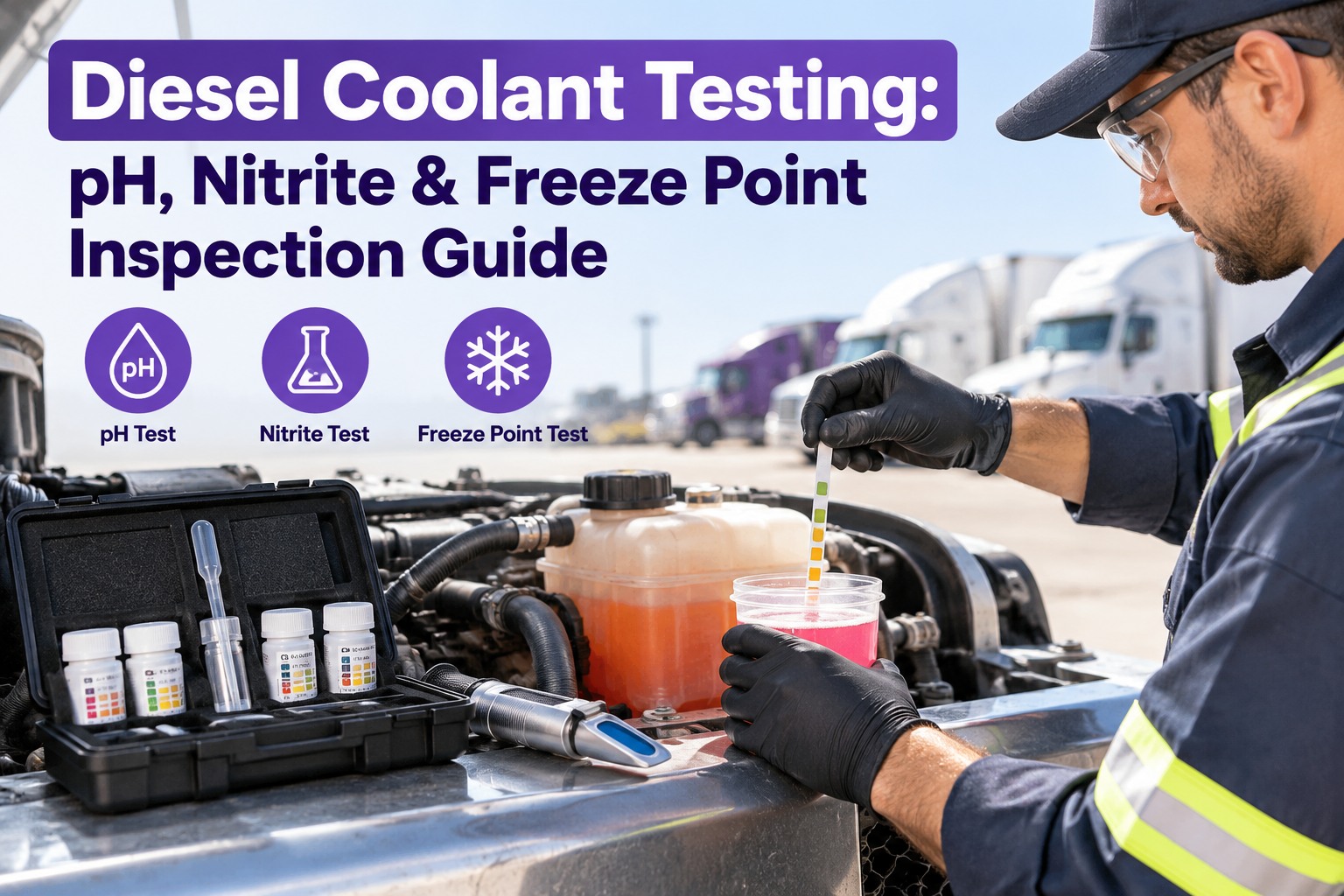
Coolant looks fine right up until it isn't. A diesel can run for months on coolant that has lost its additives, drifted out of pH, or been watered down below its freeze protection, while the damage builds quietly inside the block. Wet-sleeve diesel engines are especially exposed to liner pitting when the additive package runs low. The fix isn't guessing by color. It's testing three things on a schedule: pH, nitrite (additive strength) and freeze point (glycol concentration), then writing the numbers down for every truck. This guide shows what each test tells you, which tool to use, what to do with each result, and how Truck Inspection & Maintenance Management Software turns the readings into a trend instead of a sticky note. Start free and log coolant readings per truck.
Diesel Coolant Testing: pH, Nitrite & Freeze Point Inspection Guide
A coolant test only helps if the result gets recorded, compared and acted on. Truck Inspection & Maintenance Management Software lets technicians enter pH, nitrite and freeze-point readings on a PM checklist, keeps the history for each truck, and turns an out-of-range result into a work order, so a bad reading doesn't depend on someone remembering it.
The Three Tests, at a Glance
Measures acidity. Coolant that drifts low attacks metal and signals additive depletion or contamination.
Tool: pH strip or meterNitrite is the additive that shields cylinder liners and metal surfaces in conventional heavy-duty coolant.
Tool: nitrite test stripFreeze point shows glycol concentration, which controls freeze and boil-over protection.
Tool: refractometerFreeze Point: Concentration Is the Whole Story
With ethylene glycol, more glycol means lower freeze point, but only up to a point. Most heavy-duty engines run roughly 40–60% glycol. Too little leaves you open to freezing and boil-over, and too much reduces heat transfer. Use a refractometer made for your glycol type, because float-style testers are less precise.
Approximate values for ethylene glycol mixed with water. Propylene glycol protects differently, so use its own chart.
pH: The Early Warning Reading
Healthy heavy-duty coolant is mildly alkaline. As additives deplete, or exhaust gas, oil or fuel leaks in, pH tends to fall. The acceptable window depends on the coolant type, so use the range on your coolant data sheet or test kit.
Coolant Readings That Don't Get Lost
Add numeric coolant fields to PM-A or PM-B checklists. Set the acceptable range once per coolant type, and any reading outside it is flagged for a work order. Each truck keeps its own history, so you can see a slow drift before it turns into a failure. Free for up to 3 trucks.
Strip, Refractometer or Lab: Which Tool When?
| Method | Best for | Limits |
|---|---|---|
| Test strips | Quick shop-floor checks of nitrite and pH | Must match coolant type, and old strips or wrong timing skew results |
| Refractometer | Accurate glycol concentration and freeze point | Needs the right scale and calibration with water |
| Lab coolant analysis | Contamination, metals, additive levels and trends | Takes days, so use it for periodic checks or when readings look wrong |
Reading Result → Next Action
A Simple Coolant Testing Routine
Many fleets test coolant at regular PM visits and again before winter. Set the frequency from your OEM guidance and your own history.
Frequently Asked Questions
Turn Coolant Tests Into a Record You Can Trust
Coolant fields on your PM checklists, readings stored per truck, and out-of-range results sent to a work order, all in one platform. Start free to try it on your own trucks, or contact us and we'll help set it up.