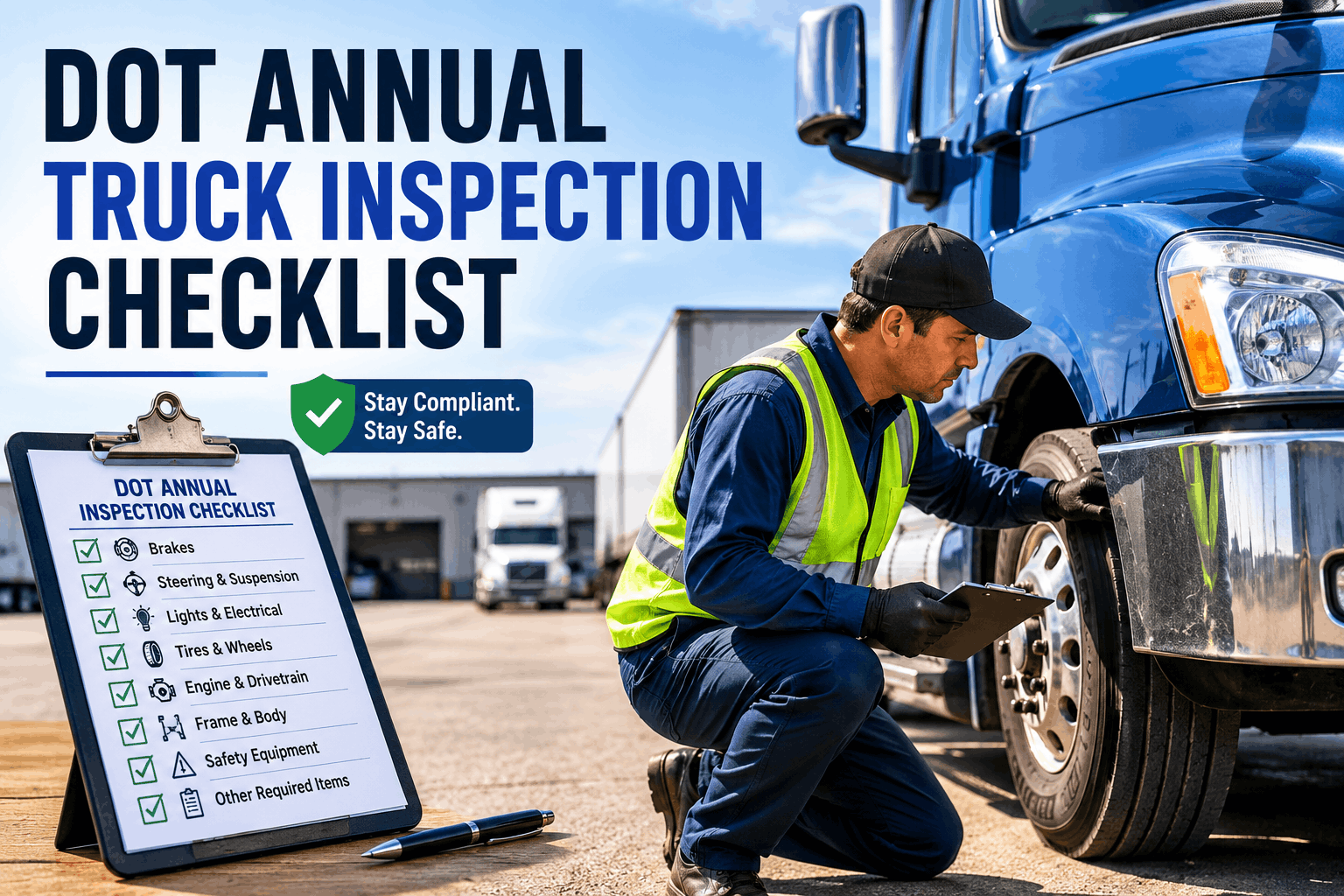
The DOT annual inspection under 49 CFR §396.17 is the federally mandated once-per-year safety check that every commercial motor vehicle operating in interstate commerce must pass before continuing in service. Unlike daily driver pre-trip inspections, this is a measured technical assessment performed by a qualified inspector against the specific federal acceptance standards in 49 CFR Part 396 Appendix A — "Minimum Periodic Inspection Standards." Every brake, light, wheel bearing, steering linkage, and structural component is checked against precise federal criteria, with hard pass/fail thresholds: pushrod stroke maximums, air leak-down rates, brake lining thickness minimums, tire tread depth requirements (4/32" on steer axles, 2/32" on others). A single out-of-service finding removes the vehicle from operation until corrected and re-inspected.
The stakes for getting it wrong are substantial. Approximately 133,000 vehicles are cited annually for operating without proof of current annual inspection — making it the second most common vehicle maintenance violation in the entire FMCSA CSA system. A truck flagged at roadside without valid AVIR (Annual Vehicle Inspection Report) documentation faces immediate out-of-service status, escalating CSA points, and significant penalty exposure under the 2026 CSA SMS overhaul that doubled OOS severity weight to 2. And yet, the violation isn't usually caused by skipping the inspection — it's caused by the annual date sneaking up, a trailer getting overlooked in a multi-unit fleet, or the proof not being where enforcement expects it to be. The annual inspection isn't a paperwork exercise; it's the safety threshold the entire FMCSA compliance framework rests on.
This guide is the complete DOT annual inspection framework for 2026: every Appendix A inspection category, the §396.19 inspector qualifications, the documentation requirements under §396.21, the integration with PM-C scheduling, and the digital workflow that makes annual inspection compliance audit-ready in seconds. Start your free trial of our truck inspection and maintenance software to deploy AVIR-compliant annual inspections on every truck in your fleet — live in 10 minutes, free for up to 3 trucks.
DOT Annual Truck Inspection Checklist Guide
The complete 2026 DOT annual inspection framework — all 13 Appendix A categories, §396.19 inspector qualifications, AVIR documentation requirements, measurement standards, and the digital workflow that makes annual compliance audit-ready in seconds.
The 13 Appendix A Inspection Categories
Every DOT annual inspection covers the same 13 inspection categories with specific federal pass/fail criteria. A single out-of-service finding in any category removes the vehicle from operation until corrected and re-inspected. Contact our sales team for help configuring annual inspection templates with all 13 categories.
Inspector Qualifications — Who Can Sign Your AVIR
The annual inspection isn't valid unless performed by a qualified inspector meeting the specific requirements of 49 CFR §396.19. A signed AVIR by an unqualified inspector is the same as no inspection at all.
Critical Measurement Standards From Appendix A
The DOT annual inspection isn't a visual walk-around — it's a measured technical assessment with specific federal acceptance criteria. These are the most commonly measured items that determine pass/fail.
| Component | Measurement | Federal Spec |
|---|---|---|
| Brake pushrod stroke | Engine off, 80-90 psi, brakes applied | Per Appendix A table |
| Air leak-down rate (single) | Brakes applied, 90 psi initial | Max 3 psi/minute |
| Air leak-down rate (combination) | Brakes applied, 90 psi initial | Max 4 psi/minute |
| Brake lining (non-steering air drum) | Thinnest point measurement | Min 1/4 inch |
| Brake lining (steering air drum) | Thinnest point measurement | Min 1/4 inch |
| Brake lining (steering air disc) | Thinnest point measurement | Min 1/8 inch |
| Tire tread (steer axle) | Major groove measurement | Min 4/32 inch |
| Tire tread (other axles) | Major groove measurement | Min 2/32 inch |
| Low-air warning device | Trigger pressure verification | Activate at 55 psi or below |
| Steering wheel free play | Lash measurement at wheel | Per manufacturer spec |
Documentation & Record Retention Requirements
The inspection itself is half the compliance equation. The documentation and retention requirements under §396.21 are the other half — and the half where most carriers actually fail audits.
Annual Inspection vs PM-C — Combine Them
The DOT annual inspection is not a separate event from your PM program — it's a component of your PM-C (annual comprehensive service). The 2026 best practice combines both in a single appointment to eliminate scheduling waste and lapsed-inspection risk.
Combining DOT annual inspection with PM-C eliminates two separate shop appointments per truck per year, ensures DOT items always get tested at the correct interval, and produces unified documentation. Most fleets schedule PM-C at an 11-month interval to provide a 30-day buffer against §396.17 expiration.
Frequently Asked Questions
Yes — every commercial motor vehicle operating in interstate commerce must undergo a §396.17 periodic inspection at least once every 12 months. This includes tractors, trailers, single-unit trucks, buses, and any other vehicle meeting the federal CMV threshold (10,001+ lbs GVWR for general commerce; 26,001+ lbs for CDL requirement; lower thresholds for passenger and hazardous materials operations). Combination vehicles require separate inspections for each component unit — the tractor's inspection does NOT cover the trailer, and trailers must be tracked and inspected independently. Vehicles operated entirely within state lines may fall under state inspection programs that satisfy §396.17 requirements through §396.17(f) reciprocity. Sign up free to confirm requirements for your operation.
The inspector must meet 49 CFR §396.19 qualification requirements: knowledge of Part 393 and Appendix A through G, mastery of inspection methods and tools, and documented training through a federal/state inspection program OR at least 1 year of practical CMV inspection experience. Qualified inspectors can be in-house fleet personnel or third-party agents. Under §396.17(e), motor carriers may use commercial garages, fleet leasing companies, truck stops, or other commercial businesses as inspection agents — provided those agents operate appropriate facilities and employ qualified inspectors. Documentation of inspector qualifications must be retained while the inspector is active plus 1 year after they stop performing inspections.
Under 49 CFR §396.21, the Annual Vehicle Inspection Report (AVIR) and supporting documentation must be retained for at least 14 months from the inspection date. Best practice is permanent cloud retention — paper files frequently get lost, destroyed, or filed inconsistently across multi-site operations. The 2026 eDVIR Final Rule (effective February 19, 2026) explicitly permits electronic creation, signature, and retention of inspection records under 49 CFR 390.32. Records must be accessible during DOT compliance reviews and roadside enforcement events. The most-cited annual inspection violation isn't actually missed inspections — it's records that can't be produced when DOT asks for them. Contact our sales team for help deploying cloud-retained AVIRs.
A single out-of-service finding in any of the 13 Appendix A categories removes the vehicle from operation until the defect is corrected and the vehicle is re-inspected. The annual inspection certificate cannot be issued until all OOS items pass. Non-OOS defects may be noted on the AVIR but don't require re-inspection. The most common annual inspection failures are: brake adjustment (pushrod stroke beyond Appendix A maximums), brake lining below minimums (1/4" non-steering air drum, 1/8" steering air disc), tire tread below minimums (4/32" steer, 2/32" other axles), air leak-down rate exceeding 3 psi/min single or 4 psi/min combination, and inoperable lighting devices. Start your free trial to track annual inspection results across your fleet.
Three different inspections at different intervals: (1) Daily pre-trip inspection — driver walk-around before each shift, no formal documentation required unless defects found, governed by §392.7; (2) DVIR (Driver Vehicle Inspection Report) — driver's end-of-day report documenting any defects encountered during operation, governed by §396.11, with 3-month retention; (3) AVIR (Annual Vehicle Inspection Report) — formal annual technical inspection by qualified inspector against Appendix A standards, governed by §396.17, with 14-month retention. All three serve different purposes: the daily pre-trip catches obvious safety items, the DVIR documents operational defects for repair tracking, and the AVIR is the federal annual safety certification. Talk to our sales team to deploy all three workflows on one platform.
Yes — provided you have a qualified inspector meeting §396.19 requirements. Self-inspection by motor carriers is explicitly permitted under §396.17(d). In-house inspections offer cost savings and scheduling control, but require: (1) qualified inspector(s) with documented training/experience, (2) appropriate facilities and inspection tools, (3) systematic documentation per §396.21, (4) inspector qualification records retained while active plus 1 year. Many small carriers find it more cost-effective to use third-party agents (commercial garages, fleet leasing companies) under §396.17(e), particularly when their fleet is too small to justify the dedicated inspector qualification investment. Mid-to-large fleets typically benefit from in-house qualification.
Deploy AVIR-Compliant Annual Inspections in Under 10 Minutes
500+ fleets deploy DOT annual inspections on our truck inspection and maintenance software: all 13 Appendix A categories pre-loaded with measurement fields, photo evidence, qualified inspector sign-off, §396.21-compliant retention, and audit-ready records exported in seconds. Pair with PM-C scheduling to consolidate annual maintenance and inspection into one appointment. eDVIR-compliant from day one.