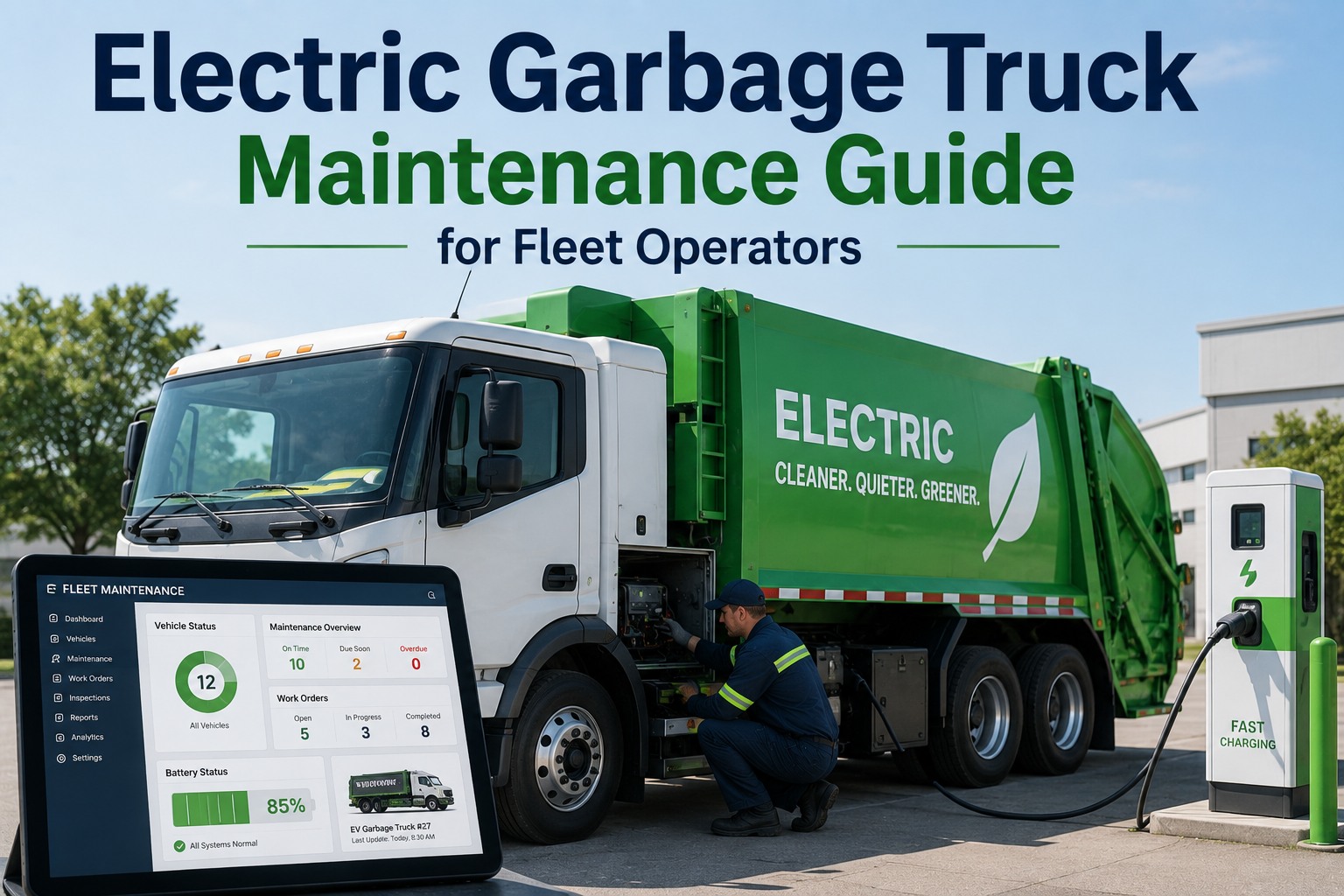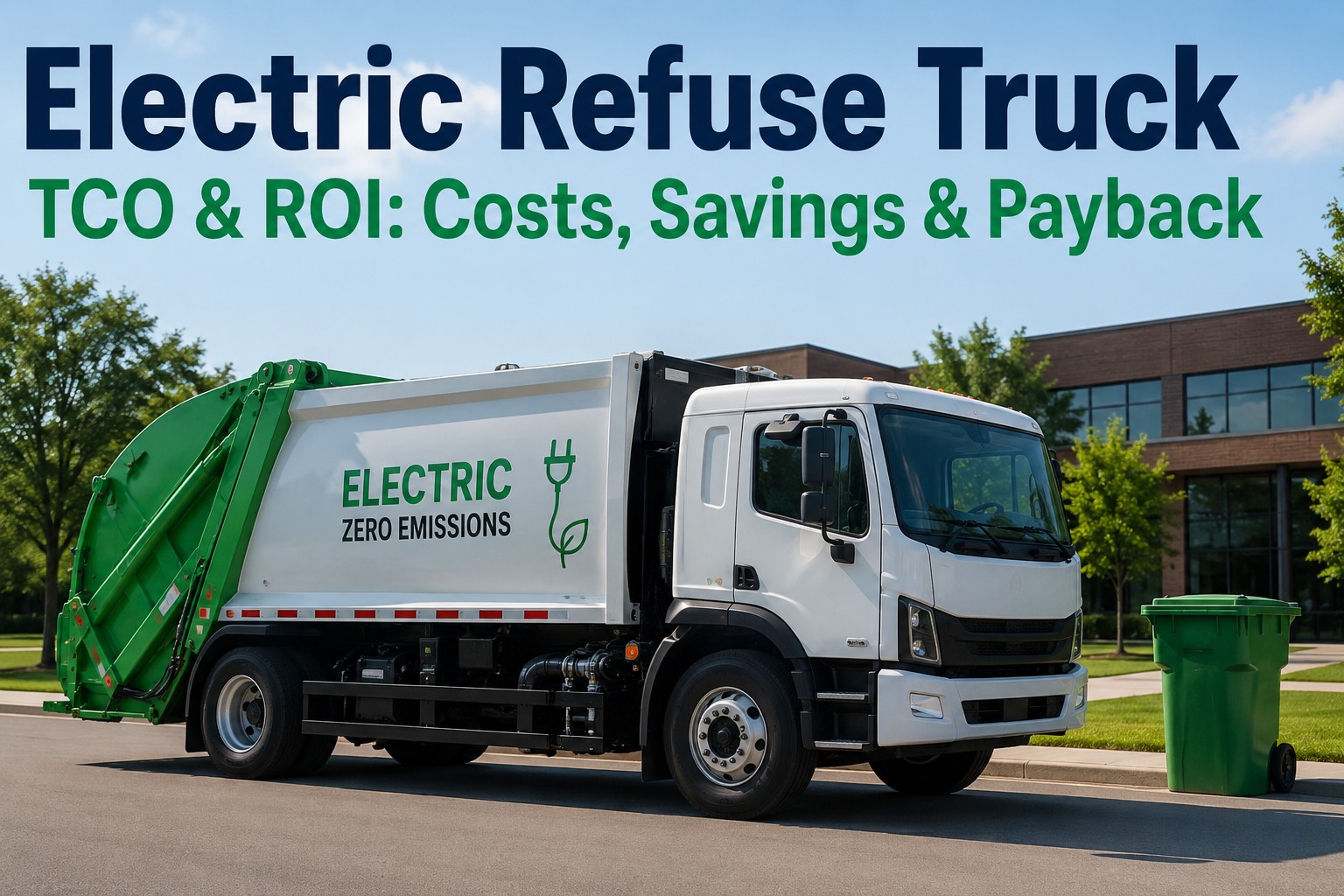
Electric refuse trucks look expensive on the sticker — $500,000 to $650,000 versus $250,000 to $350,000 for a comparable diesel — and that price gap is what stops most fleet directors from taking the conversation further. But refuse duty is uniquely suited to electrification: stop-and-go routes maximize regenerative braking, return-to-base operations solve the range problem, and predictable overnight depot charging makes electricity cheaper than diesel by a factor of 4–5x per mile. Layer in HVIP grants of up to $240,000 per truck in California, federal incentives up to $40,000, and the fact that an EV refuse truck has roughly 20 drivetrain parts versus 2,000+ in a diesel — and the 5-year TCO math flips to a 15–30% advantage for electric. This guide breaks down the real numbers: purchase premium, operating cost gap, incentive stack, break-even timeline, and where diesel still wins. Ready to model your own fleet? Start your free trial or reach out to our support team for a walkthrough.
Electric Refuse Truck TCO & ROI: The Real Cost Comparison
$300,000 more to buy, $180,000 less to run per year. When refuse duty flips diesel-to-electric math and when it doesn't — with the exact break-even year for each duty cycle.
Why Refuse Duty Is the Sweet Spot for Electrification
Not every fleet application works for EV yet. Refuse operations happen to hit every criterion that makes electric powertrains win. Here's why the math is uniquely favorable in this vertical.
Stop-and-go maximizes regen
Refuse trucks stop every 30–60 seconds. Regenerative braking recovers 15–30% of consumed energy back into the battery — far more than any highway application.
Return-to-base solves range anxiety
Every refuse truck ends its shift back at the depot. Overnight charging on a fixed circuit eliminates the "where do I charge?" problem that plagues long-haul EV adoption.
Predictable daily energy demand
Route mileage is nearly constant week over week. Batteries can be sized precisely to daily demand — no expensive over-provisioning for unlikely long trips.
Massive incentive stack
Refuse trucks qualify for HVIP ($240K in CA), EPA Clean Heavy-Duty ($400M+ pool), federal 45W credit ($40K), and local air-district grants — often stackable.
Low-idle, high-parasitic loads
Diesel refuse trucks waste massive energy powering hydraulics from idling engines. Electric drivetrains supply hydraulic load directly — with no fuel burn while stationary.
Residential noise mandates
Increasing city ordinances restrict diesel refuse noise before 7am. Electric operation lets fleets run earlier routes without compliance risk — a growing revenue lever.
The 5-Year TCO Head-to-Head
Here's what the numbers look like for a typical mid-city Class 7 refuse truck running 25,000 miles per year over a 5-year ownership cycle.
Per-Mile Cost Breakdown
The purchase-price gap is dramatic. The per-mile operating cost gap is more dramatic — and it's the number that closes the TCO gap year after year.
The Incentive Stack: What Actually Reduces Purchase Price
Sticker price and effective price aren't the same number. Here's what stacks in 2026 for commercial refuse EVs.
Model your fleet's specific TCO
Track fuel, maintenance, downtime, and battery health per vehicle. Compare EV vs diesel TCO with your actual operating data — not vendor assumptions.
Payback Timeline: When Electric Actually Wins
Break-even isn't a single number — it moves based on route type, mileage, incentive access, and electricity rates. Here's what real refuse fleets see across different scenarios.
Where Diesel Still Wins (Being Honest)
Not every refuse fleet is ready for electric — and pretending otherwise wastes capital. These are the honest scenarios where diesel still makes financial sense in 2026.
The 6-Step Refuse Fleet Electrification Roadmap
Fleets that succeed with EV refuse don't buy 20 trucks at once. They follow a phased approach that de-risks the transition and builds operational muscle memory.
Baseline your current TCO
12 months of diesel fuel, maintenance, and downtime data per truck. Without this baseline, you can't measure the improvement.
Identify a pilot route
Predictable daily mileage, return-to-base, no rural stretches. Match battery capacity to actual demand + 30% buffer.
Stack every available incentive
Federal 45W + state voucher + utility infrastructure grant + LCFS enrollment where applicable. Apply before ordering vehicles.
Build depot charging first
Grid capacity, EVSE hardware, and utility interconnect take 6–12 months. Start this before vehicle order — not after delivery.
Certify HV technicians
Only HV-certified technicians can perform EV maintenance safely. LOTO documentation, arc-flash assessments, and PPE all required.
Track battery SOH from day one
State-of-health documentation directly drives residual value. Log charge cycles, DoD, and thermal events per vehicle from delivery.
Frequently Asked Questions
Class 7 electric refuse trucks run $500,000–$650,000 as of 2026, versus $250,000–$350,000 for a comparable diesel. However, with federal 45W ($40K), state incentives ($75K–$240K depending on state), and utility infrastructure grants, effective purchase cost after incentives can drop to $300,000–$425,000 in strong-incentive markets.
Refuse duty typically pays back in 3–5 years for most U.S. mid-city fleets. High-mileage California operations with full HVIP + LCFS access can hit break-even in 2–3 years. Low-incentive states with under 15,000 miles/year may not achieve payback within vehicle life — diesel remains the better economic choice there.
Fuel cost drops from $0.35–$0.55 per mile (diesel) to $0.05–$0.09 per mile (electric) — a 60–85% reduction. Maintenance drops from $0.30–$0.45 (diesel) to $0.15–$0.25 (electric) — a 40–50% reduction. Combined operating cost savings run $0.35–$0.65 per mile.
Most heavy-duty EV manufacturers offer 8–12 year battery warranties covering degradation below 60–70% capacity. A 2026 purchase typically runs under warranty protection through years 8–10, significantly reducing replacement-risk exposure during the primary ownership window.
Depot charging infrastructure runs $50,000–$500,000+ depending on grid capacity, transformer requirements, and number of stations. Utility infrastructure grants often cover 30–80% of make-ready costs. Grid upgrades are frequently the largest single line item and take 6–12 months to complete.
Yes, but with a range penalty. Battery efficiency drops 15–30% in sub-freezing conditions. Successful cold-climate deployments include heated battery packs and route planning that accounts for winter derate. Northern refuse fleets sizing for winter conditions get year-round operation without in-day charging.
Model, deploy, and manage electric refuse trucks with confidence
Per-vehicle TCO tracking. Battery SOH monitoring. Charging session logs. Incentive claim documentation. HV-certified technician assignment. Full audit trail for LCFS credit generation. Everything you need to make the EV refuse transition data-driven, not speculative.