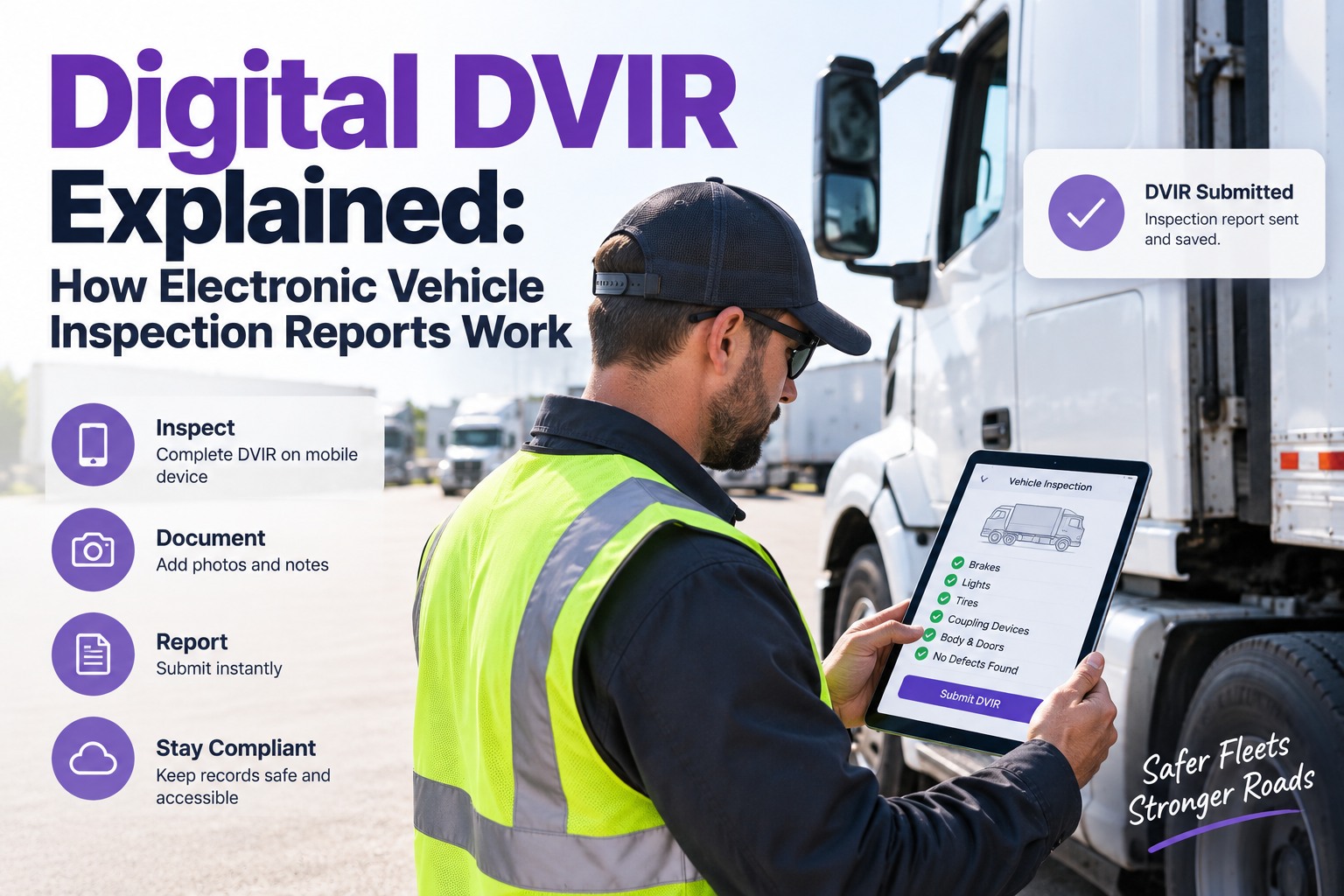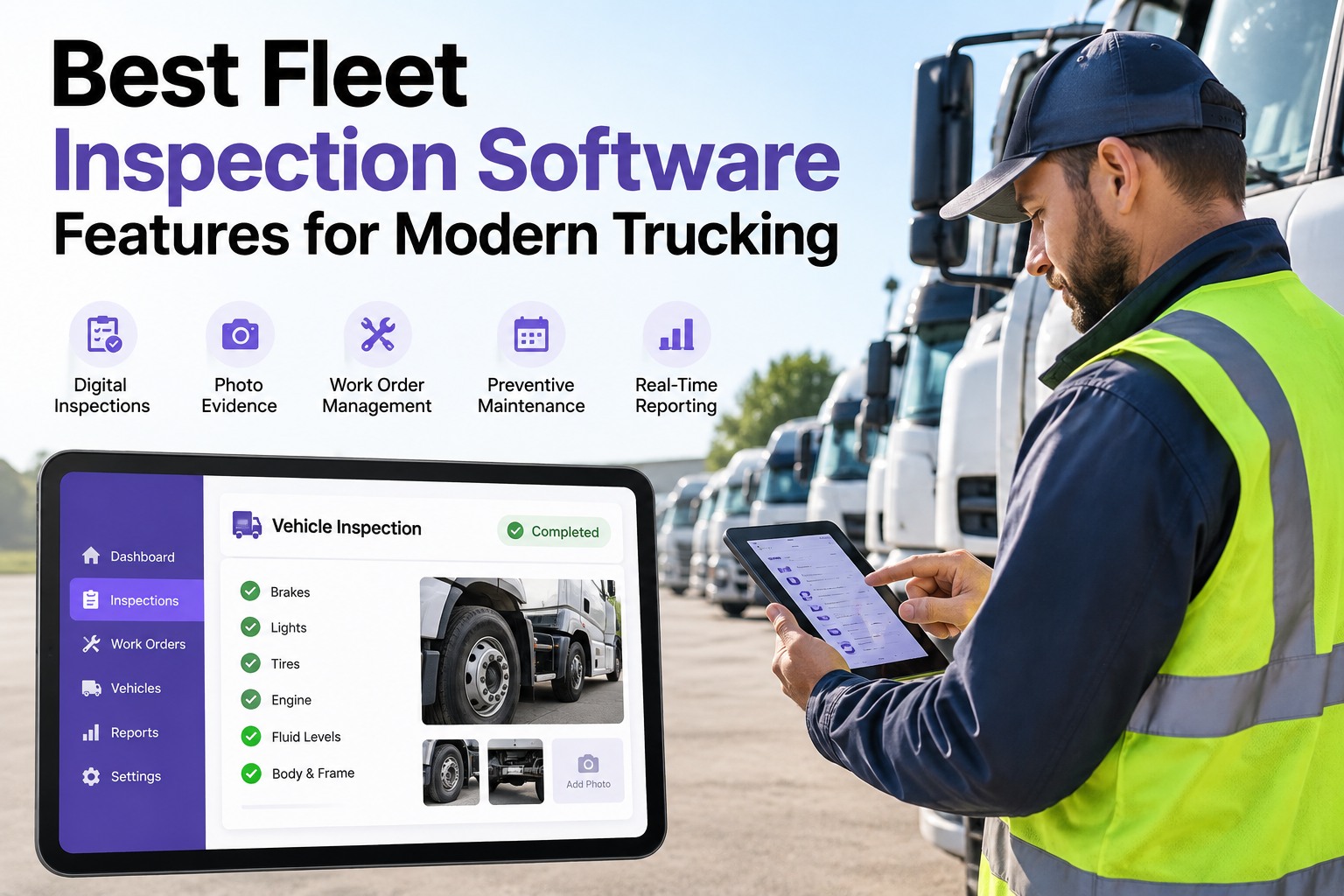
Every day, thousands of commercial drivers scribble their DVIR on a triplicate carbon-copy form, tear off the top sheet, and hand it to a dispatcher who may or may not read it before the next shift. The Federal Motor Carrier Safety Administration allows this — but they also allow the electronic version under 49 CFR §396.11, and the economics between the two are no longer close. A paper DVIR costs a fleet roughly $8–$12 per truck per day in loaded process cost. A digital DVIR closes that same loop for pennies, catches defects the paper form misses, and produces audit records that pull in seconds instead of days. For a 50-truck fleet, that difference is $150K+ per year in recoverable spend — before counting the avoided FMCSA violations, the prevented breakdowns, and the roadside inspection scores that shift from red to green. This guide breaks down the exact ROI math on digital DVIR, the specific savings mechanisms, and the transition roadmap. Ready to see it running on your fleet? Start your free trial or reach out to our support team for a walkthrough.
DVIR Software ROI: The True Cost of Paper Inspections vs Digital
Paper DVIRs feel free. They're not. The loaded cost of a paper inspection program on a mid-size fleet runs $150K+ per year in admin time, missed defects, compliance risk, and preventable breakdowns. Here's the math.
What FMCSA Actually Requires
Digital DVIRs aren't a workaround — they're explicitly authorized. Under 49 CFR §396.11 and §396.13, drivers must complete a post-trip inspection identifying any defects that would affect safe operation, and both driver and mechanic must sign. The regulation doesn't specify paper. Electronic DVIRs are fully compliant when they capture the same fields and preserve signatures.
Driver must prepare a written report at the completion of each day's work on each vehicle operated, identifying any defect or deficiency that would affect safe operation.
Before driving, the driver must review the last inspection report, be satisfied all defects have been corrected, and sign the report certifying the required repairs have been made.
DVIRs must be retained for at least three months. Under audit, the carrier must produce the records for any specified vehicle and date range.
The True Cost of a Paper DVIR (Per Truck, Per Day)
Paper looks free because nobody puts the loaded cost on an invoice. But every stage of a paper DVIR has a real cost — and they stack.
The 6-Way Cost Impact of Going Digital
Digital DVIR software doesn't just replace paper — it collapses six separate cost buckets into a single workflow. Here's what actually moves.
Tap-through checklists replace handwritten forms. Photos attach in seconds instead of being noted as "see attached."
No more manual review, filing, or data entry. Defects auto-route to work orders. Dispatchers get their time back.
Guided checklists and required photo verification stop drivers from clicking "no defect" out of habit.
Defects auto-generate work orders. Maintenance manager sees the queue in real time — no phone tag, no email chains.
Every DVIR indexed by VIN, driver, and date. DOT auditor asks for last 3 months — you export in 30 seconds.
Direct process savings only. Excludes prevented breakdowns, avoided fines, and improved CSA scores — which compound.
Calculate Your DVIR ROI
Plug in your fleet numbers. See exactly what your paper DVIR program is costing you today — and what going digital returns.
Your Current Program
What Digital DVIR Actually Looks Like
Every digital DVIR platform has surface-level checklists. The ones that deliver ROI have the workflow features that paper cannot match.
Guided pre-trip checklist
Required checkpoints matching FMCSA §396.11 categories. Cannot submit until all items pass or defect is logged. No more skipped items.
Photo-verified defects
Drivers photograph what they report. Photos attach to the vehicle record. Maintenance sees the actual defect before touching a wrench.
Auto work-order routing
Every defect logged auto-generates a work order in the maintenance queue. No email, no phone tag, no manual re-entry.
Digital signature capture
Driver and mechanic sign directly on the device. Signatures stored against the DVIR record with timestamp — audit-defensible.
Offline capture & sync
Drivers complete inspections in dead zones. Records sync when the truck returns to signal. No lost data, no re-do.
One-click audit export
DOT auditor requests 3 months of records for a specific VIN. You filter, click export, PDF is signed and delivered. 30 seconds, not 3 days.
Ready to run the numbers on your fleet?
Free trial on up to 3 vehicles. See the DVIR workflow, the auto-work-order routing, and the audit-export dashboard live.
The Compliance Angle: What a Bad DVIR Costs
Beyond the process savings, digital DVIR shifts your compliance risk profile. FMCSA violations tied to inspection failures carry real dollars and CSA points.
The 4-Week Transition Roadmap
Moving from paper to digital isn't a multi-month project. Fleets that follow this cadence go live in a month with zero downtime.
Frequently Asked Questions
Yes. FMCSA fully accepts electronic DVIRs under 49 CFR §396.11 and §396.13 as long as they capture the required fields, preserve driver and mechanic signatures, and retain records for at least 3 months. The regulation doesn't specify paper — it specifies content, signatures, and retention.
The fully loaded cost is $8–$12 per truck per day when you count driver time, dispatcher review, form materials, filing, storage, and manual data transfer to maintenance systems. On a 50-truck fleet running 260 days a year, that's $110K–$156K annually — before counting missed defects and compliance risk.
Most fleets recover software cost within 2–4 weeks. On a 50-truck fleet, direct process savings alone typically deliver $150K+ per year against a software subscription of $9K–$15K. First prevented breakdown often covers several months of subscription on its own.
Adoption rates for well-designed apps run 90%+ within 30 days. Drivers who resist paper DVIR (because it takes 15 minutes) generally embrace digital (because it takes 3–5 minutes and doesn't require legible handwriting). The friction is in the app design, not the concept.
Quality DVIR apps capture inspections fully offline and sync automatically when the device returns to signal. Drivers never have to wait for connectivity to complete an inspection. No data lost, no re-entry needed.
The value of digital DVIR compounds when it plugs into the same platform as your maintenance workflow. Standalone DVIR apps that don't route to work orders leave most of the ROI on the table. Look for an integrated inspection + maintenance platform rather than a bolt-on DVIR tool.
Retire the paper. Capture the ROI.
Guided pre-trip checklists. Photo-verified defects. Auto work-order routing. Digital signatures. Offline capture. One-click audit export. Full FMCSA §396.11 compliance. Built specifically for fleets that want digital DVIR fully integrated with maintenance — not bolted on the side.