Every ELD on the FMCSA registered list technically meets the minimum federal requirement — automatic driving-time capture synced to the engine control module, duty-status logging, and roadside data transfer in one of four approved formats. That's the floor, not the ceiling. The gap between "compliant ELD" and "ELD that actually helps your fleet run better" is enormous, and it's the reason 30% of fleet software rollouts fail within the first year. The right ELD costs $15–$40 per truck per month, delivers HOS compliance without driver friction, integrates cleanly with the maintenance and dispatch tools you already use, and comes from a vendor with a track record of surviving the FMCSA's periodic device revocations. This guide walks through the 8 evaluation criteria that separate great ELDs from the merely compliant, the pricing tiers you should expect in 2026, integration requirements, deployment gotchas, and the 10-question RFP checklist to bring to every vendor demo. Need a walkthrough on your specific fleet? Reach out to our support team.
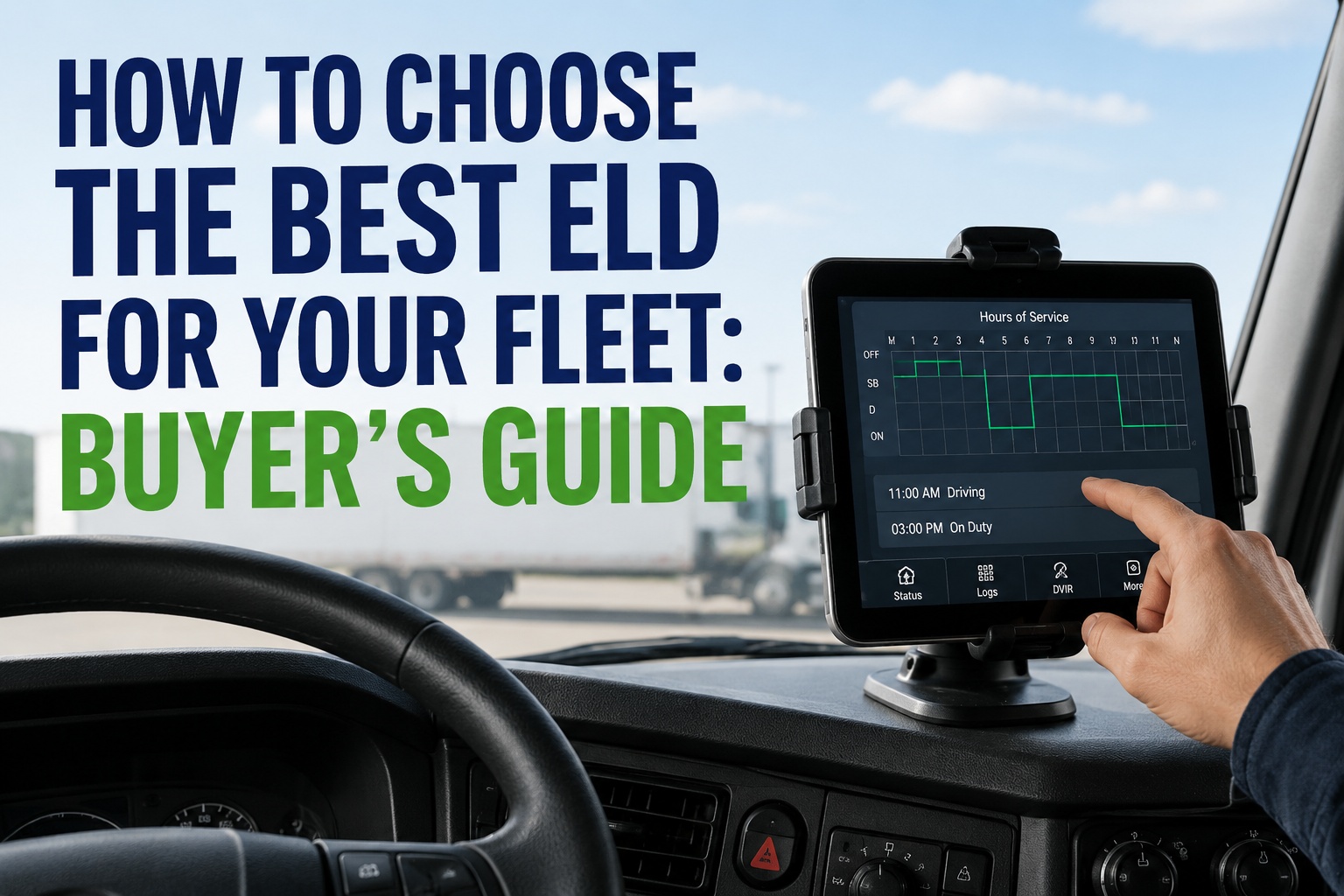
How to Choose the Best ELD for Your Fleet: The 2026 Buyer's Guide
Compliance is the floor. Adoption is the ceiling. The complete framework for evaluating ELDs beyond the sticker price — with the pricing tiers, integration requirements, and vendor questions that determine whether you'll still be happy in year 3.
Before You Compare Vendors: Know What You Actually Need
Every ELD-buying mistake starts the same way — the fleet compares 5 vendors before defining what they need the ELD to do. Answer these 4 questions first. Everything else follows.
How many vehicles, of what type?
Fleet size drives pricing tier. Vehicle mix (light-duty vans, straight trucks, tractors) drives hardware compatibility. Some ELDs support only diesel engines with 9-pin diagnostic ports; others handle mixed fleets seamlessly.
What's your operating profile?
Long-haul, regional, local delivery, short-haul exempt? Each profile has different requirements — long-haul needs robust sleeper split logic; local delivery may benefit from short-haul exemption support instead.
What systems must it talk to?
TMS, dispatch, fuel cards, maintenance software, telematics. Every integration is either free-out-of-the-box, paid-add-on, or custom-API work. Total cost changes accordingly.
What's your driver tech literacy?
Some ELDs assume every driver is comfortable with tablets. Others are designed for drivers who resent touchscreens. Adoption depends on matching the UI to the actual driver population.
The 8 Criteria That Separate Great ELDs from Merely Compliant
Every vendor on the FMCSA registered list meets the compliance floor. These 8 criteria are how you evaluate which vendor is actually right for your fleet.
Confirm the device appears on the FMCSA registered ELD list, verify it hasn't been revoked, and check how long it's been on the list. Devices under 12 months have unproven longevity — recent history includes several high-profile revocations that stranded thousands of fleets.
Log in, change duty status, add a co-driver, dispatch a load, run an inspection. If any of these takes more than 3 taps, adoption will suffer. Get a demo device in the hands of an actual driver — not just the fleet manager — before signing.
Split-sleeper calculations are where drivers get tripped up during inspections. The ELD should visually show current split status, projected available hours, and warn before non-qualifying splits are locked in.
TMS, dispatch, fuel card, maintenance, accounting. Standard connectors should be free out-of-the-box. Custom integrations run $1,500–$10,000+ each. Ask for the full standard-integration list before signing.
Roadside data transfer must work in 4 formats: wireless web services, Bluetooth, USB, and email. Ask about actual field success rates — some devices only reliably transfer via wireless when cell coverage is strong.
Real-time HOS status per driver, hour-cycle projection, weekly cap countdown, exception alerts. If the manager can't see who's about to violate 3 hours ahead of time, the system is reactive, not preventive.
What happens at 2am when a driver's ELD goes down at a scale house? 24/7 phone, chat, email? Response time SLA? Included in base or premium tier only? This matters more than any feature list — a broken ELD parks the truck.
Contract length, auto-renewal, data portability if you leave, hardware ownership. 3-year auto-renew contracts are common — as is losing all historical HOS data if you leave. Read this section of every contract before signing.
The Integrations That Actually Matter
An ELD that doesn't talk to your existing tools is a data silo. Here's what should integrate cleanly with any modern fleet stack.
Keep ELD, DVIR, and maintenance on one platform
HOS-aware dispatch, driver-defect routing, auto PM cadence — all synced from a single ELD data source. No data silos, no bolt-on integrations, no double-entry.
Deployment Reality: Where Fleets Actually Stumble
The demo goes well. The pricing looks right. Then deployment happens. These are the 5 failure modes that account for most ELD project pain — and how to avoid them.
The 10-Question Vendor RFP Checklist
Print this. Bring it to every ELD demo. Vendors that dodge these questions are telling you something.
Frequently Asked Questions
An Electronic Logging Device is a hardware unit that syncs with a commercial vehicle's engine control module to automatically record driving time and duty status. Under 49 CFR Part 395 Subpart B, most commercial drivers subject to HOS rules must use an FMCSA-registered ELD. Only a few narrow exemptions apply (short-haul 150-air-mile, drive-away/tow-away, pre-2000 model year vehicles). Check compliance requirements with our fleet compliance team.
Subscription pricing runs $15–$25/truck/month for basic ELD-only, $25–$40 for standard ELD with telematics, and $40–$70+ for premium ELD with video and AI. Add $150–$400 per vehicle one-time for hardware, 10–15% of first-year subscription for onboarding, and $1,500–$10,000+ per custom integration. Total year-1 cost typically runs 40–60% above sticker rate.
Compliance-wise, yes — every registered device meets the minimum requirement. In terms of driver experience, back-office analytics, integration ecosystem, and support quality, they differ enormously. The compliance floor is not the ceiling — evaluation should focus on adoption, integration, and support beyond just the FMCSA registration check. Compare integrated compliance platforms at our fleet software.
Real-time HOS status per driver, forward-looking hour-cycle projection, sleeper split visualization with pre-lock warnings, clean TMS and maintenance integrations, driver-friendly mobile UI, 24/7 support with response SLA, and audit-ready 6-month back-office retention. If any of these are missing, the device is compliance-only, not fleet-management-capable.
Typical deployment runs 6–12 weeks end-to-end: 2 weeks for planning and integration setup, 2–4 weeks for hardware installation across the fleet, 1–2 weeks for driver training, and 2–4 weeks for stabilization. Fleets that try to shortcut this timeline typically pay for it in adoption problems for the next 12 months.
Technically yes, but most vendor contracts include auto-renewal clauses and cancellation fees. Before signing, verify the data export format (whether historical HOS records come with you), the contract cancellation notice period (typically 30–90 days), and any early-termination fee schedule. Data portability is often overlooked and later regretted.
Choose ELD, DVIR, and maintenance as one integrated stack
FMCSA-registered ELD with HOS-aware dispatch. Digital DVIR with photo capture. Auto-triggered PM cadence. Compliance archive audit-ready by driver and VIN. Everything connected — no bolt-on integrations, no double-entry, no data silos.