Fleet maintenance just changed shape. Over 4.2 million commercial EVs now operate across North American fleets, and Fortune 500 logistics operators have committed to 40–60% electrification by 2030. The arithmetic is favorable — EVs deliver roughly 50% lower total maintenance cost per mile versus diesel — but only for the fleets that maintain them correctly. EV maintenance isn't simply "less maintenance." It's different maintenance, with higher consequences for the items that remain. A missed thermal management coolant service degrades a $30,000+ battery pack permanently and irreversibly. A wrong-type coolant in the battery loop creates a conductive path that compromises safety systems. And every EV-specific PM has no direct ICE equivalent — meaning legacy maintenance programs, technicians, and CMMS platforms simply don't cover it.
Hybrid trucks add their own complexity layer: they require both ICE maintenance (oil changes, fuel filters, exhaust service) AND EV-specific service (battery coolant, HV inspection, regenerative braking) — running parallel schedules on a single asset. Fleets electrifying gradually are running mixed fleets where one shop must support both worlds simultaneously. The 2026 winners are the operators who treat EV maintenance not as an afterthought to their existing program but as a discrete discipline with its own intervals, training, and tooling — connected to the same platform managing their diesel PM.
This guide covers the complete EV and hybrid truck maintenance picture: what's eliminated, what's new, the battery thermal management deep-dive, OEM coolant intervals, hybrid dual-schedule mechanics, and the 2026 EV PM template that fleet managers actually need. Start your free trial to manage diesel, hybrid, and EV maintenance in one platform.
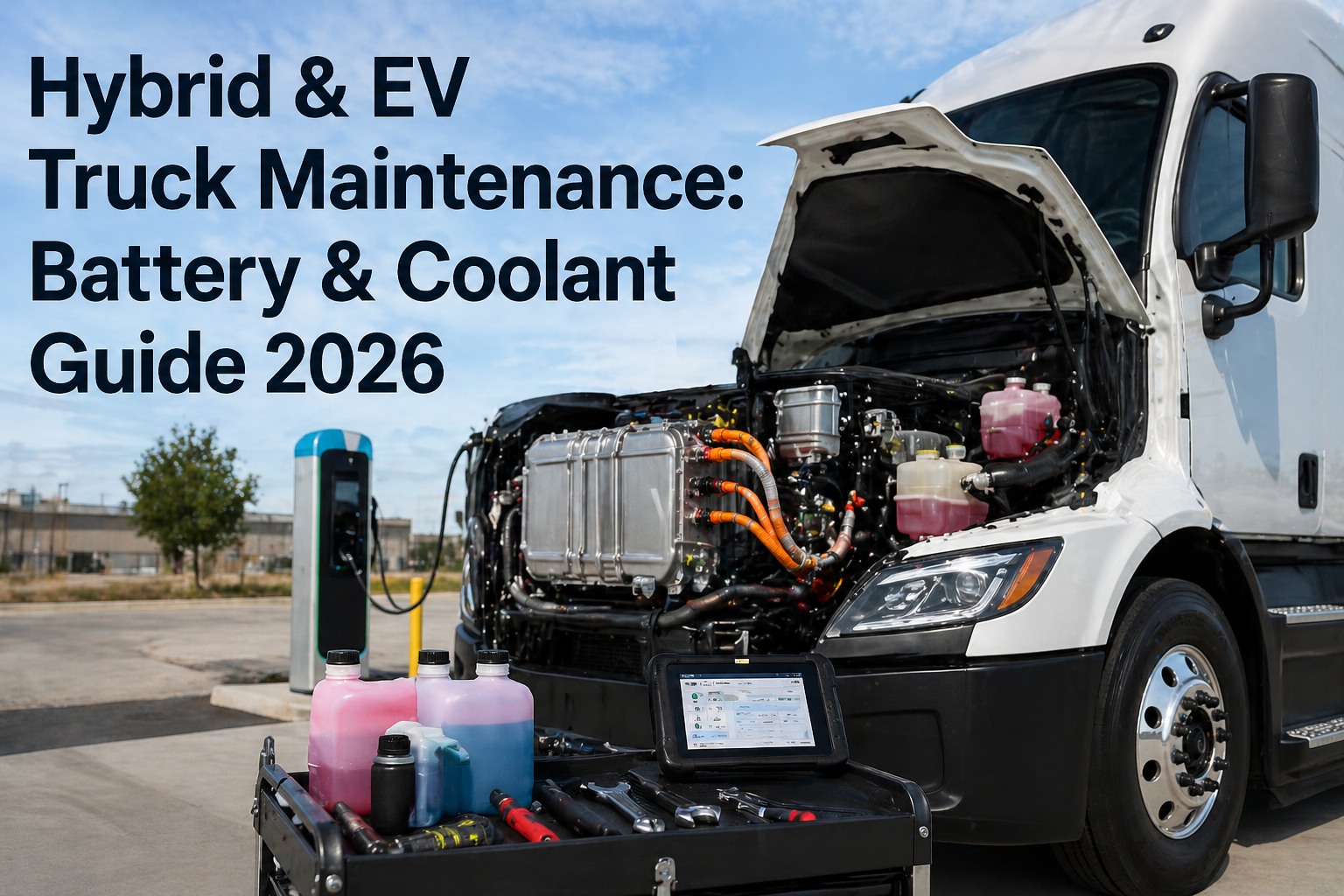
Hybrid & EV Truck Maintenance: Battery & Coolant Guide 2026
Battery health. Thermal management. HV safety. Regenerative braking. The complete 2026 maintenance handbook for electric and hybrid commercial trucks — and the dual-fuel operations that bridge both worlds.
Quick Answer: What's Different About EV & Hybrid Maintenance?
EV maintenance eliminates roughly 15–20 ICE-specific items entirely (oil changes, fuel filters, exhaust service, transmission fluid, spark plugs) but introduces 4 new high-stakes service categories: battery health monitoring (SoH testing every 10,000 miles or 6 months), thermal management coolant service (30,000–200,000 miles depending on OEM, with non-conductive coolant types), high-voltage system inspection (annual HV cable insulation, contactors, BMS), and regenerative braking verification (every 15,000 miles). Hybrid trucks require BOTH ICE maintenance AND EV-specific service running on parallel schedules on the same asset. Total EV maintenance cost runs about 50% less per mile than ICE, but the items that remain carry far higher stakes — a missed thermal PM permanently degrades a battery pack worth $30,000+.
Diesel vs Hybrid vs EV: The Maintenance Three-Way
For mixed fleets running all three powertrains, the maintenance comparison matters at every PM cycle. Each platform has its own service philosophy, intervals, and failure modes. Contact our support team to map your mixed fleet against the framework below.
The 4 New EV-Specific Maintenance Categories
EV maintenance isn't an extension of ICE maintenance — it's a different discipline with four distinct service areas that have no diesel equivalent. Each one has its own interval, its own technician requirements, and its own failure modes.
Battery Thermal Management: The Critical System
The thermal management system is the single most-consequential service item on an EV. Lithium-ion chemistry operates optimally between 15°C and 35°C (68–95°F) — outside this window, both charging efficiency and discharge performance degrade, and sustained operation outside the range accelerates permanent capacity loss. Sign up free for 3 trucks to track battery thermal health across your EV fleet automatically.
OEM Battery Coolant Intervals: Quick Reference
Battery coolant intervals vary dramatically by manufacturer — there's no industry standard yet. Always verify against your OEM bulletin, but here's the 2026 baseline by major platform.
| Manufacturer / Platform | Recommended Interval | Coolant Type | Notes |
|---|---|---|---|
| Tesla (Semi, Class 8) | 4 years (regardless of mileage) | Tesla-spec non-conductive | Time-based replaces mileage |
| Volvo VNR Electric | 50,000–100,000 mi | Volvo HV coolant | Inspection at every PM |
| Daimler Freightliner eCascadia | 100,000 mi or 5 years | Daimler HV coolant | Detroit Connect monitors |
| Ford E-Transit (Class 2/3) | 200,000 mi | Ford-spec battery coolant | Severe-duty: 100,000 mi |
| Chevrolet Bolt-platform | 150,000 mi or 5 years | Dexcool (HV-rated) | 5-year time limit binding |
| Toyota Hybrid (Class 2-4) | 100,000 mi | Toyota Super Long Life | Hybrid battery coolant |
| Generic / Aftermarket | 40,000–100,000 mi | Manufacturer-specific | Always verify non-conductive |
The 2026 EV PM Schedule Template
Here's the standard EV maintenance template most fleets follow in 2026, organized by trigger type. Multi-trigger scheduling — mileage OR charge cycles OR calendar OR telematics-based — ensures no truck slips through gaps regardless of duty cycle. Talk to our support team for a customized PM template based on your specific EV models.
Hybrid Trucks: The Dual-Schedule Challenge
Hybrid trucks run two parallel maintenance programs on a single asset — full ICE maintenance AND full EV maintenance, both required, neither optional. Skipping either side compounds wear on the other. This is why hybrids have the highest PM complexity (~32 categories) of any powertrain type.
required
Frequently Asked Questions
Yes — but with a critical caveat. EVs eliminate 15–20 ICE-specific maintenance items entirely (oil, fuel filters, exhaust, transmission fluid, spark plugs, etc.), which produces the headline 50% cost-per-mile savings. However, the items that remain — battery thermal management, HV inspection, SoH monitoring — carry far higher consequences than equivalent ICE items. A missed oil change costs you a $5,000 engine repair; a missed thermal coolant service costs you a $30,000+ battery replacement. Sign up free to track EV-specific intervals automatically.
Intervals vary dramatically by OEM — there's no industry standard. Tesla recommends replacement every 4 years regardless of mileage. Chevrolet specifies 150,000 miles or 5 years. Ford E-Transit goes 200,000 miles (100,000 severe-duty). Toyota hybrids typically require service at 100,000 miles. Always verify against your specific OEM bulletin — and never substitute standard engine coolant, which contains conductive additives and creates electrical safety risks in HV battery loops.
For routine items (tires, brakes, suspension, cabin filter, low-voltage 12V system) — yes. For high-voltage system work (battery, motor, charging system, HV cabling, BMS) — no, not without specific HV training and certification. Working on HV systems without proper PPE and lockout-tagout procedures creates electrocution risk. Most fleets handle EV routine maintenance in-house and outsource HV work to OEM-certified shops, at least until they invest in HV-certified technician training. Contact our support team to model the in-house vs outsourced split for your fleet.
State of Health (SoH) measures the battery pack's current usable capacity vs original capacity, expressed as a percentage. A new battery is 100% SoH; gradual degradation reduces this over time and charge cycles. Most EV manufacturers consider 80% SoH the warranty replacement threshold — below that, the battery may need replacement under warranty. Track SoH via OEM telematics (Volvo CareTrack, Daimler Detroit Connect, Tesla Fleet API) at every PM, and watch for accelerated declines that indicate thermal management issues.
Frequent DC fast-charging accelerates capacity degradation by generating more heat and stressing the battery chemistry harder than Level 2 AC charging. Fleets that DC-fast-charge daily see roughly 5–10% faster SoH decline than fleets running primarily on Level 2. Best practice: use DC fast for "as needed" mid-shift top-ups, not as the daily charging routine. Charge to 80% rather than 100% when possible — battery chemistry stresses hardest in the top 20%. Start your free trial to track charging behavior across your EV fleet.
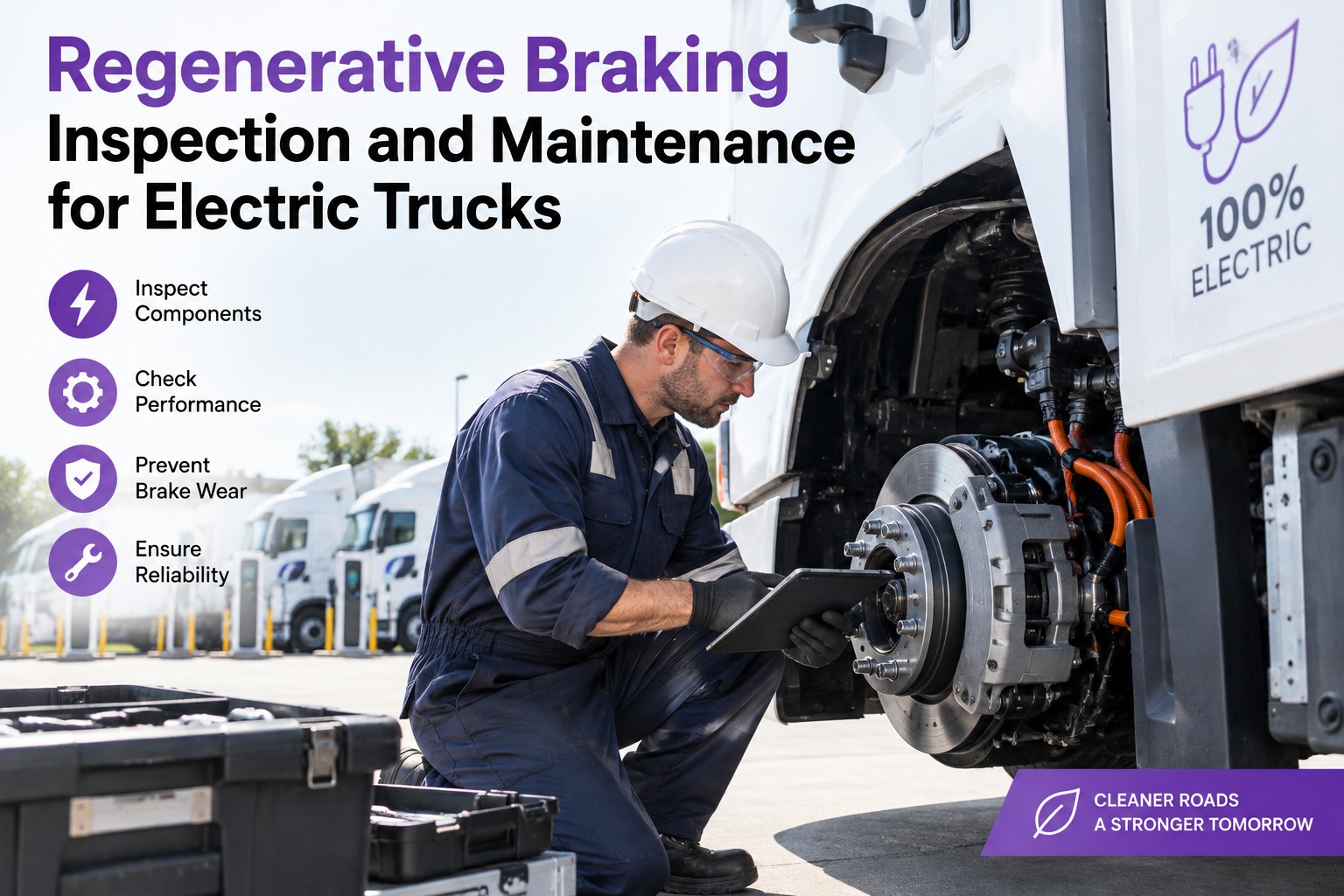
Regenerative braking handles 60–80% of stopping force in EVs — the electric motor reverses to slow the truck, sending energy back to the battery. Friction brakes only engage for hard stops or emergencies. As a result, EV brake pads can last 100,000+ miles versus 25,000–50,000 on diesel. The catch: regen braking must be verified at every PM, because if it fails the truck loses 60–80% of braking force suddenly, which is dangerous. Mechanical brakes also still need periodic exercise to prevent corrosion from disuse.
Manage Diesel, Hybrid & EV in One Maintenance Platform
Battery SoH monitoring, thermal coolant alerts, HV inspection scheduling, regen braking verification — alongside ICE PM, DVIR, and DOT compliance. See how 500+ fleets handle the electrification transition without separate systems.