Every heavy-duty truck on your lot is already broadcasting its own health, once per second, on a wire most fleets never tap. The SAE J1939 protocol is the language a Class 6–8 truck's engine, transmission, brakes, and aftertreatment system use to talk to each other over the CAN bus — and buried in that stream are the exact signals that predict a breakdown: a drifting NOx sensor, a clogging DPF, rising coolant temperature, an active fault code. The catch is that raw J1939 is machine code. An SPN and an FMI number mean nothing on a dashboard until something translates and acts on them. Turn J1939 data into maintenance action free. Integrating J1939 CAN bus data with Truck Inspection & Maintenance decodes that stream — turning fault codes into plain-English work orders, engine hours and mileage into automated preventive maintenance, and real-time diagnostics into breakdowns prevented before a driver is ever stranded. This guide breaks down what J1939 carries, how the integration reads it, and how to set it up.
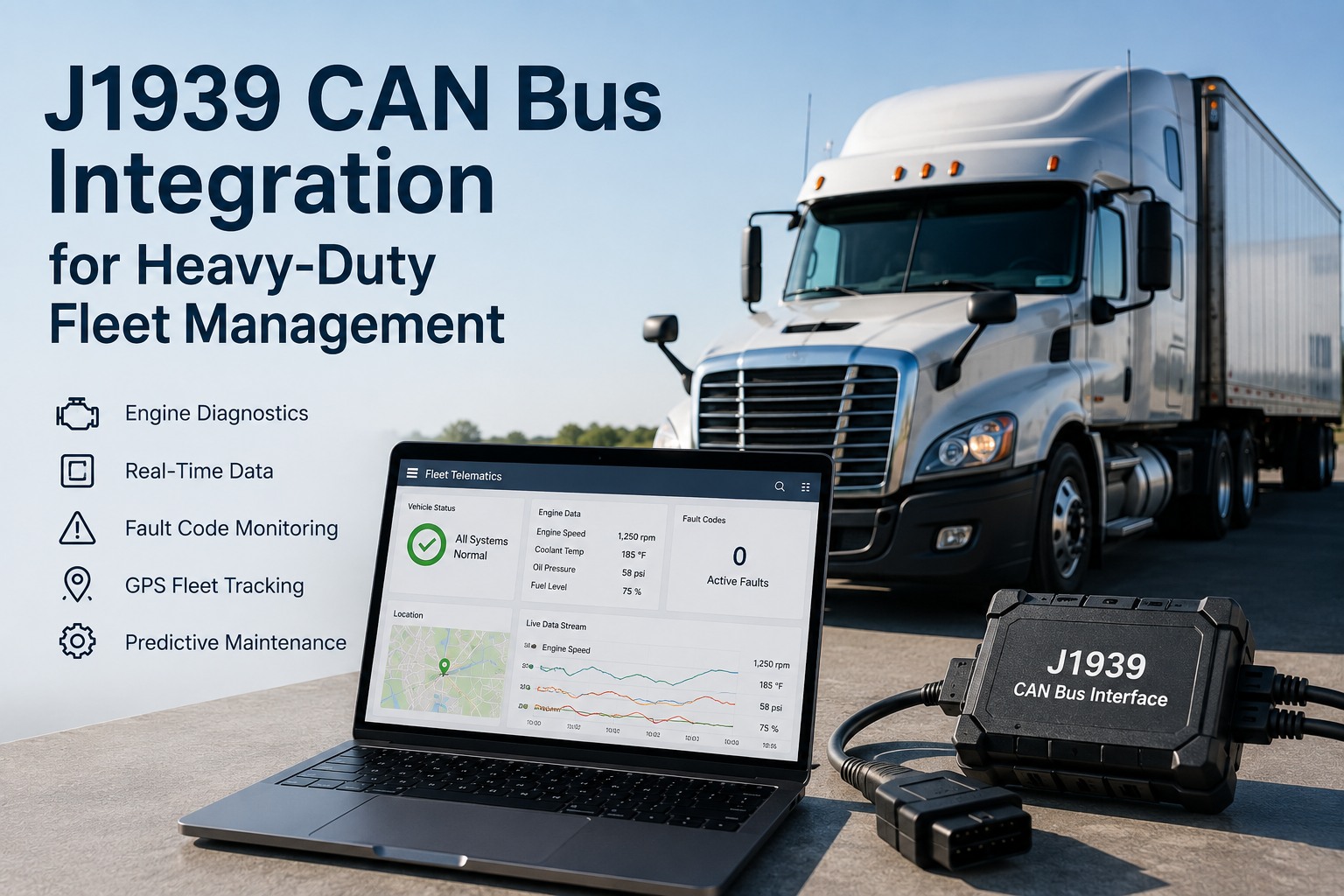
J1939 CAN Bus Integration for Heavy-Duty Fleet Management
Read the data your trucks already broadcast. Decode J1939 fault codes, engine parameters, fuel, and idle data into Truck Inspection & Maintenance — turning raw SPN/FMI codes into plain-English work orders and real-time diagnostics into prevented breakdowns.
What J1939 Actually Is
J1939 is a higher-layer protocol built on the CAN bus, running at 250 kbps. Where a passenger car uses OBD-II, heavy-duty trucks and off-highway equipment speak J1939 — one standardized language that unified the proprietary systems every engine maker once ran separately. It's how every ECU on the truck shares operational data in real time.
Anatomy of a J1939 Fault Code
This is where heavy-duty diagnostics differ most from passenger cars. Instead of one code like P0300, J1939 describes a fault with two numbers — the SPN says what failed, the FMI says how. Decoding that pair is the difference between a cryptic number and a targeted repair.
The Parameters It Streams
Fault codes are only part of the J1939 story. The bus continuously carries live engine and vehicle parameters — each identified by its own SPN — that drive both preventive maintenance and performance insight.
SPN 247 and odometer data drive condition-based PM, so services trigger on real engine runtime — not a guessed calendar date.
Live temperature and pressure parameters flag overheating and lubrication issues before they escalate into engine damage.
Fuel-use parameters (SPN 183 and related) reveal consumption trends and per-vehicle efficiency for cost analysis.
Idle, RPM, and engine-load data expose wasteful idling and link operating stress to wear patterns.
DPF, DEF level, and regen status catch emissions-system trouble before it forces a derate on the road.
Every fault and parameter lands on each asset's record — a live picture of heavy-duty vehicle health.
Start free →From Raw Bus Data to Work Order
The value isn't in the data — it's in what happens automatically once it's decoded. Here's the path a J1939 signal travels the moment a truck reports it.
Decode the Bus. Prevent the Breakdown.
Truck Inspection & Maintenance reads J1939 fault codes and engine parameters straight off the CAN bus, translates SPN/FMI codes into plain English with repair guidance, and fires prioritized work orders the moment a critical fault appears — while engine hours drive your PM schedule automatically. Raw bus data becomes uptime.
The Cost of Not Listening
The classic heavy-duty failure isn't sudden — it's a fault code that sat unread. Here's how one unnoticed SPN plays out, and what monitoring the bus changes.
Setting It Up
Reading J1939 data is a configuration task, not a development project. The integration works through J1939-compatible telematics devices — and supports legacy J1708/J1587 too, so older units in a mixed fleet aren't left out.
Why Heavy-Duty Fleets Connect the Bus
J1939 is where the earliest, most reliable signs of failure live. Reading and acting on it is what separates a fleet that prevents breakdowns from one that reacts to them on the shoulder of a highway.
Active DTCs are caught on DM1 in seconds, not at the next shop visit — before a derate or breakdown.
SPN/FMI codes are translated with repair guidance, so faults are actionable without a decoder ring.
Real engine hours and load data from the bus drive condition-based service on actual usage.
J1939 and legacy J1708 support brings modern and older Class 4–8 units into one dashboard.
Frequently Asked Questions
J1939 is the SAE communication protocol heavy-duty trucks, buses, and off-highway equipment use to exchange data between electronic control units over the CAN bus at 250 kbps. Passenger cars use OBD-II, which has a different code format and data structure — which is why a light-duty scanner usually can't read a Class 8 engine. J1939 replaced the older proprietary J1708/J1587 systems, unifying every controller — engine, transmission, brakes, aftertreatment — onto one standardized language so a single tool can read the whole truck. Start a free trial to read your fleet's bus.
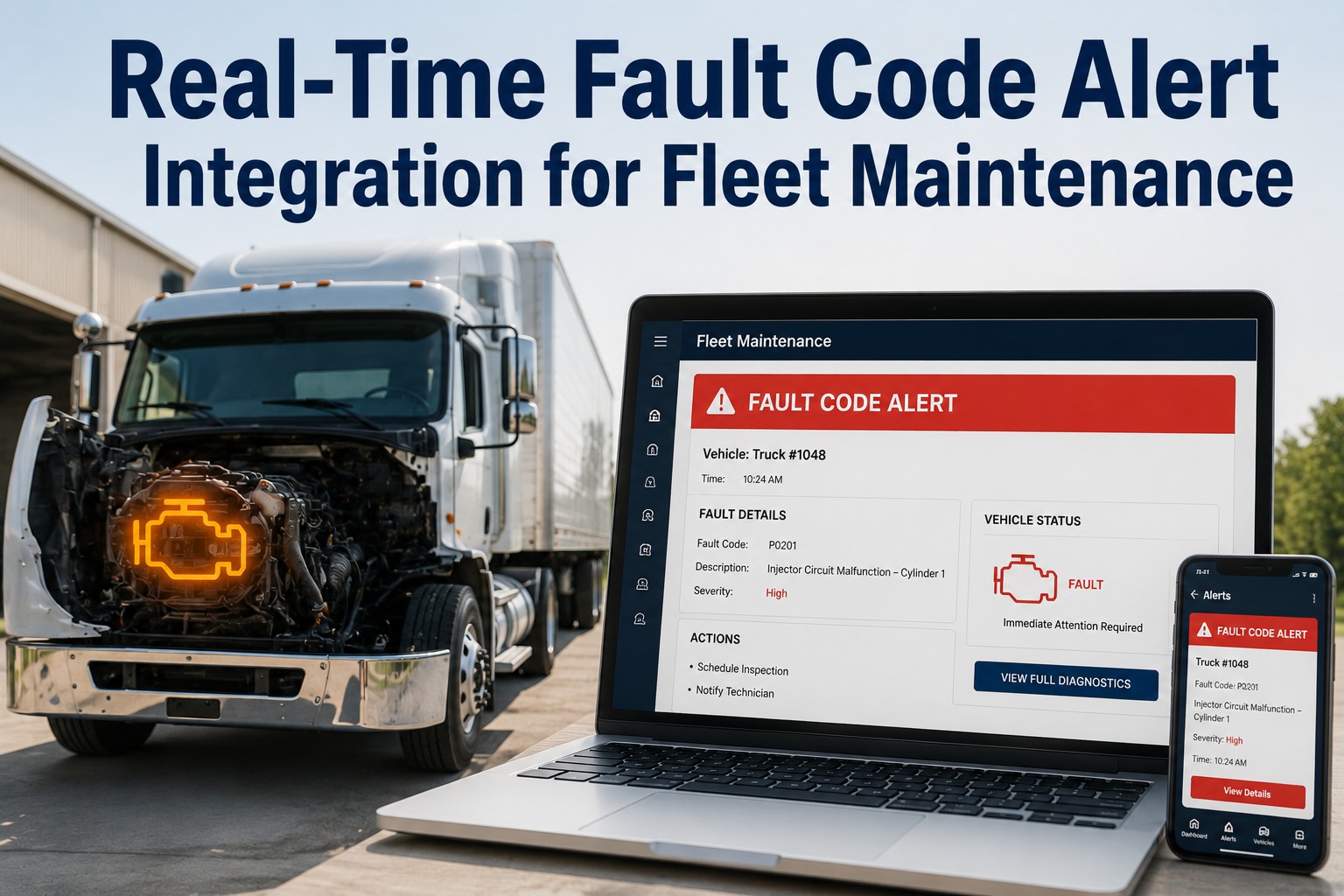
Together they describe a J1939 fault. The SPN — Suspect Parameter Number — identifies which component or parameter has the problem; there are over 10,000 defined SPNs, each mapping to a specific sensor, actuator, or data value. The FMI — Failure Mode Identifier — describes how it failed, such as voltage below normal or a reading out of range. So instead of a single code like P0300, you get a precise pair: SPN 5246 with FMI 4, for example, points to a specific aftertreatment sensor failing in a specific way. Decoding that pair turns a cryptic number into a targeted repair. See how codes are decoded.
Every ECU with an active fault broadcasts it on the DM1 message — PGN 65226 — once every second, the same data a diagnostic scanner reads. A J1939-compatible telematics device on the bus listens to that broadcast continuously and passes active DTCs to the maintenance platform within seconds of occurrence. That means a developing problem is caught the moment the ECU flags it, rather than waiting for a driver to notice a dash lamp or for the truck to reach a shop — which is exactly the window where an early fix prevents a roadside failure.
Yes. While J1939 is the standard on modern Class 6–8 trucks, many fleets still run older units built around the legacy J1708/J1587 protocol. The integration supports both, so modern and legacy vehicles report into the same dashboard rather than forcing you to manage two systems. It reads through a compatible telematics gateway connected to each vehicle's diagnostic port, which means you don't need matching hardware across the whole fleet to get unified diagnostics. Start free and unify your mixed fleet.
Heavy-duty failures usually announce themselves early on the bus — a sensor drifting out of spec, a temperature climbing, an emissions component degrading — long before the driver feels anything. When those signals are read and decoded in real time, a fault becomes a work order while there's still time to fix it at a planned stop. The often-cited example is a NOx sensor throwing SPN 5246: unmonitored, it can escalate to a DEF-forced derate that strands a truck hundreds of miles out at roughly $800 a day in lost revenue; monitored, it's a scheduled sensor swap. Multiply that across a fleet and the bus is the cheapest breakdown insurance you already own. Start free and prevent the next one.
Read the Data Your Trucks Already Broadcast
Truck Inspection & Maintenance connects to J1939 CAN bus data to decode fault codes, stream engine parameters, and turn real-time diagnostics into automatic work orders and condition-based PM. Catch the drifting sensor before it becomes a derate, keep mixed fleets on one dashboard, and stop losing trucks to faults that were flagged all along.