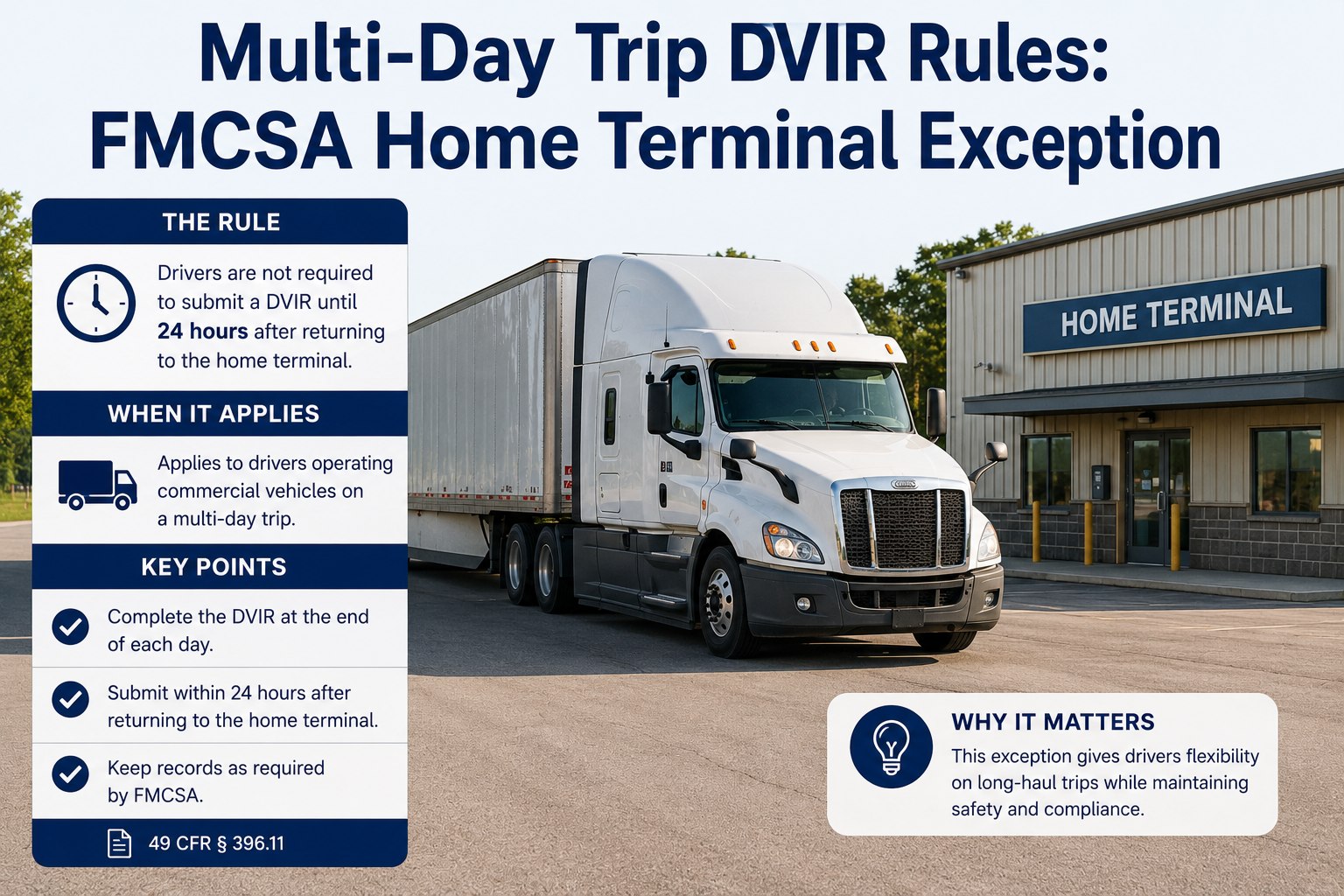
A driver leaves Monday morning on a five-day run. When are DVIRs due? Every night by fax? On return to home terminal? Never, if no defects were found? The answer confuses more fleets than any other DVIR question — and it's the second most common § 396.11 audit finding. This blog breaks down the FMCSA home terminal exception in plain English, with the exact rule, the timeline that keeps you compliant, and the workflow that makes multi-day DVIRs effortless. Start a free trial to run compliant multi-day DVIRs from day one.
Multi-Day Trip DVIR Rules: FMCSA Home Terminal Exception
Drivers on multi-day trips prepare a DVIR at the end of each day's work — but submit them to the carrier only upon return to the home terminal. Here's the exact rule, the timeline, and the workflow that keeps every OTR run audit-ready.
The Rule in Plain English
FMCSA's guidance on § 396.11 for multi-day trips is exactly one sentence long, but every phrase matters. Break it down and the whole rule becomes clear.
A 5-Day OTR Trip: What the Timeline Looks Like
Concrete example beats any regulatory paraphrase. Here's what a compliant DVIR timeline actually looks like for a driver dispatched Monday morning from Dallas on a five-day run through Memphis, Nashville, Atlanta, and back.
The Big Exception: Safety-Critical Defects Can't Wait
The submission delay only applies to routine DVIR transmission. If a driver finds a defect during the trip that "would be likely to affect the safety of the operation of the motor vehicle" — the carrier's obligation kicks in immediately, home terminal or not.
Cracked mud flap. Minor windshield chip. Radio not working. Log it on the daily DVIR. Submit with the batch on return.
Brake issue, steering problem, tire below tread, air leak, lights out. Notify carrier immediately. Repair before continuing operation.
Multi-Day DVIRs Without the Paperwork Pile
Truck Inspection & Maintenance handles multi-day OTR runs natively — driver captures each day's DVIR on mobile, safety-critical defects auto-route to the shop the moment they're logged, routine daily reports batch-submit when the truck arrives at the home terminal. No fax machines, no missing pages, no compliance gaps.
The Three Compliance Traps That Fail Audits
Three common misreadings of the home terminal exception show up in audit findings again and again. Recognizing them protects you from all three.
Some drivers hear "submit on return" and stop preparing daily DVIRs during the trip. Wrong reading. The rule requires preparation each day; only submission is delayed.
Discovering a brake problem on day 2 and continuing to day 5 to "submit with the others." That's a violation. Safety defects trigger immediate reporting regardless of the batch rule.
Driver arrives Friday and writes all five DVIRs from memory. Falsification. Each DVIR must reflect that day's actual end-of-tour inspection — with the timestamp to prove it.
The Related § 396.11 Rules You Also Need to Know
Multi-day trips intersect with several other DVIR rules. Getting the home terminal rule right doesn't help if the underlying DVIR practice is broken. Start free and enforce all of these automatically.
Frequently Asked Questions
Yes — a carrier's internal policy can require earlier submission than FMCSA's minimum. Many fleets require electronic DVIR upload at the end of each day even on multi-day trips, so shops see potential defects overnight and can plan work before the truck returns. FMCSA's rule sets the floor, not the ceiling. Company policy can be stricter, and often should be. Start free and configure daily upload for your fleet.
Anything that could compromise safe vehicle operation — brakes, steering, tires, lights, coupling devices, air systems, load securement. § 396.11 says "likely to affect the safety of operation." When in doubt, treat it as safety-critical and report immediately. The cost of over-reporting is minor paperwork; the cost of under-reporting is a rollover, an OOS order, or a wrongful-death lawsuit.
Three months from the date the report was prepared — same as any DVIR under § 396.11. The retention clock starts on the report date, not the submission date. For a Day 1 DVIR on a 5-day trip, the 3-month clock started on Day 1, not on the Friday submission. Track retention by report date, not filing date.
The mid-trip repair still requires certification of correction under § 396.13 before the truck goes back on the road — regardless of who does the work. The outside shop provides repair documentation; the carrier retains it with the DVIR record. Digital DVIR systems make this seamless by allowing photo upload of the outside repair receipt directly to the report. Ask about mid-trip repair documentation.
Multi-Day DVIRs, Made Effortless
Truck Inspection & Maintenance automates the full inspection-to-repair loop — mobile DVIR capture, instant defect routing for safety issues, batch home-terminal submission for routine reports, PM scheduling, and DOT recordkeeping in one platform. Fleet managers stop chasing paperwork and start driving uptime.