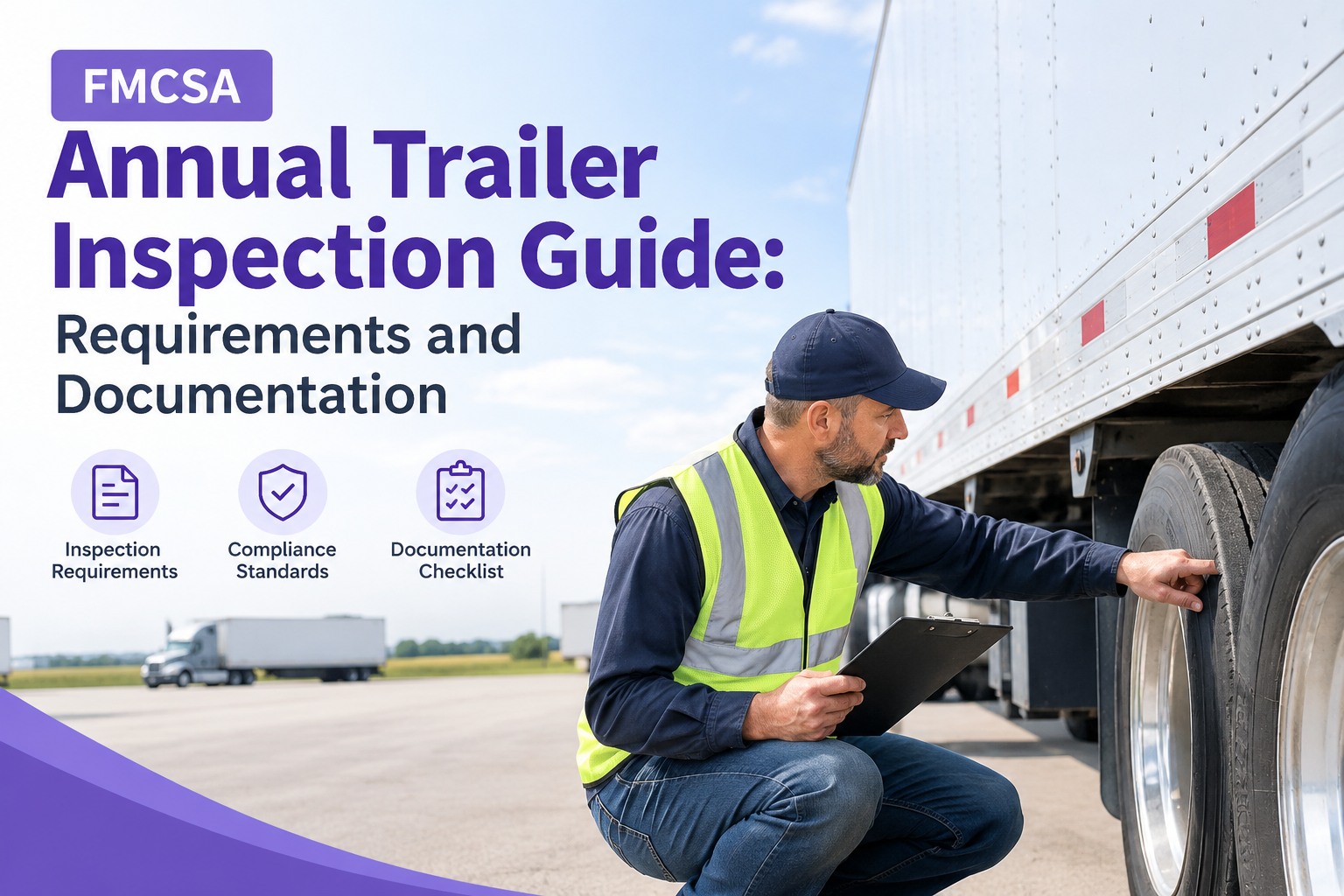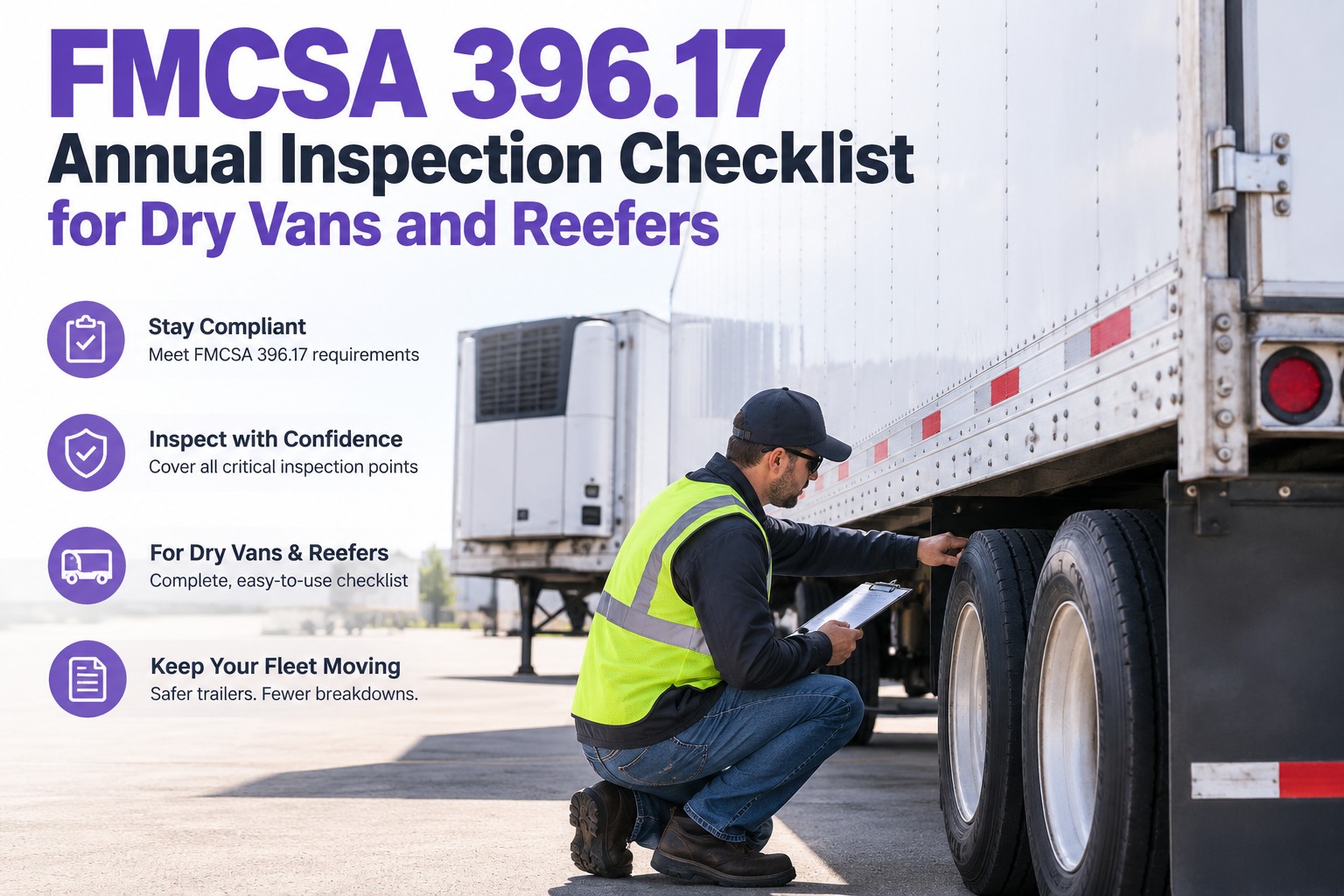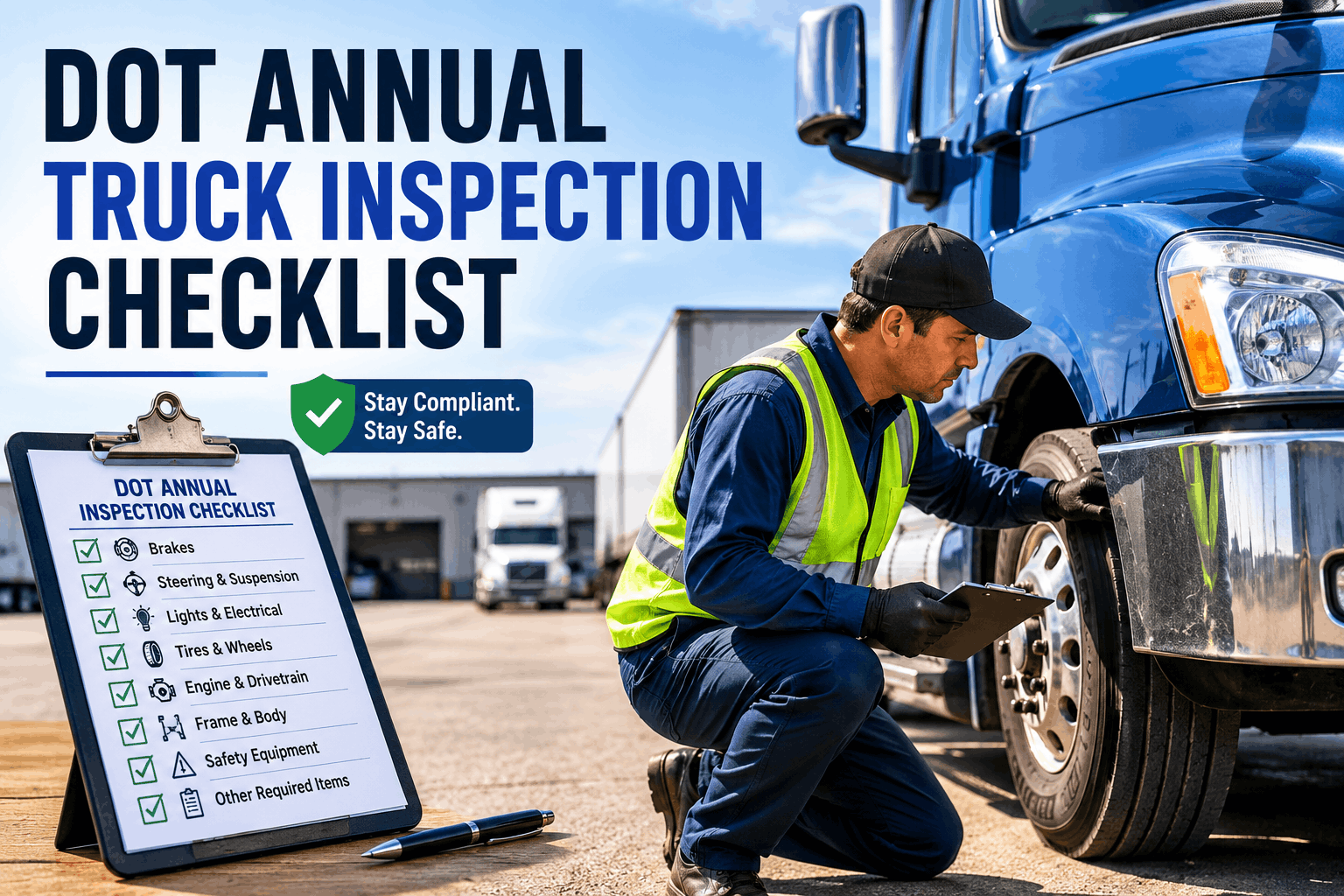
A trailer can be mechanically perfect and still put your operation out of service — if the annual inspection paperwork isn't right. Under 49 CFR 396.17, every trailer rated over 10,001 pounds must pass a full safety inspection once every 12 months, with proof carried on the trailer itself. Miss it and you join the roughly 133,000 vehicles cited each year for operating without a current annual inspection — the second most common vehicle maintenance violation in the FMCSA system — with fines reaching $19,277 per instance. And the inspection only counts if a qualified inspector performed it, every Appendix A component passed, and the records are retained correctly. This guide walks through exactly what the annual trailer inspection requires in 2026: who can perform it, what gets checked, how long to keep the records, and how to be ready when a DOT audit comes. Run compliant trailer inspections free.
FMCSA Annual Trailer Inspection Requirements: Complete 2026 Compliance Guide
Everything trailer fleets need for 49 CFR 396.17 — qualified inspector standards, the Appendix A checklist, recordkeeping rules, and DOT audit preparation, in one guide.
What 49 CFR 396.17 Actually Requires
The rule is short but strict. Every trailer under your control must clear a periodic inspection covering every component in Appendix A at least once in the preceding 12 months — and the proof has to travel with the trailer. No proof at the roadside means a citation, even if the inspection was actually done.
Any trailer with a GVWR, GCWR, or actual weight of 10,001 lbs or more operated in interstate commerce — plus placarded hazmat units regardless of weight.
Once every 12 months. Valid for 12 months from the last day of the month the inspection was performed. Separate from daily DVIRs and roadside checks.
In a combination, the tractor, semitrailer, full trailer, and converter dolly each need their own inspection — a trailer isn't covered by the truck's.
The inspection report or a compliant decal/sticker must be on the trailer at all times — carrier name, inspection date, and unique trailer ID.
Who Can Legally Perform It (396.19)
This is where carriers fail most often — and unintentionally. An inspection performed by an unqualified person is invalid, even if the trailer was genuinely safe. Under 49 CFR 396.19, the inspector must meet all three of these standards, and you must be able to prove it on demand.
You can qualify your own mechanics, or use a third-party commercial garage or fleet leasing company as your agent. Either way, retain the inspector's qualification evidence for as long as they inspect for you, plus one year. Ask how we track inspector qualifications.
Never Let an Inspection Lapse Again
Truck Inspection & Maintenance fires 90/60/30/7-day alerts before every trailer's annual inspection expires, stores the report and inspector credentials, and blocks an expired unit from dispatch.
The Appendix A Inspection Checklist
The annual inspection must cover every component category in Appendix A, each with specific pass/fail criteria drawn straight from federal regulation. For trailers, these are the systems that matter — and the measurements that decide pass or fail.
Service and parking brakes, drums, rotors, hoses, linings. Lining min 1/4" (air drum); air leak-down max 3 psi/min single, 4 psi/min combination.
Tread min 2/32" on trailer axles, measured at the shallowest groove with a gauge. No cracks, missing lugs, or improper inflation.
Fifth wheels, pintle hooks, kingpins, and safety chains — secure, undamaged, within wear limits. A failure here is catastrophic.
Tail lamps, turn signals, clearance lamps, brake lights, and conspicuity tape — all present, functioning, and visible.
Springs, hangers, torque arms, bushings, and the frame itself checked for cracks, corrosion, and broken or shifted members.
Anchor points, rails, and securement hardware sound and rated — the structure that keeps the load legal and on the deck.
Recordkeeping: The 14-Month Rule (396.21)
The inspection isn't finished when the inspector signs — it's finished when the records are where they belong. This is the part auditors scrutinize, and the part that's easiest to get wrong. Three retention rules govern trailer inspection records.
Preparing for a DOT Audit
A compliance review tests your system, not just your trailers. Auditors look for gaps between what should exist and what you can produce on demand. Close these four and an audit becomes a formality instead of a fire drill.
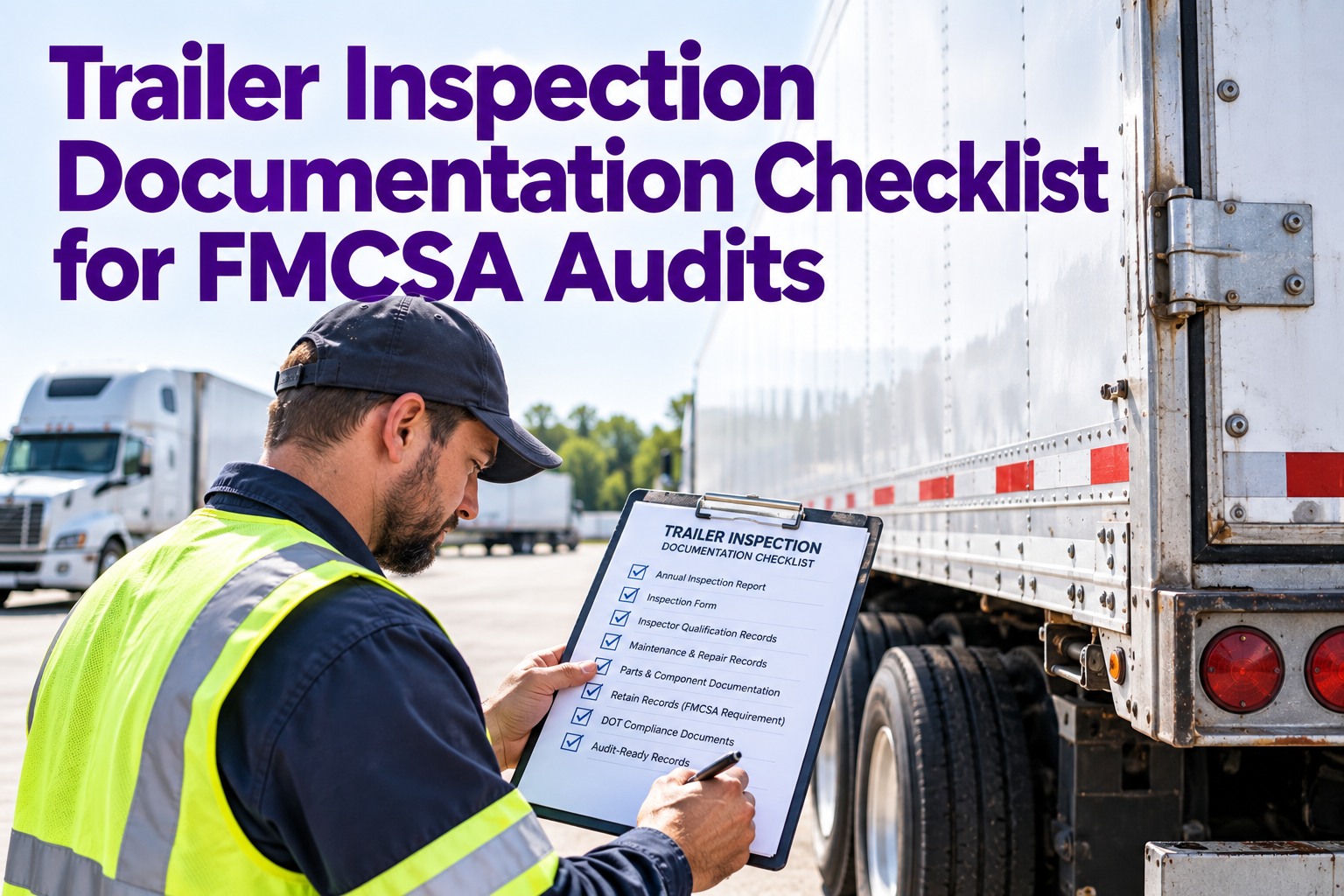
All annual inspection reports for the last 14 months, organized by trailer and instantly pullable — not buried in a binder or a truck cab.
Qualification evidence for everyone who signed an inspection, current and recently departed — a top citable gap.
For every failed item, the documented correction and re-verification — proof the fix happened before certification.
A visible schedule of upcoming inspection due dates. Auditors cite the missing tracker even when the work was done on time.
Frequently Asked Questions
Once every 12 months under 49 CFR 396.17. The inspection is valid for 12 months from the last day of the month it was performed, and proof must be on the trailer at all times. It's entirely separate from daily driver vehicle inspection reports (DVIRs) and from CVSA roadside inspections — a clean roadside inspection does not satisfy the annual requirement.
Under 49 CFR 396.19, a qualified inspector must understand the Part 393 and Appendix A criteria and identify defective components, have mastered the inspection methods and tools, and have either completed a Federal or State training program (or hold a qualifying certificate) or have at least one year of combined training and experience. You can qualify your own mechanics or use a third-party commercial garage or leasing company, but you must retain proof of their qualifications. Contact our team about qualification tracking.
The annual inspection report must be retained for 14 months from the inspection date under 49 CFR 396.21, stored where the trailer is housed or maintained and available on demand. A copy or compliant decal must also be on the trailer at all times. Separately, inspector qualification evidence must be kept while that inspector is active plus one year after they stop performing inspections for you.
The trailer cannot be certified until every Appendix A deficiency is corrected. Each repair must be documented — what was fixed, by whom, when, and with what parts — and the inspector must re-verify the correction before signing the certification. Operating a trailer with known uncorrected Appendix A defects violates 396.7 (unsafe operations), with fines up to $19,277 per instance, and signing off on uncorrected defects violates 396.17 and 396.21.
Yes, if the state (or Canadian provincial) periodic inspection program meets the minimum standards in Appendix A, it satisfies the federal annual inspection for 12 months from the last day of the month it was performed. However, a CVSA Level I or Level V roadside inspection does not satisfy 396.17 — those are enforcement inspections, not the required periodic inspection, even when violation-free.
It closes the gaps that cause violations. Truck Inspection & Maintenance provides Appendix A inspection templates with pass/fail gates and measurement fields, auto-generates compliant 396.21 reports, fires 90/60/30/7-day expiry alerts, stores inspector qualification evidence, links failed items to documented repairs, and blocks uncertified trailers from dispatch — so every inspection is valid, every record is retrievable, and a DOT audit is a quick export. Start a free trial to see the workflow.
Make Every Annual Inspection Provably Compliant
Truck Inspection & Maintenance runs guided Appendix A inspections, auto-generates 396.21-compliant reports, tracks expiry with 90/60/30/7-day alerts, stores inspector credentials, and keeps a complete defects-to-repair trail — so your trailer fleet clears every roadside check and every DOT audit without the scramble.