Cargo securement is the rare federal regulation that comes down to arithmetic. Strip away the dense language of 49 CFR Part 393 Subpart I and two numbers govern almost every flatbed load in America: you need enough tiedowns for the article's length and weight, and their combined strength — the aggregate working load limit — must equal at least half the weight of what you're hauling. A 40,000-pound load needs 20,000 pounds of aggregate WLL. That's the whole test, and it's the one drivers most often fail, because it's easy to look at four heavy-duty straps and assume they're plenty when the math says otherwise. Add commodity-specific rules that override the general standard entirely for steel coils, logs, and lumber, and a single securement violation can run toward the $18,000 range. Track securement compliance free. This guide walks the physics behind the rules, the tiedown-count formula, how to actually calculate aggregate WLL, and when the commodity rules take over.
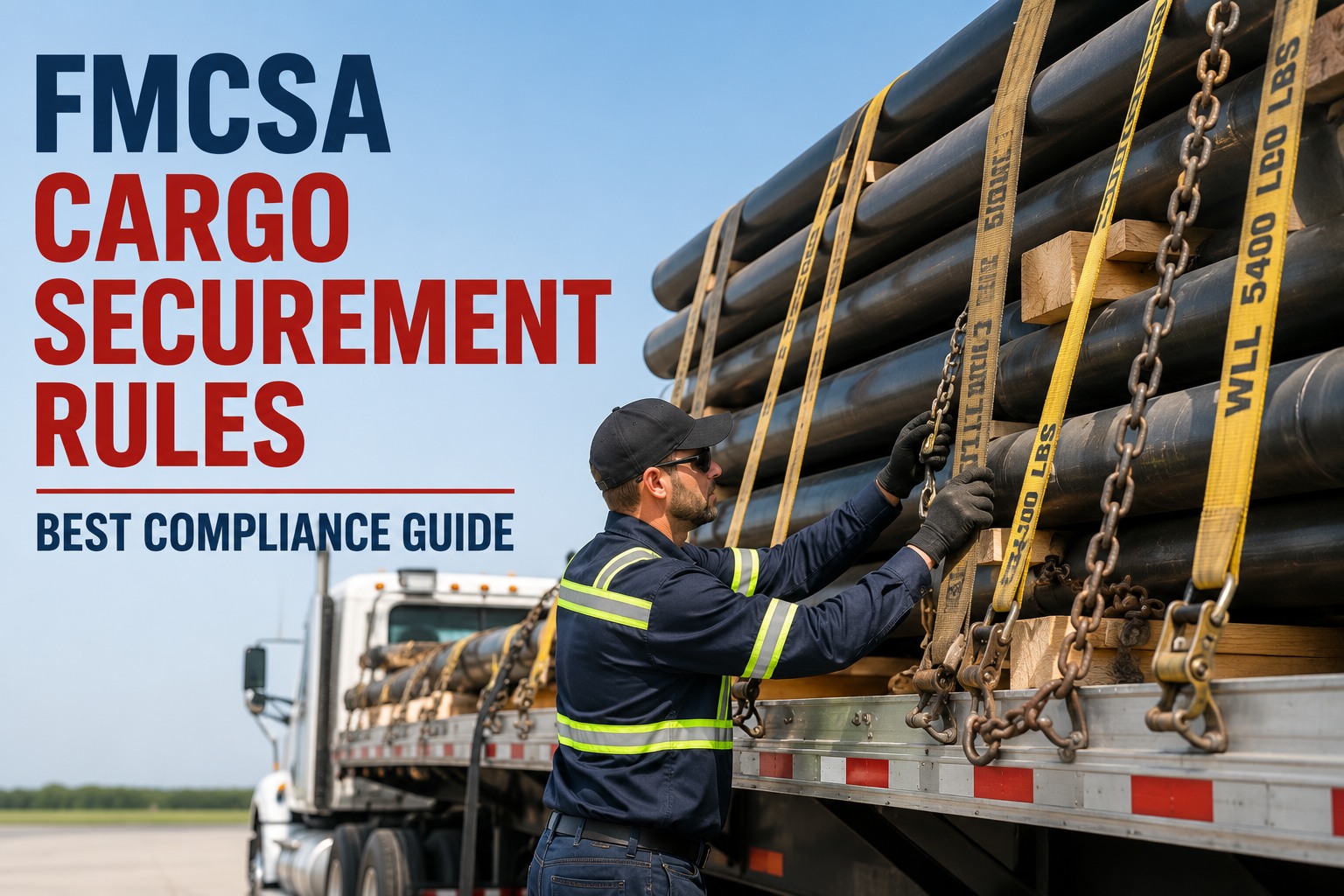
FMCSA Cargo Securement Rules: The Complete Compliance Guide
Two numbers decide compliance: enough tiedowns for the length and weight, and aggregate working load limit of at least 50% of cargo weight. Here's the math, the commodity exceptions, and the en-route checks.
The Physics Behind the Rules
Before the numbers make sense, the forces do. FMCSA built the standard around what actually happens to a load in a hard stop or a sharp turn — the securement system must hold under all three.
How Many Tiedowns You Need
The minimum count depends on the article's length and weight, and whether it's blocked against forward movement. This is the baseline under §393.110 — commodity rules can require more.
Both conditions must be true. Short and light is the only case a single tiedown covers.
Cross either threshold — too heavy or too long — and the minimum doubles.
A 24-foot article needs the base two plus two more for the length beyond 10 feet.
The 50% Aggregate WLL Rule
This is the calculation that catches people. The combined working load limit of your securement system must be at least half the cargo's weight — but how each tiedown counts toward that total depends on how it's attached.
A tiedown running from an anchor point on the vehicle to an attachment point on the cargo contributes one-half of its working load limit to the aggregate.
A tiedown that goes from an anchor point, through or over or around the cargo, and attaches to another anchor point on the vehicle contributes its full working load limit.
The Equipment Has to Be Inspection-Ready Too
The math only holds if the hardware does. Tiedowns must be in proper working order with no knots, no damaged or weakened components, and each one attached so it can't loosen or unfasten in transit — and every device needs its working load limit legibly marked. Truck Inspection & Maintenance keeps securement equipment on a real inspection cycle: rated straps, chains, and binders tracked as assets, damage findings routed to replacement, and the checks documented alongside every vehicle's record.
When Commodity Rules Take Over
Here's the part that trips up drivers and dispatchers alike: for certain commodities, the general rule stops being the standard. FMCSA wrote dedicated sections because a steel coil and a bundle of lumber fail in completely different ways.
Steel coils get an entire dedicated section (§393.120) because they roll and shift violently under sudden load. Requirements change with orientation: coils positioned eye-vertical need blocking and tiedowns placed both longitudinally and laterally, while eye-transverse and eye-lengthwise orientations carry different blocking requirements entirely. A driver hauling coils without knowing the specific rules for that orientation is exposed both legally and physically.
Checking the Load En Route
Securement isn't a one-time act at the dock. Drivers are required to re-examine the load and its securement during the trip, because straps loosen and cargo settles.
How many tiedowns does FMCSA require?
The minimum depends on the article's length and weight when it isn't blocked against forward movement. One tiedown covers articles that are 5 feet or less in length and 1,100 pounds or less in weight — both conditions must be true. Two tiedowns are required for articles 5 feet or shorter that exceed 1,100 pounds, and for any article between 5 and 10 feet regardless of weight. For articles longer than 10 feet, you add one more tiedown for each additional 10 feet of length or fraction thereof, so a 24-foot article needs four. These are minimums under the general rule, and two things can raise them: commodity-specific rules that require more, and the separate aggregate working load limit test, which can demand additional tiedowns even when you've met the count. Meeting the count alone is not compliance. Start a free trial to standardize checks.
What is the 50% aggregate working load limit rule?
It's the core strength test: the aggregate working load limit of your securement system must be at least one-half the weight of the article or group of articles being secured. So 40,000 pounds of cargo requires at least 20,000 pounds of aggregate WLL. The subtlety is in how each tiedown counts toward that total. A tiedown running from an anchor point on the vehicle to an attachment point on the cargo contributes only one-half of its working load limit. A tiedown that runs from an anchor point, through or over or around the cargo, and then attaches to another anchor point on the vehicle contributes its full working load limit. That difference means two systems using identical straps can produce very different aggregate numbers depending purely on how they're rigged, and it's the single most common place where a load that looks well secured fails the calculation. Ask about securement training records.
Do commodity-specific rules replace the general rule?
Yes — when a commodity-specific section applies, it takes precedence over the general requirements, and inspectors evaluate the load against that specific chapter rather than the general standard. FMCSA has written dedicated rules for logs, dressed lumber and similar building products, metal coils, paper rolls, concrete pipe, intermodal containers, automobiles and light trucks, heavy vehicles and machinery, flattened or crushed vehicles, roll-on/roll-off containers, and large boulders. These exist because different commodities fail in different ways — a coil rolls, lumber shifts and slides, a boulder can't be strapped like a crate. Practically, this means a securement checklist organized only around weight and length is incomplete; it has to be organized around what you're actually hauling. If you carry any of these commodities, the specific section is the standard you'll be measured against. Start free with commodity-aware checklists.
Are load bars enough to secure a load?
Usually not on their own, and the math shows why. Load locks and cargo bars are classified as blocking and bracing devices rather than tiedowns, meaning they rely on friction and compression rather than a mechanical connection to rated anchor points. More importantly, a typical load lock bar carries a working load limit of only 50 to 200 pounds. Against a palletized load of 40,000 pounds, which requires 20,000 pounds of aggregate WLL, no practical number of load bars can meet the requirement by themselves. They're genuinely useful as part of a combined system — bracing cargo against lateral shift inside a van trailer, filling voids, preventing forward movement — but treating them as a complete securement solution for heavy freight is a compliance failure waiting to be found at a scale house. Combine them with properly rated tiedowns and blocking. Start free and track your equipment.
How often must a driver check the load?
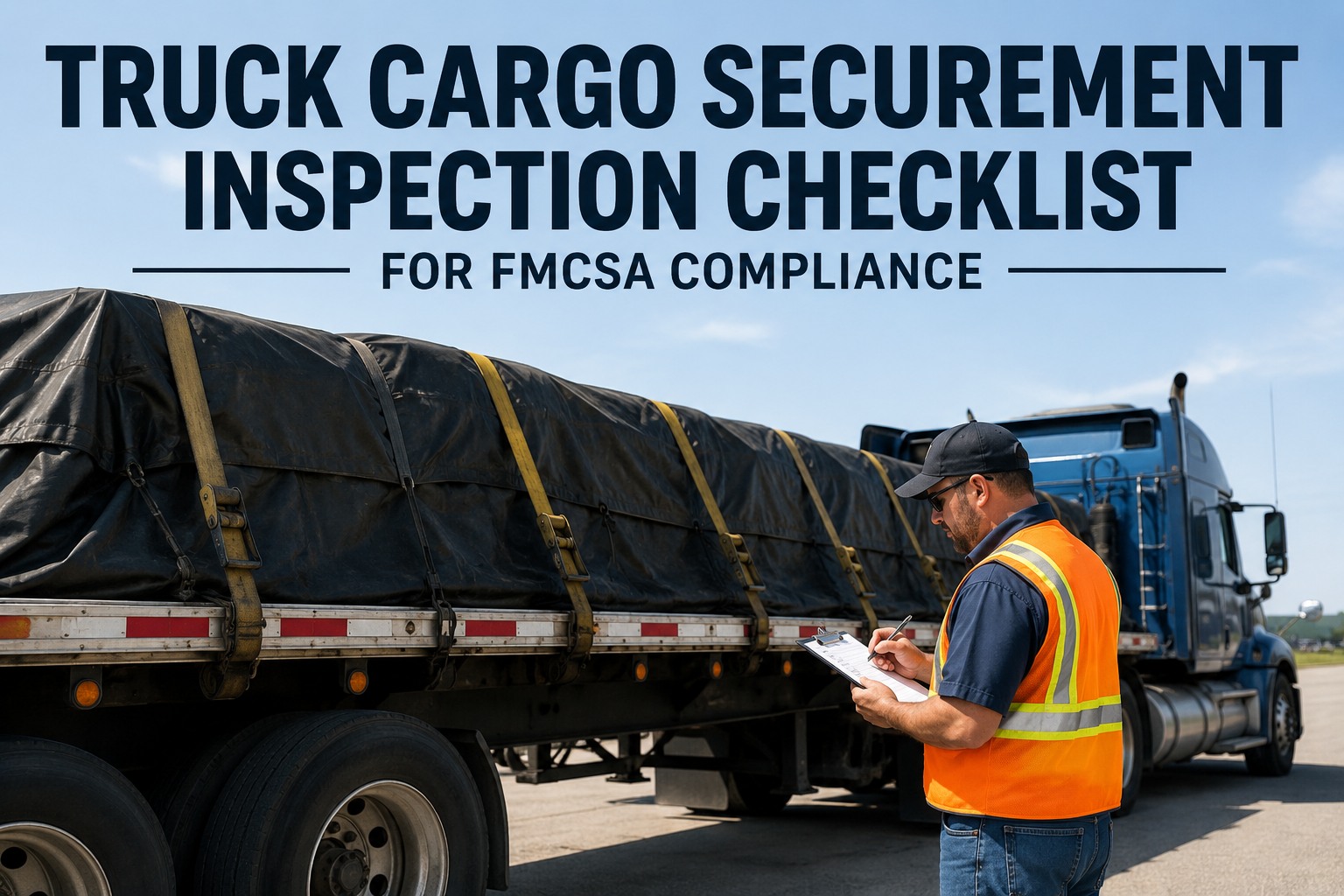
Securement has to be verified before the vehicle moves and re-examined during the trip. The driver must first be satisfied that the cargo is properly distributed and adequately secured before driving. Then the load and its securement devices should be inspected and adjusted within the first 50 miles, which is when settling and initial slack most commonly appear — straps that were tight at the dock are frequently loose after the first few miles of road vibration. From there, re-checks should happen at regular intervals during the trip, including after rest stops, duty-status changes, and any significant event. The underlying logic is simple: cargo shifts, tension is lost, and a system that was compliant at loading may not be compliant an hour later. Documenting these checks matters too, since a driver who can show a consistent re-inspection practice is in a much stronger position after an incident. Start free and document en-route checks.
Make the Math Part of the Process
Cargo securement violations come from arithmetic nobody ran and equipment nobody inspected. Truck Inspection & Maintenance keeps rated straps, chains, and binders tracked as inspected assets with their working load limits on record, routes damaged securement gear straight to replacement, and documents the pre-trip and en-route checks that prove your loads were verified — so the system that passed at the dock still passes at the scale.