Brakes are the single most-cited system at roadside inspections — air brake defects drive a large share of every out-of-service order written at the scale house. And the math is brutal: under CVSA criteria, if 20% of a vehicle's brakes are out of adjustment or defective, the whole truck is grounded — on a standard 10-brake tractor-trailer, that's just two bad brakes. The seven checks below are the ones that catch those defects before a driver rolls, each with the pass spec and the exact threshold that trips a violation. Truck Inspection & Maintenance puts this sequence on the driver's phone with a measurement field for every wheel and routes any fail straight to a work order — start a free trial or contact our team.
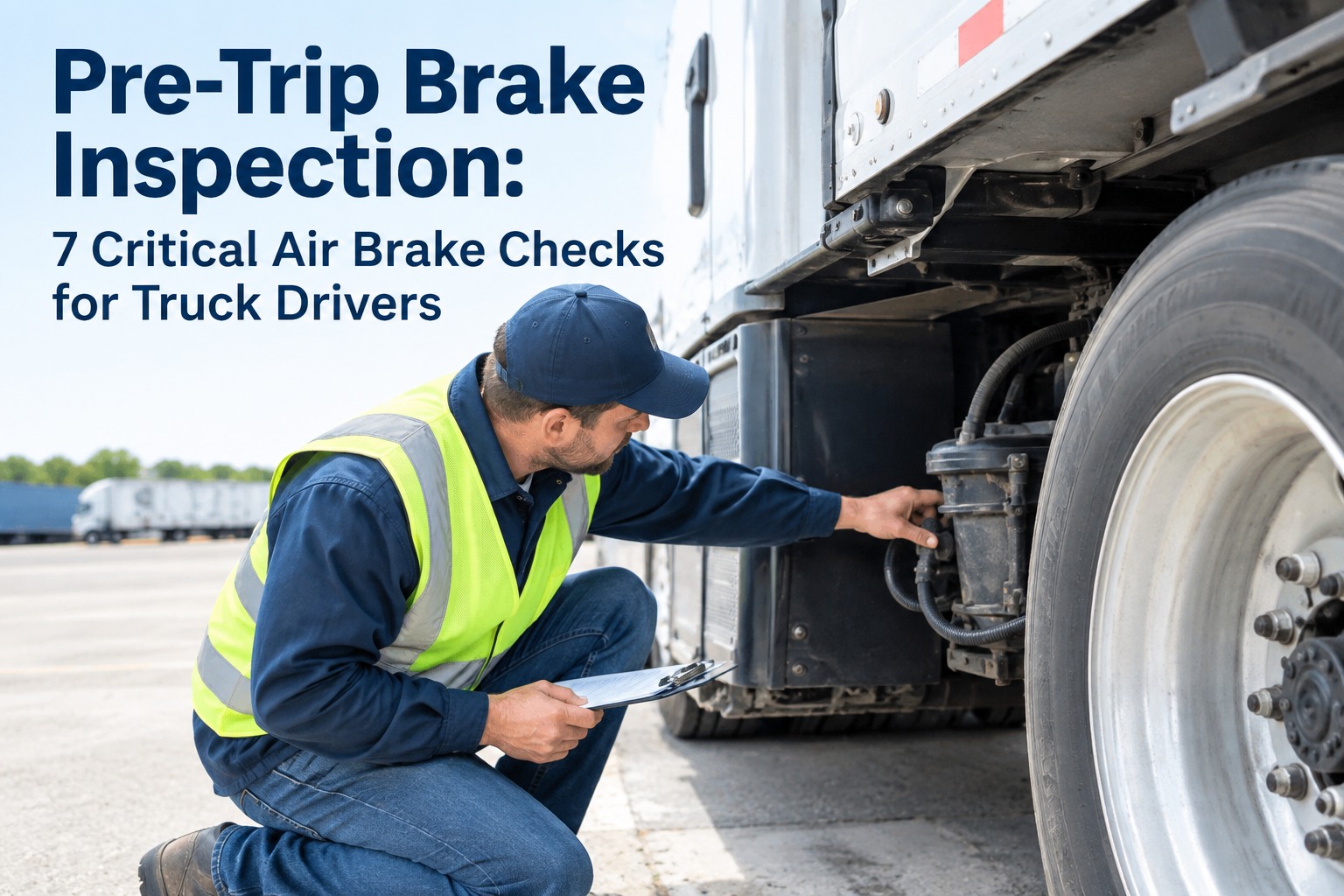
Pre-Trip Brake Inspection: 7 Critical Air Brake Checks for Truck Drivers
Brakes are the #1 out-of-service violation at roadside. Two bad brakes ground a 10-brake rig. Here are the seven checks — with the exact pass spec and the threshold that fails.
The 7 Checks — Pass Spec vs. What Fails
Walk the truck in this order. Each check shows what "good" looks like and the exact threshold an inspector uses to write a violation:
Slack Adjusters & Pushrod Stroke
The #1 brake OOS violation. With brakes applied at 90–100 psi, pushrod travel must stay within the chamber's limit. Automatic slack adjusters should never need manual adjustment — if they do, something's failing.
Air Loss / Leak-Down Rate
Charge to governor cut-out, shut the engine off, release the brakes and watch the gauge, then apply and watch again. A steady drop means a leak in a line, chamber, or valve.
Low-Air Warning Device
With the engine off, fan the service brake to bleed pressure down and confirm the warning light and buzzer activate before pressure gets dangerous.
Spring Brake Pop-Out
Keep fanning the service brake down past the low-air warning. The parking/spring brakes must engage automatically — the knob pops out on its own.
Brake Chambers, Hoses & Lines
Look at every chamber and line by eye and hand. Cracked chambers, bent pushrods, chafed or bulging hoses, and loose fittings all leak or fail under load.
Linings & Drums/Rotors
CVSA's 2026 focus is drums and rotors specifically — expect extra scrutiny. Check lining through the inspection slot and look for cracks and heat damage on the drum.
ABS Warning Lamp
Turn the key on and watch the dash. The ABS lamp should light for its self-test, then go out. A lamp that stays lit means an ABS fault the system can't clear itself.
Why the Standard "Charge, Shut Off, Listen" Test Isn't Enough
Every driver learns to build to 120 psi, kill the engine, hold the pedal, and listen for leaks — and it's a necessary check. But it only tests the air side. It tells you nothing about whether a slack adjuster has crept out of adjustment, whether a lining has worn to the rivet, or whether a drum is cracked — and those mechanical defects are exactly what an inspector measures with a tape and a flashlight at the scale house. A pass on the leak-down test creates a false sense of security if the walk-around got skipped. The seven-check sequence catches both halves: the air system and the foundation brakes. Recorded per wheel position over time, a slack adjuster creeping out or a lining wearing thin shows up as a trend weeks before it becomes a violation. Start a free trial and give every wheel position its own measurement field.
What Grounds a Truck — The OOS Thresholds
Not every defect is out-of-service, but these brake findings will pull a truck off the road on the spot:
Put the seven checks on the driver's phone — with a stroke and lining field at every wheel, and any fail routed straight to the shop.
Automate the full inspection-to-repair loop: mobile DVIR capture with brake measurement fields, instant defect routing to work orders, PM scheduling, and DOT recordkeeping — so a creeping slack adjuster shows as a trend, not a scale-house surprise. Start a free trial or talk to our team.
Frequently Asked Questions
What is the #1 brake out-of-service violation?
Brakes out of adjustment — specifically pushrod stroke exceeding the chamber's maximum, measured at 90–100 psi applied. On a 10-brake combination vehicle, if 20% (just two brakes) are out of adjustment or defective, the entire truck is placed out of service under CVSA criteria.
What's the allowable air-loss rate on a pre-trip?
For a combination vehicle, no more than 3 psi per minute with the brakes released (static) and no more than 4 psi per minute with them applied. Single vehicles are 2 and 3 psi/min. Any audible leak at a fitting or chamber is a violation regardless of the measured rate.
At what pressure should the low-air warning activate?
At or before roughly 55 psi. Fan the service brake down with the engine off and confirm the light and buzzer come on. An inoperative low-air warning device is its own out-of-service item — it's what tells the driver to stop before the spring brakes engage on their own.
When do the spring (parking) brakes pop out?
They should engage automatically between 20 and 45 psi as you keep fanning pressure down past the low-air warning. If the knob doesn't pop or engages outside that window, the spring-brake system needs service before the truck moves.
What is the maximum pushrod stroke?
It depends on chamber type: a standard Type 30 clamp chamber is 2 inches, Type 24 and long-stroke Type 30 are 2.25 inches, and larger chambers allow more. Measure at 90–100 psi applied. Exceeding the limit on even one brake is a violation worth CSA points.
How does Truck Inspection & Maintenance help with brake pre-trips?
It puts the seven-check sequence on the driver's phone with a dedicated measurement field for pushrod stroke and lining at every wheel position, routes any failed check straight to a work order, and keeps DOT-ready records — so out-of-adjustment brakes surface as a trend before they become a roadside OOS. Start a free trial or contact us.
Two bad brakes ground the rig. The seven-check pre-trip catches them at the yard — not at the scale house.
Slack adjusters, air loss, low-air warning, spring pop-out, chambers, linings and drums, ABS — each with the spec that passes and the threshold that fails, on the driver's phone with a measurement field per wheel and every fail routed to a work order.