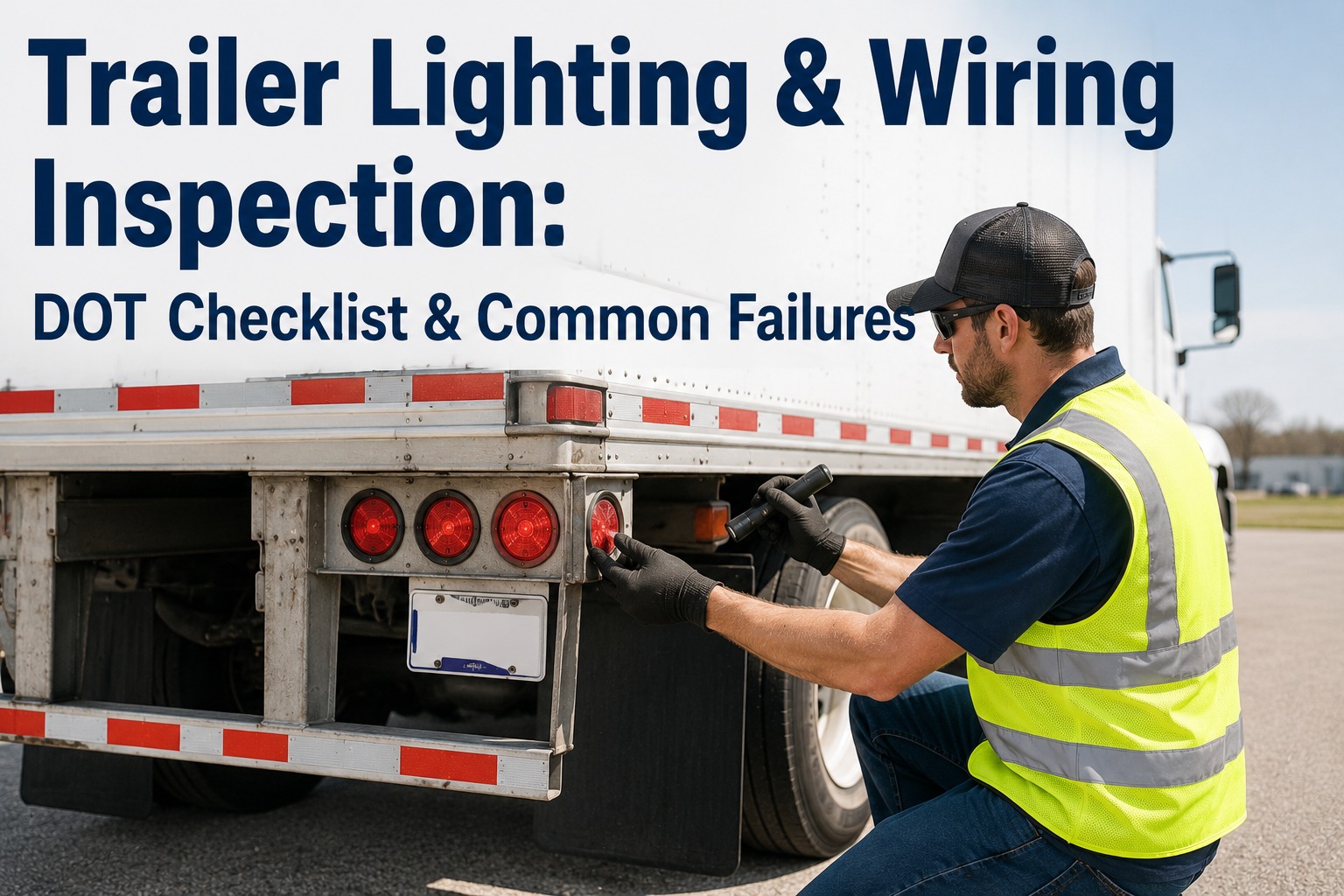
Lighting defects are the #1 category of vehicle-related roadside violations in FMCSA data — a single burned-out marker lamp can put a truck out of service on a Level 1 inspection. FMCSA §393.11 spells out exactly which lights, reflectors, and conspicuity markings a tractor-trailer combination must carry, but drivers walking the truck at 4 a.m. don't have the CFR memorized. This checklist gives you the full lighting inspection — every position, every color, every mandatory item — laid out as a printable pre-trip guide for the driver and a shop reference for the foreman. Every lamp is numbered against a tractor-trailer diagram so nothing gets missed. Truck Inspection & Maintenance runs this checklist on driver phones with photo verification and auto-WO routing — sign up free or contact our team.
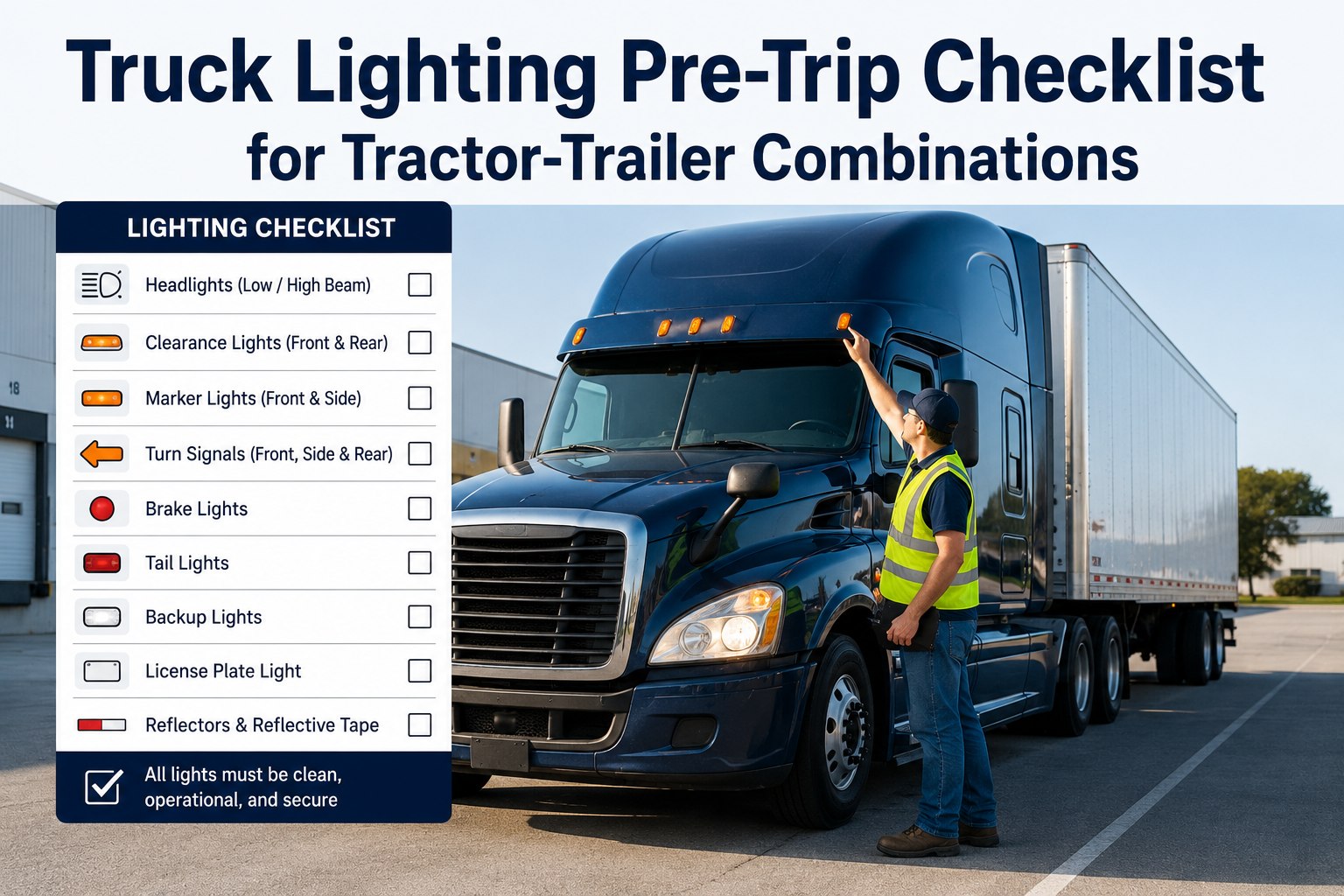
Truck Lighting Pre-Trip Checklist — Tractor-Trailer Combinations
28 mandatory lamps + reflectors on a standard 53-ft tractor-trailer. Miss one, roadside OOS.
Why Lighting Inspection Sits at the Top of the Pre-Trip
Lighting violations dominate roadside inspection data. Three numbers frame the exposure:
Lighting defects consistently rank as the highest-frequency vehicle violation category on Level 1 inspections. A single failed marker or brake lamp can put the truck out of service.
A standard 80"-wide, 53-ft tractor-trailer combination has roughly 28 required lamps and reflectors under §393.11 — cab clearance + ID, side markers, tail, brake, turn, rear clearance + ID, plus reflex reflectors.
A trained driver walks a full lighting check in under 2 minutes with a second person or a lighting-test tool. Compare that to $175+ CSA points and a delayed dispatch — the math is one-sided.
One burned-out marker = one Level 1 OOS. Start a free account and put the numbered §393.11 lighting check on every driver's phone.
The Complete 23-Position Lighting Checklist
Every numbered lamp on the tractor-trailer diagram, in walk-around order. Check for illumination, correct color, unbroken lens, and no visible damage:
Want a printable numbered lighting map for the shop wall? Contact our team and we'll send one, free.
Conspicuity Tape & Reflex Reflectors — Not Just Lamps
§393.11 requires reflex reflectors in addition to lamps, and conspicuity tape on the rear and sides of all trailers manufactured on or after December 1, 1993. Roadside inspectors check both:
Amber at trailer front-left/front-right sides; red at rear-left/rear-right sides. Plus 2 red reflectors on the rear. Must be clean, unbroken, and correctly colored — cracked lenses fail.
Red/white alternating pattern along lower rear, plus 50% coverage on lower sides. DOT-C2 minimum grade. Missing, faded, or damaged sections = OOS-risk violation.
Two 300mm white strips at upper rear corners of the trailer. Often missing after collision repairs. Verify both corners have full-length strips.
Auto-fire a work order the moment a driver logs a lighting defect — sign up free and connect defect-to-WO routing in under 20 minutes.
The One Rule That Catches Half of All Lighting Violations — Do the Circle Check With the 4-Way Flashers On
Most drivers walk the truck with all lights off, spot the burned-out ones only when checking specifics. Reverse the sequence: turn on all running lights AND 4-way flashers before the walk. Every lamp that should be lit shows immediately — dark spots are instant fails. Second pass, hit the brake pedal (with a chock or helper) and confirm all rear brake lamps illuminate brighter. Third pass, cycle turn signals L and R. Total time: under 2 minutes. Catches roughly half of all pre-trip lighting misses that would otherwise show up at the roadside. Start a free account and put the 3-pass lighting check on every driver's phone with photo verification.
Common Defect Types — What to Look For
Beyond outright bulb failure, these six defect types account for most lighting citations:
Cracked or Broken Lens
Water intrusion causes bulb failure within days. Any visible crack = replace, not tape over.
Faded / Discolored Lens
Sun-faded amber lens reads as white; red lens fades to pink. Both wrong color = violation.
Hyper-Flashing Turn Signal
Rapid flash rate signals a bulb-out elsewhere in the circuit — usually opposite side rear. Find and fix.
Corroded Connector / Pigtail
Green corrosion at 7-way trailer plug or lamp pigtail = intermittent failure. Clean, dielectric grease, done.
Loose Ground
Dim or flickering lamp usually = bad ground, not bad bulb. Verify ground stud clean and tight before swapping bulbs.
Missing Conspicuity Tape Section
Peeling or missing 6"+ section of DOT-C2 tape = violation. Replace with matching-grade tape only.
Need help mapping the 6 common defect types to your shop's parts inventory? Get in touch for a free 15-minute review.
Every driver walks the same 23-position lighting check, with photo evidence attached to every DVIR.
Numbered lighting checklist on driver phones, defect photos auto-attached, WO auto-fires on any fail. Free forever for up to 3 vehicles — create your free account or talk to our team.
KPI Dashboard — 6 Lighting Compliance Metrics
Six numbers to track weekly on any fleet running lighting as a first-class compliance KPI:
Every truck's 23-position lighting check completed before dispatch. Anything under 100% = drivers skipping the walk.
Zero tolerance target for lighting-based out-of-service events per quarter. Any OOS = pre-trip is missing something.
Lighting defect flagged on DVIR to shop-completed WO. Above 24 hours = defects riding on the road.
Percentage of pre-trip lighting checks with photo evidence attached. Photo proof = defensible in audit.
Vehicle-maintenance BASIC points attributable to lighting. Above 5 = pre-trip discipline needs review.
Every trailer's conspicuity tape verified intact and full-coverage at monthly PM. Below 100% = trailers cycling with damaged tape.
Track all 6 lighting KPIs and hit zero roadside OOS this quarter — create your free account in 10 minutes.
Frequently Asked Questions
What does FMCSA §393.11 require for tractor-trailer lighting?
§393.11 requires the lamps, reflective devices, and associated equipment specified in Table 1 of the regulation. For a standard 80"-wide, 53-ft tractor-trailer combination this comes to roughly 28 mandatory items: cab clearance lamps + 3-lamp ID cluster (amber front, red rear), front and rear clearance lamps, front + intermediate + rear side markers, tail lamps, brake lamps, turn signals, reflex reflectors, and DOT-C2 conspicuity tape. Commercial vehicles manufactured on or after December 25, 1968 must meet the applicable FMVSS 108 requirements in effect at time of manufacture.
When are clearance lamps and ID lamps required?
Front and rear clearance lamps and the 3-lamp identification cluster are required on any commercial vehicle 80 inches or more in overall width — which includes essentially every tractor and every 53-ft trailer in interstate service. The ID cluster is 3 lamps mounted together at the center top: amber front on the tractor cab, red rear at the top center of the trailer. All 3 lamps in each cluster must illuminate — one out is a violation.
Do trailers over 30 feet need intermediate side markers?
Yes. Trailers 30 feet or more in overall length must be equipped on each side with one intermediate side marker lamp and one amber reflector, centrally located along the trailer length. This is in addition to the front and rear side markers already required. A 53-ft van needs the intermediate markers; a 28-ft pup does not.
Can I combine a rear clearance lamp with a tail lamp?
No. §393.11 and FMVSS 108 both prohibit combining rear clearance lamps with tail lamps. Rear clearance lamps must be a separate lamp, mounted at the upper rear corner to show the vehicle's width. A rear clearance lamp facing rearward may be combined with a rear-facing side marker lamp, but never with a tail lamp.
What's the fastest way to complete a pre-trip lighting check?
The 3-pass method takes under 2 minutes. Pass 1: turn on running lights and 4-way flashers before the walk. Every lamp that should be lit shows immediately — dark spots are instant fails. Pass 2: with a chock or helper holding the brake, walk the rear and confirm brake lamps illuminate brighter than tail lamps. Pass 3: cycle left turn signal, walk both sides; cycle right, walk again. This sequence catches roughly half of all lighting defects that would otherwise be missed.
How does Truck Inspection & Maintenance handle lighting pre-trips?
Truck Inspection & Maintenance ships with the full 23-position §393.11 lighting checklist pre-configured. Drivers step through numbered items on their phone, attach photos of any defect, and the app auto-fires a work order to the shop the moment a fail is logged. Every completed check is timestamped and stored for the FMCSA-required period — no more paper DVIRs, no more lost defect notes. Free forever for up to 3 vehicles. Sign up in 10 minutes or contact our team for larger fleets.
One burned-out marker lamp is one Level 1 roadside OOS. Catch it in the yard, not on the shoulder.
Full §393.11 lighting checklist on driver phones, photo evidence attached to every DVIR, defect-to-WO auto-routing. Free forever for up to 3 vehicles — no hardware, no contract, no credit card.