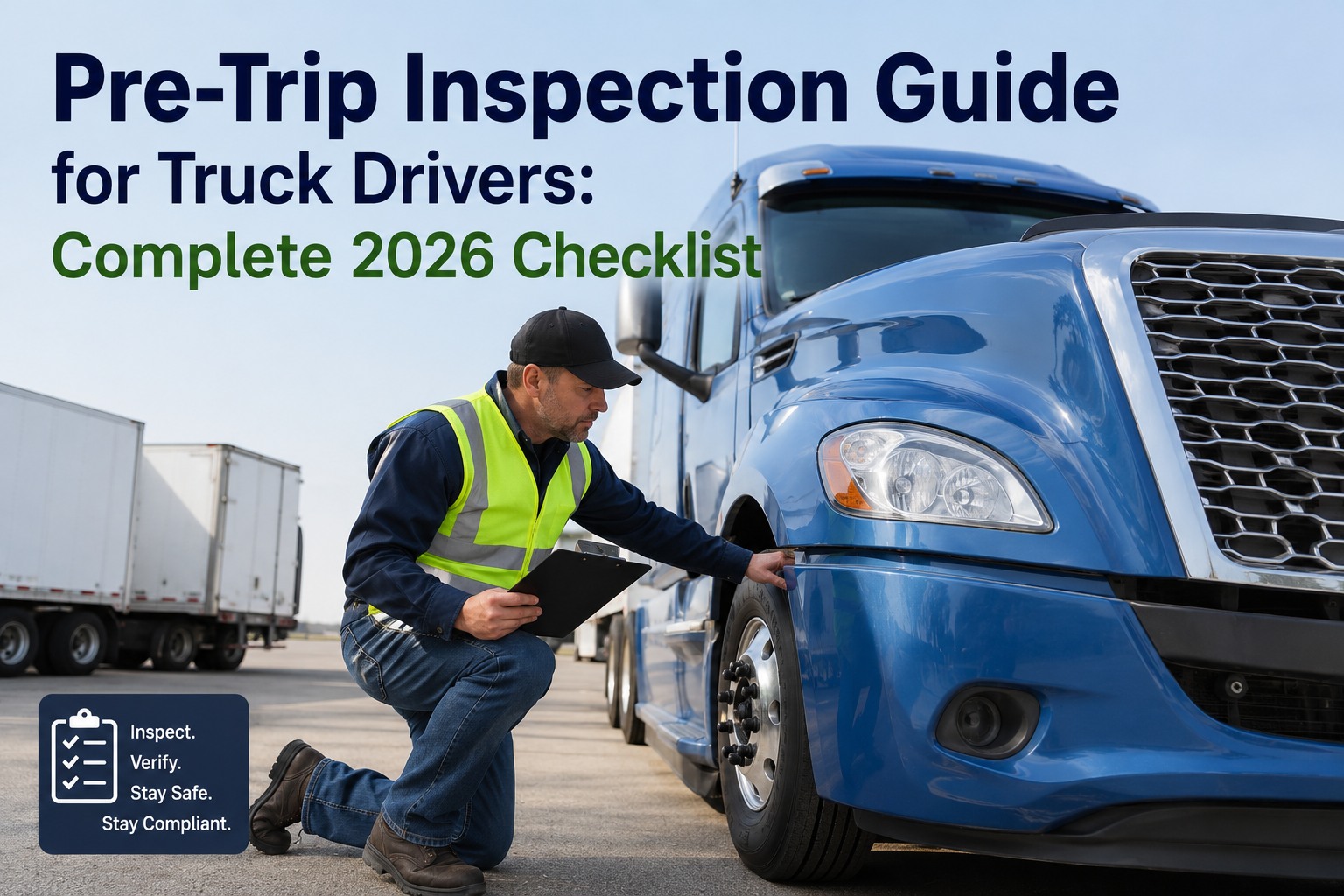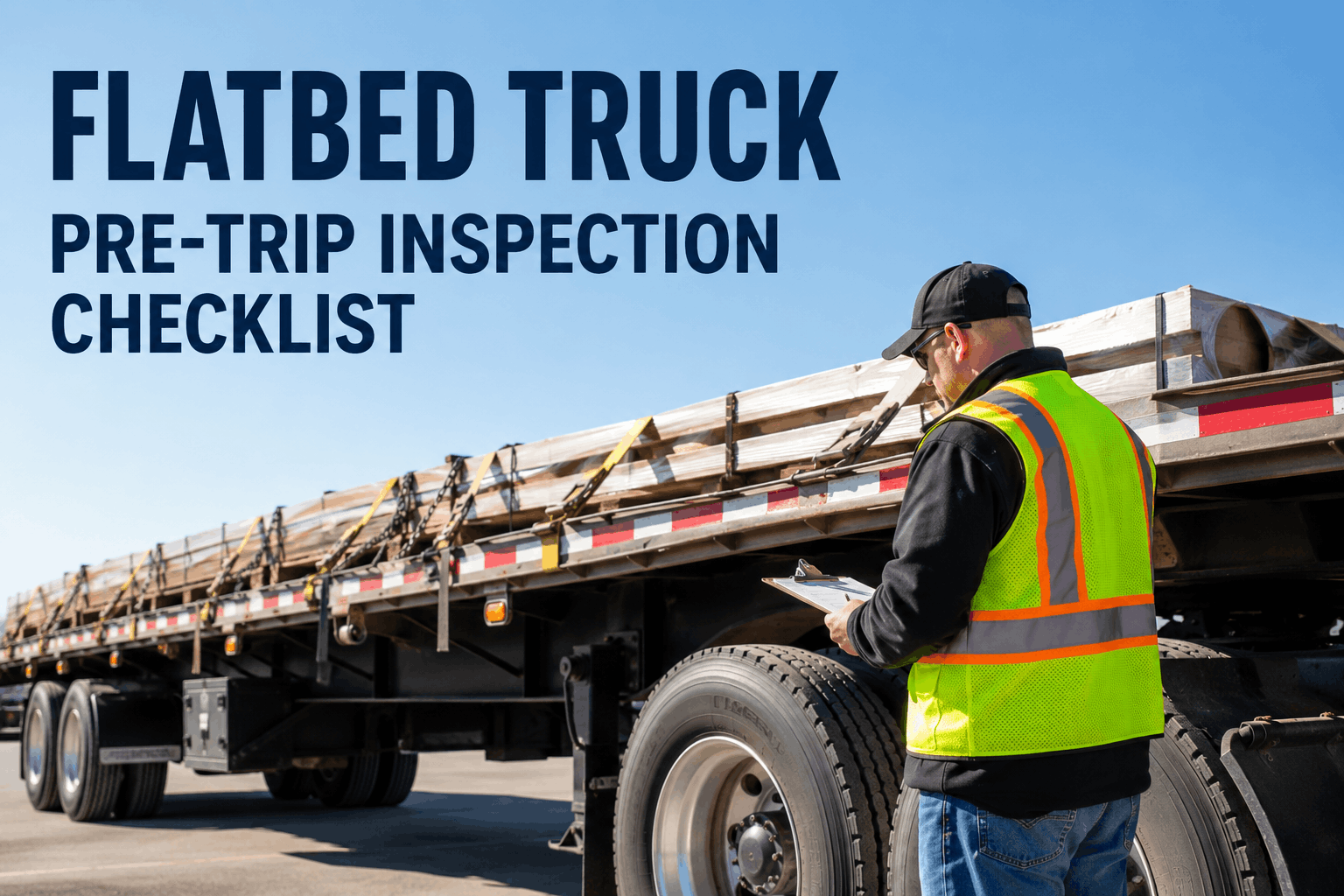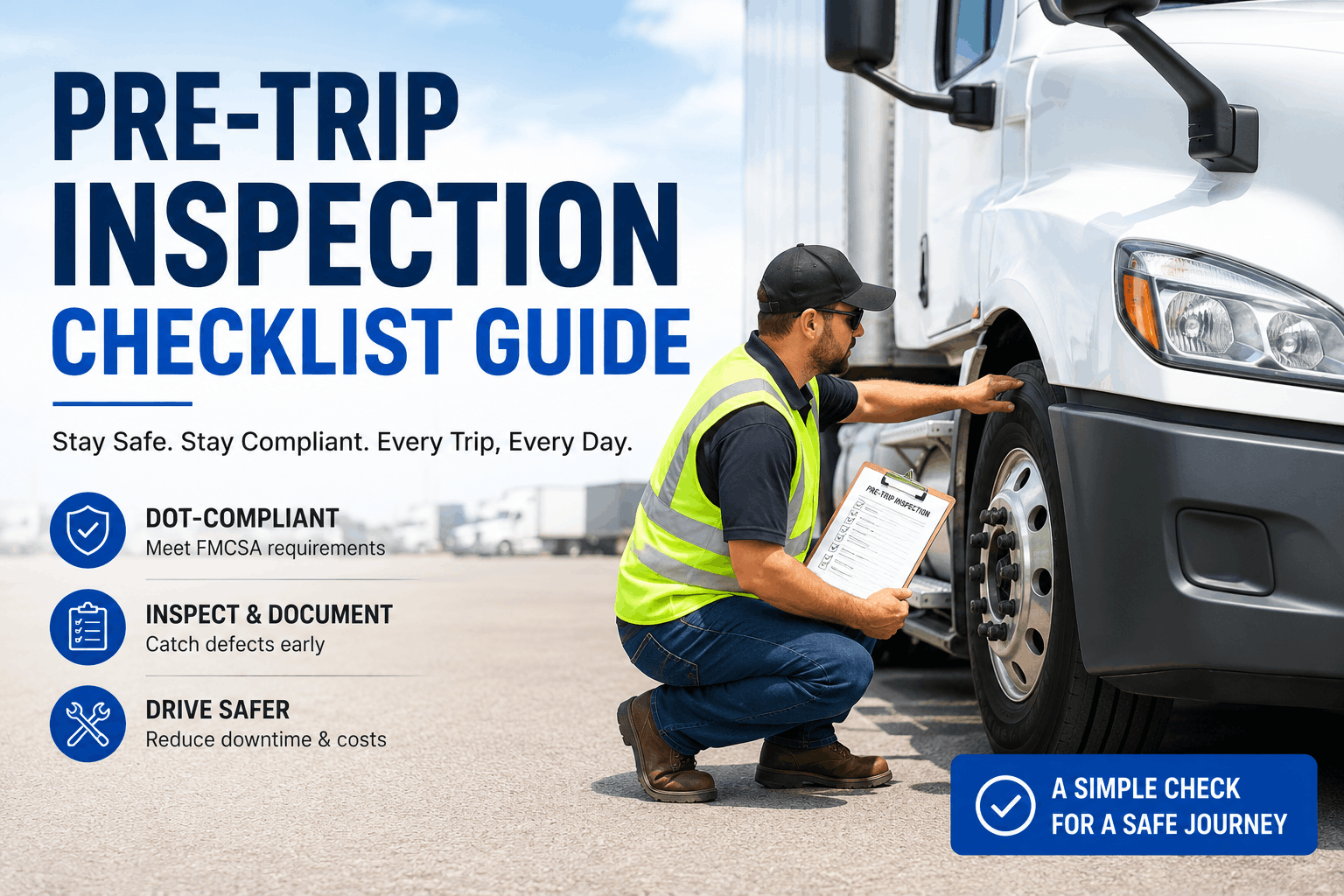
The single most common reason a commercial truck gets pulled out of service at a roadside inspection is a defect that should have been caught before the truck ever left the yard — a brake out of adjustment, a burned-out lamp, a tire below tread depth, a missing document. The pre-trip inspection exists to catch exactly these problems, and FMCSA estimates that thorough daily inspections and DVIRs prevent approximately 14,000 accidents every year. The 2025 CVSA International Roadcheck placed 18.1% of inspected vehicles out of service — with brake defects accounting for 41% of all out-of-service violations and tire issues another 21.4%. Nearly every one of those was a checklist item a proper pre-trip would have flagged in minutes.
The regulatory backbone is three connected rules: under 49 CFR §392.7, a driver may not operate a commercial vehicle unless satisfied its safety components are in good working order; under §396.13, the driver must review the previous DVIR and confirm reported defects were repaired before driving; and under §396.11, a written DVIR documents the vehicle's condition at the end of the workday. Together they form a chain of accountability that 2026's overhauled CSA scoring system now weights more heavily than ever — Vehicle Maintenance split into two BASIC categories, out-of-service violations carrying 2× severity weight, and a new "Driver Observed" category that makes the quality of each walkaround directly visible in carrier safety scores. With only about 7% of carriers passing focused compliance reviews without a DVIR violation, this is the most commonly failed compliance area in trucking.
This guide is the complete truck pre-trip inspection checklist for 2026: the 7-point walkaround pattern, the 11 FMCSA-mandated components, the penalty framework, the pre-trip vs DVIR distinction, and the digital workflow that turns inspections into audit-proof records. Start your free trial of our truck inspection and maintenance software to deploy guided digital pre-trip inspections across your fleet — live in 10 minutes, free for up to 3 trucks.
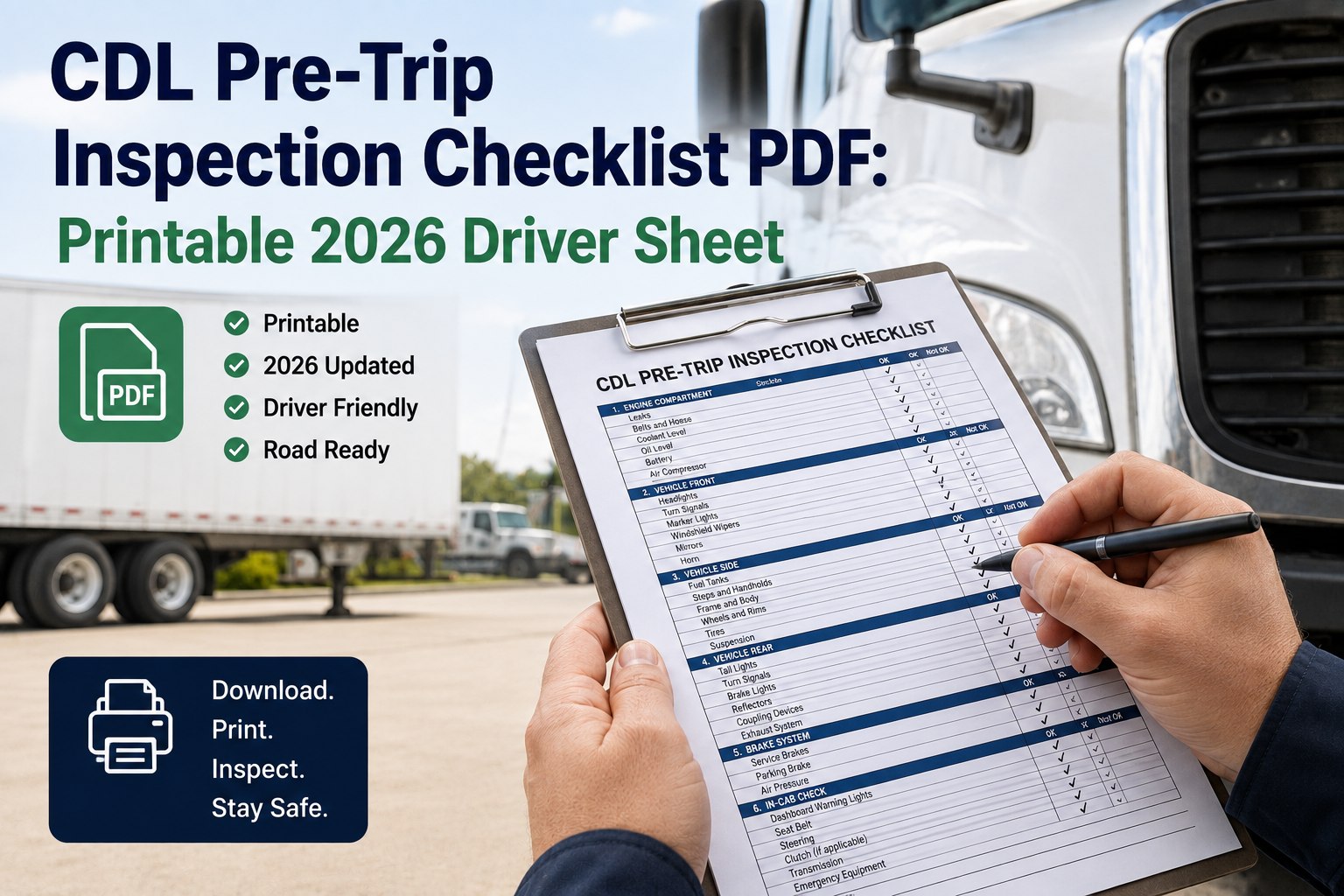
Pre-Trip Inspection Checklist
The complete 2026 DOT pre-trip framework — 7-point walkaround, 11 FMCSA-mandated components, ~45 power unit checkpoints, the §392.7 / §396.11 / §396.13 rules, and the digital DVIR workflow that prevents breakdowns and survives every audit.
The 7-Point Walkaround Pattern
A consistent walkaround pattern ensures no component is missed. Move around the vehicle the same way every time — these 7 zones cover all ~45 power-unit checkpoints. Contact our sales team for help deploying guided walkaround templates across your fleet.
The 11 FMCSA-Mandated Components
Under 49 CFR §396.11, every DVIR must cover these 11 components — and the pre-trip inspection verifies the same items before operation. Any defect affecting safe operation must be documented.
Pre-Trip vs DVIR — How They Work Together
Pre-trip and DVIR are often confused, but they're distinct regulatory events that form a connected chain of accountability across drivers.
The chain: the DVIR from the last driver feeds into the next driver's pre-trip review under §396.13. Both cover the same 11 FMCSA components — the pre-trip catches problems before operation, the DVIR documents what developed during it. eDVIRs are explicitly authorized under the FMCSA Final Rule effective March 23, 2026.
The Penalty Framework
Pre-trip and DVIR violations carry escalating civil penalties — and beyond the fines, they damage CSA scores, raise insurance premiums, and create litigation exposure after a crash.
| Violation | Penalty |
|---|---|
| Failing to complete a required DVIR | Up to $1,270/day |
| Failing to repair documented defects | Up to $15,420 |
| Falsifying inspection reports | Up to $12,700 |
| Operating an out-of-service vehicle | Up to $19,277 |
| Average single OOS violation cost | ~$4,200 |
Frequently Asked Questions
For property-carrying CMVs, FMCSA does not require a written report for a defect-free pre-trip (since the 2014 DVIR rule change) — but the pre-trip inspection itself under §392.7 is still mandatory every day. Passenger-carrying CMVs require a written DVIR every day regardless of defects. However, most carriers require written pre-trip documentation as company policy even for no-defect days, because it proves the inspection was performed and creates a defensible record for audits and litigation. With only about 7% of carriers passing focused compliance reviews without a DVIR violation, documentation discipline matters. Start your free trial to capture defect-free DVIRs in seconds.
A thorough pre-trip inspection covers approximately 45 checkpoints on the power unit plus 15 on the trailer, taking 10-15 minutes with digital tools and 30-45 minutes done thoroughly on paper, especially in challenging weather. The 7-point walkaround pattern keeps it efficient: approach/engine compartment, driver side, rear, passenger side, cab interior, coupling system, and under-vehicle. Drivers who develop a consistent pattern and use guided digital checklists complete inspections faster and miss fewer items than those working from memory. The time investment is trivial against the alternative — a single out-of-service violation averages $4,200, and brake or tire defects caught in the yard cost minutes instead of hours roadside.
A pre-trip inspection under §392.7 is performed before driving to confirm the vehicle is safe to operate. A DVIR (Driver Vehicle Inspection Report) under §396.11 is completed at the end of the workday to document the vehicle's condition. Both cover the same 11 FMCSA components but serve different regulatory purposes, and they work together as a chain: the DVIR from the last driver feeds into the next driver's pre-trip review under §396.13. The pre-trip catches problems before operation; the DVIR documents defects that developed during the day. The next driver reviews that DVIR, confirms repairs were made, and signs acknowledgment — completing the chain of custody. Contact our sales team to deploy the connected pre-trip + DVIR workflow.
FMCSA requires a minimum of 4/32" tread depth on steer-axle tires and 2/32" on all other positions (drive and trailer). Many carriers set higher internal minimums as best practice — commonly 6/32" steer and 4/32" drive — to provide a safety buffer and avoid replacing tires that fail mid-route. Tire violations are consistently among the top out-of-service categories: during the 2025 CVSA Roadcheck, tire issues accounted for 21.4% of all OOS violations. Check tread depth with a gauge (not by eye) at the most worn point, and inspect for sidewall damage, bulges, exposed cord, and uneven wear patterns that signal alignment or inflation problems. Sign up free to track tire condition trends across your fleet.
Yes. Electronic records and signatures have been authorized under 49 CFR 390.32 since 2018, and FMCSA's Final Rule effective March 23, 2026 added explicit eDVIR language to §396.11 and §396.13 — removing any remaining ambiguity. Digital DVIRs are increasingly preferred by carriers and expected by auditors because they improve accuracy and compliance rates while providing timestamped, GPS-verified, photo-documented audit trails that paper cannot match. Paper inspections suffer from lost forms, illegible handwriting, defects reported but repair-verification unsigned, no photo evidence, and maintenance notified hours or days later — all of which create audit exposure. Digital platforms route defects to maintenance instantly and prove the inspection actually occurred. Talk to our sales team to switch to compliant digital DVIRs.
FMCSA requires motor carriers to retain DVIRs for a minimum of 3 months (90 days) from the date of inspection — including the DVIR itself, the repair certification, and the next driver's acknowledgment. Best practice is to retain records for 12-24 months or longer, since lawsuits can run years after an incident and digital storage makes extended retention effectively cost-free. The complete retained record (inspection, defects, repairs, signatures, photos) is what defends a carrier during compliance reviews, insurance disputes, and crash litigation. The most common audit failure isn't a missed inspection — it's records that can't be produced when requested. Sign up free to retain DVIRs permanently in the cloud.
Catch Defects in the Yard — Not at the Roadside
500+ fleets deploy guided digital pre-trip inspections on our truck inspection and maintenance software: 7-point walkaround templates, all 11 FMCSA components, photo evidence, instant defect-to-work-order routing, §396.11 DVIR chain of custody, and audit-ready records exported in seconds. The 2026 standard for DOT pre-trip compliance.