Mining service truck downtime carries a cost structure most fleet managers from highway operations find difficult to comprehend. A water truck on dust suppression duty doesn't just affect itself — when the water truck stops, haul roads become unsafe within hours, dust loading on haul trucks accelerates engine wear, visibility drops below safety thresholds, and production stops mine-wide. A fuel truck failure means $1M-$5M haul trucks sit idle waiting for fuel that should have been delivered to them. A lube truck failure cascades into missed PM windows on haul trucks worth millions. The economics: mining service truck downtime routinely costs $5,000-$15,000+ per hour through production cascade rather than direct truck cost, with annual revenue per active haul truck reaching $5-10M making any production slowdown extraordinarily expensive. These aren't just service trucks — they're the critical support infrastructure that enables the productive equipment to operate.
The 35% downtime reduction documented across mining service fleet deployments isn't theoretical — it's field-validated across thousands of mining operations through six specific mechanisms tailored to the unique severe-duty profile and remote operating context of mining service trucks. Engine-hour-based PM scheduling replaces mileage-only thinking that fails completely on equipment running 24/7 in stationary or low-mileage operations. Mine-site parts staging keeps critical spares within 1-hour transport of operations rather than depending on supplier deliveries that take 24-72 hours to reach remote locations. Predictive maintenance through oil analysis and vibration monitoring catches problems 200-500 hours before catastrophic failure. Field maintenance trucks bring repair capability to disabled assets rather than transporting massive equipment to distant shops. Specialized tire programs address the unique economics of mining tires ($20K-$80K each, complex replacement operations). Operator training paired with telematics data reduces the abuse-driven failures common in rough-terrain operations. The combined effect: 30-40% reduction in unscheduled downtime, dramatic improvement in mine production continuity, and major cost recovery on the highest-leverage assets in the operation.
This guide is the complete mining service truck downtime reduction framework for 2026: the cost drivers that make mining downtime so expensive, the 6 reduction levers tailored to mining operations, the per-truck downtime math, and the 90-day implementation plan. Start your free trial of our truck inspection and maintenance software to deploy mining-specific maintenance workflow — live in 10 minutes, free for up to 3 trucks.
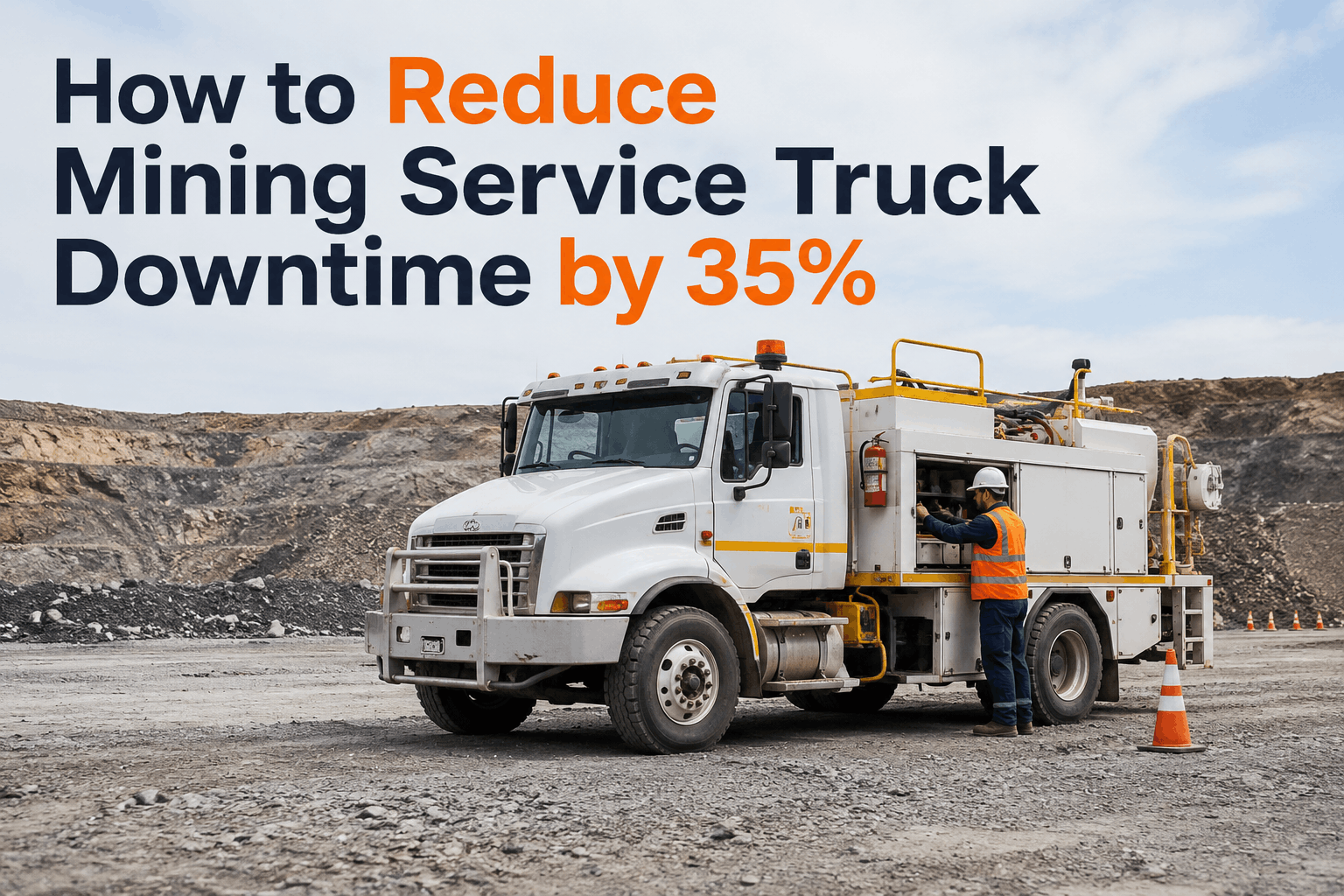
How to Reduce Mining Service Truck Downtime by 35%
Why Mining Service Truck Downtime Is Different
Mining operations subject service trucks to conditions that highway operations never produce, and the downtime cost structure cascades in ways unique to mine site operations. Understanding these factors explains why generic fleet maintenance approaches fail for mining.
Production Cascade Cost
Remote Location Logistics
Severe Duty Cycle
Heavy Loads & Specialized Equipment
Tire Economics
Safety-Critical Function
The 6 Mining-Specific Downtime Reduction Levers
Each lever addresses a specific mining service truck cost driver. Together they produce the documented 35% downtime reduction. Contact our sales team to evaluate which levers apply most to your operations.
Engine-Hour-Based PM Scheduling
SCHEDULING · 7-10% UPTIME GAINMine-Site Parts Staging
LOGISTICS · 8-12% UPTIME GAINPredictive Maintenance Program
PREDICTIVE · 8-10% UPTIME GAINField Maintenance Capability
PROCESS · 5-7% UPTIME GAINSpecialized Tire Program
TIRES · 4-6% UPTIME GAINOperator Training + Telematics
BEHAVIOR · 5-7% UPTIME GAINThe Per-Truck Downtime Math
What does a 35% downtime reduction actually save in dollar terms? The per-truck math shows why mining fleet uptime investments produce some of the highest ROI in commercial fleet management.
| Metric | Baseline | Optimized (35% reduction) | Per-Truck Recovery |
|---|---|---|---|
| Annual unscheduled downtime hours | 400-600 hrs | 260-390 hrs | — |
| Production cascade impact | $5,000-$15,000/hr | Same hourly rate | — |
| Annual cascade exposure | $2M-$9M | $1.3M-$5.85M | $700K-$3.15M |
| Tire failures avoided | 2-3/year baseline | 0.5-1/year optimized | $40K-$200K |
| Major repair events avoided | 1.5/year baseline | 0.4/year optimized | $30K-$120K |
| Parts run time saved | 15-20 events/year | 3-5 events/year | $50K-$180K |
| Total per-truck annual recovery | — | — | $820K-$3.65M |
Per-truck annual recovery of $820K-$3.65M applies primarily to high-cascade-impact service trucks (water trucks, fuel trucks, lube trucks supporting active production). Lower-cascade equipment (light-duty support vehicles, personnel carriers) sees per-truck recovery typically running $50K-$200K — still substantial. Apply across a typical 15-30 unit mining service fleet and total annual savings reach $5M-$50M+. The economics dwarf any other downtime reduction opportunity except pressure pumping operations — making structured mining uptime programs among the highest-ROI investments available in fleet operations.
The 90-Day Implementation Plan
Most mining service fleets can implement the 6-lever framework within 90 days. Remote operations require adjustments to standard deployment but the core timeline remains achievable.
Baseline & Engine-Hour PM Switch
Mine-Site Parts Staging Deployed
Oil Analysis & Tire Programs Active
Field Maintenance & Operator Scorecards
Uptime Metrics & Optimization
Frequently Asked Questions
Why are mining service trucks so expensive when they break down?
Three factors compound the cost. First, the service trucks themselves are major capital assets — water trucks $500K-$1M+, fuel trucks $400K-$800K, specialized lube trucks $300K-$700K. Second, the cascade impact when service trucks fail can be catastrophic — water truck failure halts dust suppression and stops haul road operations mine-wide, idling $20M-$100M of haul truck capacity. Fuel truck failure means $1M-$5M haul trucks sit idle waiting for fuel. The hourly cost cascades through the entire operation, commonly reaching $5,000-$15,000+ per hour. Third, remote location logistics extend repair times: parts from suppliers 100+ miles away take 24-72 hours minimum, specialty technicians may need to fly in, and field repairs can require helicoptering personnel and parts to remote pit locations. Add the safety implications when specific service trucks fail (water truck visibility, fuel truck grounding, explosives trucks under federal regulation), and mining service truck downtime becomes one of the most economically consequential equipment failure categories in industrial operations. Start your free trial for mining uptime programs.
Why doesn't standard fleet PM work for mining service trucks?
Standard fleet PM is calibrated for highway operation. Mining service trucks face conditions that highway operation never produces: 24/7 operation accumulating massive engine hours at relatively low mileage; dust loading 10-50× higher than highway operation plugging air filters and contaminating fluids; high-altitude operation (5,000-15,000+ feet at many mines) reducing air density and stressing engines; temperature extremes from desert heat to arctic cold; rough terrain accelerating suspension, brake, and tire wear; heavy loads cycling at GVW. Highway PM intervals dramatically under-service mining equipment — a truck running 15,000 miles per year at a mine might accumulate 6,000-8,000 engine hours while a highway truck at the same mileage logs 250-400 hours. Mining requires engine-hour-primary PM, intervals tightened 30-50% from OEM highway baselines, specific provisions for dust ingestion, and altitude-adjusted maintenance procedures. The platforms that win in mining are built with this severe-duty framework rather than retrofitting highway templates.
How important is parts staging for mining operations?
Parts staging is the single highest-leverage logistics improvement available in mining service truck operations. The math is dramatic: at $5,000-$15,000/hour cascade downtime cost, a single 48-hour parts wait costs $240K-$720K in downtime alone. Suppliers serving remote mine locations typically deliver in 24-72 hours minimum, often longer. Staged parts inventory at the mine site (filters, belts, hoses, common bearings, tire repair components, hydraulic seals, fluids, electrical components) reduces this to immediate availability. The staged inventory carrying cost — typically $50K-$200K depending on fleet size — is trivial compared to single avoided cascade event. Most mining operations should consider not just on-site staging but also redundant staging at the nearest supplier location and pre-positioned major components for the most critical service trucks. Partnership with primary suppliers for guaranteed-availability inventory programs typically produces 8-12% additional uptime improvement on top of the other 5 levers. Contact our sales team for parts staging coordination.
What's the economics of mining tire programs?
Mining tire economics are unique in commercial fleet management. Individual mining tires cost $20,000-$80,000 depending on size and application — mining haul truck tires (used on some larger service trucks) can exceed $80K each. Replacement is a major operation requiring specialized lifting equipment, trained crews, and 4-8 hours per tire. Single tire failure on a mining service truck commonly costs $30K-$100K in tire plus labor plus production downtime. Structured tire programs deliver substantial savings: tire pressure monitoring catches under-inflation that causes 40% faster wear; daily sidewall inspection catches damage before catastrophic failure; retread programs extend tire life 40-60% on appropriate applications; reserve inventory at mine site eliminates production-halting waits when tires fail; vendor partnerships with specialty mining tire suppliers (Bridgestone OTR, Michelin Mining, Goodyear OTR) provide emergency response capability and bulk pricing. Mining fleets that treat tires as a managed program rather than reactive purchases typically save 30-50% on total tire cost while reducing tire-related downtime 4-6%. Sign up free to track tire programs.
How does altitude affect mining service truck maintenance?
Many mines operate at significant altitude — copper mines in the Andes commonly at 12,000-15,000+ feet, US mines at 5,000-10,000 feet, others at 3,000-6,000 feet. Altitude affects truck operation in several specific ways. Reduced air density decreases engine power output (roughly 3% per 1,000 feet above sea level) and stresses turbochargers working harder to maintain output. Lower air pressure affects DPF regeneration efficiency in modern diesels, leading to more frequent forced regen and DPF cleaning. Cooling systems work less efficiently with thinner air, requiring more frequent radiator maintenance and possible cooling system upgrades. Engine controls (ECM) must be calibrated for altitude operations — OEM tuning for sea-level operation often produces poor performance and accelerated wear at high altitude. Maintenance adjustments: shorter air filter intervals due to dust + thin air ingestion, more frequent cooling system maintenance, altitude-calibrated ECM tuning, derated load capacity per manufacturer guidance, and operator training for high-altitude driving. Software platforms supporting mining must track altitude-specific intervals and maintenance procedures separately from highway baselines.
What's the realistic timeline for mining service truck uptime improvement?
Most mining service fleets see measurable uptime improvement within 30-60 days of deploying the 6-lever framework, with full 35% downtime reduction visible by month 4-6. Fastest improvements: engine-hour-based scheduling produces immediate impact as previously under-serviced equipment catches up on PM; mine-site parts staging produces immediate impact on repair logistics. Oil analysis takes 60-90 days to begin producing early-catch saves. Tire program improvements visible in 30-60 days through reduced failures. Operator coaching takes 60-90 days to change behavior measurably. Field maintenance capability requires 60-90 days to staff and equip. The compound effect builds: monthly uptime metrics typically improve 5-10% in month 1, 15-25% by month 3, and 30-40% by month 6. Production cascade impacts decrease measurably within the first quarter. Speed matters because every day of delay compounds downtime — a 60-day implementation delay on a 25-unit mining service fleet typically costs $5M-$20M in continued reactive downtime. Talk to our sales team to accelerate deployment.