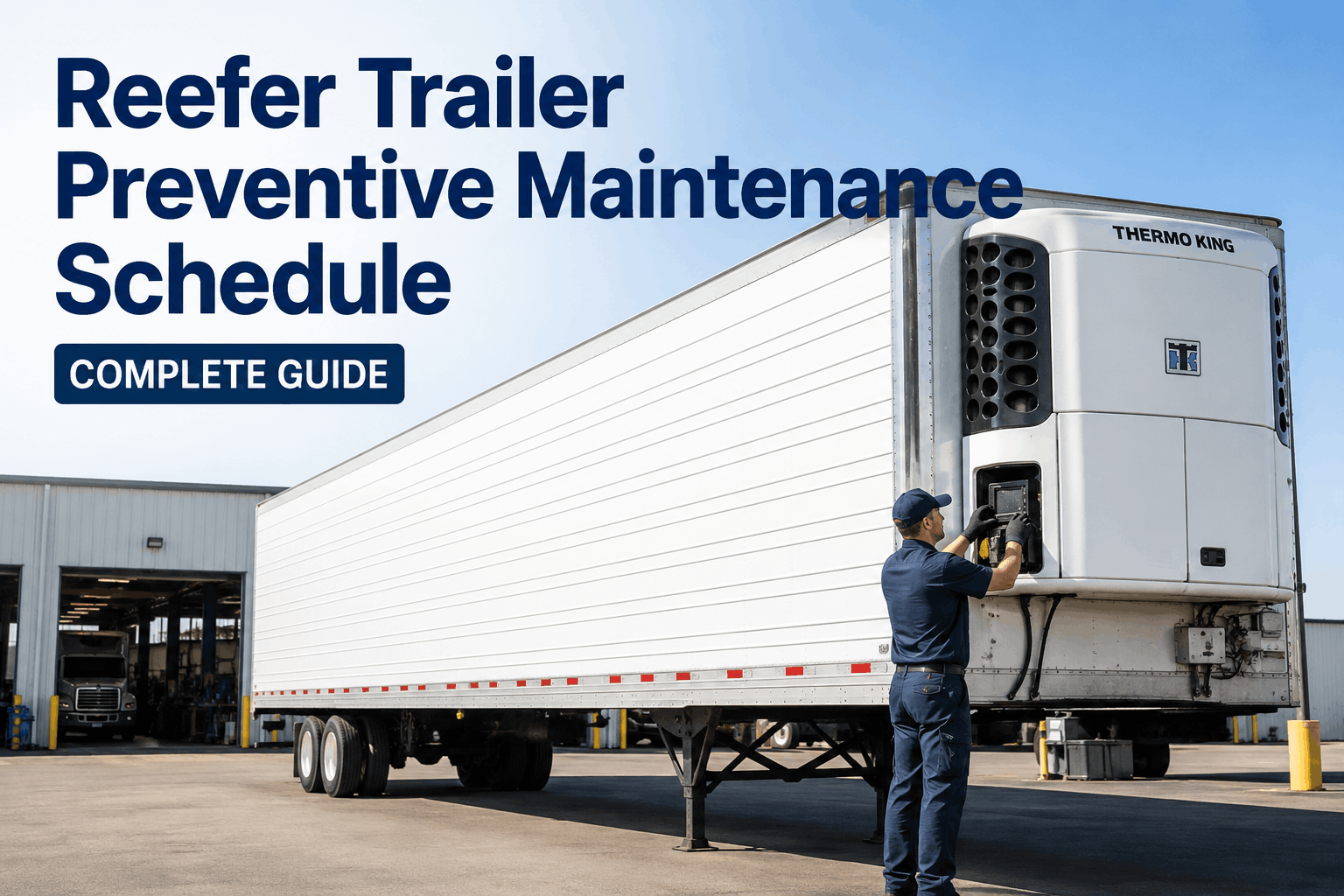
Reefer truck preventive maintenance differs from reefer trailer PM in ways that operations managers often discover only after deploying generic templates that don't fit. A reefer truck is a straight truck (Class 4-7 typically) with an integrated refrigerated body and truck-mounted TRU (Transport Refrigeration Unit) — built specifically for urban food distribution, restaurant supply, food service delivery, pharmaceutical distribution, and similar high-stop local operations. The operational profile produces wear patterns that long-haul reefer trailers never see: 10-30 stops per shift cycling doors continuously, dock-to-dock urban operation with high TRU runtime at idle, single-temp body designs serving food service customers, and routes that may never exceed 200-300 miles per day but accumulate massive TRU engine hours through continuous operation at delivery temperatures. The PM template that works for an over-the-road Carrier X4 Vector trailer unit running cross-country fails for a Thermo King T-Series mounted on a Hino 268 doing 25 restaurant stops per day in Chicago. The maintenance economics differ; the failure modes differ; the template must differ.
The 2026 regulatory and operational environment intensifies reefer truck PM importance. FDA's Food Safety Modernization Act Sanitary Transportation Rule (21 CFR Part 1, Subpart O) applies fully to local food distribution — requiring continuous temperature logs, sanitized interiors, and 12-month record retention regardless of route length. CARB regulations apply to reefer trucks crossing into California with 15% annual phase-out of diesel TRUs through 2029, refrigerant GWP cap at 2,200 driving the industry transition from R-404A to R-452A, and Tier 4 emission standards for MY 2023+ units. Sixteen additional states have committed to similar rules. Cargo loss economics: while reefer trucks carry smaller individual loads than 53' trailers ($25,000-$80,000 typical vs $50,000-$500,000 for trailer loads), the route economics multiply — a single truck running 25 deliveries per day delivers to 25 customers whose business depends on temperature integrity, with reputation and contract consequences extending far beyond the immediate cargo value. The template that protects these operations isn't optional.
This guide is the complete reefer truck preventive maintenance template for 2026: the 7-system PM framework, Thermo King and Carrier truck unit service intervals, FSMA and CARB compliance, and the digital workflow that protects cold chain integrity across high-stop urban operations. Start your free trial of our truck inspection and maintenance software to deploy reefer truck-specific maintenance workflow — live in 10 minutes, free for up to 3 trucks.
Reefer Truck Preventive Maintenance Schedule: Complete Guide
Why Reefer Truck PM Differs From Reefer Trailer PM
Operations managers commonly apply reefer trailer PM templates to reefer truck operations and produce predictable failures. Six factors make reefer truck PM operationally distinct.
High-Stop Operational Profile
Truck-Mounted TRU Differences
Integrated Body Construction
Urban Operation Wear Patterns
Continuous TRU Runtime
Per-Stop Cargo Economics
The 7-System Reefer Truck PM Template
Every reefer truck PM cycle covers these 7 systems. The depth varies by interval, but the systems don't. Contact our sales team for help deploying reefer truck-specific templates.
01 Truck-Mounted TRU
02 Refrigerant & Cooling
03 Air Flow System
04 Doors & Seals (HIGH CYCLE)
05 Floor & Body
06 Electrical & Microprocessor
07 Chassis DOT Compliance
Service Intervals — Daily to Annual
Reefer truck PM cadence runs on multi-trigger logic with three drivers: TRU engine hours (primary for truck operations), calendar (for time-degraded wear), and door cycle counts (unique to high-stop operations).
| Interval | Inspection Scope |
|---|---|
| Daily (pre-trip) | Pull-down test, fluid levels, fault codes, door seals visual, temperature display |
| Daily (DVIR) | Defects documented per §396.11 and FSMA records |
| Weekly | Belt tension visual, coil cleanliness, door seal closer inspection, sanitation |
| Monthly | TRU oil/filter (Carrier Pulsor ~1500 hrs by run-time); detailed door inspection |
| Quarterly | Comprehensive 7-system inspection, refrigerant leak test, software updates |
| Annual | Major service: refrigerant UV dye test, evaporator/condenser deep clean, full mechanical |
| Annual (§396.17) | DOT periodic inspection for interstate Class 4-7 vehicles |
TRU engine hours drive most reefer truck PM rather than truck mileage. A reefer truck running 200 miles per day in urban routes accumulates 12-14 TRU engine hours per shift. At 250 working days per year, that's 3,000-3,500 hours annually — easily triggering monthly oil service intervals on Carrier Pulsor units (~1,500 hour interval) even though the truck logs only 50,000 miles. Door cycle counts are a second important trigger unique to reefer trucks — 25 stops per day × 250 days = 6,250 door cycles annually, requiring monthly door seal inspection rather than the quarterly intervals appropriate for low-cycle trailer operations.
Thermo King vs Carrier Truck Units
Thermo King and Carrier dominate the truck unit market at 90%+ combined share. Service patterns, intervals, and parts ecosystems differ between brands.
| Attribute | Thermo King | Carrier Transicold |
|---|---|---|
| Current refrigerant | R-452A (standardized 2022) | R-452A (standardized 2022) |
| Truck unit models | T-Series, V-Series, B-Series | Pulsor, NEOS, Supra |
| A-service interval (typical) | 2,000-3,000 engine hours | ~1,500 engine hours |
| Electric standby | Available on most models | Available on most models |
| Telematics platform | TracKing | Lynx Fleet |
| Service network | Extensive dealer network | 200+ NA locations |
| Diagnostic tools | SR-2 / SR-3 software | APX / FaultRanger |
Published service intervals are starting points adjusted for actual duty cycle. High-stop urban operation accumulates engine hours faster than typical operation; extended idle at customer docks (common in food service delivery) increases oil oxidation and shortens effective intervals. Always pull data from unit's diagnostic system at PM service to verify hours accumulated versus interval target. Modern telematics platforms (TracKing for TK, Lynx Fleet for Carrier) push service alerts based on actual operating data rather than calendar estimates — meaningful improvement over manual tracking for high-utilization reefer truck operations.
FSMA & Cold Chain Compliance
Reefer trucks sit at the intersection of food safety, emissions, and DOT compliance regulations. Five frameworks apply to most reefer truck operations.
Sanitary Transportation Rule
TRU Phase-Out Rule
Refrigerant Service Certification
Annual Periodic Inspection
DVIR Documentation
Frequently Asked Questions
What's the difference between reefer truck and reefer trailer PM?
The differences are operationally significant. Reefer trucks are straight trucks (Class 4-7 typically) with integrated refrigerated bodies, used primarily for local urban food distribution, restaurant supply, and similar high-stop operations. Reefer trailers are pulled by tractors for over-the-road operation. The PM template differences: door cycles — reefer trucks see 10-30 daily door operations vs 1-2 for trailers, requiring monthly door seal inspection rather than quarterly; TRU models differ — Thermo King T-Series and Carrier Pulsor are truck units optimized for smaller capacity and electric standby, while Precedent and X4 are trailer units for long-haul; operational profile — reefer trucks accumulate massive TRU engine hours through continuous urban operation but limited mileage, while trailers see steady-state cross-country operation; body construction — truck bodies are integrated with chassis (Morgan, Supreme, Hackney builders) requiring different damage assessment than independent trailer bodies. Generic reefer PM templates designed for trailers fail when applied to trucks — they miss the high-cycle door wear, the urban operation considerations, and the truck-unit-specific TRU intervals. Start your free trial for reefer truck-specific templates.
How often should reefer truck PM happen?
Reefer truck PM follows a tiered schedule. Daily pre-trip: pull-down test, fluid levels, fault codes, door seal visual, temperature display verification. Weekly: belt tension, coil cleanliness, detailed door seal inspection (more frequent due to high cycling), interior sanitation. Monthly: TRU engine oil and filter service for high-utilization units. Carrier Pulsor service is typically every 1,500 engine hours which urban operations often hit monthly. Thermo King T-Series varies by model but 2,000-3,000 engine hours is common, also potentially monthly intervals for high-utilization operations. Quarterly: comprehensive 7-system inspection, refrigerant leak test with UV dye, software updates, sensor calibration. Annual: major service with refrigerant verification, deep cleaning, full mechanical, DOT annual periodic per §396.17 for interstate Class 4-7 vehicles. Critical principle: TRU engine hours drive reefer truck PM rather than truck mileage. A truck running 200 miles per day accumulating 12-14 TRU hours daily can hit monthly service intervals on Carrier units even at only 50,000 annual miles. Multi-trigger scheduling (hours + calendar + door cycles) catches what any single trigger misses.
What are the most common reefer truck failures?
Three failure categories dominate reefer truck downtime. (1) Door seal degradation — high-cycle door operation (10-30 cycles per day) wears gaskets faster than long-haul operations. Failed seals admit warm humid air that condenses on cold cargo surfaces, causes ice buildup on evaporator, increases TRU runtime, and produces FSMA temperature violations. Monthly seal inspection with light test catches developing wear. (2) Compressor failures — TRU compressors are the most expensive failure mode at $4,000-$10,000+ per replacement. Causes include refrigerant contamination from undetected leaks, oil starvation from skipped service, electrical faults, and overworking from compromised airflow (dirty coils, failed defrost, door seal leaks compounding compressor workload). Structured PM with refrigerant analysis and coil cleaning catches developing problems. (3) Microprocessor and electrical failures — controllers, sensors, wiring harnesses fail from vibration, moisture, age. Sensor calibration drift produces incorrect temperature readings and false alarms. Pull diagnostic codes at every PM. Other significant failures: belt failures (urban stop-start cycles stress drive belts), defrost circuit issues (heavy use in high-stop routes), and lift gate hydraulic failures where equipped. Contact our sales team for predictive maintenance integration.
Do small reefer trucks need DOT compliance?
It depends on weight, interstate operation, and other factors. Federal FMCSA regulations apply to commercial motor vehicles operating in interstate commerce above 10,001 lbs GVWR. Most Class 4-7 reefer trucks fall above this threshold — Class 4 is 14,001-16,000 lbs, Class 5 is 16,001-19,500 lbs, Class 6 is 19,501-26,000 lbs, Class 7 is 26,001-33,000 lbs. Reefer trucks operating in interstate commerce at these weights require DVIR (§396.11), annual periodic inspection (§396.17 with 14-month retention per §396.21), maintenance records (§396.3), and driver qualification files per Part 391 for CDL operations. Class 3 reefer trucks below 14,000 lbs and operations strictly intrastate may have different requirements based on state regulations. The CDL threshold is 26,001 lbs GVWR — many Class 4-6 reefer trucks operate with non-CDL drivers. FSMA Sanitary Transportation Rule applies regardless of weight or interstate status for vehicles transporting food. CARB applies to California operations regardless of size. The practical guidance: assume FMCSA applies unless specifically exempted, and assume FSMA always applies for food transport. Sign up free for compliance workflow.
How do I extend reefer truck service life?
Three practices extend reefer truck service life most effectively. (1) Strict adherence to TRU manufacturer service intervals on engine hours rather than calendar — most reefer truck premature failures trace to skipped TRU service when operations rely on mileage-based scheduling that under-services high-runtime units. Switch to engine-hours-primary PM with monthly oil/filter service for high-utilization units. (2) Disciplined door seal maintenance — door seals are the gateway failure that destroys cooling efficiency, increases compressor workload, and shortens TRU life. Monthly seal inspection with light test, immediate seal replacement when developing wear is observed, and operator training on proper door operation extend not just seal life but TRU life and refrigerant charge stability. (3) Proactive refrigerant management — annual UV dye leak testing catches developing refrigerant leaks before they produce compressor damage from low charge. Refrigerant contamination from undetected leaks is one of the leading causes of catastrophic compressor failure. Average reefer truck service life with structured PM extends from 8-10 years to 12-15 years — meaningful capital expense deferral on $50,000-$90,000+ replacement units. The economics overwhelmingly justify the additional PM investment.
What software do food distribution fleets use for reefer truck PM?
Food distribution fleets typically combine multiple software categories for reefer truck operations. Common stack: fleet management platform handling PM scheduling, DVIR, maintenance records; reefer telematics platform (Carrier Lynx Fleet, Thermo King TracKing, third-party Coretex or CalAmp) handling temperature monitoring and TRU diagnostics; ELD/HOS provider for CDL operations; routing and dispatch software for multi-stop optimization; customer portal for shipper visibility (increasingly required by major food shippers); accounting/billing systems. The fragmentation problem: running 4-6 disconnected systems creates data silos and audit prep complications. Modern integrated platforms reduce this by handling DVIR + PM + temperature monitoring + compliance on one workflow with API integrations to specialized tools. Selection considerations: validate engine-hour-based PM scheduling, door cycle tracking, FSMA temperature record retention, telematics integration with both major TRU manufacturers (mixed fleets are common), audit packet generation for FSMA inspections, and major food shipper portal compatibility (Sysco, US Foods, Performance Food Group, Aramark, Compass Group integration). Talk to our sales team for reefer truck platform fit.