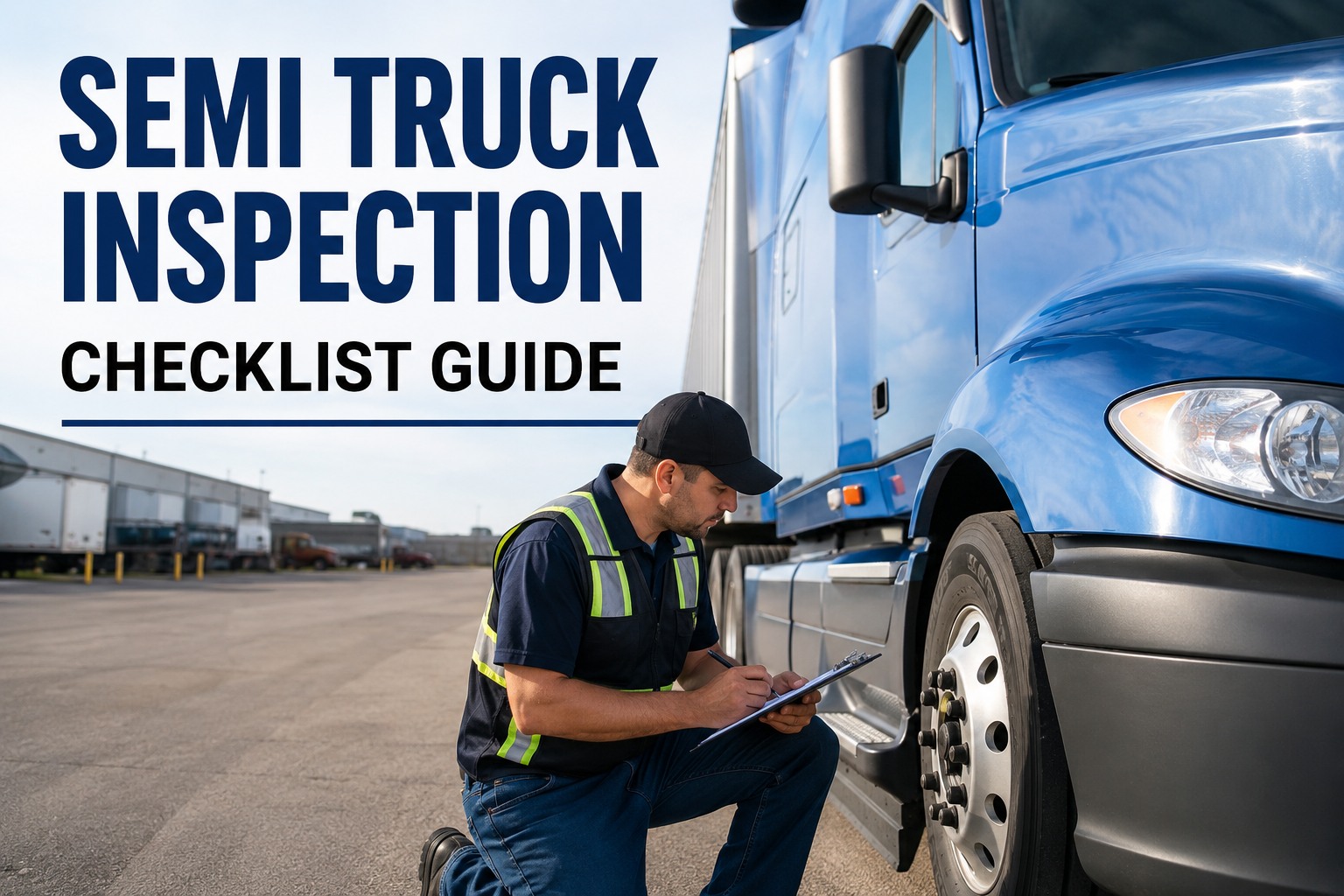
Semi trucks are the most inspected commercial vehicles on the road — and for good reason. According to the Bureau of Labor Statistics, drivers of heavy trucks and tractor-trailers experience fatal accidents at rates higher than nearly any other occupation, and the majority of preventable failures trace back to items on a standard pre-trip checklist. FMCSA regulations under 49 CFR 396.11 and 396.13 make daily inspections a personal legal obligation on every CDL Class A driver, not a suggestion — and a failed roadside inspection at a CVSA stop can drop your CSA score, put the truck out of service on the shoulder, and add points that raise insurance premiums for the next 24 months. Yet the biggest failures still happen where drivers rush the most: the coupling, the air brake test, and the trailer inspection that combination-vehicle drivers often treat as an afterthought. A proper semi truck inspection is a 7-zone systematic walkaround that catches those issues before the truck leaves the yard, protects your CSA score at every scale, and — critically — prevents fifth wheel jaw wear from becoming a runaway trailer event. This guide walks through every zone of the CDL Class A pre-trip inspection, the coupling procedure inspectors actually look for, the 7-step air brake test that trips up 30% of CDL applicants, DOT compliance essentials, and how Truck Inspection & Maintenance turns your semi inspection into a digital DVIR with photo evidence, GPS-tagged timestamps, and automatic defect routing — free forever for up to 3 vehicles.
Semi Truck Inspection Checklist: The Complete 2026 Guide
Every zone, every coupling test, every OOS criterion — the checklist that protects your CSA score and your CDL.
Why Semi Truck Inspections Are Different
Combination vehicles carry a different risk profile than straight trucks. Five specific areas need attention that other truck types don't touch at all — and these are exactly where CDL exams fail applicants and CVSA inspectors write violations:
Fifth Wheel & Kingpin
Primary load-bearing coupling. Jaw wear beyond 0.5–1.5mm tolerance = release under dynamic load = runaway trailer. Requires physical tug test.
Air Brake System
Dual-circuit tractor-trailer air brakes with governor cut-out at 120–140 PSI, low-air warning at 60 PSI, and 7-step test procedure required at every pre-trip.
Glad Hands & Electrical
Two air lines (service/emergency) plus 7-pin electrical connection between tractor and trailer. Failure at these joints = loss of trailer brakes or lights.
Landing Gear
Supports trailer weight when uncoupled. Bent, corroded, or damaged gear can collapse under load, dropping the trailer nose. Fully raised before dispatch.
Full Trailer Inspection
Separate inspection required — brakes, lights, ABS, tires, suspension, structure. Trailers underserviced show up in roadside violations more than any tractor issue.
The 7 Pre-Trip Zones — Systematic Walkaround
Do the same walkaround pattern every time. Zone 1 to Zone 7 in order, clockwise around the truck. Skipping order is where drivers miss items. Here's the visual map:
Full Pre-Trip Checklist by Zone
Every zone below has the specific items DOT inspectors check and CDL examiners test. Work through each in order, log each item, and photograph anything that needs shop attention:
The Coupling Tug Test — The Single Most Important Check
The tug test is the difference between "looks connected" and "actually connected." Multiple fleet fatality investigations trace back to fifth wheel jaws that visually appeared latched but released under dynamic load. Follow this exact procedure every time — no shortcuts:
Set Trailer Brakes
Trailer air supply valve pushed in (blue knob). Trailer brakes fully applied. Trailer must not roll under any condition.
Release Tractor Brakes
Tractor parking brake released (yellow knob out). Truck in low gear, ready to attempt movement.
Attempt Forward Motion
Slowly release clutch and apply throttle. Tractor should strain against locked trailer — engine loads, truck does not move.
Verify No Separation
If kingpin releases or coupling separates — OUT OF SERVICE. Do not drive. Recouple and re-test. Multiple failures = fifth wheel or kingpin service required.
Out-Of-Service (OOS) Criteria — Know Them Before The Roadside Stop
These are the specific violations that will put your truck out of service on the shoulder at a CVSA inspection. Every driver, safety manager, and dispatcher needs to know these — they're the difference between "keep rolling" and "sitting for hours waiting for repair":
Fifth wheel jaws not locked
Kingpin not properly engaged, missing or disconnected safety device, air line not connected or leaking at connection point.
Brake pushrod travel over spec
Any wheel with pushrod travel exceeding manufacturer's re-adjustment limit at 90–100 PSI application, or missing brake lining.
Tread below limits
Steer tires below 4/32", other tires below 2/32". Any tire with exposed cord, sidewall damage, or visible bulges.
Excessive steering play
Steering wheel free play greater than 10° (approximately 2 inches at wheel rim). Missing or loose steering components.
Required lights inoperative
Headlights, turn signals, brake lights, or tail lights not functioning. Required reflective tape or markings missing.
Air leaks or low pressure
Audible air leaks at any component, low-air warning failure to activate at 60 PSI, or governor cut-out outside 120–140 PSI range.
Every zone, every point, every OOS criterion — captured on your driver's phone
Truck Inspection & Maintenance replaces paper checklists with FMCSA-compliant digital DVIRs. Fifth wheel photo evidence, brake test data, GPS location, timestamp — all in under 5 minutes. Defects auto-routed to shop as priority work orders. 90-day retention automatic. Sign up free — no hardware, no contracts.
Preventive Maintenance Intervals — Beyond The Daily
Daily pre-trip catches immediate safety issues. Preventive maintenance catches the components that will fail next week if left alone. Here's the interval schedule that keeps a semi running past 1 million miles:
Pre-Trip & Post-Trip DVIR
Full 7-zone walkaround, air brake test, coupling verification. Post-trip captures anything that changed during the run — routes overnight to shop for morning fix.
Fluid & Belt Check
Engine oil condition, coolant level and clarity, battery terminal inspection, belt and hose visual inspection, tire pressure verification with calibrated gauge.
A Service (PM-A)
Oil and filter change, chassis lubrication (fifth wheel plate included), tire rotation, brake inspection with pushrod measurement, fifth wheel jaw wear gauge check.
B Service (PM-B)
Full A-service items plus fuel filter, air filter, transmission fluid check, DEF filter, coolant test, wheel bearing inspection, steering & suspension component inspection.
DOT Annual (49 CFR 396.17)
Comprehensive federal inspection by qualified inspector. Brake certification, air system full test, structural inspection, all safety systems verified. Certificate on file required.
Frequently Asked Questions
How long should a semi truck pre-trip inspection take?
A complete Class A pre-trip inspection takes 18–25 minutes done properly — including engine compartment, cab, tractor side, coupling, trailer, lights, and in-cab air brake test. Experienced drivers who know their routine can complete it in 15 minutes. New CDL applicants often take 30–45 minutes during their exam. Rushing is the #1 cause of missed defects — take the time, follow the same order every day, and log everything.
What's the tug test and why does it matter?
The tug test verifies the fifth wheel jaws are actually locked around the kingpin — not just visually appearing latched. Procedure: set trailer brakes, release tractor brakes, put in low gear, apply throttle. Tractor should strain against locked trailer without moving. If the kingpin releases or coupling separates, the truck is OOS immediately. Multiple documented fleet fatalities trace back to skipped tug tests — never bypass this step.
What's the minimum tread depth for semi truck tires?
Federal standards are 4/32" for steer tires and 2/32" for all other tires (drive, trailer, and dual positions). Below these limits puts the truck out of service at CVSA inspections. Best-practice fleets replace steer tires at 6/32" and drive/trailer at 4/32" to avoid OOS risk — that gives buffer against unexpected wear between inspections. Uneven wear patterns are usually alignment or suspension issues to diagnose separately.
What's the difference between OOS and citation violations?
OOS (Out-of-Service) violations require the vehicle to be taken off the road immediately until repaired — driver cannot continue the trip. Citation violations are written up but don't stop the truck from continuing. Both hit your CSA score, but OOS violations count for more points and stay on record for 24 months. Coupling failures, air brake issues, and tire violations most commonly result in OOS orders. Talk to our team about CSA score protection.
Do I need to inspect the trailer as thoroughly as the tractor?
Yes — and this is where fleets consistently lose points. Combination vehicle inspections require full trailer inspection including brakes, lights, ABS, tires, suspension, landing gear, and structure. Trailers are separately inspected during DOT reviews. Many fleets underinvest in trailer maintenance relative to tractors, which shows up in brake violations and lighting failures during roadside inspections. Treat trailer inspection with the same rigor as tractor inspection.
How does Truck Inspection & Maintenance handle semi truck inspections?
Truck Inspection & Maintenance delivers Class A-specific digital DVIR templates covering all 7 zones including coupling verification, air brake test capture, and separate trailer inspection. Every observation captured with photo evidence, GPS location, timestamp, and driver signature — fully FMCSA-compliant. Defects auto-route to the shop as priority work orders. Free forever for up to 3 vehicles. Sign up in 10 minutes to see it live.
Stop losing DVIRs in the cab. Protect your CSA score with tamper-proof digital inspections.
Every semi-specific inspection point — including fifth wheel tug test, air brake governor cut-out, coupling verification, and full trailer inspection — captured with photo evidence, GPS location, and timestamp. Defects auto-routed to your shop as priority work orders. 90-day retention automatic. Fully FMCSA-compliant. Free forever for up to 3 vehicles with no hardware and no contracts. Set it up in 10 minutes.