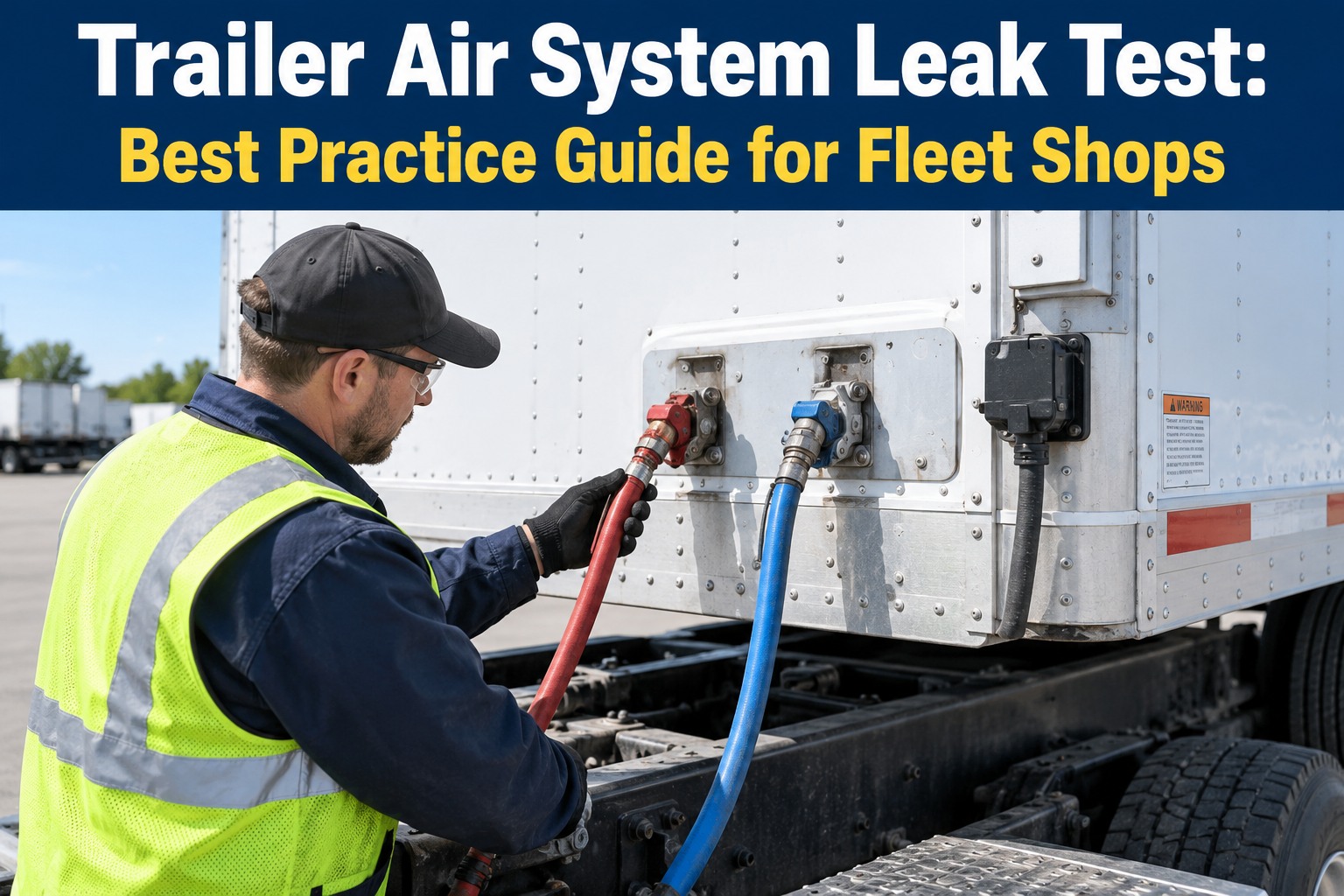
A trailer that loses 6 psi a minute doesn't announce itself. It sits in the yard looking fine, passes a glance, and then fails a roadside leakdown test — or worse, bleeds its reservoir overnight until the spring brakes lock a loaded trailer to the dock. Air leaks are the quiet killers of trailer uptime: they fail parking-brake tests, chew through glad-hand seals, and rack up § 393.45 audible-leak violations that never had to happen. This guide is the shop-floor procedure for finding them — the bench test that quantifies the leak, the four places it almost always hides, the pass/fail numbers that matter, and the 60-second version a hostler can run in the yard. Start a free trial and put a standardized air test in every tech's pocket.
The Trailer Air Leak Test, Done Shop-Right
Most trailer air leaks are found by a roadside inspector, not your shop. This guide flips that — a repeatable bench-test procedure, a leak-source map, and the exact psi limits, so leaks get caught in the bay where they're cheap to fix.
combination vehicle
Start Here: Why Trailer Leaks Slip Through
The trailer is the half of the combination that gets the least inspection attention — and its air system is the part drivers can least easily test on their own. That gap is where leaks live.
The Shop Bench Test — Step by Step
This is the repeatable procedure to run on a trailer in the bay. It isolates the trailer's own air system and gives you a hard psi-per-minute number instead of a guess. Run it the same way every time and the results become trendable.
Couple to a tractor or shop air source and build the trailer reservoir to governed pressure — a fully charged system typically sits around 120–125 psi. Let it stabilize completely before timing anything.
With the system charged and the trailer's spring brakes released, shut off the air source, wait out the initial drop, then time one full minute. On a combination the released loss should stay under 3 psi per minute.
Now fully apply the service brakes and hold. This pressurizes the chambers, diaphragms, and service-line side that were dormant before. Time one minute after the initial drop — combination limit is 4 psi per minute. A leak that only shows here points at the brake side.
If either test fails, spray a soapy-water solution across suspect points and watch for bubbles. This finds the small, hard-to-hear leaks a gauge told you exist but your ear can't locate — the single most useful trick on the bench.
Log the actual psi-per-minute for released and applied, plus where the leak was found and what was replaced. "Passed" is not a record; "2 psi released / 3 psi applied, glad-hand seal replaced" is.
Where the Leak Almost Always Is
When the gauge says you have a leak, four locations account for the overwhelming majority. Work them in this order — from most common to least — and you'll find it fast.
The rubber seal face abrades every coupling. Cracked, flattened, or contaminated seals leak steadily. Cheapest fix on the list — and the first place to spray soapy water.
Look for rubbing, cuts, chafe points, aging cracked hose, and loose fittings along both air lines. Vibration and flex slowly open these up over the trailer's life.
If the leak appears only on the applied test, listen at the chamber bodies. A ruptured diaphragm bleeds air whenever the brakes are set — and can cause uneven braking.
Relay valve, spring brake valve, and every threaded fitting. Follow the hiss to its source; a weeping valve or an under-torqued fitting is an easy miss and an easy fix.
Turn the Bench Test Into a Standard Every Tech Runs
Truck Inspection & Maintenance builds the air leak test into each trailer's digital PM — released and applied psi captured as real measurements, the leak location and repair logged with a photo, and a failed test routed straight to a work order. Results trend over time so a trailer creeping toward the limit gets flagged before the formal test date, and every record is DOT-audit ready. Dispatch, drivers, and the shop all see the same system.
The Yard Version: A 60-Second Hostler Check
The full bench test belongs in the shop, but you don't want a leaking trailer staged for dispatch in the first place. Here's the fast field version a hostler or driver can run at coupling — not a replacement for the shop test, but a catch upstream of it.
Frequently Asked Questions
Catch Air Leaks in the Bay, Not at the Scale
Truck Inspection & Maintenance gives dispatch, drivers, and the shop one system for inspections, preventive maintenance, and repair tracking — so the air leak test happens on schedule, the psi numbers get logged as measurements, failing trailers route straight to work orders, and no DOT record ever slips. Stop finding your leaks at roadside.