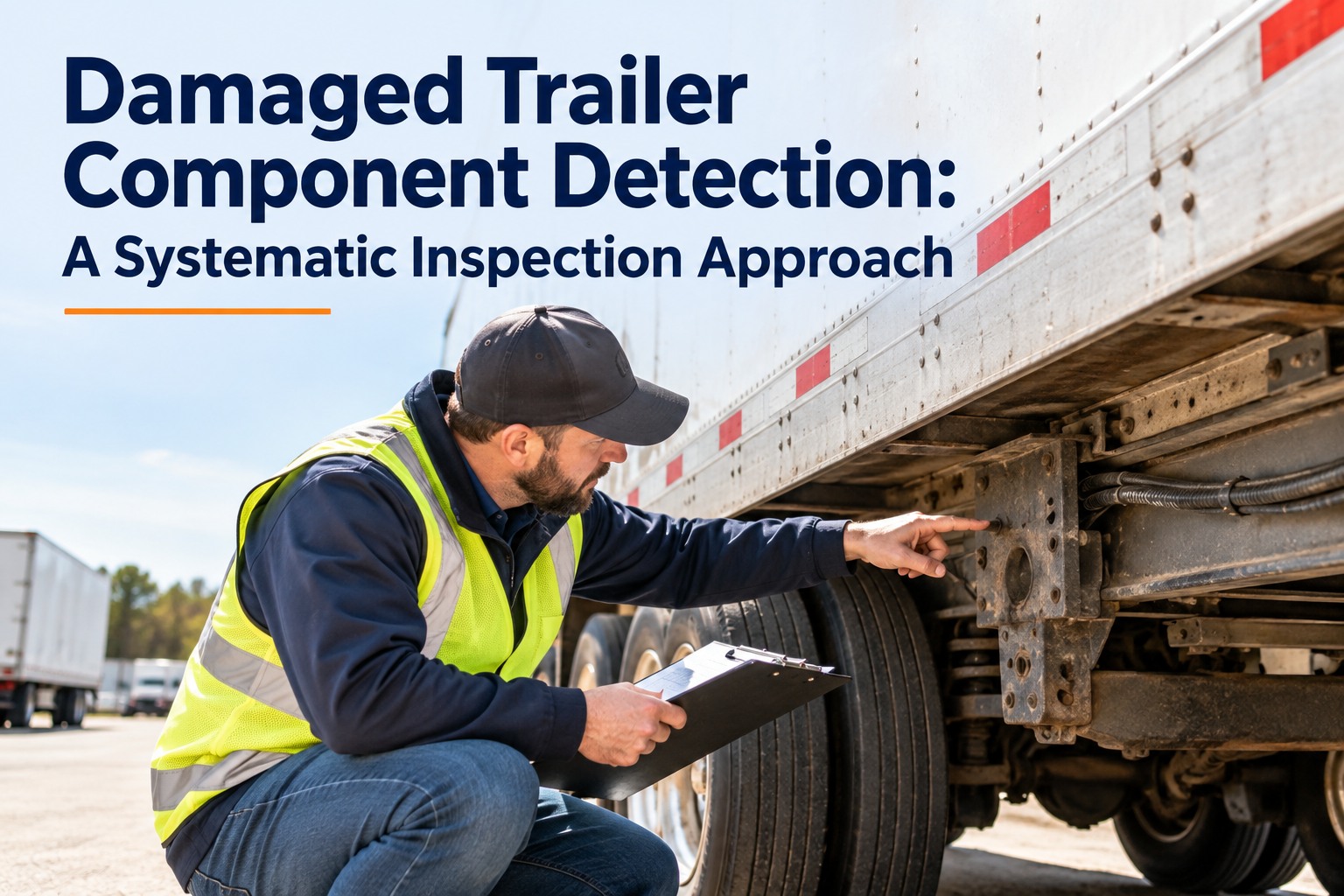
A cracked crossmember weld doesn't announce itself. The trailer tows straight, the load rides fine — until an inspector's flashlight finds it at a scale house and the unit is parked on the spot. Under 49 CFR 393.201(a), a cracked, loose, sagging, or broken frame is a condition violation, and a frame-related out-of-service order means the trailer gets towed, not driven to the shop. The gap between a $500 yard weld and a $2,000-plus roadside event comes down to whether anyone looked in the right place, in the right order, with a record to prove it. Here's the systematic detection approach that closes that gap. Start free and run every trailer through the same sequence with TIM.
A Cracked Crossmember You Never Saw Shouldn't Cost You a Towed Trailer
You want every frame, guard, and lighting defect found in the yard — not by an inspector at a scale house. TIM runs that loop end to end: a guided zone-by-zone DVIR captures the defect with a photo, grades it warning or out-of-service, and turns it into a tracked work order. Flag a structural or lighting defect and TIM guarantees a first response within 4 hours — acknowledged, graded, assigned.
Why Trailer Damage Gets Missed
Trailer components are easy to overlook for three reasons. Most of the damage lives underneath — frame rails, crossmembers, and body mounts are out of sight unless someone gets low. Structural cracks don't change how the trailer drives, so nothing prompts a second look. And lighting faults pass a static check, then fail in motion. A glance from the cab catches none of these — only a deliberate, repeatable sweep does, which is exactly what TIM enforces on every inspection.
The Trailer Body Map — Five Detection Zones
Systematic detection means dividing the trailer into fixed zones and sweeping each the same way every time — front to rear, left to right. TIM builds this map into the inspection form, walking the driver through all five zones in order and refusing to close until each is answered. Here's the map and the damage that hides in each zone.
Kingpin, upper coupler, front bolster, landing gear, and the front crossmember. This is where the trailer meets the tractor — the highest-load junction on the unit.
Both primary load-bearing rails, full length. Cracks most commonly start at crossmember weld joints and high-stress attachment points, then propagate under flex and torsion.
The lateral members tying the rails together and the floor they support. Weld joints here are the number-one origin point for frame cracks.
Rear impact guard (ICC bumper), rear frame, doors, hinges, and seals. The guard is a specific inspection item with its own attachment and geometry rules.
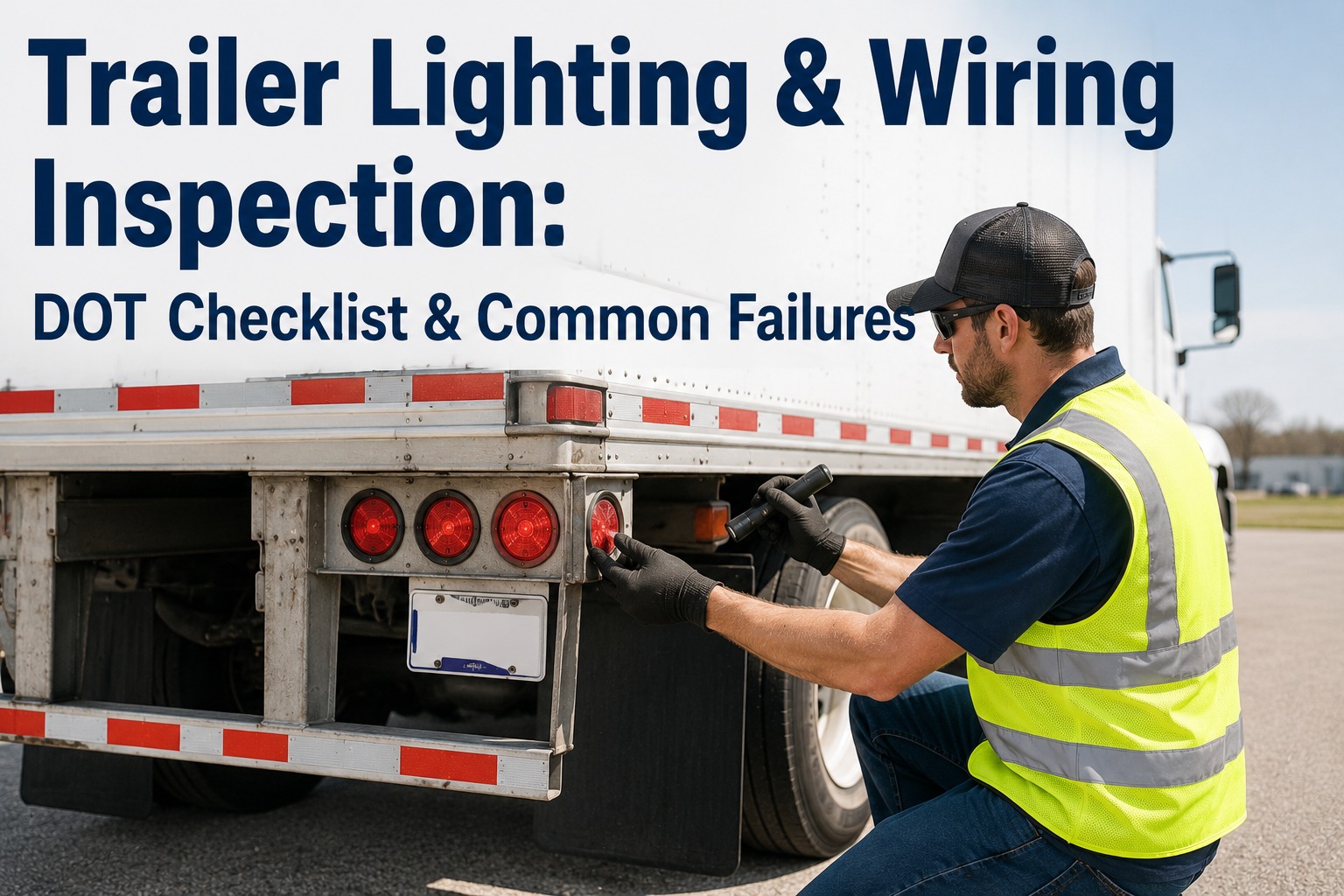
Every required lamp, reflector, and the harness that feeds them. The most-recorded roadside defect for years running — and one that hides intermittent faults.
Run the same five zones on every trailer and detection becomes a route, not a hunt. Contact our team to map these zones to your trailer types in TIM.
Damage Signatures — What Each Component Looks Like When It's Failing
Detection is pattern recognition. Each component has a signature — the early sign, and the point it crosses into a defect worth flagging. TIM attaches these prompts to each zone step, so the inspector knows what to look for and can photograph it against the unit number on the spot. Here are the four that cause the most out-of-service orders.
Warning vs. Out-of-Service — Where the Line Sits
Not every defect parks the trailer. Detection has to separate a warning-level finding (fix it soon, keep rolling) from an out-of-service condition (unit stops now) — the difference between a scheduled shop visit and a towed unit. TIM lets you set these thresholds inside the form, so the call is made the same way every time instead of in the field. Here's the working reference.
| Component | Warning-level | Out-of-service condition | Standard |
|---|---|---|---|
| Frame rail | Surface corrosion; minor pitting | Cracked, loose, sagging, or broken; crack reaching a flange | 393.201(a) |
| Frame flange | Cosmetic scuffing | Bent, cut, or notched between axles (not per manufacturer) | 393.201(c) |
| Body mounts | Surface rust on bracket | Securing bolts/brackets loose, broken, or missing | 393.201(b) |
| Rear impact guard | Light surface corrosion | Not securely attached; cracked welds/metal; broken or missing fasteners | 396 App. A |
| Required lamp | Cracked lens still showing correct color | Inoperative required lamp; missing lens; wrong color projected | 393.9 |
| Lamp hardware | Loose bracket | Missing hardware — the fastest inspector-side citation | 393.9 / 393.11 |
Reference thresholds drawn from FMCSA regulations and CVSA inspection practice. Inspectors assess a defect's location, geometry, and structural effect — a visible mark is not automatically a citation. Use as a detection guide, not a legal determination.
When your team knows where the line sits, they flag the right things and stop parking trailers that don't need it. Start free and build these thresholds into your inspection forms with TIM.
The Detection Workflow — From Sweep to Certified Record
Finding damage is only half the job — a defect that isn't documented, routed, and closed will reappear at a scale house. TIM runs the whole five-step loop as one connected flow, so nothing drops between steps the way it does with paper reports and separate spreadsheets.
TIM Runs the Whole Loop — Sweep, Capture, Classify, Route, Close
Truck Inspection & Maintenance Management Software turns the five-zone sweep into a guided digital DVIR. Every defect is photographed against a unit number, graded against your thresholds, and pushed straight into a work order — and every flagged structural or lighting defect gets a guaranteed first response within 4 hours, acknowledged, graded, and assigned. The damage you find stops being a note that gets lost and starts being a task that gets closed.
What Missed Damage Actually Costs
The economics make the case. The same frame crack costs a fraction to fix in the yard versus when an inspector finds it on the road — and a consistent, software-driven sweep with TIM is what moves the find from the second column to the first.
Frequently Asked Questions
Detect the Damage Before the Inspector Does
Every trailer that gets parked at a scale house had a defect that someone could have found first. A systematic, zone-by-zone detection approach — with clear thresholds and a documented trail — is what turns a $2,000 roadside event back into a $500 yard repair. TIM makes that approach the default for every trailer, every driver, every day.