A truck doesn't derate without warning — it warns for weeks and nobody's listening. Soot climbs past 50%, active regens start firing every few hundred miles, a fault code quietly blocks the next cycle, and then at 90% the ECM cuts power to a 5 mph crawl on a live highway. By then a $400 DPF cleaning has become a roadside breakdown and a possible $5,000+ SCR repair. The signal was in the data the whole time. Fleets that watch soot load, regen frequency, and aftertreatment fault codes report 40–60% fewer aftertreatment breakdowns than those that react. This guide breaks down how regeneration actually works, the warning signs that precede a derate, and how to catch them before a truck shuts down. Flag regen faults before they derate free.
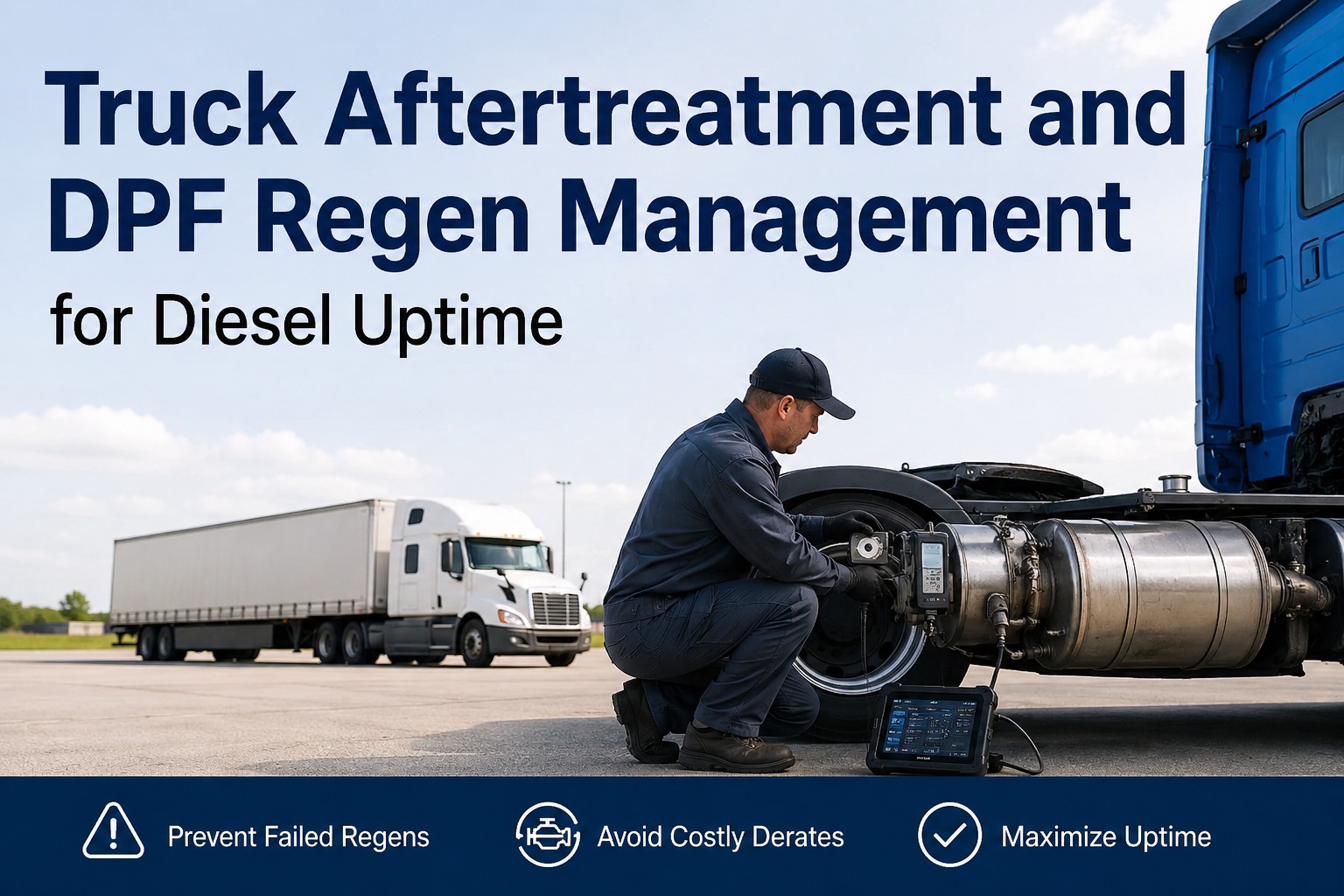
Truck Aftertreatment and DPF Regen Management for Diesel Uptime
Failed regens and clogged DPFs derate engines and kill uptime. Flag regen and aftertreatment faults early — so you fix them in the shop, not when a truck derates on the highway.
What Failed Regens Actually Cost
The DPF problem is sneaky because it's cheap to fix early and brutal to fix late. The same clogged filter is a routine cleaning at the right moment and a stranded truck plus a catalyst replacement at the wrong one. Here's the cost curve every fleet rides.
The Soot Load Ladder
Every DPF lives on a soot-load percentage, and the engine's behavior changes at known thresholds. Understanding the ladder tells you exactly how much runway you have before a derate — and where intervention is still cheap.
The Three Types of Regen
Not all regeneration is equal. The further down this list a truck operates, the worse its duty cycle or health — and the closer it is to a derate. The goal is to keep trucks in passive regen and out of the shop.
Happens on its own during sustained highway driving above ~50 mph. Soot burns off invisibly. This is the healthy state you want trucks in.
The ECU raises exhaust temperature to burn soot while driving — 20–40 minutes. Normal in moderation; frequent cycles signal a problem.
A stationary regen the truck requests at high soot load. Required when active regen can't keep up — the truck is out of service while it runs.
Catch the Climb Before the Derate
Truck Inspection & Maintenance tracks soot load, regen frequency, and aftertreatment fault codes per truck — flagging the unit climbing toward a derate while a cleaning still fixes it.
The Warning Signs That Precede a Derate
A derate is the end of a chain, not the start of one. Each of these signals appears before the ECM cuts power — and each is visible in the data or to the driver if someone is watching for it.
Regens firing far more often than every 200–400 miles means soot is loading faster than it's burning.
A regen that stops short — under 30 minutes — usually means the ECM found a fault and aborted the cycle.
Climbing differential pressure across the filter is a direct measure of restriction building up.
Codes like P1495, P1496, and P2463 halt regen entirely until the underlying issue is resolved.
The first dash warning — steady or flashing by severity. Ignoring it accelerates the climb to derate.
Unusual DEF use or quality faults point to an SCR problem that can cascade into a costly catalyst failure.
Why Trucks Clog: Duty Cycle and Habits
Most DPF failures aren't random — they trace to how a truck is driven and serviced. Three root causes account for the majority, and all three are manageable once you can see them.
Stop-and-go and low-speed work rarely reach passive-regen temperature, so soot piles up and active regens multiply. Watch these trucks closest.
Shutting the engine mid-regen is the number-one cause of clogging. Drivers must let every cycle finish — a training and accountability fix.
Worn injectors and wrong-spec oil spew soot and ash; off-spec DEF harms the SCR. Use API-certified fluids and the right low-ash oil.
Frequently Asked Questions
When soot load reaches roughly 90–100% and the truck can't complete regeneration — usually because active regens are failing or a fault code is blocking them — the ECM progressively cuts engine power to protect the aftertreatment system. Derates can limit power by 25%, 40%, or force a 5 mph crawl. It's the end of a warning chain that started with frequent active regens and rising backpressure.
Passive regen happens automatically during sustained highway driving when exhaust stays above ~600°F — soot burns off with no intervention. Active regen triggers around 70–80% soot load, with the ECU raising exhaust temps to 1,000–1,200°F for 20–40 minutes while driving. Parked or forced regen is a stationary cycle a technician runs when soot is too high for active regen to handle — the truck is out of service while it completes.
Frequent regens usually point to duty cycle or health. Short trips and low-speed work never reach passive-regen temperature, so soot accumulates and active regens multiply. Worn injectors or bad fuel add excess soot, and a filter loaded with ash (which never burns off) will keep requesting regens until it's professionally cleaned. If regens are constant, the truck is telling you something needs attention.
Repeatedly shutting the engine off mid-regen is the number-one cause of DPF clogging and eventual failure. Each interrupted cycle leaves soot behind, accelerating the climb toward derate and forced regen. Drivers should always let a regeneration finish — it's one of the cheapest, highest-impact habits for protecting the aftertreatment system and avoiding a five-figure repair.
By watching the warning chain instead of waiting for the derate. Truck Inspection & Maintenance tracks soot load, regen frequency, backpressure trends, and aftertreatment fault codes per truck, flags units climbing toward a derate, and ties DPF cleaning intervals to mileage and ash accumulation. Fleets using this proactive approach report 40–60% fewer aftertreatment-related roadside breakdowns than reactive ones.
Stop Derates Before They Start
Truck Inspection & Maintenance watches soot load, regen frequency, and aftertreatment fault codes on every truck, flags the units climbing toward a derate, and schedules DPF service while it's still a cleaning — so a $400 fix never becomes a $5,000 breakdown on the highway.