Truck idling is the most recoverable cost in fleet operations — because reducing it requires zero capital investment in most cases. A single Class-8 truck idling for just one hour burns approximately 0.8 gallons of diesel according to the US Department of Energy. At 2026's average diesel price of $4.15 per gallon, that's $1.82 per hour of fuel walking out the exhaust pipe per truck, generating zero productive miles. Multiply across a 100-vehicle fleet running typical 2,000+ idle hours per year, and the math hits $580,000 to $830,000 in pure fuel waste annually — money that's already being spent, just on nothing. Industry data attributes 8-15% of total engine runtime to idling, with overnight rest-period idling alone wasting $4,000 to $6,000 per truck per year. The Argonne National Laboratory estimates industry-wide idling consumes up to one billion gallons of fuel annually at roughly $5 billion in fuel loss.
The reassuring news: fleets implementing structured idle reduction programs achieve 22-35% reductions in idle time within the first quarter — and in some real-world cases, 71% reductions within weeks. One 18-truck regional fleet documented an 11-day ROI on idle monitoring software (idle dropped from 48 minutes to 14 minutes average per vehicle per day, saving $17,900 against $540 in platform cost). Beyond fuel, idle time accelerates engine wear at roughly 1 hour idle = 175 miles of operational wear, triggers EPA-tightened DPF regeneration cycles, and exposes fleets to anti-idling violation fines in the 31 US states plus DC where idling laws are now actively enforced — with penalties up to $25,000 per violation. The strategies that recover the most fuel waste cost almost nothing to implement.
This guide breaks down the complete idle reduction playbook for 2026: the true cost of idling, the 9 proven reduction strategies, the technology stack (APUs, eAPUs, shore power), the state-by-state regulatory landscape, and the driver behavior framework that delivers sustained savings. Start your free trial of our truck inspection and maintenance software to deploy idle tracking alongside your existing PM and inspection workflows — live in 10 minutes, free for up to 3 trucks.
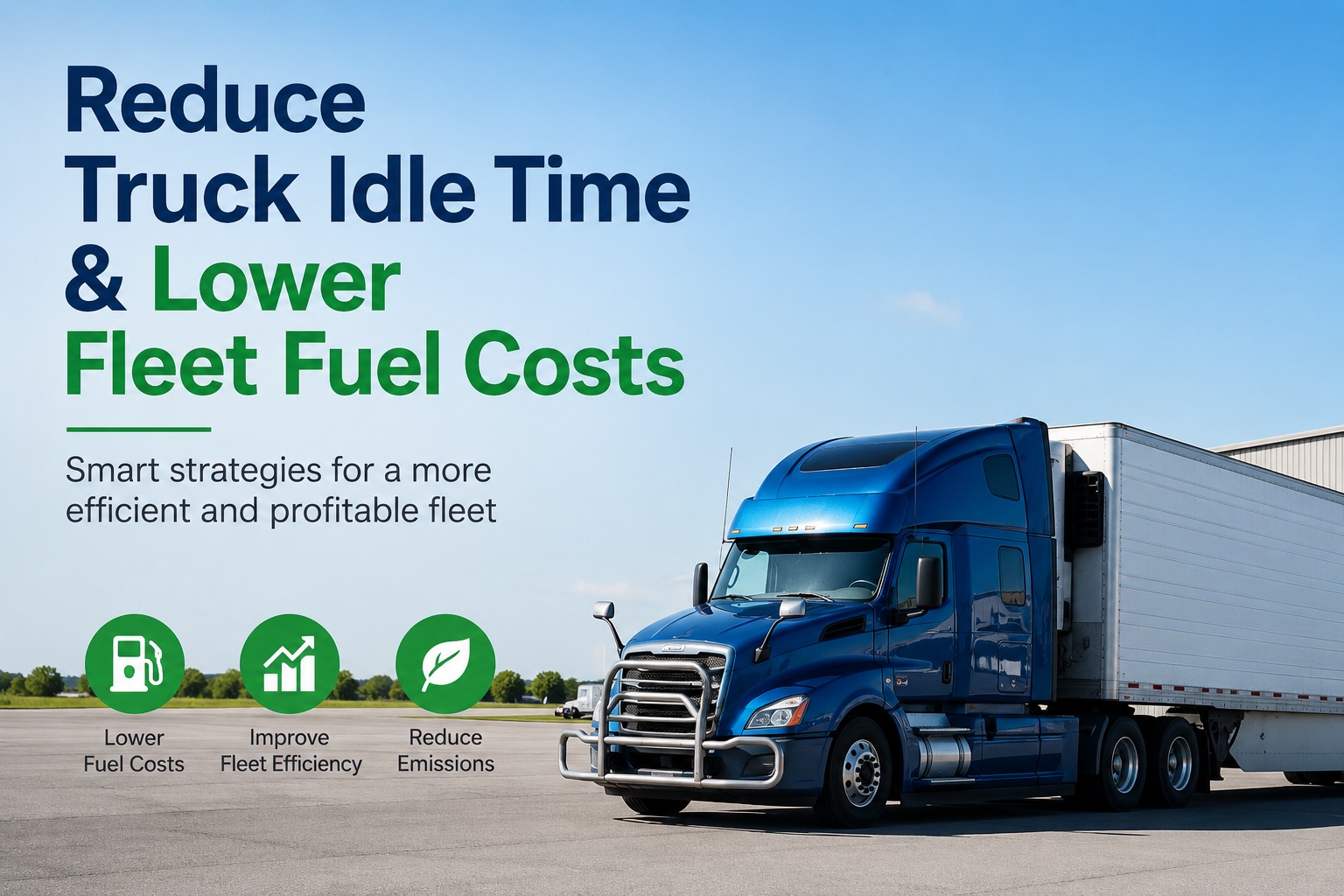
How to Reduce Truck Idle Time and Save on Fuel Costs
$4,000-$6,000 wasted per truck per year on idling alone. 0.8 gallons/hour burned producing zero miles. 31 states enforcing anti-idling laws. The complete 2026 playbook — 9 proven strategies, the technology stack, driver coaching, and the policies that deliver 22-71% idle reduction.
Quick Answer: How to Reduce Truck Idle Time
Reducing truck idle time requires a 4-layer strategy: (1) measurement — telematics-based idle tracking with driver/location/duration attribution; (2) policy — written anti-idling rules with context-specific time limits (5 min loading, 3 min traffic, APU-mandate rest periods); (3) technology — automatic engine shutoff timers, diesel or electric APUs, shore power infrastructure at terminals; and (4) driver coaching — weekly scorecards with idle time as a weighted performance metric, gamification with rewards, and transparency about the $1.82/hour cost per driver. Structured programs deliver 22-35% idle reductions on average, with documented real-world cases achieving 71% reductions. ROI on idle monitoring software is typically days to weeks; diesel APU payback runs 12-24 months; shore power infrastructure pays back in under 12 months. Idling costs $4,000-$6,000 per truck per year in fuel alone, accelerates engine wear at 1 idle hour = 175 driven miles, and exposes fleets to anti-idling fines up to $25,000 in the 31 US states actively enforcing such laws.
The Real Cost of Truck Idling — Beyond the Fuel
Fleet managers who calculate idle cost only in fuel are underestimating the total damage by roughly 40%. Here's the full cost breakdown that emerges when every category gets counted properly.
For a 100-truck fleet running typical idle patterns: $400,000-$600,000 per year — recoverable without buying new trucks, opening new lanes, or hiring new drivers. Pure operational margin recovery.
The 9 Proven Idle Reduction Strategies
These nine strategies work together as a system. Strategies #1-3 cost almost nothing to implement and deliver fast wins. Strategies #4-9 layer on for compounding gains. Contact our sales team to map your operation against the 9-strategy framework.
Anti-Idling Technology Stack — Comparison
Four technology approaches dominate idle reduction in 2026. Each fits a different operational profile. Most fleets deploy a layered combination rather than betting on a single solution.
| Technology | Capital Cost | Annual Savings | Payback | Best For |
|---|---|---|---|---|
| Telematics Idle Tracking | $0-$200/truck | $1,000-$3,000 | Days-weeks | All fleets — baseline |
| Automatic Engine Shutoff | $50-$200/truck | $1,500-$3,000 | 30 days | Day-cab + regional |
| Diesel APU | $8,000-$12,000 | $2,500-$4,000 | 12-24 months | Long-haul sleepers |
| Electric APU (eAPU) | $5,000-$10,000 | $3,000-$5,000 | 18-30 months | Sun Belt + green fleets |
| Shore Power (eTPS) | $3,000-$5,000/space | $2,000-$3,500/truck served | < 12 months | Terminal-based ops |
| TSE Truck-Stop Plugs | $0 (per-use fee) | 60-80% vs idle | Per stop | Long-haul rest stops |
The 2026 Anti-Idling Regulatory Landscape
Anti-idling laws are no longer a niche concern — 31 US states plus the District of Columbia now actively enforce idle restrictions, with penalties ranging from $100 to $25,000 depending on jurisdiction and repeat-offense status. Fleet managers should track three regulatory tracks.
The 4-Layer Driver Coaching Framework
Driver behavior is where 60-70% of idle reduction actually happens. Technology measures and enforces, but driver habits determine outcomes. This framework consistently produces sustained behavior change.
Frequently Asked Questions
A Class-8 diesel truck burns approximately 0.8 gallons per hour while idling according to US DOE data — at 2026's average diesel price of $4.15/gallon, that's $1.82 per hour of pure fuel waste per truck. Annual cost per truck runs $1,900-$4,200 in typical fleet operations, climbing to $4,000-$6,000 when overnight rest-period idling is included. Beyond fuel: idle accelerates engine wear at roughly 1 idle hour = 175 driven miles, triggers DPF regeneration premium ($600-$2,000/year), and exposes fleets to anti-idling fines up to $25,000 in 31 US states. For a 100-truck fleet, the full annual cost typically runs $400,000-$600,000+ — recoverable without capital investment. Start your free trial to model your fleet's specific idle cost.
Industry data shows fleets implementing structured idle reduction programs achieve 22-35% reductions on average within the first quarter. Best-case documented results reach 71% reduction (one 18-truck regional fleet dropped average daily idle from 48 minutes to 14 minutes per vehicle in weeks). The remaining "necessary" idle includes: required warm-up cycles, mechanical operations like power-take-off use, traffic-related stops under 3-5 minutes, and HOS-mandated rest where APU/shore power isn't available. Modern idle tracking software distinguishes avoidable from necessary idling using location, time, temperature, and duration context — driver scorecards penalize only the avoidable category.
Diesel APUs deliver clear ROI for sleeper truck fleets idling more than 1,000 hours per year — typical install runs $8,000-$12,000 with $2,500-$4,000 annual fuel savings (75% less fuel than main engine idle), generating 12-24 month payback in most operations. NACFE's 2024 fuel study found 14% of fleets currently use diesel APUs. For day-cab fleets or operations with extensive terminal time, electric APUs ($5K-$10K install) or shore power infrastructure ($3K-$5K/space) typically deliver better ROI. Critical caveat: APUs require dedicated PM ($300-$600/year) — fleets that don't maintain them rigorously see ROI evaporate. Contact our sales team for help configuring APU PM schedules alongside truck maintenance.
The strictest anti-idling jurisdictions in 2026 are: California (5-minute limit, $300+ fines, CARB enforcement), New Jersey (3-minute limit, $250-$1,500 fines), New York City ($350-$2,000 fines), Connecticut (3-minute limit), Massachusetts (5-minute limit), and the District of Columbia. Most other states with anti-idling laws set 10-minute limits with $100-$500 fines for first offenses. Exceptions exist for extreme temperature operations, defrosting, mechanical operations, and sleeper-berth rest. Repeat offenders face escalating penalties — up to $25,000 in the most aggressive jurisdictions. Fleets routing through CA, NJ, NY, CT, MA should prioritize TSE-equipped truck stops to eliminate compliance exposure.
The 4-layer driver coaching framework consistently produces sustained results: (1) Transparency — show drivers their individual idle cost in actual dollars ("$86 of fuel waste last month"); (2) Context-specific rules — different limits for different scenarios rather than blanket mandates; (3) Comfort alternatives first — ensure APU access, shore power, or TSE locations are available before enforcing strict policies; (4) Positive reinforcement — leaderboards, low-idle bonuses, gamification. Drivers who understand they personally generate the cost respond faster than drivers given abstract mandates. Real-world deployments show 60-70% of idle reduction comes from behavior change, not technology. Sign up free to deploy driver scorecards with idle KPIs.
Idle tracking software typically delivers ROI within days to weeks — one documented 18-truck fleet hit 11-day payback ($17,900 saved against $540 platform cost). Automatic engine shutoff timers pay back in 30 days. Driver scorecard programs show measurable reduction within the first month of weekly publication. Diesel APUs take 12-24 months for capital payback. Shore power infrastructure pays back in under 12 months for terminal-based operations. Idle reduction is unique among fleet investments because the bulk of savings come from $0-capital strategies (measurement, policy, scorecards) — meaning fleets can capture 60%+ of the available savings before investing in any equipment.
Stop Burning $4,000-$6,000 Per Truck on Idle Time
500+ fleets deploy idle tracking alongside PM scheduling, DVIRs, work orders, parts inventory, and driver scorecards on our truck inspection and maintenance software. The fastest-ROI investment in fleet operations — measurable savings within 30 days, no capital required. Pure operational margin recovery.