Your telematics already catches fault codes the instant an ECU throws them. That's not the problem. The problem is the code that fires, gets glanced at, and gets ignored — then fires again next week, and the week after, until the intermittent misfire becomes a cracked catalyst and a $6,000 tow. Real-time alerts detect. They don't decide. The weekly fault code review meeting is the 30-minute governance ritual that turns a stream of alerts into decisions: what gets fixed now, what gets scheduled, what gets watched, and which chronic code has been quietly recurring for a month. This guide gives you the exact agenda, the reporting pack, and the roles that make it work. Start a free trial and generate the review pack automatically each week.
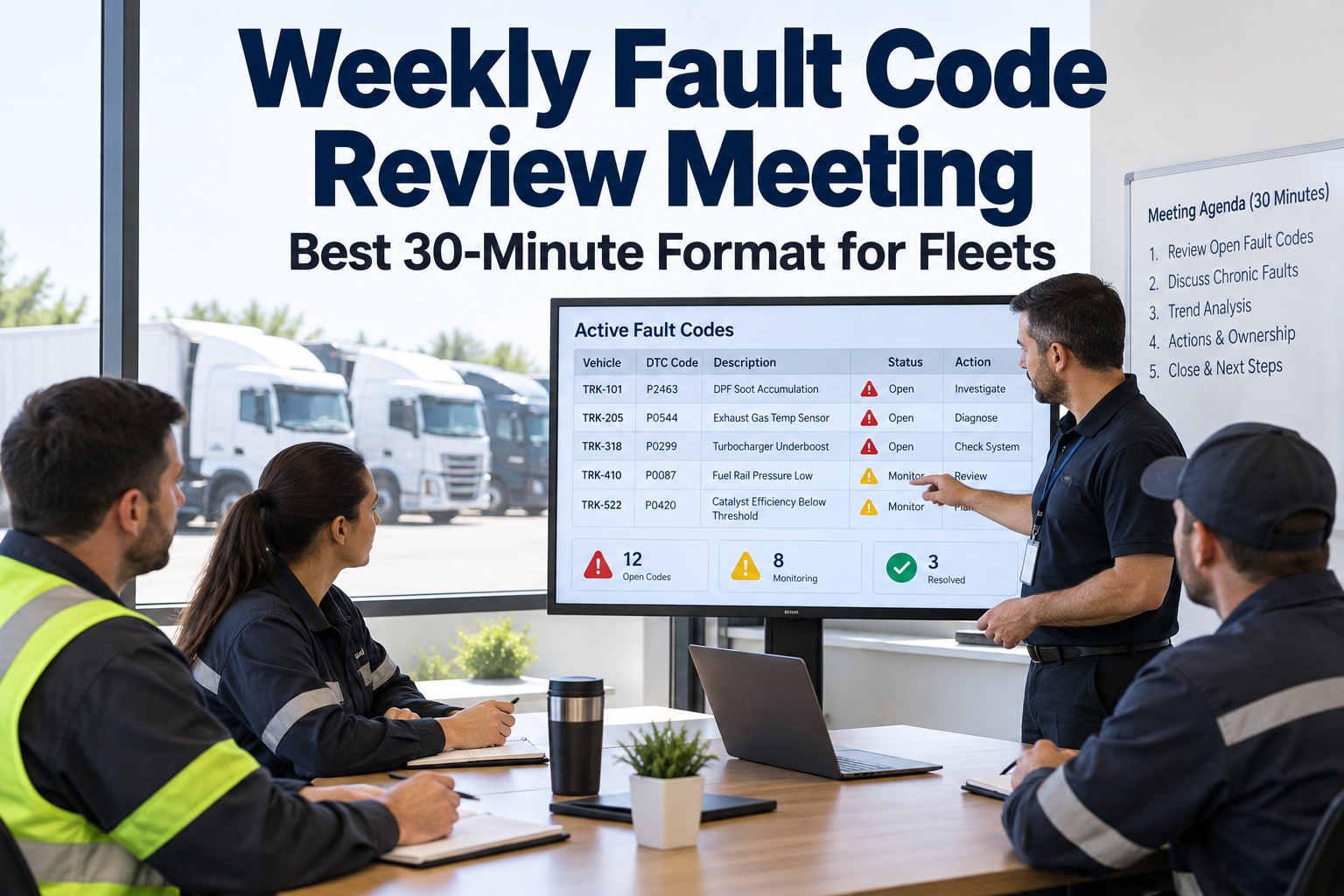
The 30-Minute Weekly Fault Code Review
Detection is automated. Judgment isn't. A tight weekly meeting is where chronic codes get caught before they become chronic breakdowns — a fixed agenda, a standard reporting pack, and clear owners. Here's the format top fleets run.
Why a Meeting, When Alerts Are Already Automated?
Every fleet manager's first reaction: I already get real-time fault alerts — why do I need a meeting? Because alerts answer "what fired?" A weekly review answers the three questions alerts never do.
A J1939 code carries an occurrence count. One misfire is noise; the same SPN firing for the fifth straight week is a chronic fault hiding in the alert stream. Only a trend review across the week surfaces it.
An unread alert is a decision by default — the decision to ignore. The meeting forces a call on every open code: fix now, schedule, or monitor. Nothing sits in limbo.
A code cleared in the shop that reappears three days later means the repair missed the root cause. Without a weekly loop, that reappearance blends back into the noise instead of reopening the case.
The 30-Minute Agenda, Minute by Minute
The whole point is speed. This is a standing 30-minute meeting with a fixed structure — same segments, same order, every week. Discipline on the clock is what keeps people showing up.
Open with the week's numbers: total active codes, how many critical, how many new vs. carried over, and the trend line vs. last week. Sets the temperature in one glance — no discussion yet.
Walk every Critical (stop-now) and Urgent (service-within-48-hrs) code. For each: truck, code, probable cause, and the decision — already in the shop, or assigned an owner and a date right here in the room.
The heart of the meeting. Any code with a rising occurrence count or a repeat across weeks gets pulled up. This is where the money hides — the "minor" code nobody escalated that's been trending toward a major failure.
Quick pass on codes closed since the last meeting. Cleared and stayed clear? Case closed. Reappeared? Reopen it as a root-cause miss and re-assign — don't let it re-enter the stream unowned.
Confirm every action has an owner and a due date. One-line recap sent to the group. Meeting ends on time — the follow-through lives in the work orders, not in the meeting.
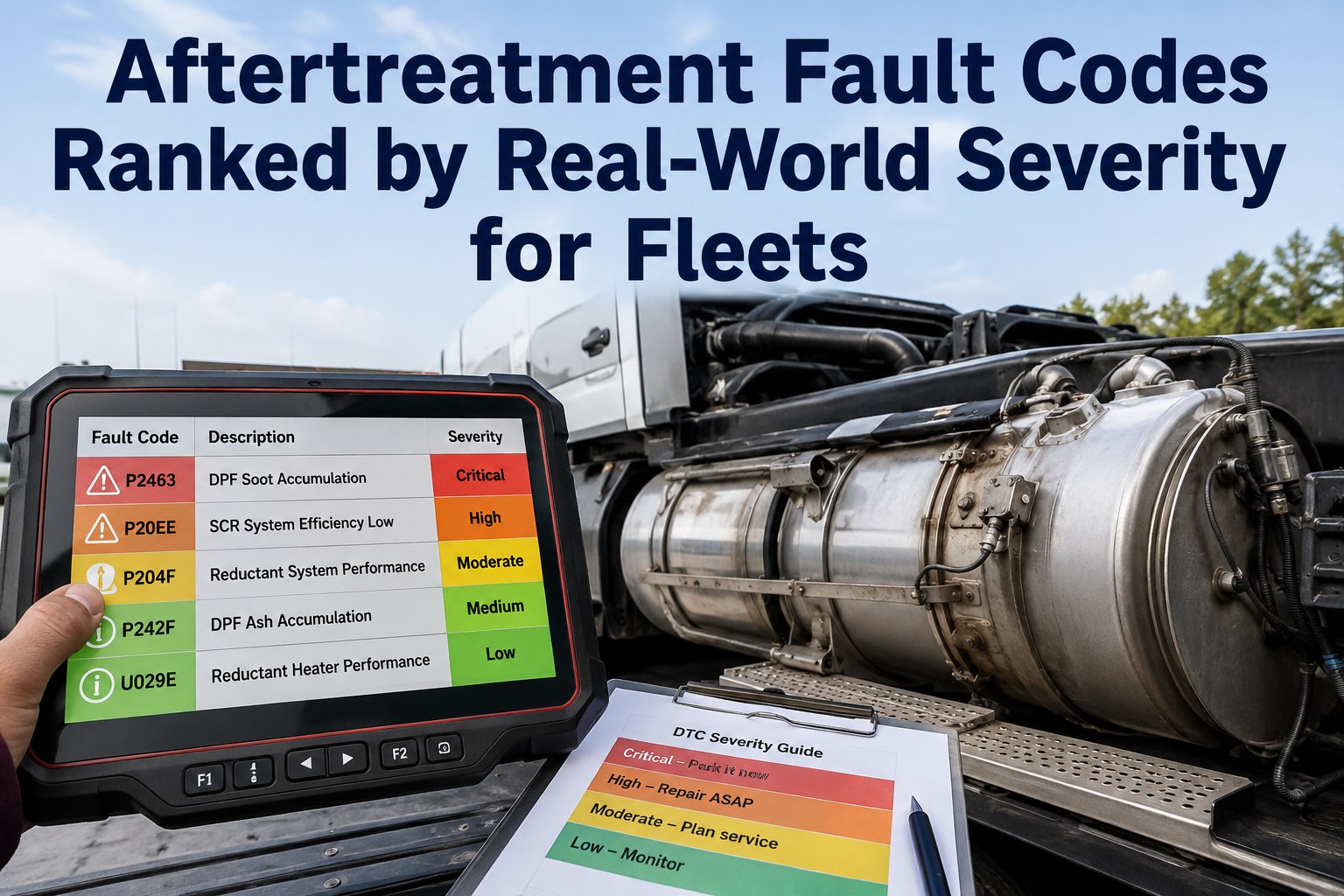
The Severity Framework That Sorts Every Code
You can't review a hundred codes in 30 minutes — and you don't need to. A severity framework sorts them automatically, so the meeting only touches the ones that need a human decision.
Overheating, low oil pressure, severe misfire — damage or safety risk. Truck comes off the road immediately; reviewed to confirm, not to decide.
Real fault, not yet dangerous. Gets an owner and a date in the meeting so it lands in the next available shop slot, not next month.
Rolled into the next regular PM window. Tracked so it doesn't get forgotten — and watched for a rising occurrence count that would escalate it.
Emissions minor, transient sensor blips. No action unless it recurs — the occurrence count is what promotes it up the ladder.
Let the Software Build Your Review Pack
Truck Inspection & Maintenance captures every fault code from your fleet, scores it by severity, and tracks occurrence counts across weeks — so your review pack builds itself. Walk into the meeting with the scorecard, the critical list, and the chronic-code trend already assembled. Assign an owner in the room and it becomes a digital work order on the spot, with the whole loop audit-ready.
Who's in the Room
Five people, clear lanes. Keep it small — a fault code meeting that turns into an all-hands loses its speed and its edge.
Chairs it, owns the clock, makes the final call on any code where fix-now vs. schedule is a judgment.
Reads probable cause and repair difficulty, flags which "minor" codes they know from experience turn into big jobs.
Confirms parts availability and shop capacity so assigned dates are real, not aspirational.
Says which trucks can come off the road when, so repair timing fits the run schedule instead of fighting it.
Frequently Asked Questions
Critical codes should never wait for the meeting — those get actioned the moment they fire. The weekly review isn't for the obvious emergencies; it's for everything below Critical that quietly accumulates: the moderate code climbing in occurrence count, the "informational" blip that's now appeared six times, the repair that didn't hold. Those are exactly the faults that never feel urgent enough to act on in the moment and then become the expensive failure. The meeting is the forcing function for the codes real-time urgency alone won't catch. Start free and see the chronic-code trend surface on its own.
Four things, one page each: a scorecard (total active codes, count by severity, new vs. carried over, week-over-week trend); the critical & urgent list with truck, code, probable cause, and status; the chronic/recurring view sorted by occurrence count and weeks-active; and the verification list of codes closed since last meeting with whether they stayed clear. If your maintenance platform captures and scores codes automatically, this pack generates itself — no one spends Thursday night in a spreadsheet building it by hand.
The J1939 standard makes this easy: alongside the SPN (which component) and FMI (how it failed), heavy-duty codes carry an occurrence count that tracks how many times the fault has triggered. A rising occurrence count on the same SPN, or the same code reappearing across multiple weekly reviews, is the signature of a chronic fault. That's why the meeting is weekly and why occurrence count is the metric that promotes a code up the severity ladder — a "moderate" code firing every single day isn't moderate anymore.
Yes, and it's arguably more valuable when you're small, because one unplanned engine failure hits a small fleet's capacity and cash flow far harder. The meeting scales down cleanly: fewer trucks means a shorter list and possibly a 15-minute version, but the discipline is identical. The math is stark — catching a fault before it cascades avoids emergency repairs that run several times the cost of planned service. Talk to our team about running fault-code governance on Truck Inspection & Maintenance.
Turn Your Fault-Code Stream Into 30 Minutes of Decisions
Truck Inspection & Maintenance connects drivers, mechanics, and managers on one mobile-first platform — capturing every fault code, scoring it by severity, tracking occurrence counts, and building your weekly review pack automatically. Assign an owner in the meeting and it's a digital work order instantly, with audit-ready records the whole way through. Stop letting chronic codes become chronic breakdowns.