Cold weather doesn't just slow trucks down — it actively attacks them. Diesel fuel begins gelling at 15°F as paraffin crystallizes in fuel lines and filters. DEF (Diesel Exhaust Fluid) freezes solid at 12°F since it's 67.5% water by composition. Batteries lose up to 60% of their cranking power at 0°F — meaning a battery that started reliably in October dies on the first sub-freezing morning in December. Tire pressure drops 1-2 PSI for every 10°F temperature decrease, so a tire correctly inflated at 80°F is 8-10 PSI underinflated by the time temperatures hit 0°F. Air brake moisture freezes at 32°F if the air dryer isn't functional. Coolant that protects to 20°F fails at 8°F — and a cracked engine block from coolant failure costs $12,000+ to replace. Every one of these failure modes is preventable with structured pre-season winterization — and every one of them is what strands trucks when fleets skip preparation.
Pre-season winterization is a one-time, comprehensive preparation completed 6-8 weeks before first frost — typically October in most US operating regions, September in northern states. It's distinct from the ongoing winter maintenance that happens through the season. The goal is to enter winter with every cold-sensitive system verified, every borderline component replaced, and every driver briefed on cold-weather procedures — so the operation runs on routine maintenance through the season instead of emergency repairs. Industry data shows the typical fuel system freeze event costs $600-$1,500 per truck, and frozen brake line incidents run $3,000-$15,000+ once the DOT violation and downtime are factored in. A fleet that completes structured winterization typically reports zero cold-weather breakdowns through a season that strands neighboring operations multiple times.
This guide is the complete pre-season truck fleet winterization checklist for 2026: the 8-system winterization framework, critical temperature thresholds to know, FMCSA compliance considerations under §396.3 and §396.11, state chain law requirements, and the digital workflow that turns winterization into a documented, audit-ready process. Start your free trial of our truck inspection and maintenance software to deploy seasonal winterization templates across your fleet — live in 10 minutes, free for up to 3 trucks.
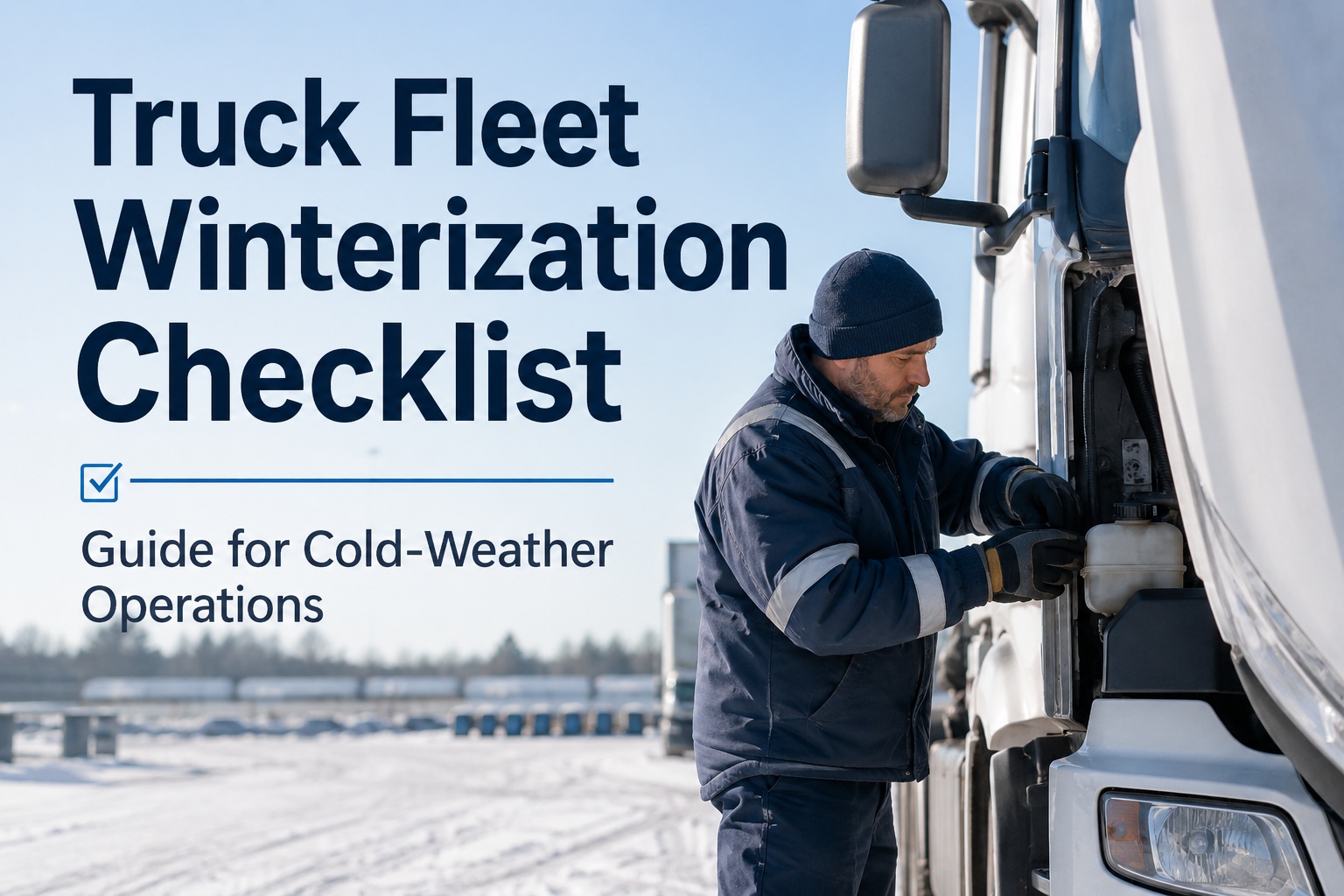
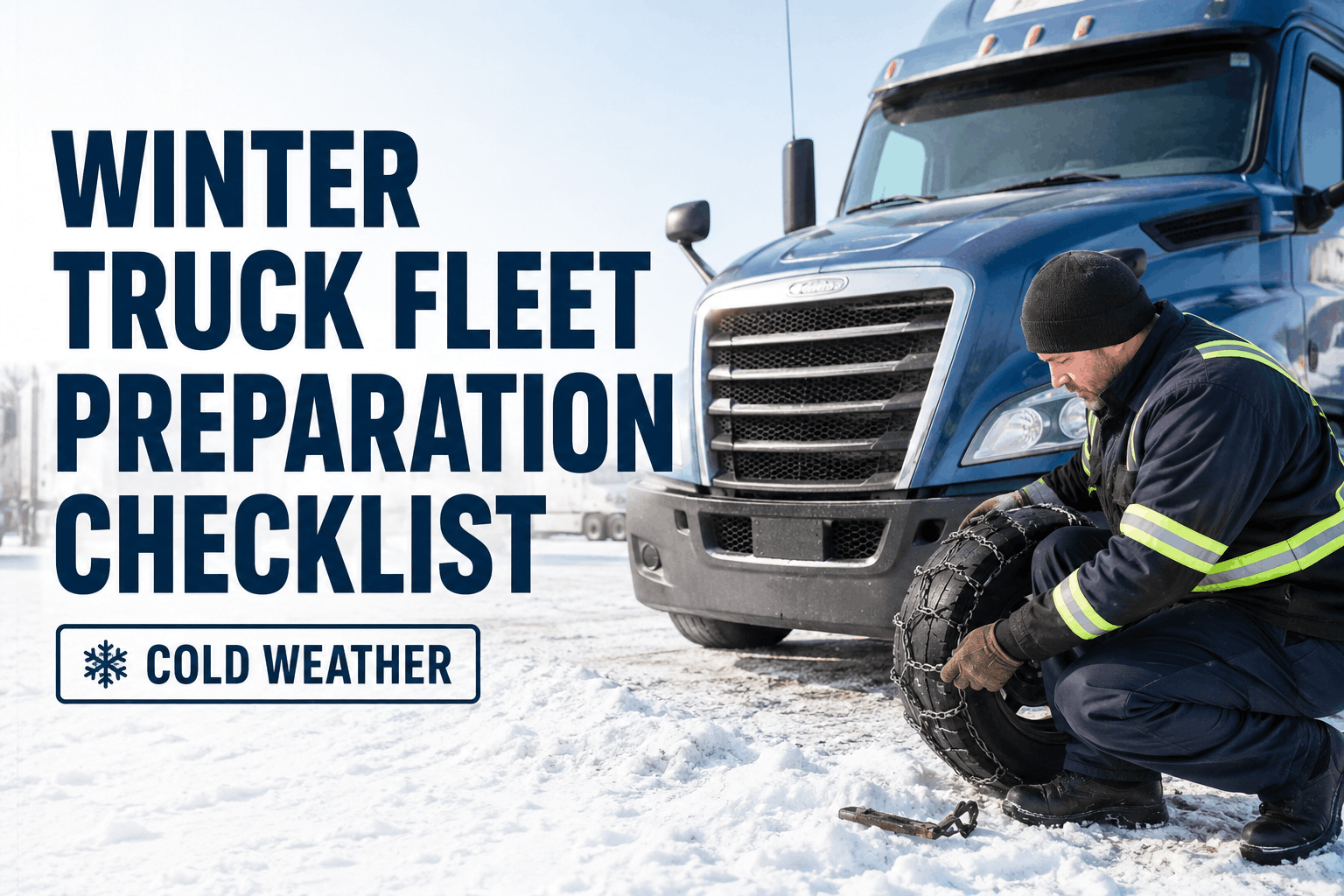
Winter Truck Fleet Preparation Checklist [Cold Weather]
The 8-System Winterization Framework
Every cold-weather failure traces back to one of 8 systems. Each needs verification before first frost — not in response to it. Contact our sales team for help deploying seasonal winterization templates across your fleet.
01 Engine Oil & Cooling
02 Fuel System & Anti-Gel
03 Battery & Charging
04 DEF & Aftertreatment
05 Tires & Chains
06 Air Brake System
07 Cabin, Visibility & Heating
08 Emergency Kit & Driver Briefing
Critical Temperature Thresholds — What Happens When
Cold-weather failures happen at specific temperatures. Knowing the thresholds tells you exactly when each system needs winter-grade protection.
| Temperature | System Affected | Action Required |
|---|---|---|
| 32°F | Water in air brakes, batteries weaken | Daily air tank drain, battery monitoring |
| 20°F | Diesel cloud point approaches | Anti-gel additive mandatory, winter-blend diesel |
| 15°F | Diesel fuel gelling begins | Anti-gel must already be in fuel |
| 12°F | DEF freezes solid (urea/water mix) | DEF tank heater operational, level >1/4 |
| 8°F | 20°F-rated coolant fails | Coolant must protect to -34°F minimum |
| 0°F | Battery cranking 60% reduced | Battery already replaced if borderline |
| -34°F | Standard 50/50 coolant freezes | Stronger coolant blend or block heater |
Diesel anti-gel additive cannot reverse already-gelled fuel — it must be added before temperatures drop. This is the most common cold-weather mistake: drivers adding anti-gel to fuel that's already cloudy and discovering it doesn't help. Pre-season anti-gel treatment is non-negotiable. Once paraffin crystals form, fuel filter replacement is required to restore flow.
FMCSA Compliance & State Requirements
Winter preparation isn't just operational — it's regulatory. FMCSA enforces winter readiness through multiple regulations, and several states impose additional chain law and emissions requirements.
Systematic Maintenance
DVIR Documentation
Tire Standards
Chain Laws
Anti-Idle Exemptions
Frequently Asked Questions
When should I start fleet winterization?
Start 6-8 weeks before first frost in your operating region — typically September in northern states, October in mid-latitudes, and November in southern operations that see occasional cold snaps. The 6-8 week lead time isn't arbitrary: it covers time to load-test and replace borderline batteries, schedule fuel filter replacements, source winter-blend diesel from suppliers, train drivers on cold-weather procedures, verify block heaters before they're needed, and handle any cold-sensitive component replacements while parts are available. Fleets that wait until the first cold morning discover the same problem every other unprepared fleet has — competing demand for emergency parts and service capacity right when temperatures drop. Start your free trial to deploy seasonal winterization templates.
At what temperature does diesel fuel start gelling?
Untreated #2 diesel begins forming paraffin wax crystals (the "cloud point") at approximately 15°F, with full gelling that blocks fuel filters and lines typically occurring between -10°F and 10°F depending on fuel quality. The defense is layered: switch to winter-blend diesel (which suppliers transition to in November in most US regions), add anti-gel fuel additive for operations seeing sub-20°F temperatures, replace fuel filters before winter starts, and drain water separators weekly through the season. The single most common winter fuel mistake: adding anti-gel to fuel that has already started gelling — the additive cannot reverse paraffin crystallization once it has formed. Anti-gel must be in the fuel before temperatures drop, not added after problems appear.
Does DEF really freeze in cold weather?
Yes — DEF (Diesel Exhaust Fluid) is 32.5% urea and 67.5% deionized water, so it freezes solid at 12°F (-11°C). Modern diesel trucks include DEF tank heaters, DEF line heaters, and DEF injector heaters that automatically thaw frozen DEF when the engine is running — so frozen DEF doesn't prevent operation. However, repeated freeze-thaw cycles damage DEF tanks, pumps, and injectors over time. Best practice: maintain DEF level above 1/4 tank through winter (a fuller tank takes longer to freeze and thaws faster), verify DEF heaters operational during pre-season preparation, and replace cracked DEF lines before they fail. Don't dilute DEF with water to "extend it" — the wrong urea ratio destroys the SCR system. Contact our sales team for DEF system winterization templates.
How much battery capacity do I lose in cold weather?
Significant — and consistently underestimated. At 32°F, batteries lose approximately 35% of cranking capacity vs 80°F. At 0°F, that drops to about 60% loss — meaning a battery delivering 800 cold-cranking amps at warm temperatures delivers only ~320 amps at 0°F. The mechanism: cold slows the chemical reactions inside the battery while simultaneously thickening engine oil that requires more starting torque. A battery that was "marginal" in October fails completely in January. The defense is load-testing every battery before first frost and replacing any battery showing borderline output — not waiting for failures. Borderline batteries don't get better in winter. Note: a fully charged battery doesn't actually freeze until -70°F, but a partially discharged battery can freeze at 32°F and crack the case. Keep batteries charged through winter.
What tire tread depth should I run in winter?
FMCSA legal minimums under §393.75 are 4/32" on steer tires and 2/32" on drive and trailer tires. These are minimums, not winter targets. Best practice for winter operations is 6/32" on steer tires and 4/32" on drive and trailer positions — providing meaningful traction reserve through the season versus running tires to legal minimum and replacing in March. Tire pressure also matters more in winter: pressure drops 1-2 PSI for every 10°F temperature decrease, so a tire correctly inflated at 80°F can be 8-10 PSI underinflated at 0°F. Underinflated tires lose load capacity, wear faster, and have higher blowout risk on cold hard road surfaces. Pressure should be checked weekly through winter, with cold-temperature target pressure (not warm-day pressure). Sign up free to track tire condition through winter.
Which states require tire chains on commercial trucks?
State chain laws vary but the major jurisdictions are Colorado, Washington, Oregon, California, Idaho, Montana, with seasonal requirements also active in Nevada, Utah, Wyoming, and at-discretion enforcement in several others. Colorado's Traction Law and Passenger Vehicle Traction Law specifically require chains on commercial vehicles during designated winter storms on Interstate 70 and other mountain corridors. California requires chains during chain control conditions in Sierra Nevada and other mountain passes. Each state defines its own rules for chain placement (which axles), chain type (cable vs link), and enforcement (mandatory vs at trooper discretion). Fleets running these jurisdictions must verify chain availability on each truck before winter, train drivers on installation, and monitor state DOT chain control advisories. Operating without required chains during chain control = significant fines plus forced stop. Talk to our sales team for state chain law compliance tracking.