The 2026 CSA overhaul is the biggest change to FMCSA's Safety Measurement System since the program launched in 2010. Vehicle Maintenance is now split into two separate compliance categories. Violation codes have been consolidated from 950+ down to about 116 groups. Severity weights simplified to a 1-or-2 scale. Fleets are seeing their percentiles jump 10–20 points overnight — with no new inspections logged. This guide breaks down what actually changed, why one DVIR miss can now show up in two categories, and how Truck Inspection & Maintenance keeps every defect, PM, and DOT record from slipping into an unnecessary point. Start a free trial to run inspections against the new methodology from day one.
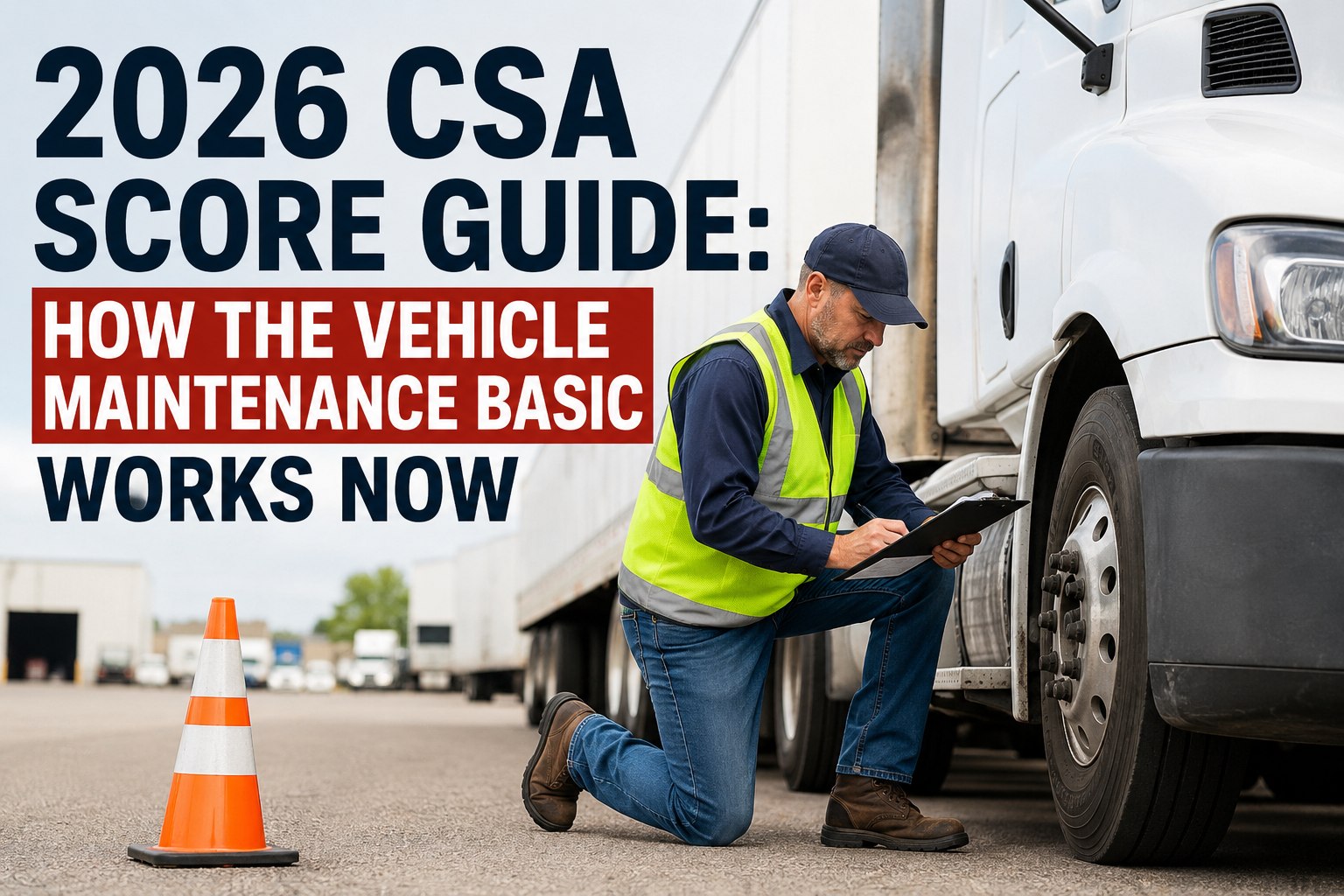
2026 CSA Score Guide: How the Vehicle Maintenance BASIC Works Now
The 2026 SMS update split Vehicle Maintenance into two BASICs, consolidated 950+ violation codes, and made DVIR quality directly scoreable for the first time. The new categories, point weights, and how a single missed defect now shows twice.
What Actually Changed in 2026
Four structural changes matter more than any of the rest. Each one on its own would move a carrier's percentile; together they are the largest reset of the CSA scoring system in over a decade.
The old single Vehicle Maintenance BASIC is now Vehicle Maintenance (shop-found defects and roadside violations) and Vehicle Maintenance: Driver Observed (defects that should have been caught at pre-trip). Each scored separately, each with its own threshold.
Individual violation codes rolled up into violation groups. The list is shorter, but each group's severity is now applied more uniformly across similar defects.
The old 1-to-10 severity weight replaced with a simple 1 or 2. A violation is either standard severity (1) or elevated severity (2) — no middle ground, no debate.
Terminology change with real implication — the reorganized categories reshape which violations feed which score. Same violation, potentially different category, potentially different threshold.
The Two Vehicle Maintenance Categories: What Each Covers
The split is the change that matters most for maintenance-focused fleets. Understanding which defects feed which category — and how a single incident can now show up in both — is what separates fleets that adapt from fleets that get surprised by their new percentile.
Defects found by roadside inspectors or in the shop that were not (or should not have been) visible during a pre-trip. Mechanical, hidden, or complex-system issues.
- Brake system defects found during Level 1 inspection
- Suspension, steering, and driveline issues
- Emissions and exhaust system defects
- Cargo securement violations
- Frame, wheel, and hub issues
Defects that should have been caught and logged by the driver during pre-trip walk-around. This category grades DVIR quality directly for the first time.
- Inoperative lights (headlamps, tail, marker, brake)
- Visibly worn or flat tires
- Damaged or missing mud flaps
- Cracked windshields obstructing view
- Missing or non-functional wipers
- Air leaks audible or visible on inspection
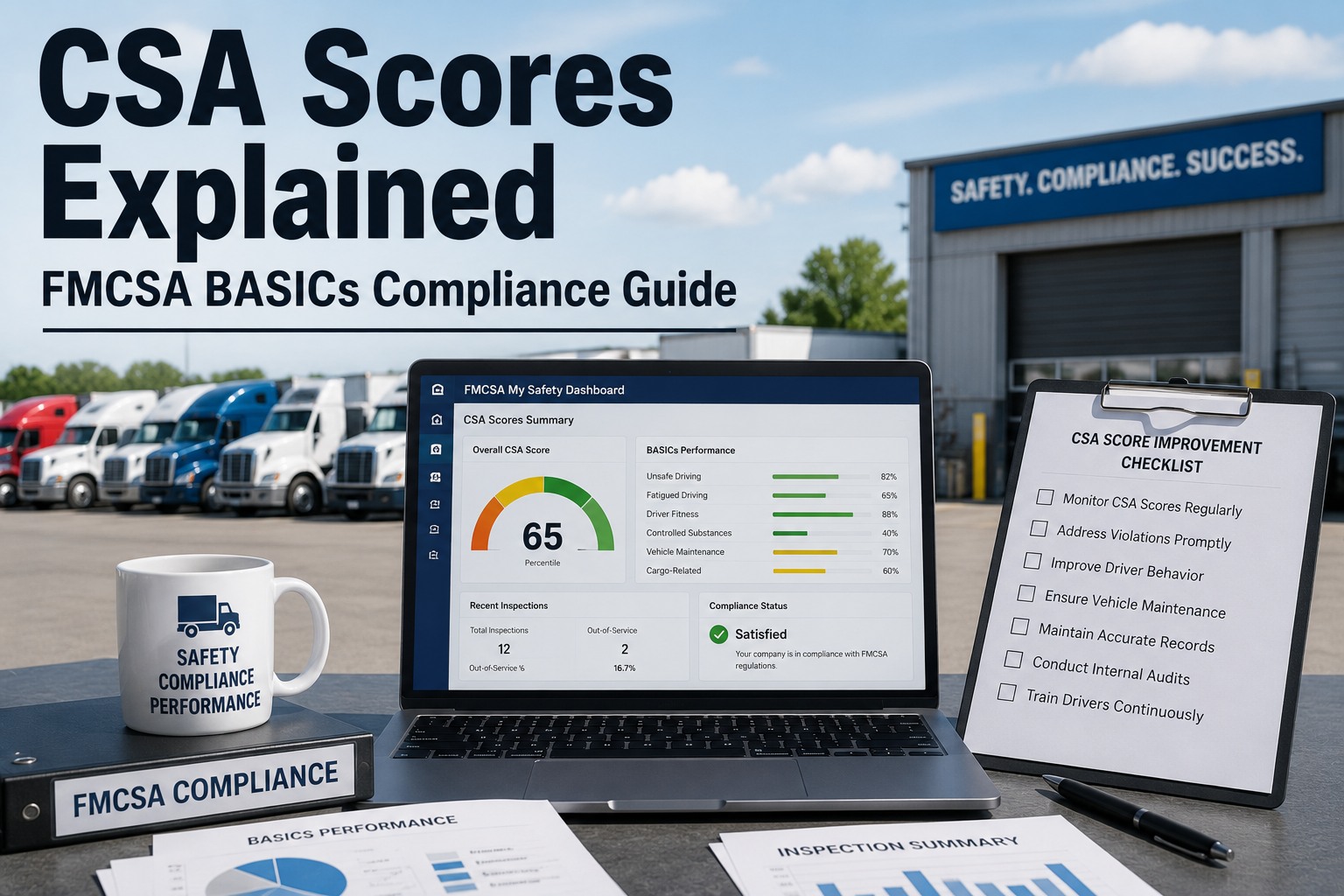
Every 2026 Compliance Category at a Glance
The full list of scored categories, their 2026 intervention thresholds, and what drives each one. Cross any threshold and FMCSA prioritizes your carrier for intervention — starting with a warning letter and escalating.
Speeding, reckless driving, phone use. Now also includes controlled substance and alcohol violations. Strongest crash correlation — lowest threshold.
HOS violations, ELD errors, driving fatigued. Same strict threshold as Unsafe Driving — treated as direct safety risk.
24-month crash history and severity. Crashes count regardless of fault — frequency alone triggers intervention.
Shop-found and roadside-inspection defects. Brakes, tires, lights make up 60%+ of all OOS violations.
Brand new in 2026. Tracks defects that should have been caught at pre-trip. DVIR quality now has its own compliance score.
Driver qualification file completeness, medical certs, license validity. Documentation-heavy category.
Placarding, shipping papers, packaging. Only applies to carriers hauling HM loads.
Why Scores Are Moving Without New Inspections
Many carriers logged into their CSA dashboard the week the 2026 methodology went live and saw their percentiles jump — with no new roadside inspection since the last check. Three mechanisms are driving that.
FMCSA recalculated the last 24 months of inspection data using the new methodology. Same violations, new weights, new categories = different percentiles.
Fleets whose defects skewed toward driver-observable items (lights, tires, windshields) now see those violations scored in a second category as well.
Some violations that scored 3-5 on the old 1-10 scale now score as 2 (elevated). Others that scored 6-8 also drop to 2. Winners and losers within the same fleet.
DVIR Quality Now Directly Moves Your Score
Truck Inspection & Maintenance turns every pre-trip into a documented, timestamped record with GPS and photos — the exact evidence chain that keeps driver-observable defects off your CSA record. Mobile DVIRs, PM reminders, digital work orders, DOT recordkeeping — one platform, one record per truck, one system that speaks with one voice on audit.
The DVIR Discipline That Protects Both Categories
Because the same defect can now score in both Vehicle Maintenance categories, DVIR discipline has become the single highest-leverage compliance activity a fleet can invest in. These are the five behaviors that separate carriers who benefit from the split from carriers who get hit twice by it. Start free and run these five habits through one platform.
DVIRs are not spot-check items. Every driver operating a vehicle files a pre-trip and post-trip DVIR every day, every truck, no exceptions.
Location, symptom, severity, photo. Vague DVIRs help nobody — a specific entry both routes better in the shop and reads better to a DOT auditor.
Every reported defect gets a mechanic's certification and a next-driver acknowledgment before dispatch. Chain integrity is what proves the DVIR system works.
Lights, tires, mud flaps, windshields — anything a driver-observed category could pick up. A photo on the DVIR is your evidence the item was inspected.
Sample 10% of the week's DVIRs randomly. Score for completeness, specificity, photo attachment. The score that catches drift before roadside does.
The 60-Day Action Plan After a Percentile Jump
If your CSA dashboard shows a category above threshold after the 2026 methodology went live, do not wait for the warning letter. This is the sequence that gets a carrier back below threshold fastest.
Pull your full 24-month inspection history. Identify every violation that could support a DataQs challenge — misattribution, wrong carrier, corrected on-site. File all challenges immediately.
Roll out the five DVIR habits above. Add a photo-required weekly DVIR section covering all driver-observable items. Every driver trained within two weeks.
Every unit with an open defect over 14 days gets closed or grounded. PM compliance target pushed to 95%+. No truck rolls with a red DVIR entry unreconciled.
Every clean roadside inspection now improves your percentile. Focus is stability — no new violations, plus DataQs decisions coming back. Percentile begins to drop.
Frequently Asked Questions
Log into csa.fmcsa.dot.gov with your DOT number and PIN. The CSA Prioritization Preview shows your carrier's percentiles under the new methodology alongside the old one — so you can see which categories moved and by how much. Any category with a marked change is where to focus your response. FMCSA also published a Foundational Document detailing the reorganization; it's the definitive reference for which violation groups feed which category. Start free and map your violations to the new categories in one dashboard.
Yes — for defects that a driver could reasonably observe at pre-trip. An inoperative headlamp cited at roadside now generates a violation in Vehicle Maintenance (the defect itself) AND in Vehicle Maintenance: Driver Observed (the failure to identify it during pre-trip). That's the mechanical reason for the percentile jumps many fleets are seeing. The counter-move is provable DVIR discipline — a documented pre-trip that flags the issue before roadside catches it.
The data weighting window is 24 months — same as before. Violations lose weight after 12 months and drop off the calculation entirely after 24. The 2026 change was to how violations are weighted and categorized, not how long they stay in the calculation. What did change is that the two-value severity scale means most violations either score the same or less than they did before, so the aging benefit is more predictable.
Two moves in parallel. File DataQs challenges on any driver-observable violation where your DVIR record actually captured the defect — that's proof the driver did their job. Then tighten forward-going DVIR discipline: photo-required entries on every observable item, weekly random audit, defects flagged internally before they surface at roadside. Every clean inspection from that point improves your percentile, and the category's percentile drops fastest when there are no new violations to replace the ones aging off. Ask about DVIR audit tools.
Yes, increasingly. Brokers screen scores before awarding loads — a category above threshold can eliminate a carrier from the bid list entirely, and the new Vehicle Maintenance: Driver Observed category is now on that screen. Insurance underwriters are also pricing off the new methodology; recent industry reporting has cited premium increases of 25-50% for carriers with categories above threshold. The score isn't just a compliance issue — it's a competitive one, immediately.
Every Defect, Every PM, Every DOT Record — In One Place
Truck Inspection & Maintenance gives dispatch, drivers, and the shop a single system for inspections, preventive maintenance, and repair tracking — so no defect, PM, or DOT record ever slips into an unnecessary CSA point. Both Vehicle Maintenance categories protected. Both percentiles working with you, not against you.