For nearly a decade the English Language Proficiency rule sat dormant — on the books since 1937, but a 2016 policy told inspectors to cite it without pulling the truck off the road. That ended June 25, 2025. An ELP failure is now an immediate out-of-service condition on the CVSA criteria, in print since the April 1, 2026 edition and written into federal law by the 2026 Appropriations Act — 12,308 ELP out-of-service orders in the second half of 2025 alone. A violation that used to be a warning is now a stopped truck and a stranded load. This guide breaks down the rule, the two-step roadside assessment, and what keeps a fleet ready — with Truck Inspection & Maintenance Management Software (TIM) holding the driver-qualification and inspection records that back it up. Start free and keep every driver-qualification record audit-ready.
An ELP Failure Used to Be a Warning. Since June 2025, It's a Stopped Truck.
You want drivers who clear a roadside inspection and loads that arrive — not a unit parked at a weigh station because a driver couldn't answer the inspector in English. ELP is now a federal out-of-service violation, and the defense is a documented driver-qualification file plus clean inspection records. TIM keeps that documentation ecosystem audit-ready: DQ records, inspection history, and compliance exports on one platform, each defect logged with a first response within 4 hours — acknowledged, graded, and assigned.
How ELP Enforcement Came Back — a 90-Year Rule, Reactivated
The requirement never disappeared; enforcement did, then returned harder than before. Understanding the timeline matters, because it explains why this is now a statutory mandate a future memo can't quietly undo.
English proficiency requirement first established in federal regulation.
CVSA drops ELP from OOS criteria; a 2016 FMCSA memo tells inspectors to cite but not park drivers.
Executive order directs DOT to rescind the 2016 guidance and restore strict enforcement.
CVSA restores ELP as an out-of-service condition. Enforcement begins nationwide.
FMCSA revises roadside policy (MC-SEE-2026-0002); April 1 CVSA edition lists ELP in print.
Consolidated Appropriations Act writes the OOS trigger into federal law — now statutory.
What the Rule Actually Requires — the Four Duties of §391.11(b)(2)
The regulation is specific. An interstate CMV driver must read and speak English well enough to perform four safety-and-recordkeeping duties. An inspector's assessment maps directly to these — this is the standard, not grammar perfection.
Communicate sufficiently with the general public at the scene of an incident or interaction.
Read and interpret U.S. traffic signs and signals — including electronic changeable message boards.
Answer an inspector's or officer's questions in English, without an interpreter or app.
Make legible entries on reports and records — logs, DVIRs, shipping documents.
The Two-Step Roadside Assessment — Exactly How Inspectors Test It
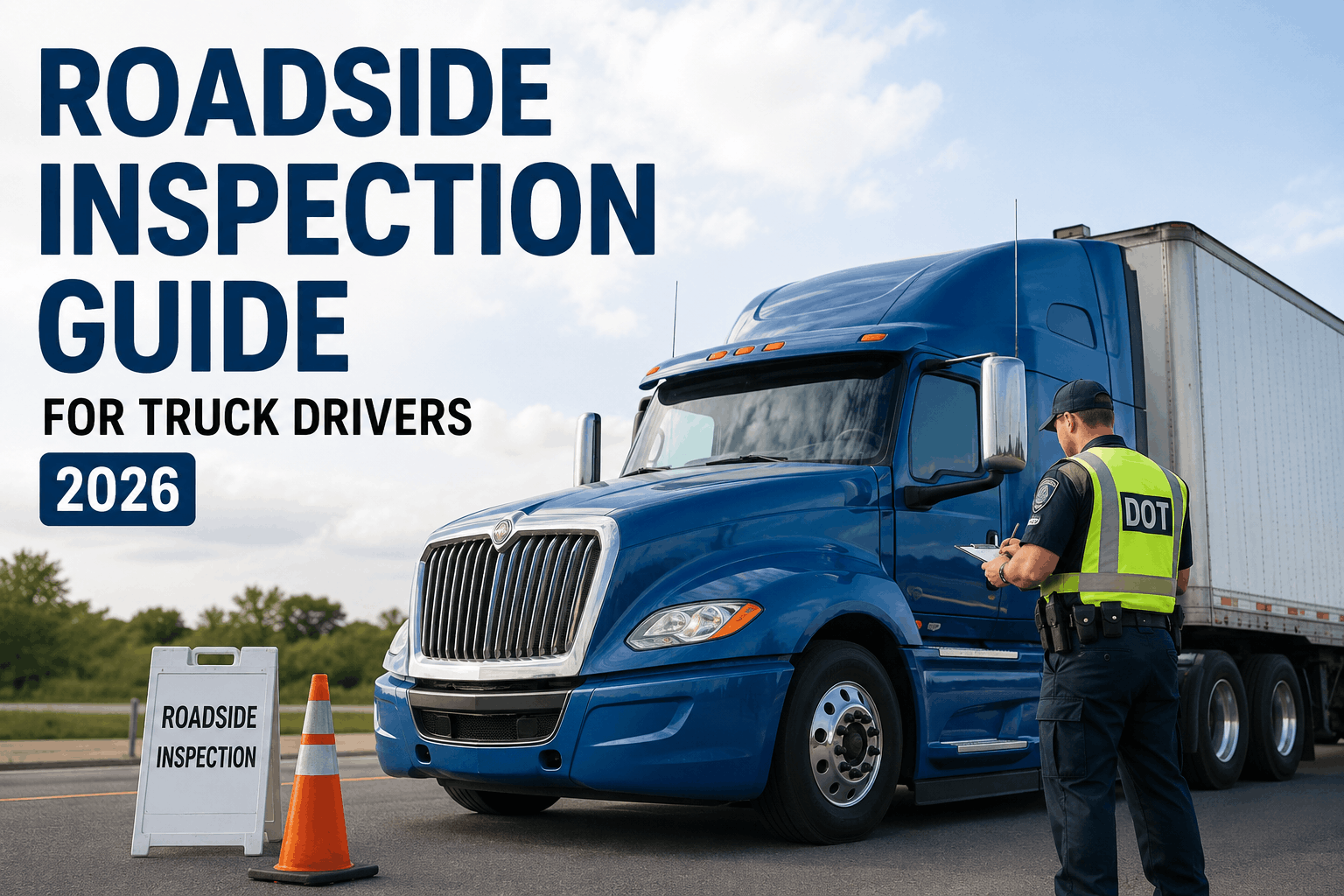
FMCSA's guidance sets a standardized two-step process. Inspectors begin every inspection in English; if the driver seems not to understand the initial instructions, the assessment starts. The critical mechanic: fail Step 1 and the inspector stops there — there's no need to reach Step 2, and the driver is cited and placed out of service.
The inspector asks questions in English about the driver, the trip, cargo, duty status, and equipment. It's a screening based on the interaction — not a formal exam or a grammar test. The goal is comprehension and response.
Only if Step 1 is passed. The driver must identify and explain common U.S. highway signs — both text and pictogram — including electronic changeable message boards. It tests real road meaning, not memorized classroom definitions.
What an Out-of-Service Order Actually Costs
An OOS order isn't a ticket you pay and drive off. It stops the truck where it sits and sets off a chain that reaches the load, the carrier's safety score, and future business. This is why prevention beats any roadside outcome.
The driver can't operate until the violation is resolved — the unit is out of service where it was inspected.
The freight doesn't move on schedule; a replacement driver or truck has to be arranged, at cost.
The violation hits the carrier's safety profile, raising inspection frequency and insurance exposure.
ELP is a federal qualification requirement; an OOS event can undercut carrier representations to shippers.
The Roadside Defense Is Built Before the Truck Leaves the Yard
Carriers are responsible for verifying ELP compliance as part of driver qualification — and when an inspection or a dispute lands, the paperwork is what protects you. TIM keeps the documentation ecosystem audit-ready: driver-qualification records, inspection and DVIR history, maintenance trails, and compliance exports searchable by driver, vehicle, or date. When an inspector or an auditor asks, every record is one search away — not a scramble through a filing cabinet.
Enforcement by the Numbers — and Where It's Heading
This isn't a paper change. The enforcement data from the first year shows the scale, and the statutory codification means it only intensifies from here.
Placed in the second half of 2025 alone, after June 25 enforcement began.
Of 704 driver OOS orders in Operation SafeDRIVE (Jan 13–15, 2026), ~500 were ELP-related.
Operation SafeDRIVE spanned 26 states + D.C. over a single mid-January window.
The 2026 Appropriations Act embedded the OOS trigger — no longer reversible by memo.
Frequently Asked Questions
You Can't Coach the Roadside — but You Can Document Everything Around It
ELP is now a federal out-of-service violation with the numbers to prove it's enforced. The carrier's defense is a clean driver-qualification file and inspection history — and TIM keeps that documentation ecosystem searchable, complete, and one export away when an inspector or auditor asks.