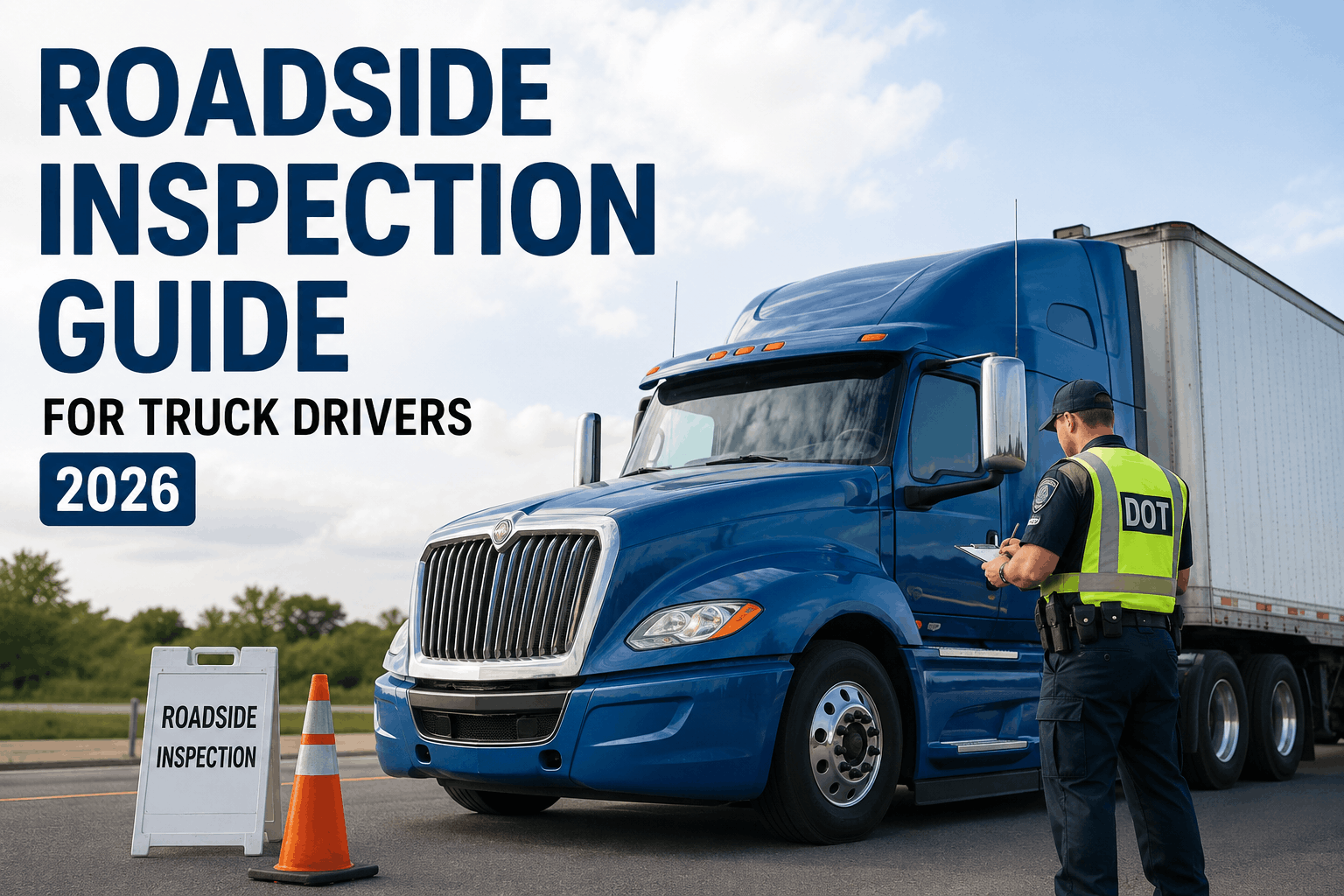
49 CFR §391.11 is the single regulation that defines whether a driver is qualified to operate a commercial motor vehicle in interstate commerce. Subsection (b)(2) — the English Language Proficiency clause — is one of seven qualifications listed in that regulation, and until June 25, 2025, it was the only one FMCSA had directed inspectors to cite without an OOS consequence. That changed. This guide is the clause-by-clause reference for §391.11(b)(2): the exact regulatory text, where it sits inside §391.11, what "sufficiently" means in practice, and what belongs in the Driver Qualification File to prove compliance. Truck Inspection & Maintenance Management Software centralizes the DQ file across all seven §391.11(b) qualifications, so an ELP challenge doesn't ambush a fleet at the roadside. Start free and centralize §391.11 DQ files in TIM.
49 CFR §391.11(b)(2) · Verbatim · DQ File · Subpart B
The Actual Text of §391.11(b)(2) — and Where It Sits Inside the Full Driver-Qualification Framework
Most fleets know the ELP rule exists. Fewer know it's one of seven qualifications inside the same regulation. TIM keeps a DQ file per driver against all seven subsections, so any single audit — ELP, medical, license, road test — reaches a complete record.
7 clausessubsections (b)(1) through (b)(7)
Subpart BGeneral Qualifications of Drivers
OOSon failure of (b)(2) since Jun 25, 2025
The Verbatim Text of §391.11(b)(2)
The regulation is short. It has been on the books since 1937, and the wording below is the current version of the Code of Federal Regulations. Every roadside inspector, every DataQs reviewer, and every plaintiff's attorney reads this exact sentence.
49 CFR §391.11(b)(2)
A person is qualified to drive a motor vehicle if he/she — can read and speak the English language sufficiently to converse with the general public, to understand highway traffic signs and signals in the English language, to respond to official inquiries, and to make entries on reports and records.
Source · eCFR, current version
Four capabilities in one sentence. Each one is testable at the roadside, and each one lands as its own line in the Driver Qualification File. Contact us to see how TIM maps the four capabilities to the DQ record.
Where (b)(2) Sits — The Full §391.11(b) Framework, All 7 Qualifications
ELP isn't the only qualification in §391.11. Below is the complete list of subsections (b)(1) through (b)(7), the seven items that together define whether a driver is qualified. If any one fails, the driver isn't qualified — but only (b)(2) currently triggers roadside OOS under the June 25 2025 CVSA addition.
(b)(1)
Minimum age
Is at least 21 years old (18 for intrastate operation in some states)
Age check
(b)(2)
English Language Proficiency · ELP
Reads + speaks English sufficient to converse, understand signs, respond to inquiries, make report entries
OOS trigger
(b)(3)
Safe operation of vehicle type
Experience + training to safely operate the type of vehicle they'll drive
Experience
(b)(4)
Physical qualifications
Meets physical standards under Subpart E — medical certificate current
Med cert
(b)(5)
Single valid CDL
Has a currently valid CDL issued by only one State or jurisdiction
CDL
(b)(6)
Not disqualified under §391.15
No pending disqualification for major convictions, OOS orders, or DUI events
§391.15
(b)(7)
Road test or equivalent
Passed road test under §391.31 or presented equivalent documentation under §391.33
Road test
Why the framework matters Auditors don't check (b)(2) in isolation. When ELP compliance is challenged, the full DQ file surfaces — medical, MVR, road test, disqualification history. A weak line anywhere in (b)(1) through (b)(7) becomes an incidental finding. TIM keeps all seven current on one driver record.
What "Sufficiently" Means in Practice — Breaking Down the Four Capabilities
The word doing all the work in (b)(2) is "sufficiently." It's not a standardized test score — it's a functional standard measured against the four downstream capabilities. Below is how each capability translates from regulation to roadside.
(b)(2)(i)
Converse with the general public
Ability to hold a conversation with people encountered in the course of duties — shippers, receivers, dispatch, fellow drivers, public in emergencies. Sufficient for the transaction, not fluent.
Roadside test · Open-ended verbal exchange
(b)(2)(ii)
Understand highway traffic signs + signals in English
All MUTCD-standard regulatory, warning, and guidance signage. Understanding the message, not just identifying the shape. STOP means come to a complete stop; LOW CLEARANCE means the trailer will strike the bridge.
Roadside test · MUTCD sign recognition panel
(b)(2)(iii)
Respond to official inquiries
Answer questions and follow directions from law enforcement, DOT inspectors, and CVSA officers. Standard inspection interview questions — trip origin, HOS, load details, paperwork provision.
Roadside test · Structured interview per MC-SEE-2026-0002
(b)(2)(iv)
Make entries on reports + records
Complete DVIRs, HOS logs, accident reports, and required documentation in legible English. This is where paper trails matter — an eDVIR record showing the driver has been making legible English entries for months is defensive evidence.
DQ file · Historical eDVIR + HOS records
The §391.11(b)(2)-Specific Driver Qualification File Contents
Every driver qualification file should carry evidence against each of the four (b)(2) capabilities. Below is the working DQ-file inventory TIM builds for the ELP portion. Start free and build the (b)(2) evidence chain in TIM.
✓
Internal 2-step ELP assessment record
Dated pre-hire result + annual retest, mirroring the FMCSA roadside protocol under MC-SEE-2026-0002
✓
Prior CDL exam documentation
Copy of state CDL knowledge + skills test records (typically administered in English at issuance)
✓
MUTCD sign-recognition practice log
Documented practice covering regulatory, warning, and guidance sign categories
✓
Historical eDVIR + HOS records
Time-series proof of legible English entries — evidence against (b)(2)(iv)
✓
English-language training records
Any documented training completion for drivers whose pre-hire assessment identified a gap
All 7 §391.11(b) Qualifications · Driver-by-Driver · DataQs-Ready — All in TIM
TIM keeps a §391.11-anchored DQ file per driver — age verification, ELP assessment record, safe-operation history, medical certificate, single-CDL check, disqualification screen, road test — so any audit reaches a complete record. The clause-by-clause structure of the regulation maps directly to the DQ file structure.
Frequently Asked Questions
Is the exact regulatory text of §391.11(b)(2) different from what CVSA and FMCSA enforce?
No — the eCFR text is what's enforced. FMCSA memorandum MC-SEE-2026-0002 tells inspectors how to assess the four capabilities in (b)(2), but it doesn't add a new regulation. The rule itself is unchanged since 1937; enforcement is what changed on June 25, 2025.
Start free and align your DQ file to the actual §391.11 text.
Does §391.11(b)(2) require a specific English test or certification?
No — the regulation uses "sufficiently," a functional standard, not a standardized test score. Fleets are not required to administer a TOEFL, IELTS, or similar exam. What matters at the roadside is that the driver can demonstrate the four capabilities in the moment. Internal documented assessments are the practical way to file evidence.
Contact us for internal-assessment setup in TIM.
If a driver passes (b)(2), can they still fail on another subsection?
Yes — the seven subsections are cumulative. A driver must satisfy all of (b)(1) through (b)(7) to be qualified. A valid CDL (b)(5) with an expired medical certificate (b)(4) fails the qualification regardless of ELP status. TIM tracks all seven subsections per driver as one composite qualification status.
Start free with full §391.11 tracking in TIM.
How does TIM structure the DQ file against §391.11?
Per driver, TIM stores a subsection-mapped record: (b)(1) age verification, (b)(2) ELP assessment + practice + historical eDVIRs, (b)(3) experience log, (b)(4) medical certificate + expiry alerts, (b)(5) CDL scan + single-state check, (b)(6) MVR + disqualification screen, (b)(7) road-test documentation. Every field ties to the regulatory clause it satisfies.
Contact support to see the clause-mapped DQ layout.
§391.11(b)(1)–(b)(7) · Clause-Mapped · DataQs-Ready · TIM
Every §391.11 Subsection Belongs in the DQ File — TIM Structures It That Way
TIM maps the seven subsections of §391.11(b) directly to the DQ file per driver — so an audit landing on any single clause reaches a complete, dated, sourced record. The rule is written clause by clause; the file should read the same way.
No credit card required · Free for up to 3 trucks · Clause-mapped DQ file built in