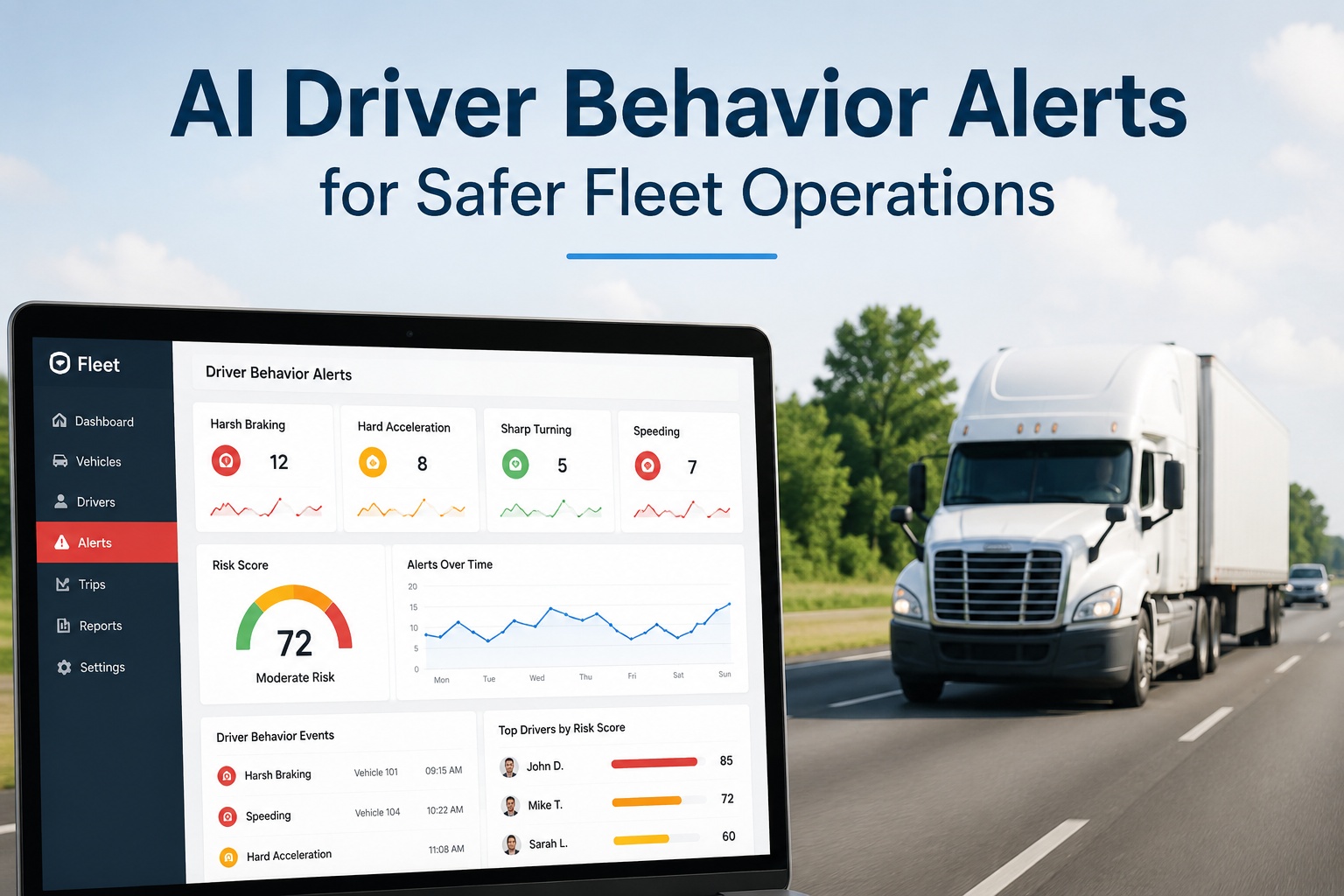
Ninety percent of fleet crashes trace back to how someone drove — not to a mechanical failure. Yet most fleets still find out about a driver's habits the same way they always have: after the incident report lands on a desk, when the premium has already spiked and the truck is already in the shop. A driver who hard-brakes fourteen times a shift, corners hard through every left turn, and runs 75 in a 65 is generating measurable risk on every trip — risk that's invisible until it becomes a claim. AI driver behavior alerts flip that timeline. Instead of reviewing the wreck, you correct the habit in the moment it happens, with an in-cab warning and a logged event that feeds coaching, maintenance, and compliance all at once. This guide covers how the alerts work, what they catch, and how Truck fleet management software turns behavior data into fewer accidents, lower premiums, and longer-lasting trucks.
Guide · AI Fleet Safety · 2026
AI Driver Behavior Alerts for Safer Fleet Operations
Catch harsh braking, speeding, and distraction the second they happen — then turn every event into coaching, maintenance flags, and insurance-ready proof from one platform.
90%
Of crashes come from driver behavior, not mechanics
20-50%
Fewer accidents with alerts plus active coaching
60%
Less manager intervention with in-cab alerts
8-15%
Insurance premium savings from documented safety
Reactive vs. Real-Time Safety
The old model of quarterly safety meetings and annual reviews creates a dangerous blind spot: risky behavior goes undetected until it causes a collision. Real-time alerts close that window — the correction happens while the driver is still behind the wheel, not weeks later in a conference room.
Reactive model
Habits surface only after an incident
Coaching is generic and delayed weeks
Premiums spike after the claim
No objective per-driver record
Real-time alerts
Driver self-corrects in the moment
Coaching targets the exact event
Risk drops before it becomes a claim
Timestamped scorecard per driver
The Six Behaviors AI Scores
Each of these has a documented statistical link to crash probability in FMCSA and NHTSA data. Modern systems score every driver on all six continuously — with per-event logging and rolling 30-day trends. The percentages show typical weighting in a composite safety score:
Harsh braking
~30%The strongest predictor — tight correlation to front-end collisions. Tracks frequency, severity, and pattern.
Distracted driving
~20%Phone use and eyes-off-road time detected by AI vision. Texting is 6× more dangerous than drunk driving.
Speeding
10-30%Speed relative to posted limits and conditions. Weighting is adjustable to your fleet's priorities.
Harsh acceleration
~10%Rapid speed increases that signal an aggressive style — and burn fuel and drivetrain life.
Sharp cornering
ScoredHigh lateral G-force through turns — a rollover and tire-wear risk in one event.
Fatigue & drowsiness
ScoredEye closure, head drop, and yawning flagged by camera vision. Fatigue contributes to 31% of fatal truck crashes.
How the Alert Engine Works
Behind every alert is a four-step loop running continuously — and the third step is what keeps good drivers from being punished for a single bad moment. The AI weighs context before it scores:
Collect
Telematics sensors capture acceleration, braking force, cornering G-force, speed, and GPS every second; AI cameras add distraction and fatigue signals.
Compare
The AI measures each event against the driver's own historical baseline and fleet-wide safety standards to spot real deviations.
Score in context
Each event gets a severity score weighted by magnitude, frequency, weather, and traffic — so a cautious driver's sudden three hard-brakes gets flagged as an anomaly, not a character flaw.
Alert & log
An instant in-cab warning — "eyes on road," "maintain distance" — lets the driver self-correct, while the event feeds the rolling safety score and coaching queue.
Why context matters: a system that penalizes every hard brake equally trains drivers to distrust it. Baseline-aware scoring flags genuine risk while leaving good drivers alone — which is exactly why adoption holds up and the scores stay meaningful.
Free · Up to 3 Vehicles
Turn every risky moment into a coaching moment
Truck fleet management software scores every driver across all six behaviors, fires real-time in-cab alerts, and routes the highest-risk events straight to a targeted coaching queue — no manual review of thousands of clips. It connects to the telematics you already run via API, so most fleets need no new hardware. Sign up free for up to 3 vehicles and see your first driver scores today.
Monitoring Is Easy. Coaching Is the Point.
Here's the truth vendors gloss over: capturing the data is trivial — the behavior change only comes from what you do with it. Alerts without a coaching loop are just noise. The fleets seeing 20-50% accident drops all run the same closed loop:
Flag the driver
Rolling scores surface exactly who needs attention — no guessing, no favoritism.
Show the event
Managers get curated, context-rich clips of the highest-risk moments — not thousands of raw recordings.
Coach specifically
Attributed, specific feedback drives change fast; scores improve within the first month.
Track the trend
The rolling 30-day score confirms whether the coaching worked — and flags anyone sliding back.
The results compound quickly. Within six months, fleets running alerts plus structured coaching report roughly 48% fewer harsh events, 84% less phone use, and a 37% drop in crash rate — improvements that show up directly in claims and renewals.
The Maintenance Connection
Risky driving isn't only a safety cost — it's a maintenance cost. The same behaviors that cause crashes physically wear the truck down faster. When behavior data and maintenance live in one platform, aggressive drivers flag the vehicles that need earlier service:
Brakes
Repeated harsh braking eats pads and rotors far ahead of schedule — flag those units for earlier inspection.
Tires
Sharp cornering and hard acceleration scrub tread and shorten tire life across the fleet.
Fuel
Aggressive driving and idling burn 10-30% more fuel — behavior scores pinpoint where it's leaking.
CSA & inspections
Aggressive-driving patterns correlate with failed inspections; catching them protects your CSA scores.
The Compliance & Insurance Payoff
A documented behavior program does double duty: it lowers risk and it produces exactly the paperwork underwriters now demand. In 2026, insurers don't just want cameras installed — they want proof you're using the data to reduce risk:
Insurance evidence
At renewal, the platform auto-generates the documentation underwriters request — 12-month scorecard history, fleet-wide trends, coaching completion logs, and incident correlation — supporting 8-15% premium reductions.
Claim defense
An objective, timestamped safety record per driver exonerates safe drivers from false claims — critical when nuclear verdicts against carriers are climbing.
Direct savings
Each prevented incident saves $8,000-$45,000 in claims, repairs, and downtime. Premium savings alone often cover several times the platform's annual cost.
Frequently Asked Questions
What behaviors do AI driver alerts detect?
The core six are harsh braking, speeding, harsh acceleration, sharp cornering, distracted driving (phone use, eyes off road), and fatigue or drowsiness. Each has a documented link to crash probability in FMCSA and NHTSA data. Modern systems score every driver on all of them continuously, with per-event logging and rolling 30-day trends.
Do the alerts happen in real time?
Yes — that's the whole point. When the AI detects risky behavior, it fires an instant in-cab audio and visual warning so the driver self-corrects in the moment, before an incident. This reduces the need for manager intervention by about 60% and produces faster behavior change than post-incident coaching ever could.
Will good drivers get unfairly penalized?
Not with context-aware scoring. The AI compares each event against the driver's own baseline and weighs magnitude, frequency, weather, and traffic. A normally cautious driver with three sudden hard-brakes is flagged as an anomaly worth investigating — not automatically marked as risky. That fairness is what keeps drivers trusting the system. Contact our team to see how scoring works.
Do I need new hardware?
Usually not. If you already run a telematics platform, AI behavior monitoring integrates through APIs and pulls the kinematic events you're already capturing. AI camera vision for distraction and fatigue adds an in-cab camera, but the behavior scoring layer typically needs no new hardware for OBD-based events.
How fast will I see results?
Quickly. Scores often improve within the first month because behavior responds fast to specific, attributed feedback. Within 90 days, fleets typically see 20-35% fewer incidents; by six months, around 48% fewer harsh events, 84% less phone use, and a 37% lower crash rate when alerts are paired with structured coaching.
How does behavior monitoring help maintenance?
The same events that cause crashes wear the truck faster. Harsh braking eats brakes, sharp cornering and hard acceleration scrub tires, and aggressive driving burns 10-30% more fuel. When behavior data and maintenance sit in one platform, high-risk drivers automatically flag the vehicles that need earlier inspection. Sign up free to connect safety and maintenance in one place.
Fix the Habit, Not the Wreck
Make every driver your safest driver.
Truck fleet management software scores every behavior, alerts drivers in real time, routes high-risk events to coaching, flags the trucks that aggressive driving is wearing down, and generates the safety documentation insurers reward — all from one platform. Free for up to 3 vehicles. Live in 10 minutes. No new hardware for most fleets, no contracts.