Under 49 CFR 396.17, every commercial motor vehicle you operate must pass a comprehensive periodic inspection at least once every 12 months — covering every component listed in Appendix A of Part 396, performed by an inspector qualified under §396.19, documented in a report retained for 14 months, and with proof kept on the vehicle at all times. Miss any one of those pieces and the truck goes out-of-service at the next roadside stop. Approximately 133,000 annual inspection citations are issued nationally each year, making it the second most common FMCSA vehicle maintenance violation — and penalties can reach $19,277 per instance for operating a CMV without a current inspection. The rule is component-based, not vehicle-based: each Appendix A item must have passed within the preceding 12 months, or the vehicle is OOS for that specific defect. Combination vehicles compound the burden — a tractor with two trailers means three separate §396.17 inspections, three separate reports, three separate retention trails. This guide breaks down exactly who's covered, what gets inspected, who can inspect it, what the state equivalents look like, and how top-performing fleets automate the whole cycle. Ready to stop chasing expiry dates on spreadsheets? Start your free trial of Truck Inspection & Maintenance — no credit card required — or contact our team for a fleet-specific compliance walkthrough.
Annual DOT Inspection Requirements Under 49 CFR 396.17
The federal rule that keeps your trucks legal — or parks them on the shoulder. Here's exactly what §396.17 requires, who can perform it, and how fleets automate the full cycle before expiry dates become out-of-service orders.
The Rule in One Screen
Before the details, here's every requirement §396.17 places on you as a motor carrier, on one page. If any of these boxes is unchecked for any unit in your fleet, that unit is out of compliance right now.
Is Your Vehicle Covered? The 60-Second Test
Not every truck on the road is subject to §396.17 — but the coverage net is wide. Run each of your units through this decision chart. If any answer is yes, that unit needs an annual DOT inspection.
What Actually Gets Inspected — The Appendix A Component Map
§396.17 requires the inspection to cover the parts and accessories set forth in Appendix A to Part 396. Here are the component categories every annual DOT inspection must touch, grouped by system.
The Compliance Timeline — From Inspection Day to Audit Day
An annual DOT inspection isn't a single event — it's a 12-month lifecycle with distinct milestones. Here's what happens (and what has to be documented) at each stage.
Penalty Reality — What Non-Compliance Actually Costs
Stop chasing 40+ expiry dates across a spreadsheet
Truck Inspection & Maintenance tracks every §396.17 due date across every unit in your fleet — tractors, trailers, converter dollies, buses — and fires automatic alerts at 60, 30, and 7 days before expiry. Digital Appendix A checklists guide qualified inspectors through every component with photo capture and pass/fail gates. Reports auto-archive against the vehicle record, retained through the 14-month window and instantly retrievable during a compliance review. Every inspector's §396.19 qualification file is stored alongside the reports they signed — one click, ready for audit.
Who Can Perform the Inspection? The §396.19 Qualification Paths
§396.17 requires a qualified inspector — but "qualified" has a specific federal meaning. Under §396.19, an inspector must (1) understand Part 393 and Appendix A well enough to identify defective components, (2) have mastered the tools and procedures, and (3) meet one of the following experience paths.
The Three Ways to Get It Done
§396.17(d) and (e) give motor carriers three options for who actually performs the inspection. Each has trade-offs.
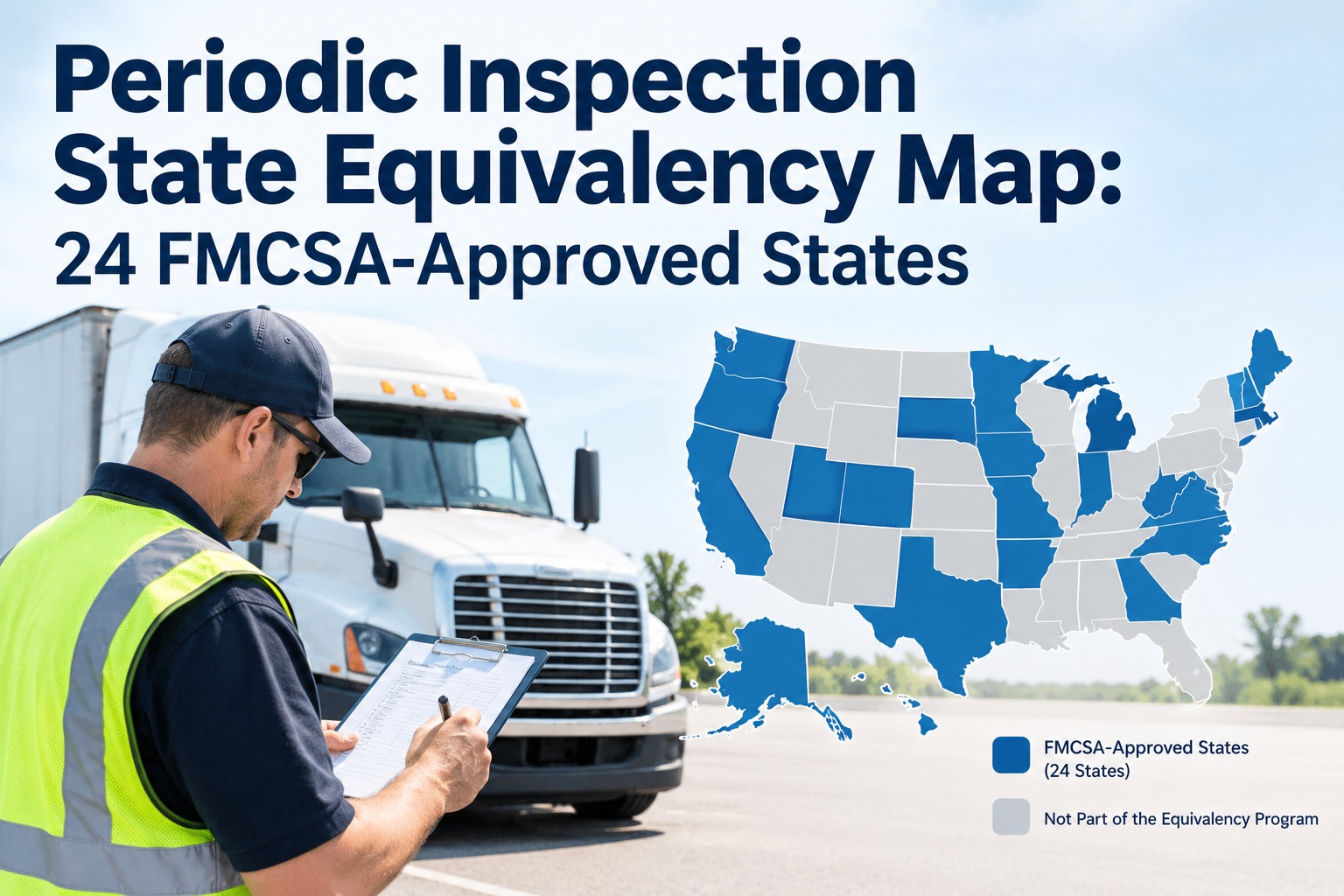
State Equivalent Programs & the Roadside Substitution Rule
Federal §396.17 sets the floor — several states run their own periodic inspection programs that FMCSA has recognized as equivalent, and a passing CVSA roadside inspection can also substitute in specific circumstances.
Frequently Asked Questions
At least once every 12 months for every covered commercial motor vehicle. The rule is component-based: each item in Appendix A to Part 396 must have passed an inspection within the preceding 12 months, or the vehicle is out of service for that specific defect. Each vehicle in a combination counts individually — a tractor-semitrailer-full-trailer combination requires three separate §396.17 inspections and three separate report retention trails. Some states impose stricter cycles: New York requires inspection every 6 months for CMVs over 10,000 lbs GVWR, and California's BIT program requires 90-day periodic inspections for many vehicles over 26,001 lbs GVWR. Whichever cycle is tighter wins. Truck Inspection & Maintenance tracks due dates per vehicle with automated 60/30/7-day alerts across every unit in your fleet.
Under §396.19, a qualified inspector must (1) understand the inspection criteria in Part 393 and Appendix A well enough to identify defective components, (2) have mastered the methods, procedures, tools, and equipment used in the inspection, and (3) meet one of two experience paths — either successfully completed a Federal- or State-sponsored training program or hold a qualifying State/Canadian Province certificate, OR have a combination of training and experience totaling at least 1 year. Qualifying experience includes CMV manufacturer training programs, mechanic or inspector work in a motor carrier maintenance program, mechanic or inspector work at a commercial garage or fleet leasing company, or experience as a commercial motor vehicle inspector for a State, Provincial, or Federal government. The carrier must retain evidence of each inspector's qualifications for the entire period the inspector performs annual inspections for the carrier, plus 1 year after — a common audit failure point.
Coverage extends to: interstate commercial motor vehicles or combinations with a combined GVWR greater than 10,001 lbs; intrastate CMVs with a GVWR over 26,001 lbs; commercial vehicles at any GVWR that transport hazardous materials in placardable quantities; motor coaches and buses designed to transport 16+ passengers including the driver (interstate or intrastate); and vans or mini-buses designed to transport 9-15 passengers for compensation (including airport and hotel shuttles). Each vehicle in a combination is inspected individually: for a tractor-semitrailer-full-trailer combination the tractor, semitrailer, and full trailer (including the converter dolly if equipped) each need their own §396.17 inspection.
Yes, under 49 CFR 396.23. A CVSA Level I inspection performed within the preceding 12 months — where the vehicle passed and every Appendix A component was actually covered — can substitute for the periodic annual inspection required by §396.17. To rely on the substitution, keep the CVSA inspection form in the same file location as the vehicle's periodic inspection records, and track the CVSA inspection date the same way you would a §396.17 report date (12 months forward). If the CVSA inspection did not cover every Appendix A item, or the vehicle was cited on any item, the substitution does not apply and a full §396.17 inspection is still required.
A missing or expired annual inspection triggers an automatic out-of-service order at any roadside inspection — no questions, no exceptions, no grace period. The vehicle cannot move until a new inspection is performed and passed, meaning tow, downtime, missed dispatch, and freight rerouting on top of the compliance penalty. Federal civil penalties for operating a CMV without a current annual inspection can reach $19,277 per instance, with repeat or aggravated violations compounding. The violation also feeds the Vehicle Maintenance BASIC in the FMCSA CSA system, pushing your carrier score higher and increasing the likelihood of interventions, off-site investigations, and insurance premium hikes. Approximately 133,000 annual inspection citations are issued nationally each year, making it the second most common vehicle maintenance violation category in the CSA system.
Under 49 CFR 396.21, the annual inspection report must be retained by the motor carrier for 14 months from the date of the report. The 14-month window is intentional — it's two months past the next 12-month inspection cycle, so a DOT auditor can always compare the current and immediately previous inspection reports together. In addition, a copy of the current inspection report or the inspection decal must be carried on the vehicle at all times. For inspector qualification records under §396.19(b), the retention is different: keep the qualification file for the entire period the inspector performs annual inspections for you, plus 1 year after they stop. Truck Inspection & Maintenance archives every completed inspection report against the vehicle record automatically, retains it through the full 14-month window, and stores each inspector's §396.19 qualification file alongside — one click, ready for audit.
Yes. Under §396.17(d), a motor carrier may perform the required annual inspection for vehicles under its control (not otherwise subject to §396.23(a)(1)). The catch: the person performing the inspection must be qualified under §396.19, and the carrier must maintain both the inspection reports (14 months) and the inspector qualification files (period of service plus 1 year). Under §396.17(e), the carrier may alternatively use a commercial garage, fleet leasing company, truck stop, or similar commercial business as its agent, provided that business operates and maintains facilities appropriate for CMV inspections and employs qualified inspectors under §396.19. Either way, compliance risk stays with the motor carrier — the inspection provider is your agent, not your indemnifier. Try our compliance workflow free.
Turn annual DOT inspection from an audit risk into an automated workflow
Truck Inspection & Maintenance tracks every §396.17 due date across every unit, guides qualified inspectors through digital Appendix A checklists with photo capture and pass/fail gates, auto-generates §396.21-compliant reports, and stores every inspector's §396.19 qualification file alongside the inspections they signed. Automatic 60/30/7-day expiry alerts. 14-month retention built in. One-click audit retrieval. Because a $19,277 penalty and an out-of-service order should never come down to a missed calendar reminder.