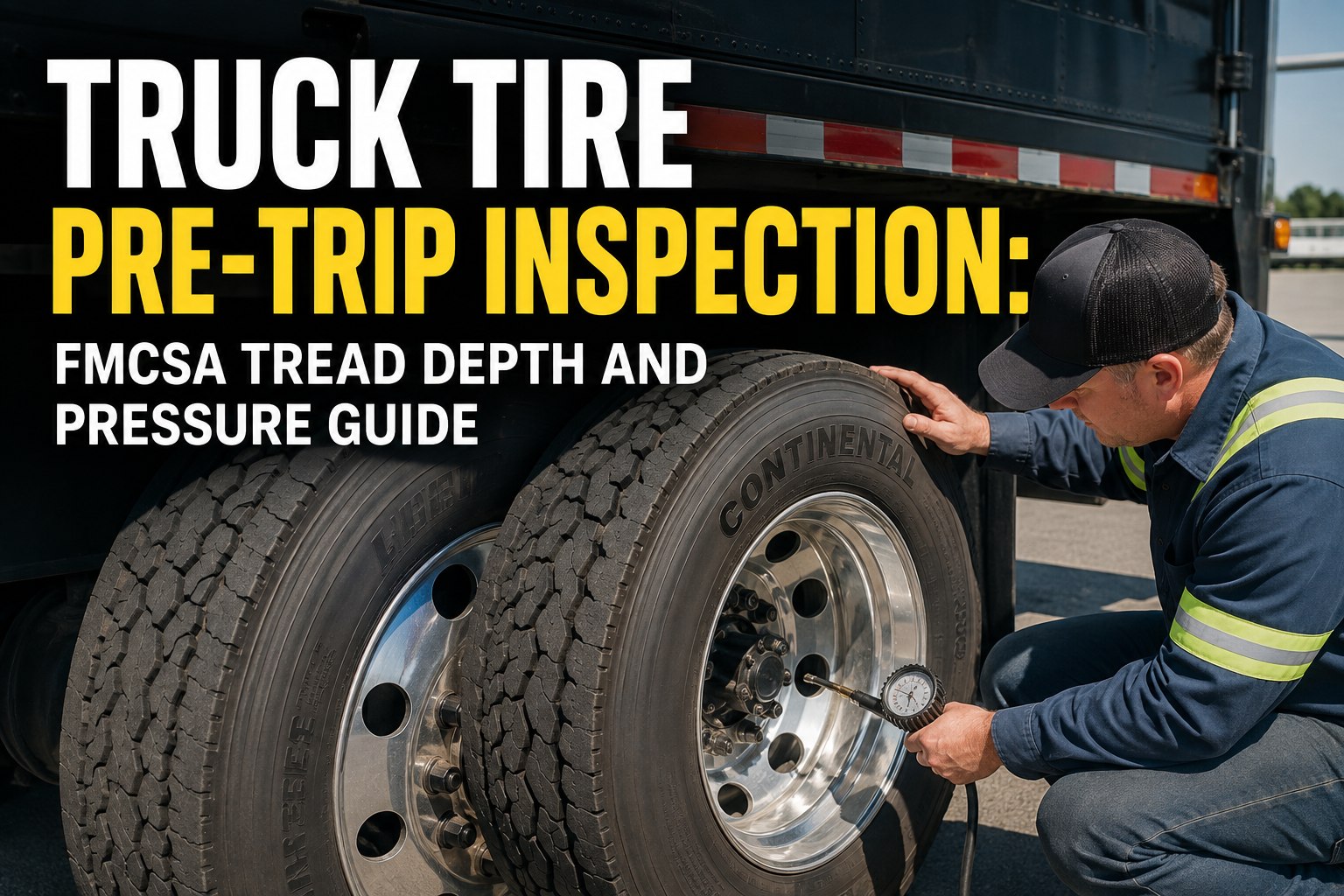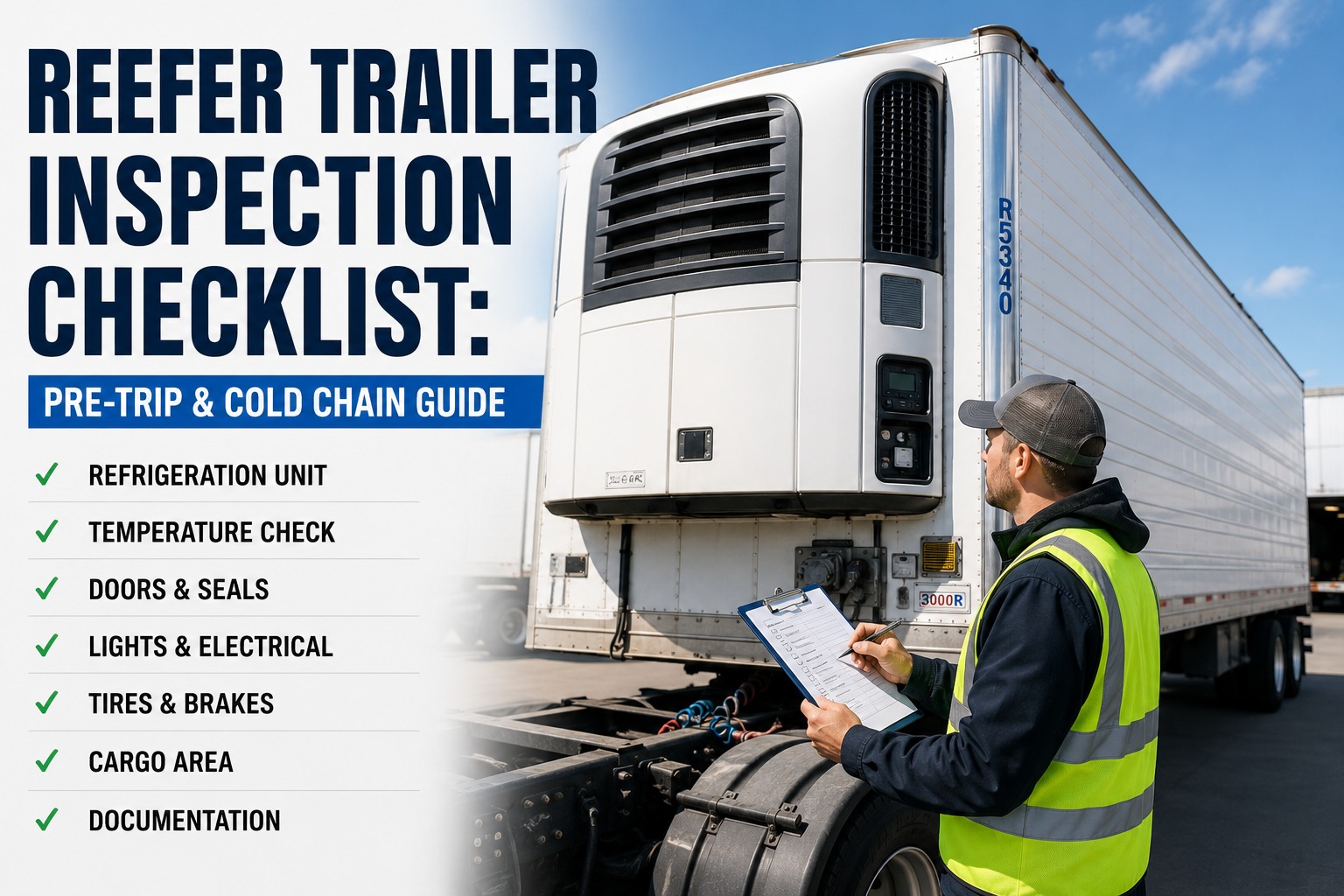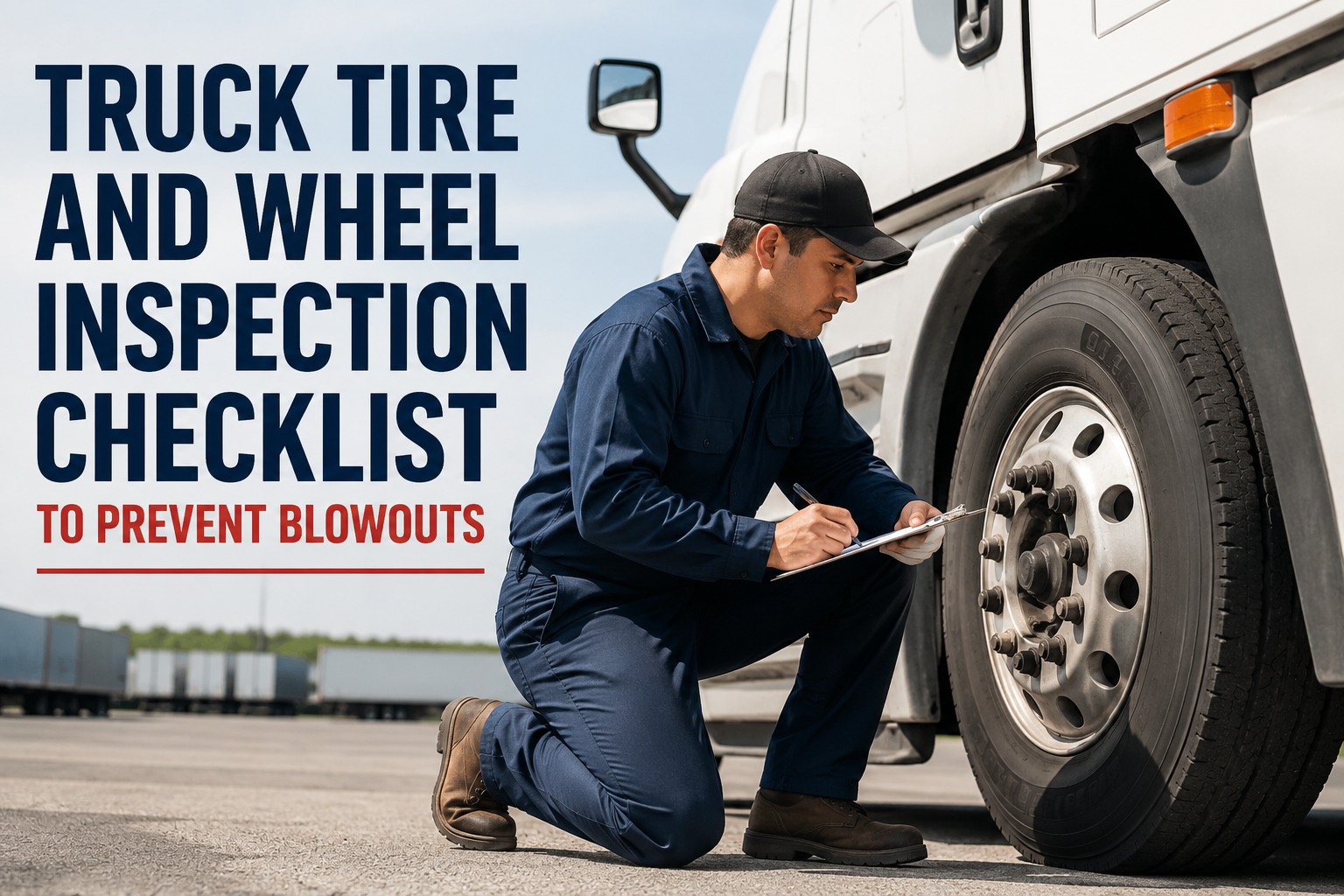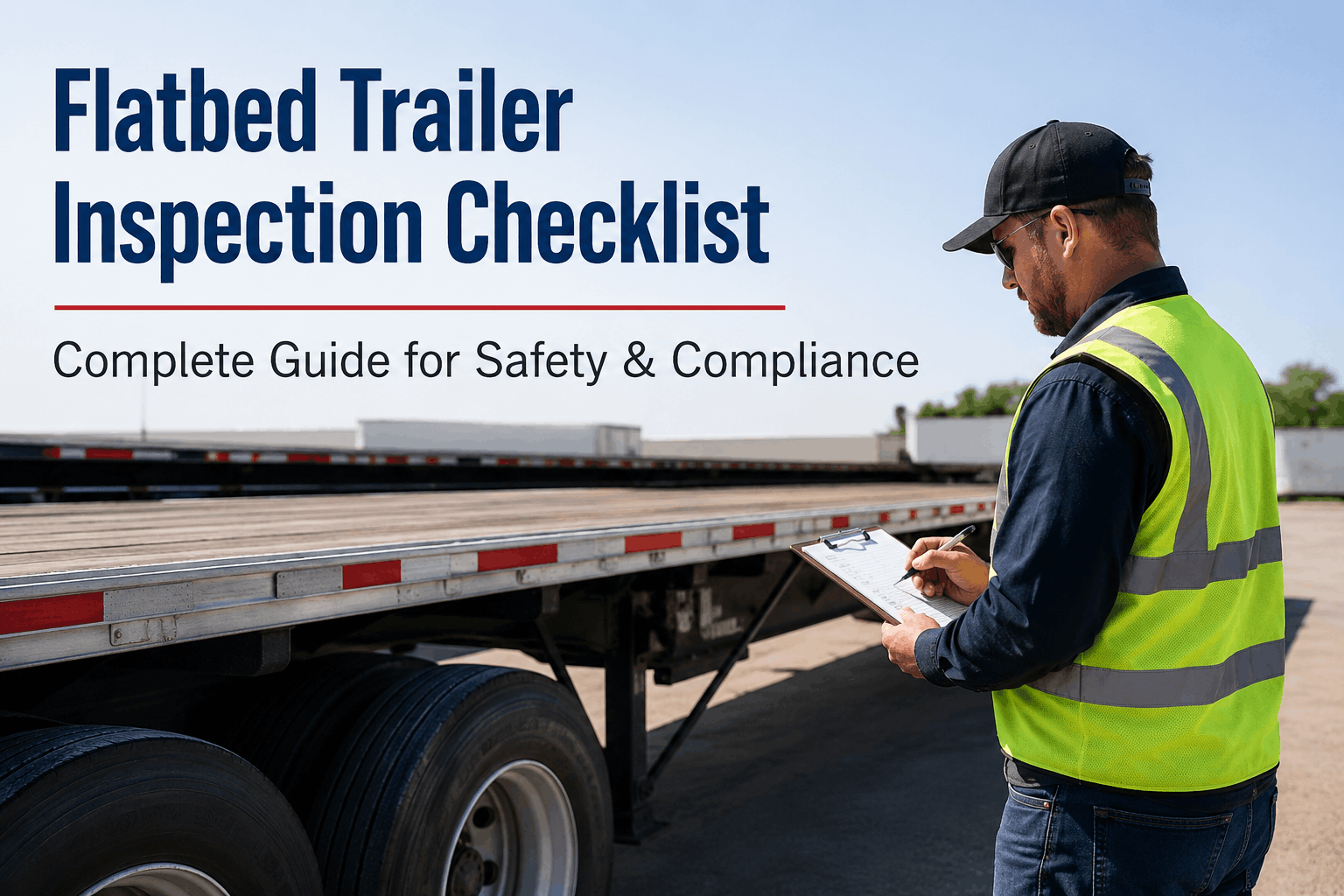
Trailer tires and wheels produce more roadside violations than any other single asset on a tractor-trailer combination — 21.4% of all vehicle out-of-service orders at the 2025 CVSA International Roadcheck came from tires alone, and trailer positions carry a disproportionate share of those citations because drivers inspect the tractor thoroughly and then rush past the trailer. The physics of the problem is that a trailer has more tires than the tractor (8 on a typical dry van, 12 on a set of doubles), each running under load without a driver in the seat to feel a vibration or a pull. The regulatory picture is that FMCSA §393.75 sets a hard 2/32" tread depth floor on trailer positions, but out-of-service goes further — a single major groove below 2/32, an exposed belt, an audible leak, a missing lug, or a leaking wheel seal are all immediate OOS conditions that end the shift on the shoulder. This checklist is the field-ready reference — every measurement, every torque spec, every look-here-not-there detail an inspector or roadside enforcement officer will check on your trailer before you do. Sign up free for Truck Inspection & Maintenance today — no credit card required to run this checklist digitally on every trailer, every trip, or contact our team for a printable trailer inspection template configured to your trailer types and axle counts.
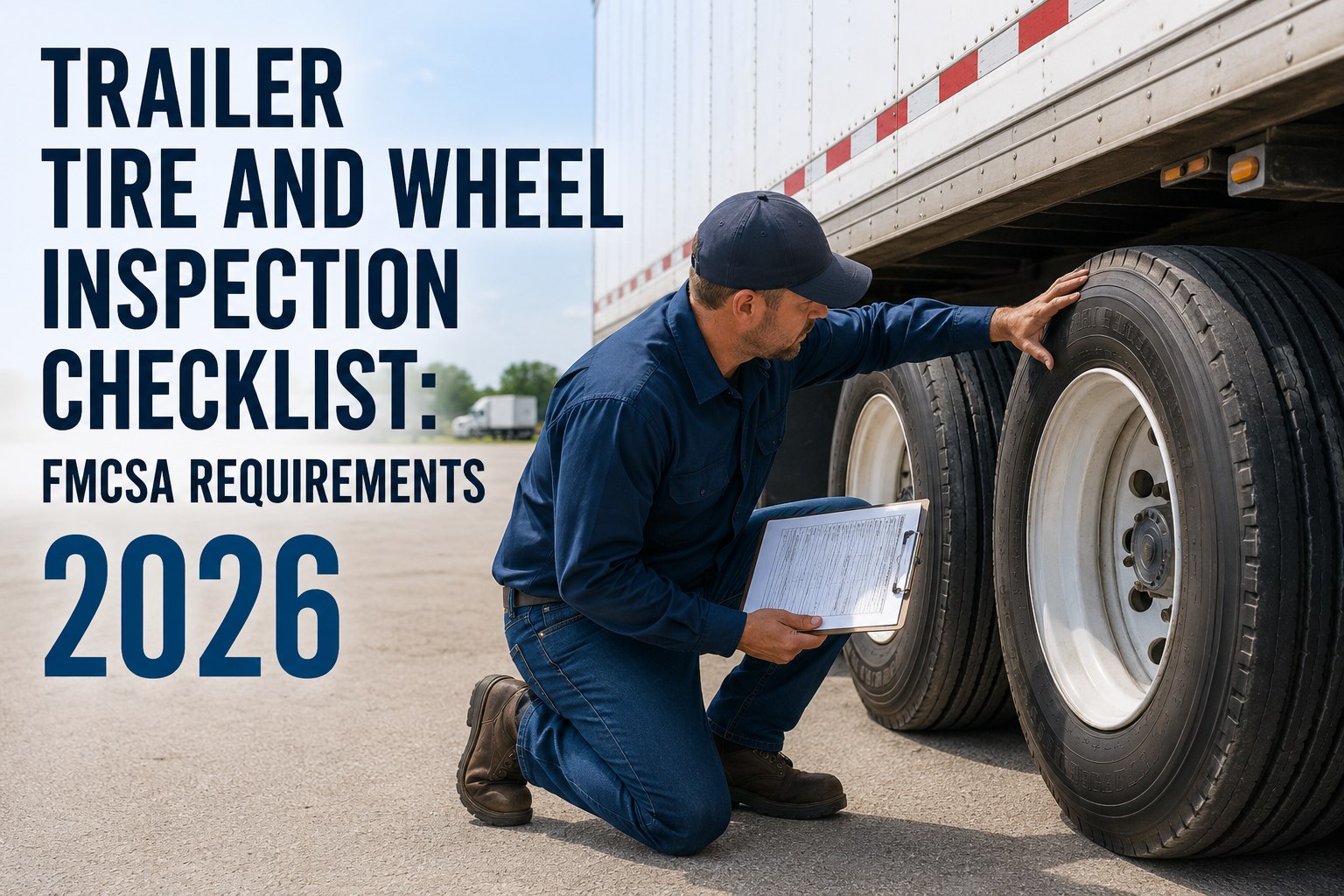
Trailer Tire & Wheel Inspection Checklist: FMCSA Requirements 2026
Every measurement, torque spec, and look-here-not-there detail an inspector will check before you do. Built for trailers that carry a disproportionate share of every roadside OOS the fleet sees.
The 5 OOS Conditions That End the Shift on the Shoulder
Before the full checklist, these are the five findings that put a trailer immediately out of service under CVSA criteria — the driver cannot move the vehicle until repaired. Any single one is an instant OOS; the checklist below prevents them from being found by an inspector instead of by you.
Section 1 · Tire Condition (per tire, per position)
Walk every tire on the trailer. Standard dry van has 8 tires (4 axles, 2 per side, dual-mounted on drives). Set of doubles has 12. Every position, every trip. This section is the single biggest CSA-scoring category on trailer inspections.
Section 2 · Wheel & Rim Condition
The wheel and rim are what nobody looks at until the truck is on the shoulder. Cracks propagate slowly, then fail catastrophically. Every position, every trip.
Section 3 · Hub, Bearing & Wheel Seal
Wheel seal failure is the single most consequential mechanical event on a trailer. A leaking seal means the bearing is losing lubrication. A dry bearing overheats, seizes, and the wheel separates from the axle. If any of the following is found, the trailer is OOS until repaired — no exceptions.
Run this exact checklist on every trailer, every trip — from the driver's phone
Digital checkpoints with photo capture per position. Tread depth logged per major groove. Lug torque and hub temp thresholds enforced. Defects auto-route to the shop with GPS and timestamp.
The Tread Depth Reference Card
The specs that decide the ticket. Print this and put it in every trailer cab, or run it digitally on the app. §393.75 numbers are federal minimums — CVSA out-of-service triggers slightly differently, and best-practice replacement points are more conservative than either.
| Position | FMCSA Minimum §393.75 | CVSA OOS Trigger | Best-Practice Replacement |
|---|---|---|---|
| Steer axle | 4/32" | Below 2/32" in 2 adjacent grooves | 6/32" |
| Drive axle | 2/32" | Below 1/32" in 2 adjacent grooves | 4/32" |
| Trailer axle | 2/32" | Below 1/32" in 2 adjacent grooves | 4/32" |
| Dolly / spare | 2/32" | Below 1/32" in 2 adjacent grooves | 4/32" |
The 10-Point Trailer Wheel-End Round · 3-Minute Version
The compressed version for pre-trip use. If you don't have the full checklist time, this is the minimum every driver should complete at every trailer before hitting the road.
What This Checklist Prevents — By the Numbers
The checklist isn't compliance theater. Trailer tire and wheel violations produce measurable ROI at scale — here's what changes when a fleet runs it digitally on every pre-trip.
Frequently Asked Questions
Under 49 CFR §393.75, the minimum legal tread depth for trailer tires is 2/32 of an inch, measured in any major tread groove. Steer axle tires require a higher minimum of 4/32". Drive axle and trailer axle tires share the 2/32" minimum. If any single major groove on a trailer tire measures below 2/32" anywhere on the tire, that tire is out of service — the truck cannot legally move until it's replaced. CVSA out-of-service criteria are slightly different: a trailer tire is placed OOS when tread depth measures below 1/32" in two adjacent major grooves at three separate locations around the tire's circumference. Most professional carriers set an internal minimum of 4/32" to give scheduling headroom — a tire pulled at 4/32" has roughly 20,000 miles before it hits the federal floor, enough to plan the replacement into a scheduled shop visit.
Five conditions immediately put a trailer OOS on the roadside: (1) tread depth below 2/32" in any major groove; (2) any exposed body ply, belt material, or steel cord through the tread or sidewall; (3) any flat tire or audibly leaking tire — §393.75(a)(3) is one of the most-issued vehicle citations annually; (4) any missing lug nut, with rust trails from nut to rim treated as a walking-loose warning that's cited the same way; (5) any oil leak from the wheel seal or hub area, because a leaking seal means the bearing is losing lubrication and is on the path to seizing and separating. Any one of the five ends the shift at the shoulder — the driver cannot move the vehicle until repaired. Prevention is entirely about running the checklist before an inspector does.
Torque verification requires a calibrated torque wrench — never an impact gun for final torque. Typical trailer wheel lug torque is 450-500 ft-lbs, but always verify against the OEM manual for your specific hub and wheel combination. On daily pre-trip inspection, torque verification is visual: count all lugs, look for rust trails or shiny arcs radiating from any nut (which indicate the nut has walked loose enough to fret against the rim), and check for distortion around bolt holes. On PM interval, use a calibrated torque wrench to verify actual torque on every lug on every wheel. Re-torque after 50-100 miles on newly installed wheels — a critical step most fleets skip and then wonder why lugs walk. Over-torque stretches studs and causes fatigue cracks; under-torque lets the wheel fret against the hub pilot, damaging both. Try the platform free to see torque logging enforced per PM.
Walk to the back of each wheel and inspect the hub face, the wheel face, the brake drum, and the ground beneath. Look for oil residue, wet streaks, or accumulated grime that indicates seepage. Any visible oil is an immediate out-of-service finding — not a "watch it" item. On sight-glass hubs, verify oil is visible at the fill line and is clear (not milky or discolored). Milky oil means water contamination and requires immediate service. Brown or black oil means bearing wear is producing metal particles. On post-trip, use the back of your hand — never bare skin — on each hub after arrival. A hub running dramatically hotter than adjacent hubs indicates bearing wear or brake drag developing. Log the finding before it fails. A leaking wheel seal on the road becomes a seized bearing, then a separated wheel, then a fatal incident — every stage is preventable at inspection.
Two reasons. First, physics: a typical dry van trailer has 8 tires (4 axles × 2 sides, mostly dual-mounted); a set of doubles has 12. That's more surface area, more positions to fail, and each tire runs under load without a driver in the seat to feel a vibration or a pull. Second, human nature: drivers inspect the tractor thoroughly because it's what they drive, then rush past the trailer because it's just "the box" behind them. During the 2025 CVSA International Roadcheck, tire violations accounted for 21.4% of all vehicle out-of-service orders, and trailer positions were disproportionately represented in that number. Trailers also swap between tractors during the day in most fleets, which creates documentation gaps — the driver who inspected the trailer at 6 AM isn't the one hooking to it at 3 PM. Digital inspection systems that link trailer inspections to specific tractor-trailer combinations close this gap.
Only within strict limits, and never on the sidewall. Tread punctures up to 1/4" in diameter may be repaired with a proper plug-and-patch combination applied from inside the tire — a plug alone is not a compliant repair. Sidewall repairs are prohibited on any position of any commercial vehicle regardless of the puncture size — a sidewall injury means tire replacement. Multiple visible plugs on the tread face indicate a failing tire that should be pulled. Shoulder punctures (where the tread transitions to the sidewall) are treated as sidewall damage — not repairable. An improper repair discovered at roadside is an OOS finding under §393.75. When in doubt, replace — a $600 tire is cheaper than a $1,500 roadside call plus violation points on the CSA record. Contact our team for a tire-repair policy template.
Every pre-trip and every post-trip under 49 CFR §392.7 and §396.13, plus at every PM service interval, plus at every driver changeover on trailers that swap between tractors during the day. Documentation is the compliance requirement — an inspection that happened but wasn't recorded may as well not have happened when an auditor asks. Digital inspection systems solve this by making the documentation automatic: tread depth logged per major groove, photo of any defect auto-attached with GPS and timestamp, defects routed directly to the shop with a work order opened. Paper checklists are still legal but they fail two ways in practice: drivers skip fields to save time (leaving audit gaps), and paper records get lost, water-damaged, or filed incorrectly. FMCSA published a February 2026 final rule (effective March 23, 2026) explicitly authorizing electronic DVIRs, removing any remaining ambiguity about digital inspection as the standard.
Run this checklist on every trailer, every trip — from the driver's phone
Digital tread-depth logging per major groove, photo-verified defects, lug torque tracking, wheel-seal inspection routing to shop, and full FMCSA-aligned audit trail. Built for fleets that want to cut the 21% of OOS violations trailer tires cost them.