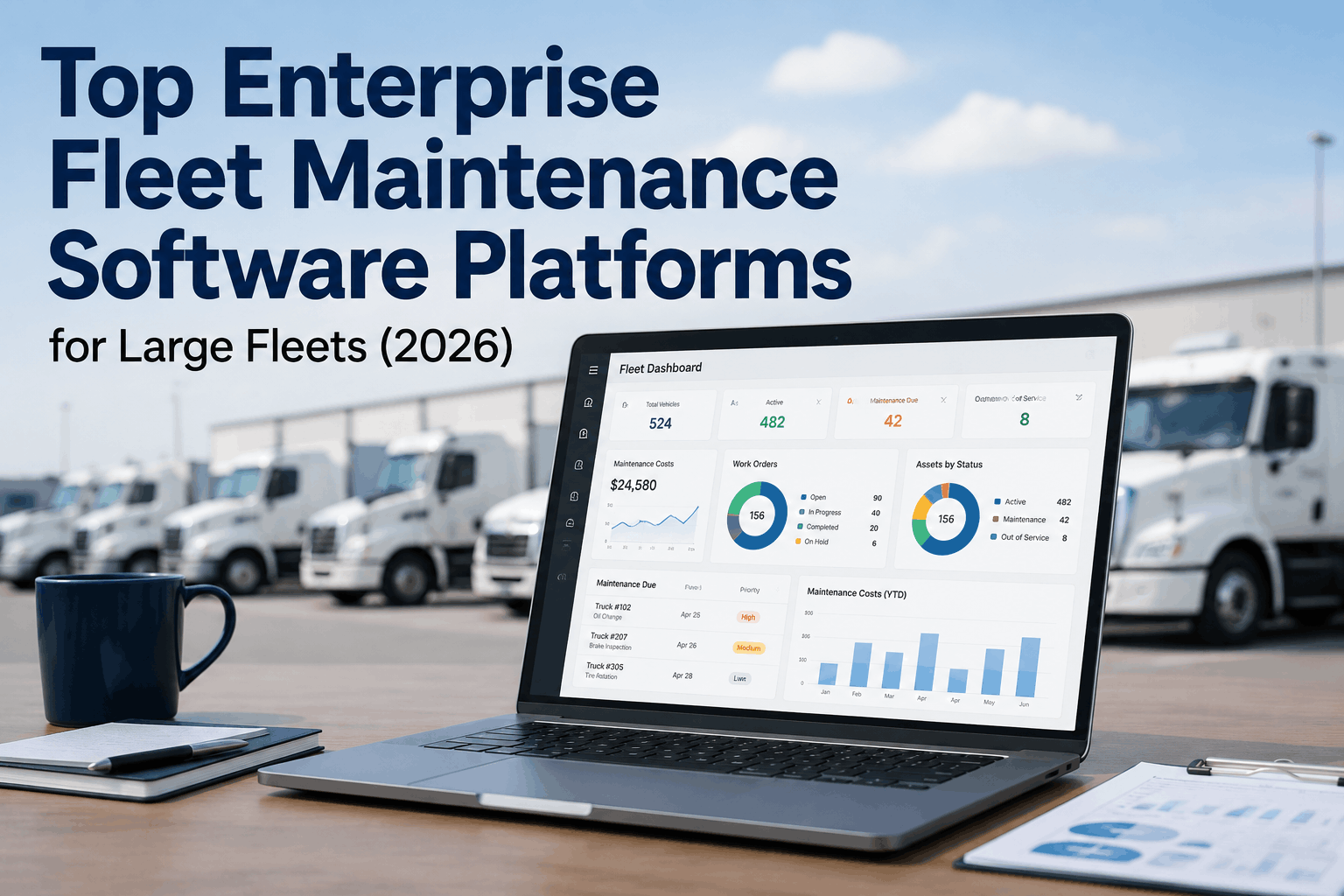
The 2026 truck inspection and maintenance software landscape spans four main categories: telematics-first platforms such as Samsara, Motive, Verizon Connect, and Geotab; maintenance-first platforms focused on PM scheduling and work orders; inspection-first platforms built around DVIR and defect workflows; and all-in-one platforms that combine tracking, inspections, and maintenance. Each category solves a different operational problem, so choosing based on your fleet’s biggest pain point—whether it’s ELD compliance, missed PMs, reactive maintenance, or DVIR completion—is more important than simply comparing feature lists. This buyer’s overview compares the top platforms by strengths, limitations, hardware needs, pricing transparency, and ideal fleet type to help you choose the right fit. Ready to evaluate a purpose-built solution? Sign up free for Truck Inspection & Maintenance today — no credit card required, or contact our support team for a personalized walkthrough based on your fleet size and operational needs.
Top Truck Inspection and Maintenance Platforms Compared for 2026
Four platform archetypes. Seven leading platforms. One decision framework. Match the platform to your operational pain — not a generic feature checklist.
The 4 Platform Archetypes — Match Category to Problem
Before evaluating individual platforms, identify which archetype fits your operational problem. Choosing the wrong archetype is what causes most implementations to fail regardless of platform quality.
Platform-by-Platform Comparison
Seven leading 2026 platforms with what they do best, where they fall short, hardware requirements, and which fleet type they serve. Neutral overview — no ranked "winner."
8-Dimension Evaluation Matrix
Evaluate every platform against these 8 dimensions. Score each dimension 1-5 based on demonstrated capability in your specific operational context, not the sales deck.
Test a purpose-built inspection-and-maintenance platform on your own fleet data
Mobile-first § 392.7 DVIR with all 11 items covered. § 396.13 3-signature chain enforcement. First-to-occur PM scheduling across mileage/hours/calendar. Aftertreatment fault code severity classification. FMCSA-ready audit export. No proprietary hardware — smartphone-native across iOS and Android. Transparent pricing with free trial. Truck Inspection & Maintenance software was built specifically for fleets where DVIR quality and PM discipline are the primary pain points — because getting the archetype match right is what separates 30-40% failed implementations from platforms fleets actually keep using.
Decision Framework by Fleet Size & Priority
The right platform depends on fleet size and primary priority. Use this decision framework to narrow options before deep evaluation.
Frequently Asked Questions
There is no single "best" platform because the 2026 fleet software market has four distinct archetypes serving fundamentally different operational problems. Telematics-first platforms (Samsara, Motive, Verizon Connect, Geotab) lead when GPS tracking, driver safety, and ELD compliance are the primary need. Maintenance-first platforms (Fleetio, Truck Inspection & Maintenance) lead when PM discipline and cost tracking are the primary pain. Inspection-first platforms (Truck Inspection & Maintenance, Whip Around) lead when DVIR quality and defect routing are the biggest gaps. Integrated all-in-one platforms (Fleet Rabbit, Motive, Samsara) attempt all three with varying depth trade-offs. Choosing the wrong archetype for your #1 operational problem is what causes 30-40% of fleet software implementations to fail — the platform can be excellent in its category and still miss your actual pain. The correct evaluation approach: identify your #1 operational problem specifically (DVIR completion below 90%? PM compliance below 85%? ELD compliance gaps? GPS tracking absent?), pick the archetype that solves it deepest, then evaluate whether secondary modules meet minimum viable requirements or need to be paired via integration. Truck Inspection & Maintenance software serves fleets whose primary problem is DVIR quality and PM discipline.
It depends on the platform archetype. Telematics-first platforms like Samsara and Motive require proprietary vehicle gateway devices costing $99-$500 per truck upfront, plus ongoing subscription. This hardware enables GPS tracking, ELD compliance, and AI dash cam features — genuine capabilities that require in-vehicle sensors. Maintenance-first platforms like Fleetio and Truck Inspection & Maintenance work with existing smartphones and existing ELD devices — no new hardware investment required, deployment in 1-2 weeks vs 6-12 weeks for hardware-based platforms. Inspection-first platforms are entirely smartphone-native. Integrated all-in-one platforms like Fleet Rabbit take the smartphone approach and integrate with third-party ELDs and telematics. The trade-off: hardware-based platforms deliver richer real-time data (exact truck location every 30 seconds, driver behavior scoring, video incident capture) but create lock-in — switching platforms means either buying new hardware or stranding the existing devices. Smartphone-native platforms sacrifice some data depth but eliminate lock-in and drop entry cost to near zero, making pilot deployments and platform switches materially easier.
Pricing spans a wide range depending on platform tier and hardware requirements. Free tier: Fleet Rabbit offers a free plan for up to 3 vehicles with no credit card. Entry tier: $3-$5 per vehicle per month for smartphone-native platforms (Fleet Rabbit, Fleetio starts at $4). Mid tier: $15-$40 per vehicle per month for platforms including some hardware or advanced features. Enterprise tier: $60+ per vehicle per month for premium hardware-based platforms (Samsara, Motive) with full telematics, AI dash cams, and enterprise features. Only Fleetio and Fleet Rabbit publish transparent per-vehicle pricing among major platforms; Samsara, Motive, Verizon Connect, and Geotab use custom quotes that scale with fleet size, feature bundle, and contract length. Beyond monthly subscription, evaluate: hardware upfront cost ($99-$500/truck for telematics platforms), installation fees, multi-year contract commitments (often 3+ years for hardware-based platforms), and true total cost of ownership across year 1 and year 3. For most fleets, payback runs 60-90 days through prevented violations ($1,000-$16,000 each), avoided breakdowns ($2,500-$9,000 average), and admin time savings.
This is the central architectural decision. All-in-one platforms (Fleet Rabbit, Motive, Samsara) simplify vendor management, unified billing, single dashboard, no integration maintenance. Best-of-breed with integration (e.g., Truck Inspection & Maintenance for DVIR + Fleetio for maintenance + Samsara for telematics + Whip Around integrations) delivers deeper capability in each area but requires managing multiple vendors and ensuring integrations stay healthy. The correct choice depends on fleet size and problem depth. Small-to-midsize fleets (5-50 trucks) with moderate problems in all areas usually benefit from all-in-one — the depth trade-offs matter less than vendor consolidation. Mid-to-large fleets (50+ trucks) with a severe problem in one area typically benefit from best-of-breed — a specialist platform for the severe problem plus integrations for adjacent capabilities. Compliance-heavy operations often need best-of-breed because ELD compliance failures cost thousands per violation, and all-in-one platforms rarely match specialist ELD depth. The false choice: "all-in-one" doesn't mean "best in every category" — it means "adequate in most categories with a single vendor." Choose accordingly. Contact our team for a Truck Inspection & Maintenance architecture consultation.
Test 8 specific capabilities in your own operational environment before signing any contract. (1) Offline mode — put phone in airplane mode, complete a full work order including photo, parts log, and signature. Failure = platform not truly mobile-first. (2) DVIR completion on actual truck — time a driver completing a full § 392.7 inspection; anything over 15 minutes signals adoption problems. (3) QR code scan to asset — should load full truck history in under 2 seconds. (4) Defect routing time — driver reports a defect; measure minutes until maintenance is notified. (5) PM schedule creation with first-to-occur triggers across mileage, hours, and calendar — verify all three trigger types work simultaneously. (6) Fault code capture and severity classification — feed a real SPN 5246 through the platform, confirm root-cause vs masking-code identification. (7) Audit export — generate a 90-day DVIR history export in FMCSA-compliant format; time the process. (8) Reference customer conversations with fleets of your size and vertical — ask specifically about adoption rate at 30 and 90 days, not aspirational marketing metrics. Any platform vendor unwilling to enable these tests with real data is not the right vendor.
Timeline varies dramatically by platform archetype and hardware requirement. Smartphone-native platforms (Fleet Rabbit, Fleetio, Truck Inspection & Maintenance, Whip Around): 1-2 weeks from contract to full deployment. No hardware installation, no vehicle downtime, mobile app downloads on existing devices, PM templates migrated from prior system or built from OEM defaults, driver training via in-app tutorials. Hardware-based platforms (Samsara, Motive, Verizon Connect, Geotab): 6-12 weeks typical. Vehicle gateway installation across the fleet (30-60 minutes per truck), calibration, driver training, integration configuration, data migration from prior systems. Enterprise deployments with custom integrations can extend to 12-18 months for full rollout across large fleets. Adoption timeline is separate from technical deployment: even smartphone-native platforms need 30-90 days for driver and technician adoption to reach 80%+ levels. Payback typically runs 60-90 days from full deployment through prevented violations, avoided breakdowns, and admin time savings. The single biggest predictor of successful implementation is not platform capability — it's rollout quality with technician involvement and staged adoption. Try free: sign up here.
Truck Inspection & Maintenance software solves the DVIR quality and PM discipline archetype specifically
Mobile-first native app with full offline capability. § 392.7 11-item DVIR coverage. § 396.13 3-signature chain-of-custody enforcement. First-to-occur PM scheduling across mileage, hours, and calendar. FMCSA-ready audit export. No proprietary hardware — deploy in 1-2 weeks. Built for the DVIR quality and PM discipline archetype specifically.