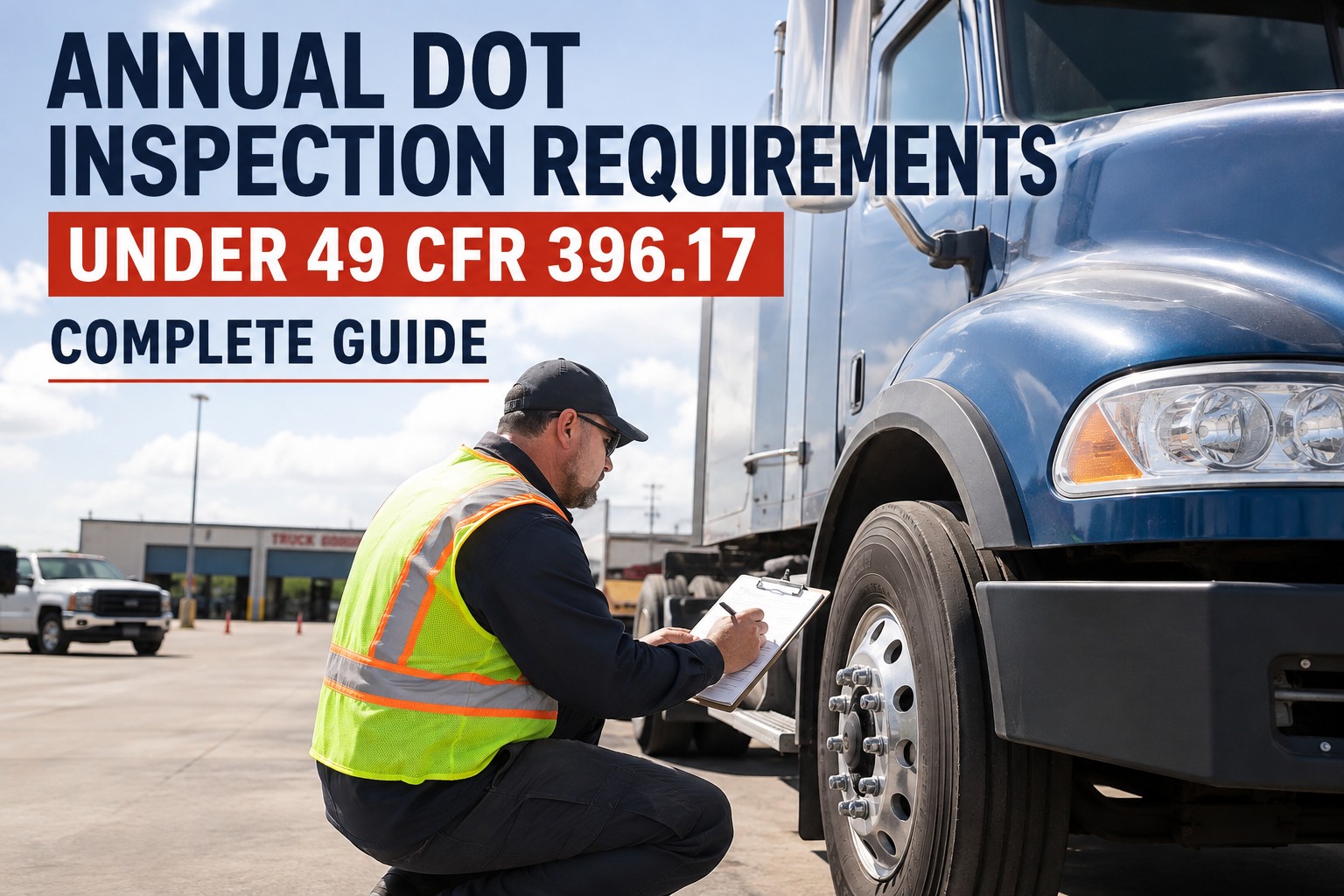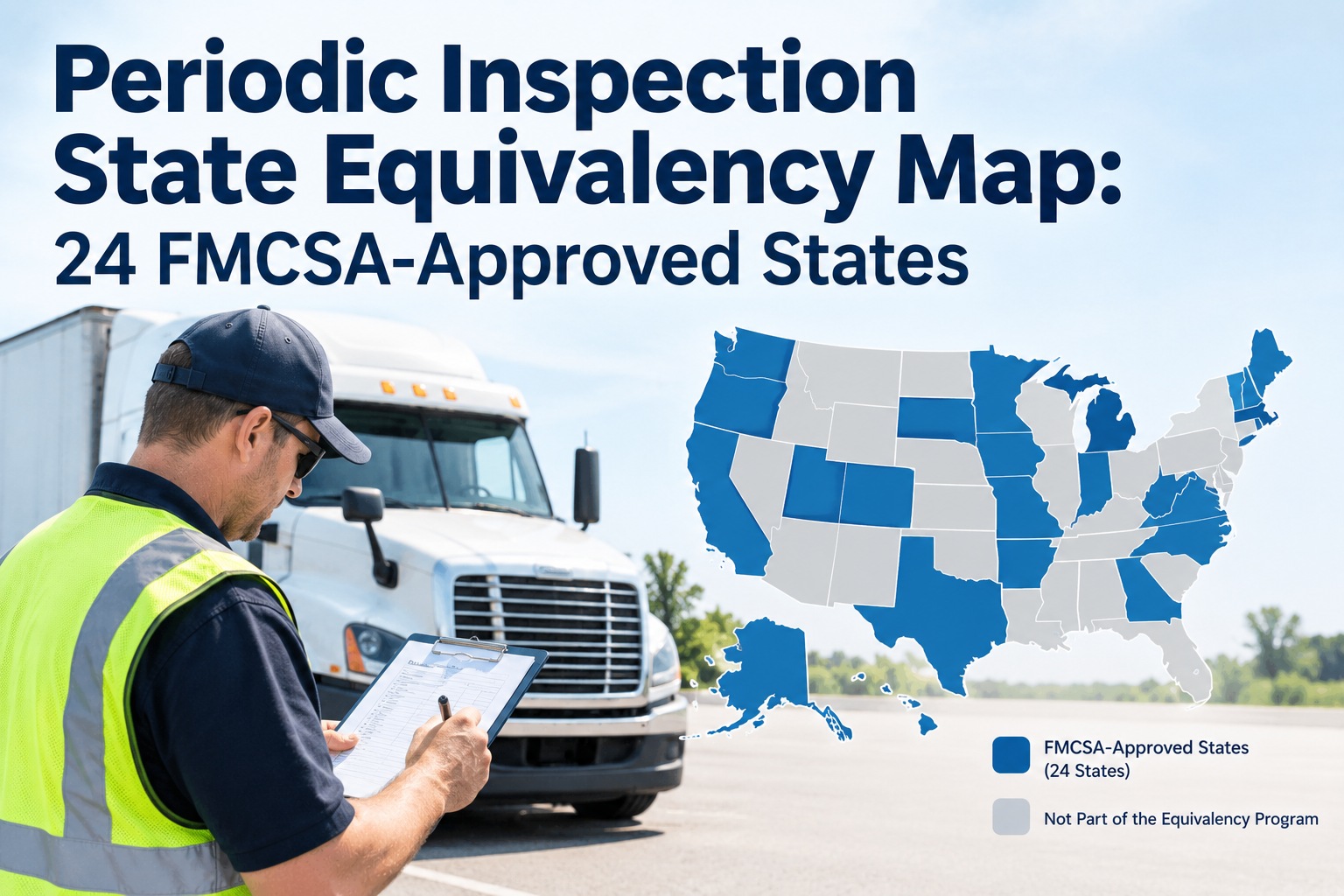
Here's a compliance trap that catches fleets in both directions: in 24 jurisdictions 23 states plus DC — FMCSA has deemed the state's own periodic inspection program equivalent to the federal annual inspection, and under 49 CFR §396.23 you must satisfy the federal requirement through that program, not around it. In every other state you run your own annual inspection under §396.17 with a §396.19-qualified inspector. Get it backwards and you either skip a federal requirement your state sticker didn't actually cover, or pay for federal inspections you were required to get through the state. This is the current state-by-state map, plus the scope catch that trips people up. Truck Inspection & Maintenance tracks each truck's inspection type, jurisdiction, and expiry so nothing lapses across state lines — start a free trial or contact our team.
Periodic Inspection State Equivalency Map: 24 FMCSA-Approved States
In these jurisdictions the state program is your federal annual inspection — and you must use it. Everywhere else, you run your own under §396.17. Here's the full map.
How State Equivalency Actually Works
Three rules govern the whole system. Get these and the map makes sense:
The 24 Approved Jurisdictions
The current FMCSA-recognized list. Green tiles cover commercial trucks broadly; amber tiles are scope-limited — read the catch below before you rely on one:
The Scope Trap — Being "On the List" Doesn't Mean Your Truck Is Covered
This is where fleets get burned. Several approved programs cover only part of the fleet — Alabama's applies to LPG carriers, and some states ran bus-only programs. If your truck class isn't in scope, you're back to a §396.19-qualified federal annual. So the real question isn't "is my state on the list?" — it's "does the program actually cover this vehicle?" Verify scope per vehicle class, not per state. Start a free trial and tag each truck with its inspection type and jurisdiction so scope is never a guess.
Which Path Applies to You — A Quick Decision
Two questions settle it for any vehicle in your fleet:
Either way, keep the report 14 months and the current sticker/report/decal on the vehicle. Each unit in a combination needs its own inspection — a tractor-semitrailer-full trailer is three separate annuals.
Tag every truck with its inspection type, state program, and expiry — so nothing lapses when a unit crosses a state line.
Purpose-built for trucking, the platform connects drivers, mechanics, and managers with mobile DVIRs, PM reminders, digital work orders, and audit-ready reports — tracking each vehicle's inspection path so state-vs-federal is never a guess at the scale house. Start a free trial or talk to our team.
Frequently Asked Questions
How many states have FMCSA-equivalent inspection programs?
Twenty-four jurisdictions — 23 states plus the District of Columbia: Alabama (LPG), California, Connecticut, DC, Hawaii, Illinois, Louisiana, Maine, Maryland, Massachusetts, Michigan, Minnesota, New Hampshire, New Jersey, New York, Ohio, Pennsylvania, Rhode Island, Texas, Utah, Vermont, Virginia, West Virginia, and Wisconsin. FMCSA also accepts the 10 Canadian Provinces, the Yukon, and Mexico's NOM-068.
Does a state inspection satisfy the federal annual inspection?
Yes — if the state's program is FMCSA-approved and covers your vehicle class. Under §396.17(f) a passing inspection counts as the federal annual for 12 months from the last day of the month it was performed, and every other state must accept it. In a covered state, §396.23 makes using the state program mandatory.
What's the "scope trap" with approved states?
Some approved programs cover only part of the fleet — Alabama's applies to LPG carriers, and some states have run bus-only programs. If your truck isn't within the program's scope, you still need a §396.19-qualified federal annual. Always verify coverage per vehicle class, not just whether the state is on the list.
Can I do my own annual inspection in an approved state?
Not for vehicles the state program covers — §396.23 requires you to satisfy the requirement through that program. For vehicles outside the program's scope, or in states with no approved program, you may self-inspect with a §396.19-qualified inspector or use a qualified third party.
What happened to Arkansas and Oklahoma?
Both were removed from the equivalency list. Arkansas dropped its bus inspection program and Oklahoma repealed its inspection requirement, so neither carries an FMCSA-approved program today. Fleets there now meet the annual requirement under §396.17 with a qualified inspector like any non-program state.
How does Truck Inspection & Maintenance help across state lines?
It tags each vehicle with its inspection type, governing jurisdiction, and expiry date, sends renewal reminders before the 12-month window closes, and keeps the report and sticker records audit-ready — so a truck operating across multiple states never lapses or double-pays. Start a free trial or contact us.
The list tells you which states have a program. The scope tells you whether it covers your truck. Get both right and the annual inspection stops being a gamble.
Track every vehicle's inspection type, jurisdiction, and expiry in one platform — with reminders before the window closes and audit-ready records on demand, so state-vs-federal is settled before a roadside inspector ever asks.