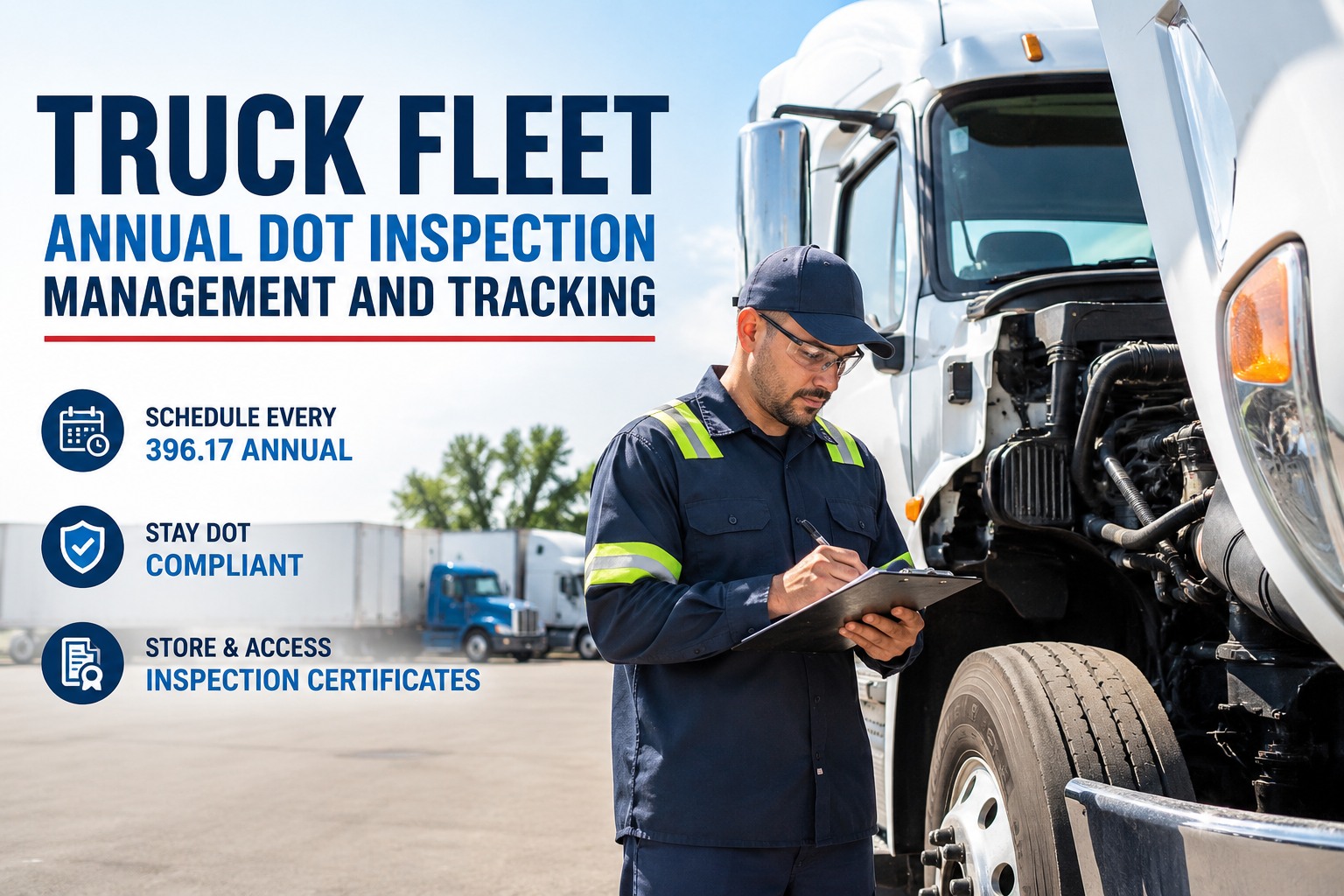
Here's how 49 CFR 396.17 actually catches fleets: a truck pulls into a scale house, the brakes feel fine, the truck looks fine — then the officer asks for proof of the annual inspection, and the entire stop turns on paperwork, a date, and whether defects were fixed. Miss it, and the truck goes out of service on the spot. Every commercial motor vehicle in the U.S. must pass a comprehensive annual periodic inspection at least once every 12 months, the certificate must be carried on the vehicle at all times, and the report must be retained for 14 months — yet annual-inspection violations remain one of the top FMCSA audit findings, with roughly 133,000 citations issued every year. Civil penalties reach $16,000 per vehicle per day, and repeat violations can suspend operating authority. The failure point is almost never the wrench work — it's tracking due dates, inspector credentials, and certificates across a fleet. This guide covers the rule, the Appendix A scope, the required report, retention, and how to manage it all. Truck Inspection & Maintenance schedules every 396.17 annual and stores the certificate for instant roadside proof. Talk to our team to set it up.
Annual DOT Inspection Management & Tracking
Schedule every annual, store every certificate, prove it roadside in seconds.
The Rule in Four Questions
The annual inspection requirement comes down to who, what, when, and the record. Get all four right on every unit and you're compliant; miss any one and it's a roadside out-of-service order or an audit finding. This is the framework to manage against. Start a free account to track all four automatically per vehicle.
When
At least once every 12 months, per vehicle. Each unit in a combination — tractor, trailer, dolly — counts separately and needs its own inspection.
What
Every component category in Appendix A to Part 396 — brakes, steering, suspension, frame, tires, lighting, coupling, fuel, exhaust, and more.
Who
A qualified inspector under 49 CFR 396.19 — knowledge of Part 393 & Appendix A plus a training program or 1+ year of experience.
Record
A signed report meeting 396.21, the certificate carried on the vehicle, and the report retained for 14 months — available on demand.
Appendix A — What Gets Inspected
The annual covers the safety-critical component categories defined in Appendix A to Part 396. An inspector works every one against the Part 393 standards. Here's the scope at a glance. Reach our team to attach component-level results and photos to each annual.
Brake systems
Service, parking & emergency brakes, linings, drums, air system
Steering mechanism
Steering wheel free play, column, gear box, linkage, power steering
Suspension
Springs, hangers, U-bolts, axle attachment, air suspension
Frame
Frame members, cross-members, no cracks or sagging
Coupling devices
Fifth wheel, pintle hooks, safety devices, saddle mounts
Tires & wheels
Tread depth, condition, rims, fasteners, locking rings
Lighting devices
All required lamps & reflectors operative
Fuel & exhaust
Secure fuel system, no leaks; exhaust clear of leaks & hazards
Windshield, wipers & more
Glazing, wipers, horn, mirrors, windshield, emergency exits
Never miss an anniversary date again
Truck Inspection & Maintenance tracks every vehicle's annual due date, sends 60- and 30-day alerts, stores the completed 396.21 certificate digitally with photos, and makes it instantly retrievable for any roadside stop or DOT audit. No more calendar spreadsheets. No hardware, no contracts. Sign up free and put annual tracking on autopilot.
The 396.21 Report — 6 Required Elements
An inspection isn't compliant just because a mechanic signed it. Under 49 CFR 396.21, the report must contain six specific elements — miss one and the documentation itself fails an audit. Open a free account to capture every required field automatically.
Who Can Perform It — 3 Options
The inspection must be done by a qualified inspector under 396.19, but you have three legitimate paths to one. Pick what fits your operation — just keep the qualification evidence. Talk to our team about storing inspector credentials alongside each report.
In-house technicians
Your own mechanics, if qualified under 396.19 — Part 393 & Appendix A knowledge plus a training program or 1+ year experience. Retain their qualification evidence while active and one year after.
Third-party commercial
A commercial garage, fleet leasing company, or truck stop with qualified inspectors and proper facilities, acting as your agent under 396.17(e).
State inspection program
A state periodic program meeting Appendix A minimums satisfies the annual for 12 months — and you don't have to retain inspector-qualification docs for these.
Frequently Asked Questions
How often is a DOT annual inspection required?
At least once every 12 months for every commercial motor vehicle, under 49 CFR 396.17. Critically, each unit in a combination is inspected separately — a tractor-semitrailer-full trailer combination requires three separate annual inspections. A vehicle passing the inspection is considered compliant for 12 months commencing from the last day of the month in which it was performed. Proof must be on the vehicle at all times. Start a free account to track every unit's due date.
How long must I keep the inspection report?
14 months from the date of the inspection report, per 49 CFR 396.21. The original or a copy must be retained where the vehicle is housed or maintained and be available on demand to authorized federal, state, or local officials. Separately, proof of the current inspection — the report, or a sticker/decal based on it — must be carried on the vehicle itself at all times. Missing either is a violation. Talk to our team about digital retention.
Who is qualified to perform the annual inspection?
A qualified inspector under 49 CFR 396.19 — someone who understands the Part 393 and Appendix A criteria, has mastered the methods and tools, and is capable by training or experience: either completion of a federal/state-sponsored training program (or a qualifying state/provincial certificate) or a combination of training and experience totaling at least one year. You must retain evidence of their qualifications while they're active and for one year after. Sign up free to store inspector credentials.
Can a roadside inspection count as the annual?
Yes. Under 49 CFR 396.23, a CVSA Level I inspection performed within the preceding 12 months — where the vehicle passed and all Appendix A items were covered — can substitute for the periodic annual inspection. The report must still be kept per 396.21. This is a useful way to avoid duplicate work, but only if the Level I genuinely covered every required component. Contact us about tracking Level I records alongside annuals.
What does the annual inspection actually cover?
Every component category in Appendix A to Part 396: brake systems, steering mechanism, suspension, frame, coupling devices, tires and wheels, lighting devices and reflectors, fuel system, exhaust system, windshield and glazing, wipers, horn, mirrors, and other listed safety items. The inspector evaluates each against the Part 393 standards and documents results, identifying any component that fails the minimum. It's a comprehensive safety inspection, not a quick walk-around. Start free to record component-level results.
What's the penalty for missing an annual inspection?
Steep. A vehicle without valid annual-inspection documentation can be placed out of service immediately at roadside, and civil penalties reach $16,000 per vehicle per day, with repeat violations risking operating-authority suspension. Annual-inspection violations are among the top FMCSA audit findings, at roughly 133,000 citations a year. The cost of a missed date dwarfs the cost of tracking it. Contact us to stay ahead of every due date.
Every annual scheduled, every certificate one tap away.
Truck Inspection & Maintenance tracks each vehicle's 396.17 annual due date, fires 60/30-day alerts, captures the full 396.21 report with photos and inspector credentials, manages the 14-month retention window, and makes certificates instantly retrievable roadside or in an audit. Free for up to 3 vehicles, no hardware, no contracts.