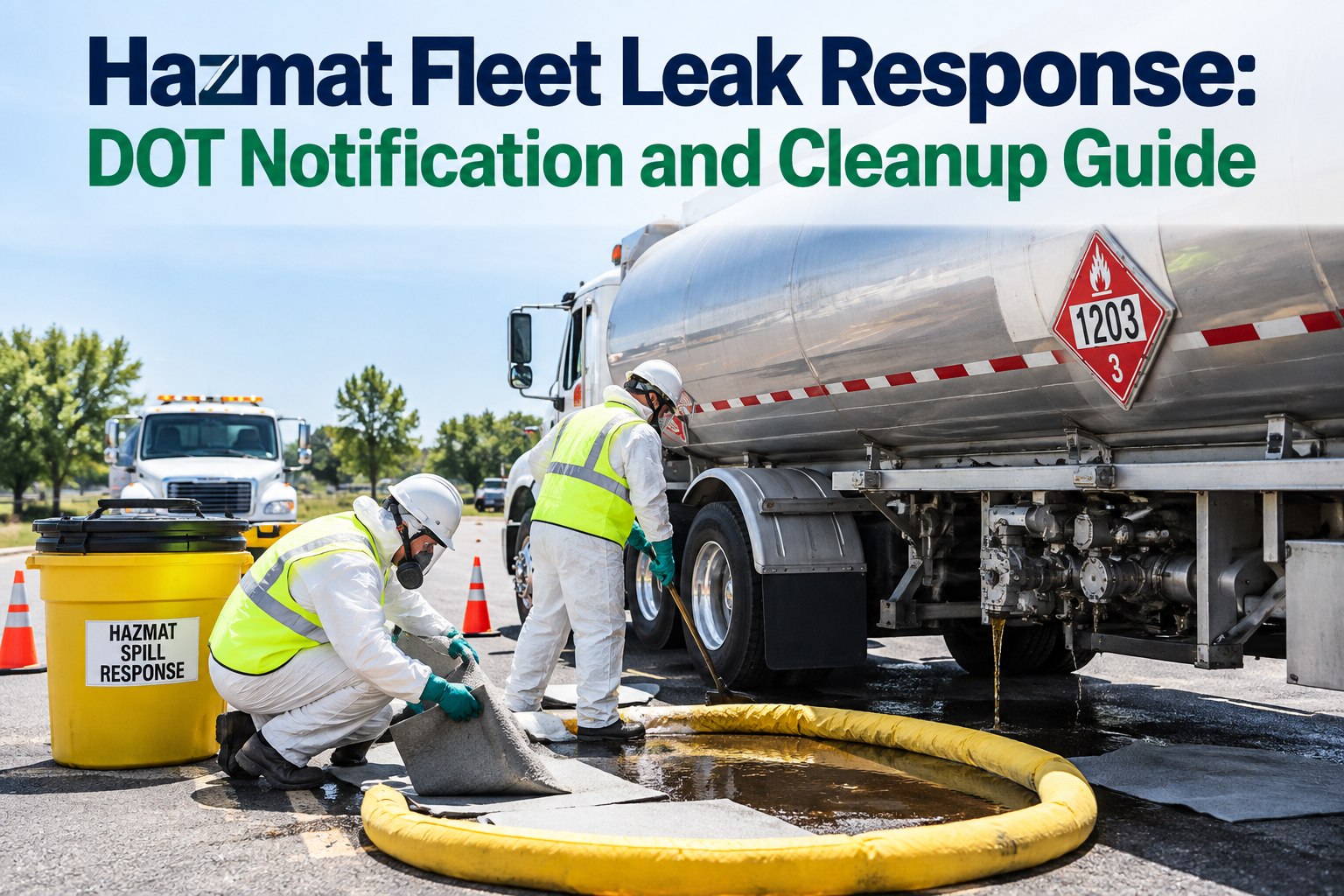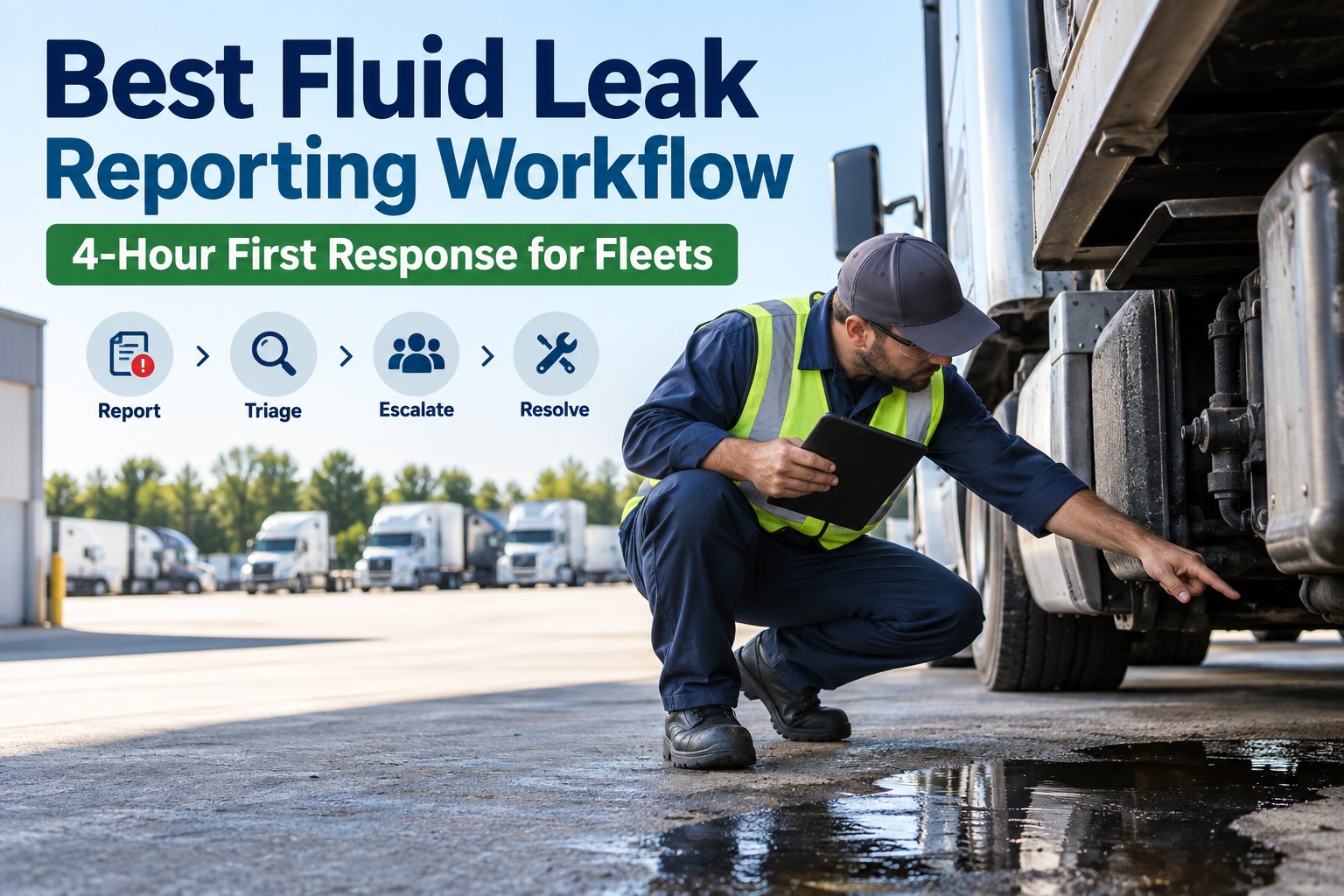
A leak almost never starts as an emergency — it starts as a dark spot under a truck that someone means to look at later. The problem is that "later" is where fleets lose money: a seep that gets a 4-hour response becomes a scheduled repair, while the same seep ignored for a week becomes a dripping fuel leak, an out-of-service order on the shoulder, and a fine of up to $19,277 per occurrence. The difference isn't the leak — it's the workflow around it. The best fleets treat every reported leak like a clock starts the moment it's logged: a guaranteed first response inside four hours, a graded severity that decides the action, and an escalation rule that never lets a fuel or brake-line leak sit in a queue. This guide lays out that workflow end to end — the severity grades, the 4-hour SLA, the escalation tiers, and the dashboard that makes it run. Our truck inspection and maintenance management software is built to run exactly this loop: a driver logs a leak on a mobile DVIR, it becomes a graded work order instantly, and the response clock is visible to everyone.Start a free trial and give every reported leak a 4-hour response clock.
The 4-Hour Leak Reporting Workflow
A leak reported late is a roadside shutdown waiting to happen. The fix is a workflow, not a mop: every reported leak gets a guaranteed 4-hour first response, a graded severity, and an escalation rule that never lets a fuel or brake leak wait. See it run on your own fleet — start free or talk to our team below.
The Workflow at a Glance
Every reported leak should move through the same five stages, and each stage has an owner and a time box. The point of the workflow is that no leak ever falls into the gap between "a driver mentioned it" and "someone got around to it."
Step 1: Grade the Leak — The 4-Class System
Not every leak is an emergency, and treating them all the same either wastes shop time or misses the dangerous one. The industry-standard severity ladder runs from a weep to an active drip, and the class decides everything downstream.Start free and auto-grade every leak the moment it's reported.
Bearded-up film that has never dripped. Monitor and note — recheck at next PM.
Moist, migrated area that has dripped but not while watched, hasn't hit the ground. Schedule inspection.
Drips often, has hit the ground, would drip when parked. Possible fire/level hazard — schedule repair now.
Drops every time when parked, visible trail on the pavement. Fuel/brake = ground the truck immediately.
Step 2–3: The 4-Hour First Response
The SLA that matters isn't "fixed in 4 hours" — it's first response in 4 hours. Someone with authority sees the report, confirms the grade, and decides the action inside the window. That single guarantee is what stops a class-2 seep from quietly becoming a class-4 shutdown.
Start free and put a visible response clock on every open leak.
Step 4: The Escalation Ladder
The action isn't a judgment call in the moment — it's set by the grade and the fluid. This is the escalation table that turns "how bad is it?" into a rule anyone in the shop can apply the same way every time.Contact our team to tune these tiers to your fleet's policy.
| Class | Fluid | First response | Action |
|---|---|---|---|
| 1 · Weep | Any | Log & queue | Monitor, recheck at next PM |
| 2 · Seep | Oil / coolant | Within 4 hrs | Schedule inspection this week |
| 3 · Leak | Oil / coolant | Within 4 hrs | Schedule repair now; watch level |
| 3–4 | Power steering / brake | Immediate | Do not dispatch until inspected |
| 4 · Drip | Fuel | Immediate | Out of service — do not move |
The Workflow, Automated End to End
Our truck inspection and maintenance management software replaces paper DVIRs and PM spreadsheets with mobile inspections, automated work orders, and real-time compliance dashboards. A driver logs a leak with a photo; it becomes a graded work order instantly; the 4-hour response clock is visible to the whole team; escalation fires by class and fluid; and the mechanic's sign-off updates the DVIR into an audit-ready trail — helping fleets lift PM compliance above 95% and stay DOT-ready year-round.
Step 5: Close the Loop with a Paper Trail
A leak isn't resolved when it's fixed — it's resolved when the record proves it. This is also where the compliance value lives: with FMCSA's eDVIR rule now in effect, an electronic report that routes to a work order and back to a signed-off DVIR is the cleanest audit trail a fleet can hold.
Frequently Asked Questions
Give Every Leak a Clock, Not a Corner to Hide In
Our truck inspection and maintenance management software runs the whole leak workflow — mobile DVIR capture, instant graded work orders, a visible 4-hour response clock, class-and-fluid escalation, and signed-off audit-ready records. Leading fleets use it to cut breakdowns, pass DOT audits, and give drivers a maintenance system they'll actually use.