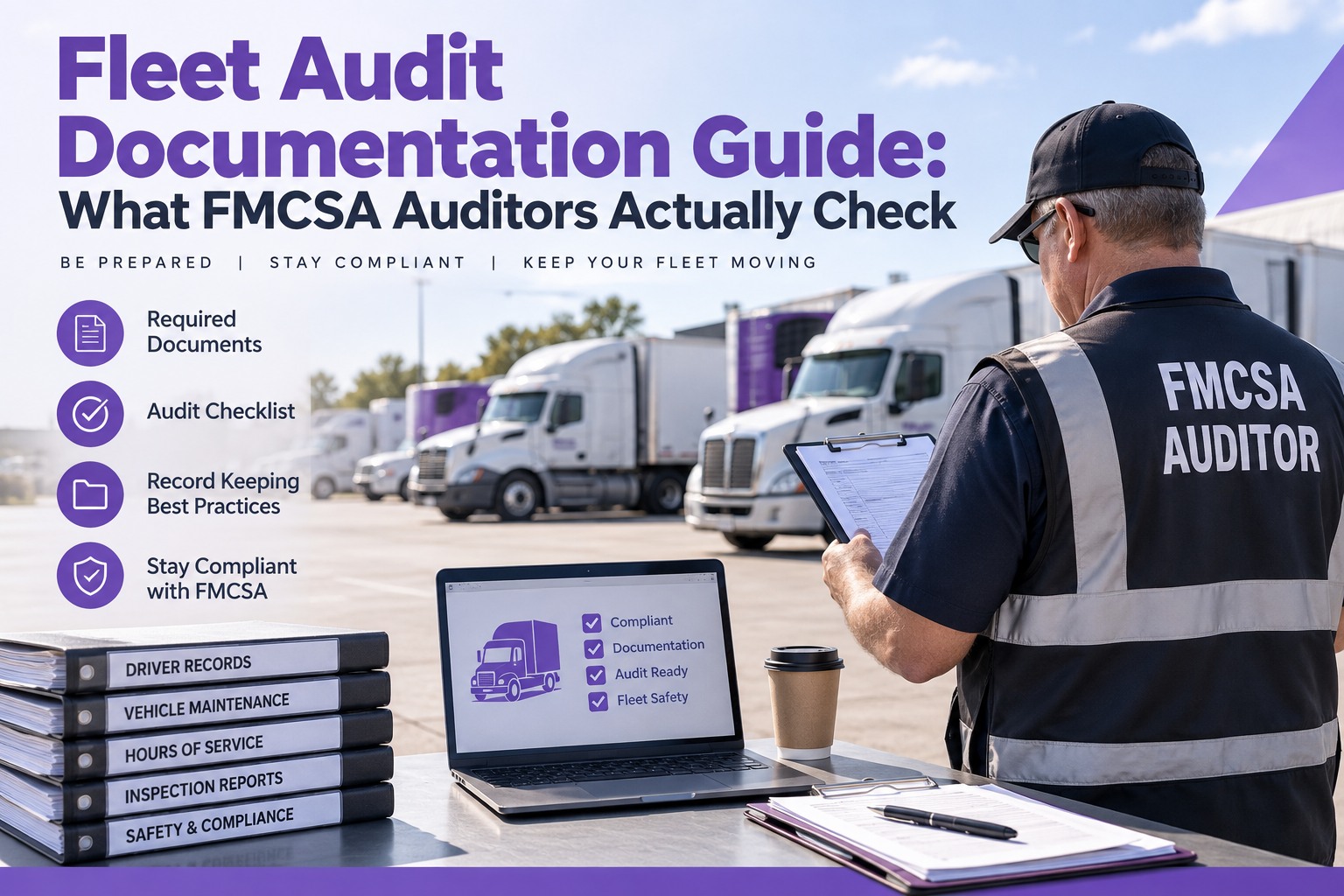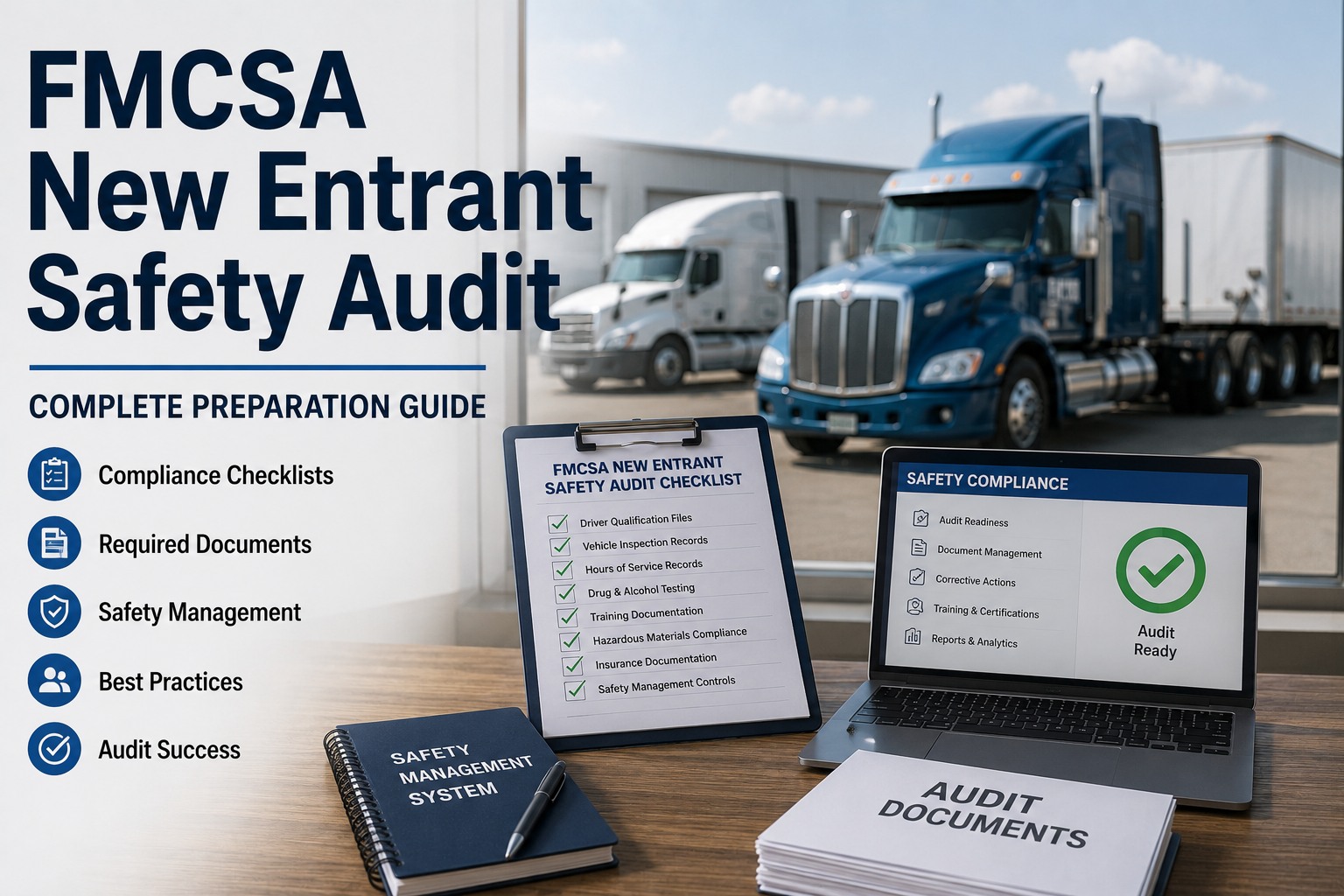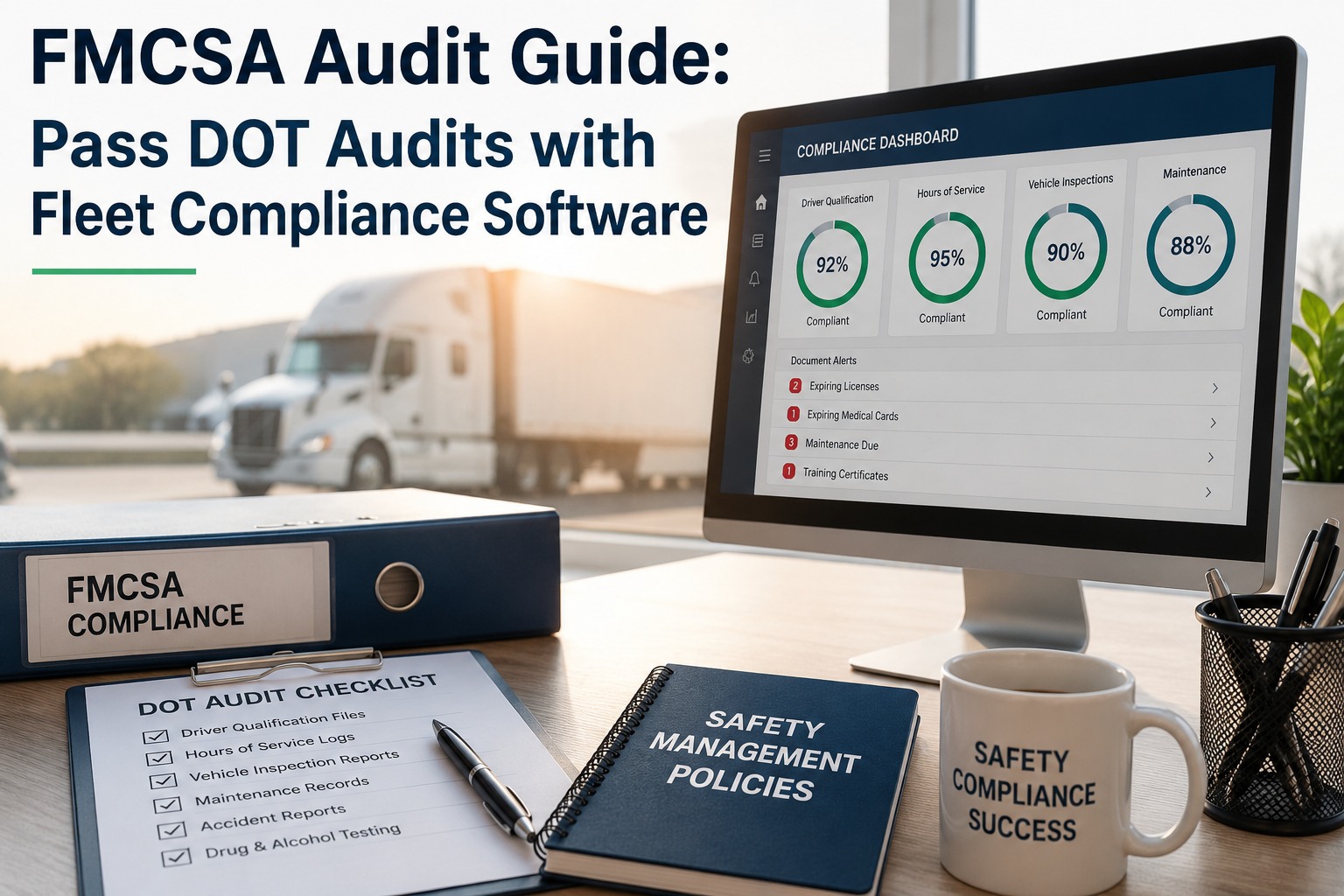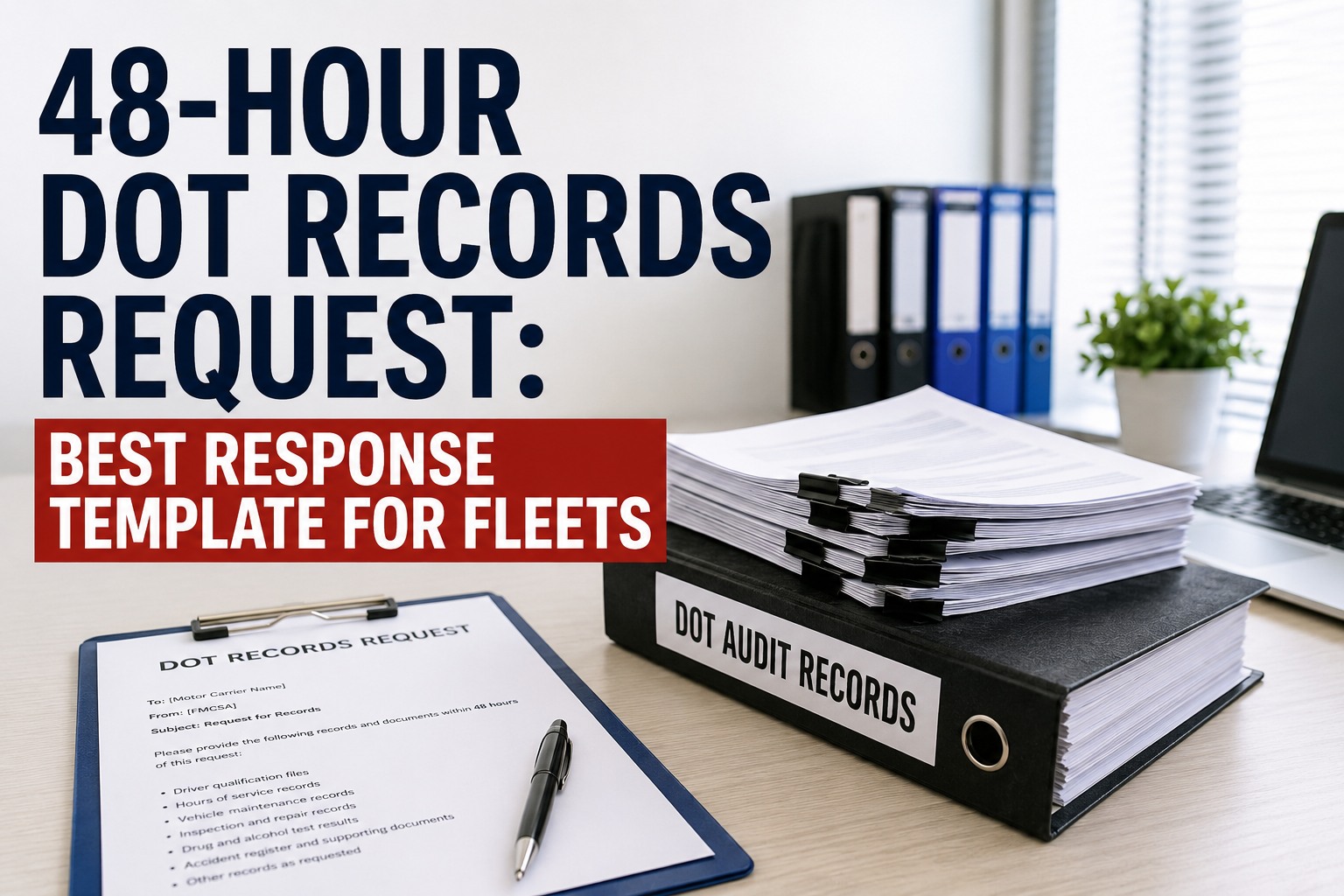
The email arrives Tuesday at 4:47 PM. Subject line: "FMCSA Compliance Review — Records Request." Body: 48 hours to produce 8 categories of records, digitally, in FMCSA-specified formats. Miss the window or produce incomplete records, and the auditor's default assumption shifts from "let's verify compliance" to "let's document non-compliance." Offsite audits have increased 400% in recent years, and 92% of paper-based fleets fail the 48-hour window. The response template below is the exact file-by-file structure that top-performing fleets use to produce complete, audit-defensible submissions on time — every time. It covers what the auditor is asking for across all 8 FMCSA compliance areas, what format they expect, and the sequencing that lets you assemble a defensible submission in hours instead of days. Whether the request lands during business hours or Friday afternoon before a long weekend, having the template ready is the difference between passing and having 20 line-item violations show up in the report. Sign up free for Truck Inspection & Maintenance today — no credit card required to keep every audit-required record indexed and instantly exportable, or contact our team for an audit-readiness assessment configured to your fleet size and compliance history.

Audit Response Guide · 2026 · 48-Hour FMCSA Records Request

48-Hour DOT Records Request: Best Response Template for Fleets

The exact file-by-file template top-performing fleets use to produce complete, audit-defensible submissions within the 48-hour window — every time.

48 hrs
Standard production window
400%
Offsite audit growth
92%
Paper fleet failure rate
7%
Carriers passing zero-violation

What the 48-Hour Rule Actually Requires

The 48-hour production window isn't in the CFR by that exact number — it's operational practice under FMCSA's compliance review procedures. In practice, auditors give 48 hours as the standard window for offsite (remote) reviews, with same-day production sometimes required for onsite. Miss the window and the review shifts from cooperative to adversarial.

HOUR 0
Request arrives
Email with records categories, driver/vehicle sample list, and production deadline. Sometimes phone follow-up. Format specification (PDF, CSV, ELD standard output) attached.
HOUR 0-4
Acknowledge & scope
Reply within 4 hours confirming receipt, deadline understood, and any clarifying questions. Silent fleets get flagged as uncooperative before production even starts.
HOUR 4-36
Assemble & verify
Pull all records for the sample drivers/vehicles/period. Verify completeness. Organize per the template below. Flag any gaps for explanation memo.
HOUR 36-46
QC & explanation memo
Second-pass quality check. Draft explanation memo for any gaps (missing driver, lost record, system outage). Package for transmission.
HOUR 46-48
Transmit & confirm
Submit via FMCSA-specified portal or secure email. Request delivery confirmation. Note timestamp in your audit file. Never assume transmission = receipt.

The 8 FMCSA Compliance Areas — Records Template

Every audit hits some subset of these 8 areas. Fleets that maintain records by area (rather than by driver or vehicle) can pull the exact response in hours.

01
Driver Qualification Files (DQF)
49 CFR §391
What auditor wants: Complete DQF for each sampled driver — signed employment application (3-yr history), MVRs from every state driver licensed past 3 years, current Medical Examiner's Certificate (paper waivers expired Jan 10, 2026), pre-employment Clearinghouse full query with consent, previous employer safety verification, annual MVR review documentation.
Retention: DQF maintained for duration of employment + 3 years after termination
02
Hours of Service (HOS) Records
49 CFR §395
What auditor wants: Complete RODS for each sampled driver's operating days in the review period, ELD data files in FMCSA standard output format, supporting documents (fuel receipts, dispatch records, GPS breadcrumbs), unassigned driving time review documentation, ELD malfunction records, short-haul exception time records.
Retention: 6 months minimum for RODS and supporting docs — longer retention recommended
03
Vehicle Maintenance Records
49 CFR §396
What auditor wants: Systematic PM program documentation per vehicle, all repair/inspection/PM completion records with date, vehicle, mileage, work performed, parts used, and mechanic signature. Preventive maintenance schedule with intervals by mileage/hours/time and completion evidence.
Retention: 12 months minimum, 6 months after vehicle disposal
04
DVIR Records
49 CFR §396.11 & §396.13
What auditor wants: Daily DVIRs for each sampled vehicle in the review period, three-signature chain intact (driver post-trip, mechanic repair certification, next-driver acknowledgment), all defects with certification of repair or "not necessary" documentation. eDVIRs with server timestamps, GPS, and photo evidence now explicitly authorized under the Feb 2026 rule.
Retention: 3 months minimum — longer strongly recommended for litigation defense
05
Annual DOT Inspection Records
49 CFR §396.17 & §396.19
What auditor wants: Annual inspection reports for every CMV, performed by qualified inspector per §396.19, with all 15+ inspection items documented. Inspection decal or documentation on vehicle. Inspector qualification documentation.
Retention: 14 months minimum from inspection date
06
Drug & Alcohol Testing Records
49 CFR §382 & §40
What auditor wants: Pre-employment, random, post-accident, reasonable suspicion, and return-to-duty test records. Random selection documentation showing proper randomization rate. Clearinghouse query records (pre-employment + annual for current drivers). Positive results, refusals, and SAP completions reported within 24 hours per 2026 tightened window.
Retention: 5 years for positive/refusal records, 1 year for negative results
07
Accident Register
49 CFR §390.15
What auditor wants: Accident register with all DOT-recordable accidents in review period. Each entry with date, location, driver, injuries/fatalities, hazmat involvement, and copies of accident reports, police reports, and insurance claim data.
Retention: 3 years minimum from accident date
08
Insurance, Authority & Registration
49 CFR §387 & §390
What auditor wants: Current MCS-90 or equivalent insurance certificate meeting minimum liability ($750K general freight, $1M-$5M hazmat/passenger). USDOT number registration current, biennial update filed, BOC-3 process agent on file. State operating authority if required.
Retention: All current documents plus prior 3 years of historical filings
The retention gap that kills audits: Every category above has a different minimum retention window — 3 months (DVIR), 6 months (HOS), 12 months (maintenance), 14 months (annual inspection), 3 years (accident register), 5 years (drug test positives). Fleets that use a single "keep everything 1 year" retention policy underperform on categories requiring longer retention. Fleets that purge at the minimum lose litigation defense evidence. Best practice: retain all categories minimum 3 years, 5+ years for drug testing.

The File-by-File Response Template

The auditor doesn't want a data dump — they want an organized submission that matches their sample request. This is the folder structure that produces the fastest, cleanest audit review.

? 00_COVER_LETTER
Signed cover letter from safety officer or designated audit contact. Confirms receipt of request, deadline understood, contents of submission, and contact for questions. Also lists any known gaps with explanation.
? 01_DRIVER_QUALIFICATION_FILES
One subfolder per sampled driver, named by driver's last name and CDL last-4. Inside each: DQF documents in the sequence auditor expects (application → MVR → medical → Clearinghouse → verification → annual review).
? 02_HOURS_OF_SERVICE
One subfolder per sampled driver. ELD standard output file for the review period, RODS printouts (PDF), supporting documents organized chronologically (fuel receipts, dispatch records, GPS breadcrumbs matched to log entries).
? 03_MAINTENANCE_RECORDS
One subfolder per sampled vehicle, named by unit number and VIN last-6. PM schedule for that vehicle class, PM completion records in date order, repair records with mechanic signatures, parts documentation.
? 04_DVIR_RECORDS
One subfolder per sampled vehicle. DVIRs organized by date for the review period, three-signature chain visible on each (driver / mechanic / next-driver), certifications for repaired defects, photos if eDVIR.
? 05_ANNUAL_INSPECTIONS
Annual §396.17 inspection reports for each sampled vehicle in the current 14-month retention window. Inspector qualification documentation included for each inspector who performed the work.
? 06_DRUG_ALCOHOL_TESTING
Random test roster, selection documentation, test results (negative results 1-year retention, positive/refusal 5-year), Clearinghouse queries for each sampled driver, SAP records if applicable.
? 07_ACCIDENT_REGISTER
Complete accident register for the review period (typically 12-24 months). Individual folders for each recordable accident with accident report, police report, insurance documentation, and any driver post-accident test results.
? 08_INSURANCE_AUTHORITY
Current insurance certificate, MCS-90 endorsement, USDOT registration confirmation, current biennial update filing, BOC-3 process agent designation, any state operating authority documents.
? 09_EXPLANATION_MEMOS
Optional but recommended. Written explanations for any known gaps — driver who left mid-review-period, vehicle sold during window, system outage affecting records, one-off documentation issue. Proactive disclosure beats auditor discovery.
Naming convention matters: Use consistent naming (LastnameCDL####_DQF_2025.pdf, Unit247_VIN123456_PM_20250815.pdf) so the auditor can find any specific document in under 30 seconds. Random naming schemes force the auditor to search — which delays the review and creates the appearance of disorganization.

The First 4 Hours — What to Do When the Request Arrives

The first four hours after receiving the request set the tone for the entire audit. Get these steps right and the remaining 44 hours run smoothly. Get them wrong and you're playing catch-up the whole window.

MIN 0-15
Read the request completely
Read every word. Note: review period dates, driver/vehicle sample list, record categories requested, format specifications, submission portal or contact, exact deadline (day + time + time zone).
MIN 15-30
Notify leadership & legal
Alert the safety officer, operations lead, and legal counsel or compliance attorney. Never handle an audit alone. Assign a single point-of-contact for FMCSA communication going forward.
MIN 30-60
Confirm receipt to auditor
Reply email confirming receipt, deadline understood, and identifying your single point-of-contact. Ask any clarifying questions about scope or format. Silent fleets get flagged.
HR 1-2
Assemble response team
Convene team: safety, maintenance, HR (for DQF and drug testing), operations (for HOS and dispatch), IT (for ELD data extract). Assign categories per person. Set internal deadlines 12 hours before FMCSA deadline for QC buffer.
HR 2-3
Pull sample records
Each team member pulls records for their assigned category and the specific drivers/vehicles/period in the sample. Flag missing records immediately for explanation memo.
HR 3-4
Complete inventory check
Reconcile pulled records against auditor's request line-by-line. Identify any category with <95% record completeness. Escalate gaps to legal counsel for guidance on disclosure and remediation.

Produce every record the auditor asks for — in minutes, not days

Indexed retention across all 8 FMCSA compliance areas. Category-based folder structure matches auditor expectations. Instant export in FMCSA-required formats. Retention windows enforced automatically (3 mo / 6 mo / 12 mo / 14 mo / 3 yr / 5 yr). Cover letter and gap explanation templates included.

The 6 Most Common Audit Failure Points

FMCSA compliance reviews cite predictable failures. Knowing them in advance is the fastest way to avoid them.

01
Missing next-driver DVIR acknowledgment (§396.13)
The most-missed signature in the DVIR chain. Truck gets handed off, DVIR sits in a folder, next driver rolls without acknowledging prior report. Digital DVIR systems make this signature a required step before dispatch.
02
Expired medical examiner certificates
Driver's medical card expires, DQF isn't updated, driver keeps operating. Auditor pulls MVR and DQF, sees the gap. Paper waivers officially expired Jan 10, 2026 — digital submission now required.
03
HOS supporting document gaps
RODS look clean, but supporting documents (fuel receipts, dispatch records) don't corroborate them. Auditor treats mismatch as prima facie falsification unless explained.
04
Annual DOT inspection past 14-month window
Vehicle inspected 15 months ago instead of 12, no current inspection on file. Sometimes calendar tracking error, sometimes inspector never got scheduled. Either way, §396.17 violation.
05
Missing Clearinghouse pre-employment query
New hire completed all paperwork except the Clearinghouse full query. Auditor pulls Clearinghouse records, sees driver never queried. Violation per driver, per year.
06
Late submission beyond 48-hour window
Records complete but submitted at hour 52 instead of hour 48. Auditor's default frame shifts from "verify compliance" to "document non-compliance." Communication about legitimate delays helps; silence doesn't.

Paper vs Digital — Why the 48-Hour Rule Was Written for Digital

The 48-hour window assumes fleets have indexed, searchable, exportable records. Paper systems fail this window 92% of the time per industry data. Here's the difference in practice.

PAPER-BASED FLEET
Record retrieval time8-40 hours
Storage locationMultiple physical files
48-hour window pass rate~8%
Signature verificationHandwriting inspection
Chain of custodyBreakable
Format complianceManual formatting per submission
Rule was written assuming digital. Paper fleets fail the window structurally, not operationally.
DIGITAL FLEET (eDVIR + CMMS)
Record retrieval timeMinutes to hours
Storage locationSingle indexed system
48-hour window pass rate~95%+
Signature verificationCryptographic timestamps
Chain of custodySystem-enforced
Format complianceFMCSA export preset
The 48-hour window is a routine task, not a fire drill. Auditors expect this level of readiness.

Frequently Asked Questions

Several triggers, most commonly: routine compliance reviews scheduled by FMCSA based on CSA score, safety event review (post-crash or post-fatality investigation), complaint-based review (from driver, competitor, or public), targeted focus areas (hazmat, passenger, high-CSA-BASIC), and follow-up reviews after a prior finding. Offsite audits have grown 400% in recent years because they let FMCSA cover more carriers with less field staff. The auditor typically requests a sample — 10-30 drivers and 20-50 vehicles are common — plus records for a specific review period (6-24 months). New carriers face mandatory new-entrant audits within 12 months of authority. High-CSA-scoring carriers face more frequent scrutiny. Any fleet running commercial motor vehicles should assume a records request is coming and structure operations accordingly.

Sometimes — but always ask; never just miss the deadline. Legitimate reasons FMCSA typically accommodates include: records held by third party requiring transfer time, natural disaster affecting operations, key personnel unavailable due to medical emergency, or unusually large sample size relative to fleet capacity. Never-acceptable reasons include: "we didn't have time to organize records," "our IT is slow," or "we thought the deadline was next week." Request extensions in writing within the first 24 hours (not the last 6), with a specific new deadline proposed, a reason, and evidence of good-faith effort so far (records already assembled, categories still outstanding). Auditors have discretion; they typically grant reasonable extensions to cooperative fleets and deny extensions to fleets that appear to be stalling. The frame matters as much as the request.

Depends entirely on how the fleet handles the gap. If the fleet identifies missing records in advance and includes an explanation memo (driver terminated mid-period, vehicle sold, one-time system outage, records genuinely lost), the auditor typically treats it as a documentation issue rather than falsification. If the fleet submits without acknowledging gaps and the auditor discovers them, the frame shifts to non-compliance or worse — falsification. Proactive disclosure beats auditor discovery every time. Common recoverable gaps: driver hired mid-period without complete DQF at time of request (submit what exists, plus explanation), vehicle acquired mid-period without full maintenance history (submit acquisition records, plus PM history since acquisition). Non-recoverable gaps: systematic missing DVIRs across multiple months, missing annual inspections past 14 months, missing drug test records for post-accident incidents. Get legal counsel involved on any category showing significant gaps. Try the platform free to eliminate systematic gap risk with automated retention enforcement.

Highly variable but consistently expensive. Individual violations typically start around $200 per occurrence and escalate quickly for patterns. Serious violations (falsified records, HOS falsification, willful non-compliance) can hit $16,000+ per violation. Hazmat-related violations can exceed $78,000 per day. Most audits find multiple violations, not one — a fleet with 20 trucks and one missing DVIR per truck per month over a 90-day sample is 60 potential citations before the auditor moves to other categories. Beyond direct fines, violations feed CSA BASIC scores which affect insurance rates, customer contract eligibility, and can trigger operating authority reviews for repeat offenders. Only 7% of motor carriers pass a compliance review without a single violation. The math strongly favors investment in audit-ready systems: preventing a single medium-severity audit finding saves more than a year of software subscription for most fleets.

For routine offsite reviews with clean records, no — the safety officer can typically handle the submission. For anything with complications — known compliance gaps, prior violations, safety event review, post-crash investigation, hazmat focus, potential falsification exposure — yes, absolutely. A transportation attorney with FMCSA experience typically costs $300-$600/hour but often prevents six-figure exposure. Signs you need legal counsel involved from hour 1: the request follows a fatal accident or major incident, the fleet has prior violation history in the same category being reviewed, records for the requested period have known significant gaps, the auditor requests interviews with drivers or leadership, or the request specifically mentions falsification concerns. Most transportation law firms will do a quick assessment call at no or low cost — take it. The cost of not having counsel when you needed one is dramatically higher than the cost of having counsel when it turned out you didn't need one.

Assume the request is coming this quarter and structure operations to respond within 24 hours (not 48). Six specific practices: (1) Maintain records digitally with retention enforcement per category (3mo DVIR / 6mo HOS / 12mo maintenance / 14mo inspection / 3yr accident / 5yr drug testing). (2) Run quarterly mock audits — pull 5 random drivers and 5 random vehicles, produce complete records, measure time. (3) Maintain the folder structure and file naming convention above at all times, not just during audits. (4) Document your response process so any team member can execute it — the person who normally handles audits will inevitably be on vacation when the request arrives. (5) Keep a "known gap register" — any record you know is incomplete with the explanation memo already drafted. (6) Build audit prep into monthly operations rather than treating it as a fire drill. Fleets that follow these practices routinely produce complete responses in 8-12 hours, leaving 36+ hours of buffer for QC and legal review. Contact our team for a mock audit assessment.

Yes, materially. FMCSA audits DVIR records in 89% of compliance reviews, and DVIR failures are among the most-cited findings. The Feb 19, 2026 FMCSA final rule (Docket FMCSA-2025-0115, effective March 23, 2026) explicitly authorized electronic DVIRs with server timestamps, GPS stamps, and photo evidence — giving them clear regulatory standing equal to paper. Digital DVIRs typically produce 60-80% reduction in DVIR-related audit findings compared to paper systems, driven by three factors: server-side timestamps prevent back-dating (paper's biggest falsification exposure), system-enforced three-signature chain prevents the most-missed signature (next-driver acknowledgment under §396.13), and instant retrieval means the DVIR category alone doesn't consume 60% of the 48-hour window. Fleets that pair eDVIR with fleet-specific CMMS (unified digital records across all 8 FMCSA compliance areas) typically move from paper's ~8% pass rate on the 48-hour window to 95%+. The regulatory standing was clarified in 2026 partly because FMCSA wanted to eliminate any excuse for paper-only fleets to keep operating with structural audit failure risk.

Purpose-built for commercial fleet compliance

Make the 48-hour window a routine task — not a fire drill

Indexed retention across all 8 FMCSA compliance areas. Category-based folder structure. Instant export in FMCSA-required formats. Automated retention windows (3 mo / 6 mo / 12 mo / 14 mo / 3 yr / 5 yr). Cover letter and gap explanation templates. Move from paper's 8% pass rate to digital's 95%+.


No credit card required  •  FMCSA §391/395/396 native  •  Trusted by commercial fleets across North America