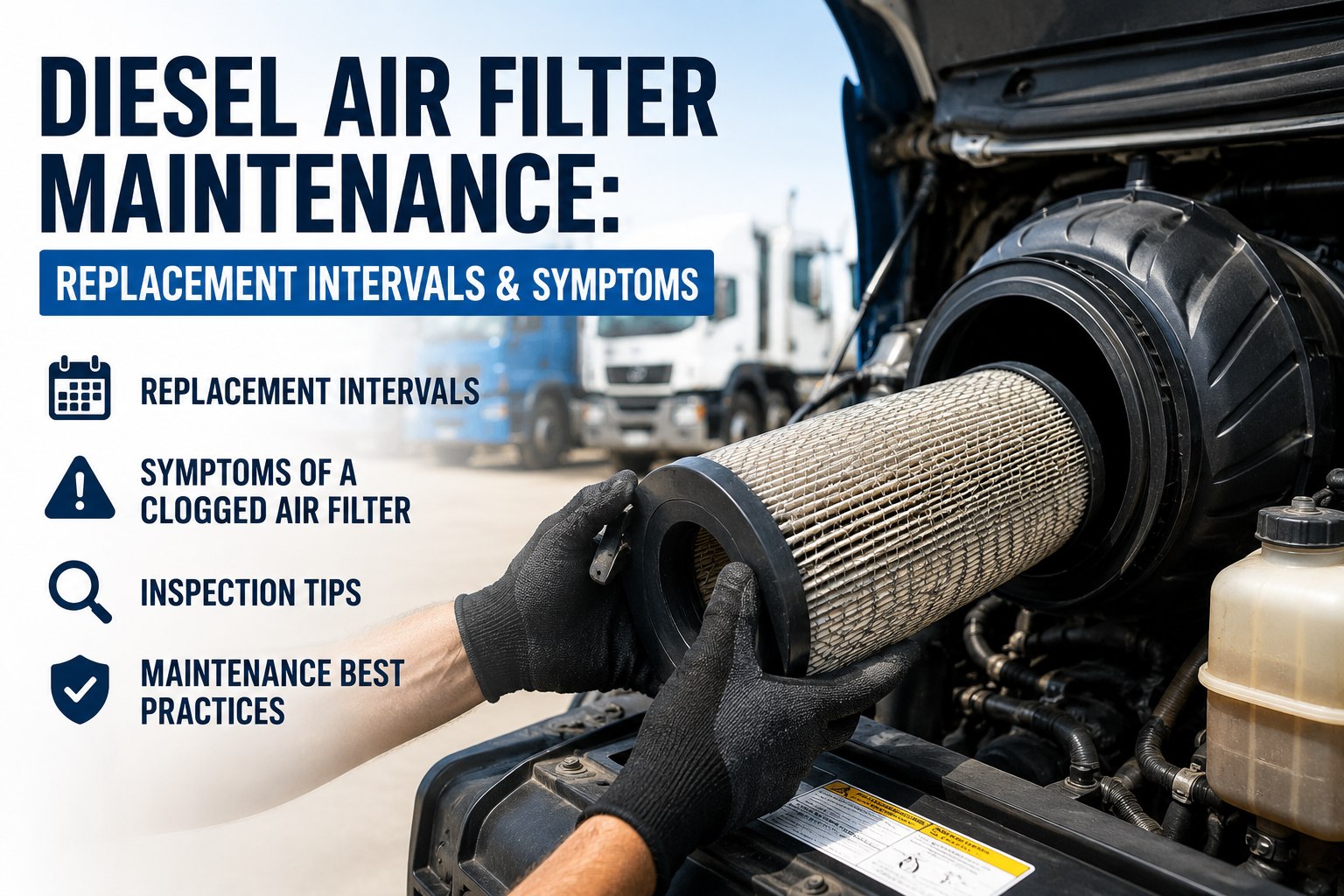
Heavy-duty diesel engines consume enormous volumes of air — a Cummins X15 or Detroit DD15 running under load pulls somewhere between 500 and 1,000 cubic feet of air per minute through the intake system. Every one of those cubic feet has to pass through the air filter before reaching the turbocharger. That filter is doing two jobs at once, and both are life-critical: it has to trap abrasive particles down to a few microns so they never touch the turbo blades, piston rings, or cylinder walls, and it has to do it while letting enough air through to make full boost pressure under peak load. Neither compromise is acceptable. Restrict the flow too much and you get a rich fuel mixture, black smoke, 10–30% fuel-economy loss, EGT climb, and forced regens as the DPF loads with unburned soot. Let dust bypass past a damaged filter and you get scored cylinder walls, ruined rings, turbo shaft wear, and a repair path that runs $8,000–$25,000 depending on how far the abrasion cascaded before anyone noticed. The frustrating part is that air filter service is one of the cheapest PM tasks on a heavy truck — routinely under $100 — yet it's one of the most commonly skipped because it doesn't show up as an obvious symptom until restriction becomes severe. This guide covers exactly how the diesel air intake system works, when to replace filters by duty cycle and environment, the six symptoms drivers report first, restriction indicator reading, single-stage vs two-stage housings, dry vs oiled media, and how Truck Inspection & Maintenance software turns restriction checks and filter service into a scheduled, tracked event across every truck. Ready to run air intake service on schedule fleet-wide? Start a free trial of Truck Inspection & Maintenance, or contact our support team for a walkthrough.
Diesel Air Filter Maintenance: Replacement Intervals & Symptoms
The cheapest PM on the truck. The most commonly skipped. And the one that stands between clean cylinder walls and a $15,000 rebuild.
How the Diesel Air Intake System Actually Works
A modern heavy-duty air intake isn't one filter — it's a four-stage protection chain. Each stage handles a different particle size range, and each stage has its own failure mode. Here's how the airflow actually moves from ambient to combustion chamber.
Replacement Intervals by Operating Environment
There is no single "right" mileage for air filter replacement. Duty cycle and dust exposure drive the interval more than anything else. Match the row that fits how your trucks actually operate.
The 6 Symptoms Drivers Report First
A clogged air filter announces itself through a specific set of drivability complaints. Train drivers to escalate these six at every DVIR — every one is a filter check trigger.
Restriction Indicators: How to Read the Real Data
Every heavy-duty diesel has a way to measure intake restriction. Reading it correctly is the difference between "changed too early" and "changed too late." Here's how the numbers work.
Two-Stage Filter Housing Anatomy
Most heavy-duty trucks use a two-stage housing: primary and safety element working together. Understanding the layout tells you what to inspect and what to replace at every service.
Never guess an air filter interval again
Restriction reading logs at every PM. Duty-cycle-based intervals per truck. Automatic work orders when threshold approaches. Truck Inspection & Maintenance software turns filter service into a data-driven event, not a guess.
The Real Cost of Neglecting Air Filter Service
Air filter service is one of the cheapest PM tasks on a heavy truck. Ignoring it produces one of the most expensive repair chains. Here's the actual math.
Best Practices for Fleet Air Intake Service
Systematic fleets follow a simple set of best practices at every air filter service. Follow these seven and you'll extend filter life, catch problems early, and prevent every downstream failure.
Frequently Asked Questions
Interval depends on duty cycle and dust exposure, not just mileage. Highway linehaul: every 75,000–100,000 miles or 12 months. Regional mixed: every 50,000–75,000 miles or 9 months. Urban delivery with heavy idle: every 30,000–50,000 miles or 6 months. Construction and off-road: every 10,000–30,000 miles, sometimes as short as weeks. Restriction indicator readings and visual inspection at every PM are more reliable than any calendar. Truck Inspection & Maintenance software tracks intervals per truck by duty cycle so no unit slips.
Six main symptoms: loss of power under load (truck bogs down on grades and acceleration), black smoke from the exhaust (rich fuel mixture from insufficient oxygen), fuel economy drop of 10–30%, check engine or restriction warning light, rising EGT and increased DPF regen frequency, and visible dust cake or discoloration when the housing is opened for inspection. Any single symptom is worth a check; two or more together indicate the filter is well past its usable life.
You can, but the cost climbs quickly. Restricted airflow causes rich fuel mixture, 10–30% MPG loss, elevated EGT, more frequent DPF regens, black smoke, and reduced power. Worse, extreme restriction can crack the filter media or the housing seals, letting abrasive dust bypass into the turbo and cylinders. That path leads to turbocharger wear ($2,500–$5,500), cylinder scoring, ring wear, and eventually engine overhaul ($8,000–$25,000). A $60 filter change is always cheaper than continuing to drive on a bad one.
Almost always replace. Most heavy-duty primary filter elements are not designed to be cleaned — the pleated paper or synthetic media tears when washed, creating pinholes that let dust bypass to the turbo and cylinders. A few specific oiled-media aftermarket filters (K&N-style) are washable, but factory OEM primary filters on Class 8 trucks generally are not. Safety elements are never cleaned — always replaced. When in doubt, replace. A $60 filter is cheaper than a $15,000 engine rebuild caused by fibers punched through washed media. Contact our team to see how the software tracks filter service history per truck.
A restriction indicator measures the vacuum on the engine side of the air filter, in inches of water (in H₂O). New filter: 0–10 in H₂O. Normal operating range: 10–20 in H₂O. Warning zone: 20–25 in H₂O — schedule replacement in the next 5,000 miles. Above 25 in H₂O: replace immediately, the filter has reached maximum restriction. Read the gauge at load — wide-open throttle in gear or during a dyno pull — not at idle. Idle readings understate real restriction dramatically. And never trust just the gauge; visual inspection catches damaged media that a stuck indicator would miss.
The damage cascades in stages. First, fuel economy drops 10–30% as the engine overfuels to compensate for restricted airflow. Then DPF regens increase in frequency and duration from the extra soot. Then EGT climbs, stressing turbo and exhaust components. Eventually, extreme restriction cracks the filter media or housing seals, letting abrasive dust bypass into the turbocharger — shaft wear starts, VGT actuator fails, boost pressure collapses. Worst case, dust reaches the cylinders and scores the walls and rings, requiring a full overhaul at $8,000–$25,000. A $60 filter every 50,000 miles prevents every link in that chain. Try free: sign up here.
Truck Inspection & Maintenance software turns air filter service into a scheduled, tracked event
Duty-cycle-based intervals per truck. Restriction indicator readings logged at every PM. DVIR-driven filter inspections. Auto-scheduled work orders before the mileage threshold. Safety element replacement tracked separately. Cost-per-mile visibility at the intake system level. Everything a fleet needs to keep every diesel breathing clean — one platform, one workflow, one source of truth.