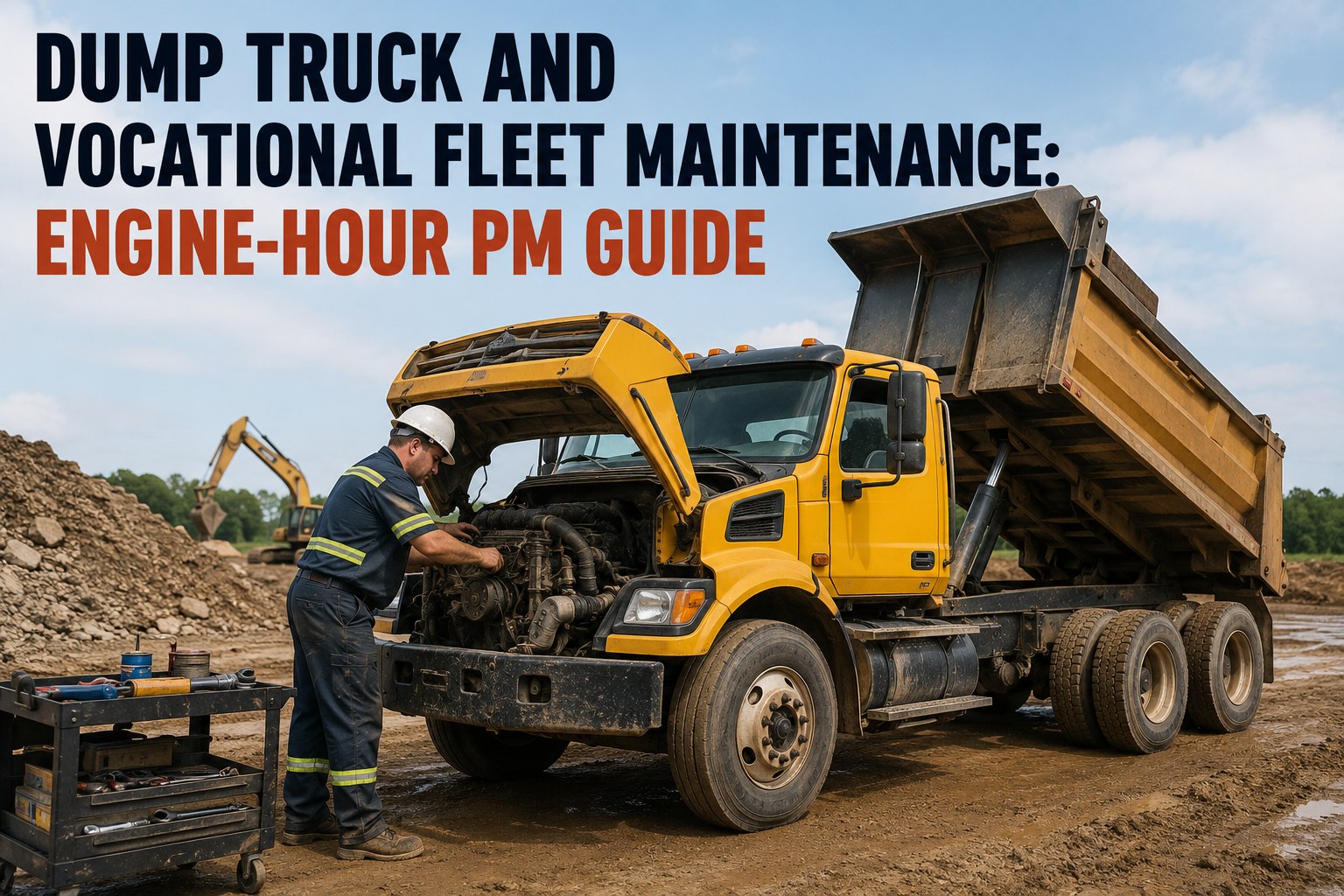
A dump truck running construction routes covers 40,000 miles a year and accumulates 4,000-6,000 engine hours doing it. On a mileage-based PM schedule, that truck comes in for oil changes every 6-8 months. On an engine-hour PM schedule, it comes in every 6-8 weeks. The gap between those two intervals is the entire reason vocational fleets have double the breakdown rate of long-haul fleets running identical trucks. Miles are the wrong unit for measuring wear on a vocational asset. A tractor cruising I-80 at 65 MPH accumulates engine hours at a 1:65 ratio to miles. A dump truck idling at a quarry gate, running the PTO to lift a bed, or crawling 4 MPH across a jobsite accumulates engine hours at a ratio closer to 1:5 — or worse. At 6,000 hours, the engine has aged the equivalent of 200,000+ highway miles regardless of what the odometer reads. Vocational trucks that get serviced on mileage schedules are chronically under-maintained, and they're usually the most expensive iron in the fleet. This guide walks the engine-hour PM program built specifically for vocational duty cycles — the intervals, the tier structure, and the first-to-occur logic that keeps the shop honest. Sign up free for Truck Inspection & Maintenance today — no credit card required to switch your vocational fleet to engine-hour PM this week, or contact our team for a duty-cycle assessment configured to your truck mix and jobsite pattern.
Dump Truck & Vocational Fleet Maintenance: Engine-Hour PM Guide
Miles are the wrong unit for a vocational asset. Engine hours are the honest measure of wear — and the difference between a 6-year truck and a 10-year one.
The Mileage Trap — Why Vocational Fleets Fail on Odometer-Based PM
Odometer-based PM assumes a predictable relationship between distance and engine wear. That assumption holds for long-haul highway operation. It falls apart for every vocational application. Here's the math on three common vocational truck types.
| Truck Type | Annual Miles | Annual Engine Hours | Hours-to-Miles Ratio | PM Trigger That Wins |
|---|---|---|---|---|
| Long-haul Class 8 tractor | 120,000 | 2,000 | 1 : 60 | Mileage |
| Dump truck (construction) | 40,000 | 4,000-6,000 | 1 : 7-10 | Engine hours |
| Concrete mixer | 30,000 | 3,000-4,500 | 1 : 7-10 | Engine hours |
| Refuse packer | 18,000 | 2,000-2,500 | 1 : 8-9 | Engine hours |
| Oilfield service truck | 25,000 | 3,500-5,000 | 1 : 5-7 | Engine hours |
| Utility bucket truck | 15,000 | 1,800-2,500 | 1 : 6-8 | Engine hours |
Why Vocational Duty Cycles Punish Trucks Harder
The engine-hour math is only half the story. Vocational duty exposes trucks to specific stressors that highway trucks never see. Any one of them shortens component life; the combination compounds them.
The Engine-Hour PM Tier Structure
The four-tier PM structure (A / B / C / D) works for vocational trucks — but the intervals are engine hours, not miles. Here's the standard framework, with severe-duty adjustments already applied.
First-to-Occur Logic — The Three-Trigger PM Engine
The professional standard in 2026 is not choosing one PM trigger over the others. It's running all three simultaneously and servicing on whichever one arrives first. For vocational fleets, engine hours usually win — but not always.
Configure engine-hour PM per vocational truck — automatically
Real-time engine hours pulled from telematics. First-to-occur logic across hours / mileage / calendar. Grace-window rules per service tier. PTO hours tracked separately for hydraulic-specific PMs.
The Vocational-Specific Systems That Get Ignored on Mileage PM
A mileage-based PM schedule tracks engine, transmission, brakes, tires. It rarely tracks the systems that fail first on vocational trucks — the ones that only accumulate wear during PTO or hydraulic operation, invisible to the odometer.
What Changes When You Switch — Real Fleet Numbers
The transition from mileage-based to engine-hour PM produces measurable results within the first month. Here's what a typical 50-truck vocational fleet sees in the first year.
Frequently Asked Questions
Engine hours, with mileage and calendar as secondary triggers running in parallel. Vocational trucks — dump, mixer, refuse, oilfield, utility — accumulate engine hours at a rate 6-10x faster than the odometer records because of idle time, PTO operation, and low-speed jobsite driving. A dump truck running 40,000 miles per year typically accumulates 4,000-6,000 engine hours in the same period. At 6,000 hours, the engine has aged the equivalent of 200,000+ highway miles regardless of what the odometer shows. Mileage-based scheduling leaves these units chronically under-serviced. The professional standard is first-to-occur logic: configure PM to fire on engine hours OR mileage OR calendar days, whichever threshold arrives first. For vocational fleets, engine hours will win the trigger race on most services, but tires and alignment still fire on mileage, and coolant flushes still fire on calendar. All three run simultaneously per truck.
The four-tier PM structure translates to hour-based intervals for vocational service: PM-A (safety and lube) at 250 hours, PM-B (systems inspection) at 500 hours, PM-C (major service) at 1,000 hours, PM-D (annual and DOT) at 2,000 hours. Severe-duty operations — deep-mine dust, coastal salt exposure, mountain terrain, sub-zero winters, or 12+ hour shifts — should tighten each interval by an additional 15-20% (PM-A at 200 hours, PM-B at 400, PM-C at 800, PM-D at 1,600). These are baselines to start from; actual intervals should be validated against OEM manuals and adjusted based on oil analysis results and observed component wear rates. For a truck accumulating 4,000-6,000 engine hours per year, PM-A fires roughly every 4-6 weeks, PM-B every 8-12 weeks, PM-C every 3-4 months, and PM-D annually. That's dramatically more service than a mileage-based schedule would produce on the same truck.
Modern telematics platforms and engine ECUs log PTO hours as a separate data stream from total engine hours — the two numbers are recorded independently and can be pulled through telematics integrations (PACCAR Connect, Detroit Connect, Mack GuardDog, Volvo Dynafleet, Cummins Connected Diagnostics). PTO hours matter separately because they drive wear on hydraulic pumps, PTO clutches, and hydraulic-adjacent components that don't accumulate wear during normal drive operation. A truck with 6,000 total engine hours and 2,400 PTO hours has a different maintenance profile than one with 6,000 engine hours and 400 PTO hours — the first needs a hydraulic system service the second doesn't. Fleet management platforms that pull both data streams can trigger hydraulic-specific PMs on PTO hour thresholds while continuing to run standard engine PMs on total engine hours. Try the platform free to see PTO tracking in action.
Industry rule of thumb: one hour of idle time equals roughly 25-30 miles of engine wear. That's why an odometer-based PM schedule misses so much on vocational trucks. A dump truck waiting at a quarry gate at 800 RPM for two hours has aged its engine the equivalent of 50-60 miles — but the odometer moved zero. Multiply by a typical 300+ idle hours per month across dozens of trucks, and the invisible wear compounds into premature component failure the maintenance schedule never anticipated. Idle time also degrades oil faster than driving does — combustion at low RPM produces incomplete fuel burn, dilutes oil with unburned diesel, and accumulates soot faster. This is why hour-based PM intervals capture engine reality that mileage-based intervals systematically miss. Fleets that add idle-time monitoring on top of hour-based PM see additional savings from behavior change: reducing 300 monthly idle hours to 100 saves both fuel and PM service events.
Long-haul PM is optimized for consistent highway operation — predictable mileage, moderate idle, minimal PTO use, controlled ambient conditions. Vocational PM is optimized for unpredictable duty cycles — variable idle, heavy PTO cycling, jobsite dust, off-road vibration, aggressive load cycling. The tier structure (A/B/C/D) is the same in both, but three things change. First, the trigger unit shifts from miles to engine hours as primary. Second, intervals tighten 20-30% to account for severe-duty wear multipliers (oil change intervals on a PACCAR MX-13, for example, drop from 75,000 miles on highway spec to 30,000 miles on vocational). Third, vocational PM adds systems that highway PM ignores — hydraulic fluid analysis, PTO clutch inspection, DPF regen cycle audits, body-to-frame fastener retorque, and dust-driven filter service. A one-size-fits-all PM template applied across mixed fleets is the single most common maintenance mistake in operations that run both truck types.
The measurable results appear within 90 days and stabilize by six months. Typical outcomes on a 50-truck vocational fleet: PM compliance rate climbs from 65-75% baseline to 94%+ once hours-based scheduling stabilizes, hydraulic failures drop 42% (per fleet reports on structured tracking systems), overall maintenance spend falls 28% in the first operating year, and unplanned downtime drops roughly 45% because breakdowns get caught in the shop instead of the jobsite. The dollar figures scale with fleet size — a mid-size vocational fleet saving 28% on maintenance spend typically recovers the software cost within the first quarter, then the ongoing savings drop to the bottom line. The compounding benefit is uptime: one avoided jobsite breakdown recovers a full day of billed work, which on aggregate hauling contracts can be worth $3,000-8,000 per truck per incident. Contact our team for an ROI calculation specific to your truck count and duty cycle.
Yes — completely. Dump trucks and other vocational vehicles operating on public roads are subject to full FMCSA requirements regardless of how much time they spend on jobsites. That includes daily DVIRs under §396.11 and §396.13, annual DOT inspections under §396.17, Hours of Service and ELD compliance under Part 395, CDL and medical certificate tracking, and Drug & Alcohol Clearinghouse queries under Part 382. The engine-hour PM program discussed here doesn't replace FMCSA requirements — it runs in parallel with them. The PM-D tier (2,000 engine hours or annual, whichever comes first) is typically structured to align with the §396.17 annual DOT inspection so both events happen at the same shop visit. Fleets running vocational trucks that never leave private property (mine haul roads, quarry-internal only) may operate under different rules, but any truck that touches public roadway is subject to the full FMCSA framework.
Switch your vocational fleet to engine-hour PM this week
Real-time engine hour and PTO tracking per truck. First-to-occur PM logic across hours, mileage, and calendar. Severe-duty templates for construction, refuse, oilfield, utility, and mixer applications. Cut hydraulic failures 42% and maintenance spend 28% in the first year.