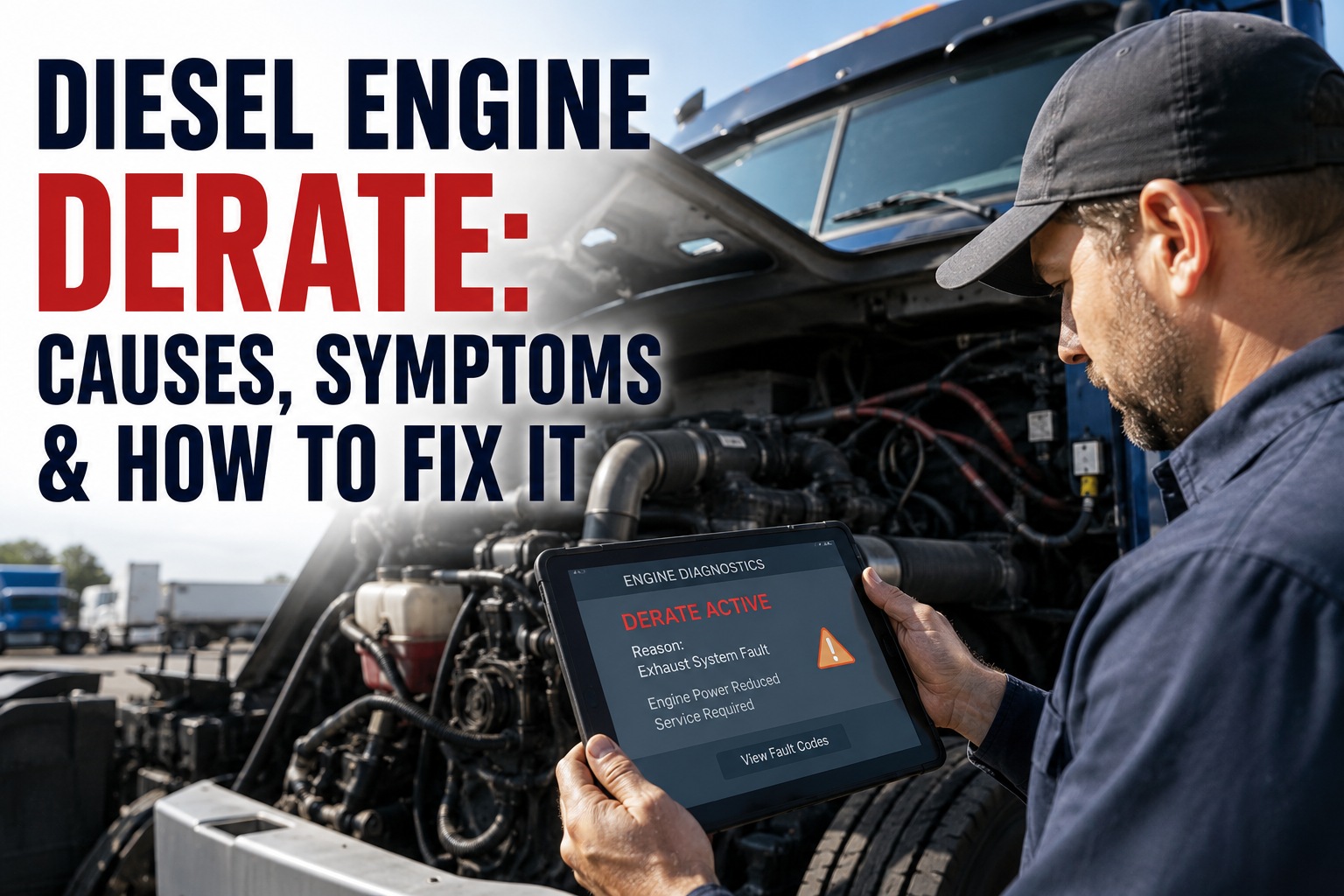
When a diesel truck suddenly won't go faster than 55 — and then, if ignored, crawls at 5 mph on the shoulder — it hasn't broken down in the usual sense. It's protecting itself. Engine derate is a deliberate, ECM-commanded power reduction, a forcing function that makes you deal with a serious fault before it turns into mechanical destruction or an emissions violation. Think of it like a body going into shock to protect vital organs: uncomfortable and alarming, but by design. The majority of derates trace back to the emissions system — a contaminated batch of DEF, a clogged DPF, a lazy NOx sensor — but low oil pressure, an overheating engine, or a turbo fault can trigger one too. The key is that a derate almost always arrives in stages, and the early stage is your window to fix it cheaply. This guide explains what a derate is, the two-stage escalation, everything that triggers it, and how to respond — plus how truck maintenance software catches the fault before the countdown reaches 5 mph.
Diesel Diagnostics Guide · Engine Derate · 2026
Diesel Engine Derate: Causes, Symptoms & How to Fix It
Why your truck cuts its own power, what actually triggers it, and how to act in the warning window — before a 55 mph limit becomes a 5 mph tow.
Protect
A derate guards the engine, not a failure of it
2 stages
Partial power cut, then near-immobilizing limp
55 to 5
The mph escalation if the fault is ignored
Emissions
The single biggest source of derate triggers
What a Derate Actually Is
A derate is a protective operating state, not a malfunction in itself. When the ECM detects a serious fault — most often in the emissions or aftertreatment system — it deliberately limits engine power to reduce the risk of damage and to compel a repair. It's more targeted and condition-specific than a generic "limp mode," but the driver experience is the same: a sudden, unmistakable loss of power and speed.
It protects
The ECM caps power to keep a developing fault from destroying the turbo, injectors, or engine.
It forces action
By making the truck slow and awkward, it guarantees the fault gets addressed rather than ignored.
It enforces compliance
On emissions faults, the derate is federally mandated — the truck must reduce output until it meets standards.
The Two Stages of a Derate
A derate rarely drops you to a crawl without warning. It escalates — and understanding the stages tells you exactly how much time you have and how urgently to act:
Partial derate — around 55 mph
Reduced power and a speed cap, typically near 55 mph, alongside dashboard warnings and a fault code. The truck still drives. This is your window — often a day or two — to diagnose and fix the cause before it worsens.
Severe derate — as low as 5 mph
If the fault isn't resolved, the ECM drops the speed limit to roughly 5 mph — sometimes shown as "5 mph max in 100 miles." The truck is effectively immobilized and usually needs a tow and professional reset.
The countdown is real — but it's changing: many trucks display a literal mileage countdown ("5 mph in X miles") after a fault is confirmed. Recognizing that abrupt lockouts hurt operators, updated EPA guidance now encourages gentler, staged inducements with more warning and, on some trucks, a 25 mph floor instead of 5 — delivered through manufacturer software updates. Either way, the lesson is the same: the moment a derate warning appears, treat it as urgent.
What Triggers a Derate
Derate causes fall into two broad families. The emissions system is by far the most common source, but mechanical faults trigger protective derates too — so a derate is never automatically "an emissions problem":
Emissions & aftertreatment
Most commonContaminated or old DEF
The most frequent trigger. DEF degrades after about 12 months and is ruined by heat, water, or the wrong fluid — the quality sensor forces a derate.
Low DEF level
Simply running the DEF tank low or empty starts an inducement on its own.
DEF pump / dosing injector fault
If the system can't dose DEF at the right pressure, it can't reduce NOx — and derates.
SCR efficiency / NOx sensor
A downstream NOx reading that's too high tells the ECM the aftertreatment isn't meeting targets.
Clogged DPF
Soot overload creates dangerous backpressure, spiking exhaust temps and forcing a protective derate.
Mechanical & engine
Also possibleLow oil pressure
One of the most serious triggers — the ECM cuts power immediately to protect the engine from oil starvation.
Engine overheating
High coolant temperature or low coolant prompts a derate to prevent catastrophic heat damage.
Turbo / boost faults
A split boost hose or a sticking turbo actuator can drop the engine into reduced power.
Fuel supply problems
A weak lift pump or low rail pressure starves the engine and can trigger a protective derate.
Oil dilution from failed regens
Repeated incomplete regens can leak fuel into the oil — a serious condition that itself needs urgent attention.
First moves when it happens — and what not to do
The instinct to "floor it to clear it" is exactly wrong and can cause real damage. Instead: get to a safe location, then check the basics. Look at your oil and coolant levels first — a mechanical derate from low oil pressure or overheating needs immediate attention, not a drive. Critically, if the oil level reads high and smells of diesel, that's fuel dilution from failed regens: do not attempt a forced regen or a long high-load drive, as it can worsen engine damage. Read the fault codes to learn what the truck is actually protecting against before you act.
Free · Up to 3 Vehicles
See the fault before the derate
Truck maintenance software streams fault codes, DEF and DPF status, oil pressure, and coolant temperature from your trucks the moment anything drifts — so the emissions or mechanical fault that would trigger a derate reaches you during the warning window, not at 5 mph on the shoulder. Every code is logged against the VIN with its repair history and derate stage. Sign up free for up to 3 vehicles and stay ahead of the countdown.
Can You Clear a Derate Yourself?
It depends entirely on which stage you're in — and clearing the code is never a substitute for fixing the cause. A derate will return, often within miles, if the underlying fault is still present:
Often recoverable
Fix the root cause — top up or replace bad DEF, complete a proper regeneration, resolve the sensor or mechanical fault — and a Stage 1 derate frequently clears after a successful drive cycle that lets the system re-verify itself.
Needs professional reset
A severe emissions derate typically can't be cleared with a basic parts-store scanner. It requires OEM-level diagnostic software, a confirmed repair, a forced regeneration, and a passing NOx conversion test before the truck exits the lockout.
One firm caution: it's illegal to tamper with, bypass, or "delete" a diesel emissions system to defeat a derate — it fails inspection, carries substantial federal fines, and removes the very protection keeping the engine safe. The legitimate path is always to diagnose and repair the cause, then reset the system properly. That also keeps the truck compliant and preserves its value.
Preventing Derates
Because emissions faults cause most derates, and most emissions faults come from fluid quality and neglected early warnings, the majority are preventable with routine discipline:
Use fresh, certified DEF
Store it properly and replace aging fluid — DEF degrades within a year and contamination is the single most common derate trigger.
Give the DPF highway time
Regular sustained highway runs let regeneration complete, keeping soot from building to the level that forces a derate.
Watch oil & coolant
Low oil pressure and overheating trigger the most serious derates. Routine checks and prompt repairs prevent the mechanical kind.
Never ignore the first light
Stage 1 is the cheap, drivable window. Acting on the earliest warning is what keeps a truck out of a 5 mph tow.
Frequently Asked Questions
What is engine derate mode?
It's a protective state where the truck's ECM deliberately reduces engine power after detecting a serious fault — usually emissions-related, but sometimes mechanical. It's not a breakdown; it's a safeguard designed to prevent engine or turbo damage and to force the driver to fix the problem. In its mildest form it limits speed to around 55 mph; at its most severe, roughly 5 mph, leaving the truck effectively immobilized.
What most commonly causes a derate?
Emissions and aftertreatment faults are by far the most common cause, and within those, contaminated or degraded DEF tops the list — DEF spoils after about 12 months and is easily ruined by heat or the wrong fluid. Clogged DPFs, NOx sensor faults, and DEF pump problems are also frequent. Mechanical causes like low oil pressure or overheating trigger derates too, which is why reading the codes matters. Contact our team about fleet-wide derate monitoring.
How long can I drive in a derate?
It depends on the stage. A Stage 1 derate — reduced power, around 55 mph — often gives you a day or two of drivable time to reach a shop, and many trucks show a mileage countdown like "5 mph in 100 miles." Once it drops to the Stage 2 speed, the truck is barely mobile. Don't rely on the countdown as breathing room; treat any derate warning as urgent, because continued driving can compound the fault.
Should I "drive it hard" to clear a derate?
No — that's a common and risky mistake. Flooring a truck in derate won't clear the fault and can worsen it, especially if the cause is a restricted DPF or a mechanical problem. Get somewhere safe, check oil and coolant levels, and read the codes first. If the oil is high and smells of diesel, that's fuel dilution — do not attempt a forced regen or high-load drive, as it can seriously damage the engine.
Can I reset a 5 mph derate myself?
Usually not with consumer tools. A severe emissions derate generally can't be cleared by a basic scanner — it requires OEM-level diagnostic software, a confirmed repair of the root cause, a forced regeneration, and a passing NOx conversion test before the truck will exit the lockout. And clearing a code without fixing the cause only means the derate returns. It's also illegal to bypass or delete the emissions system to defeat it.
How can I stop derates from happening?
Prevention is mostly good habits: use fresh, certified DEF and store it properly, give the DPF regular highway driving so regeneration completes, keep up with oil and coolant checks to catch mechanical issues early, and never ignore the first warning light. Monitoring fault codes and emissions-system health across the fleet turns a surprise derate into a scheduled repair. Sign up free to track derate triggers across your trucks.
Act in the Window, Not at 5 MPH
Turn a derate warning into a scheduled fix, not a roadside tow.
Truck maintenance software streams fault codes, DEF and DPF status, oil pressure, and coolant data from your fleet, flags the emissions or mechanical fault behind a derate the moment it sets, and logs every escalation against the VIN — so you repair the cause in the Stage 1 window and never meet the 5 mph limp. Free for up to 3 vehicles. Works with your existing telematics, no contracts.