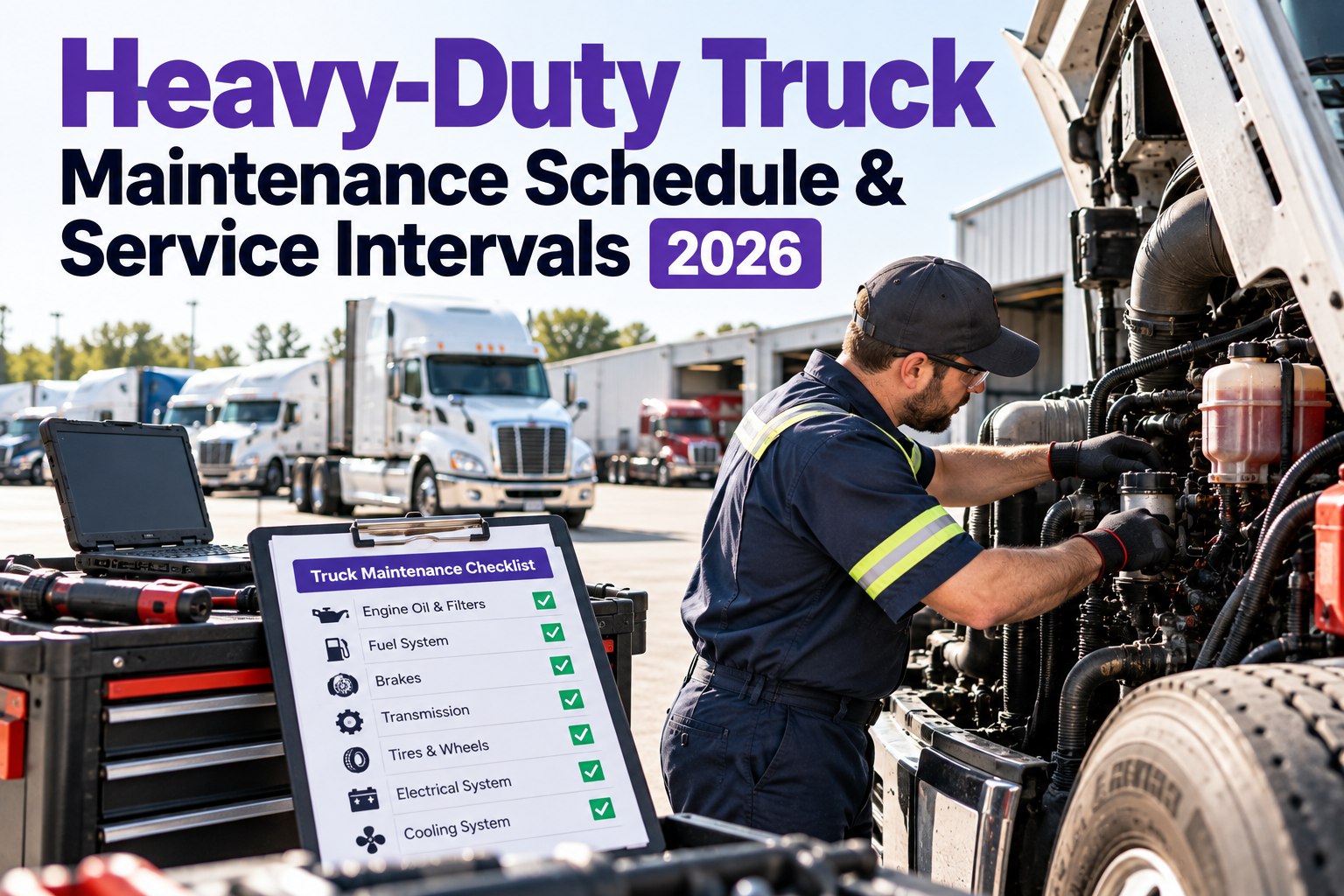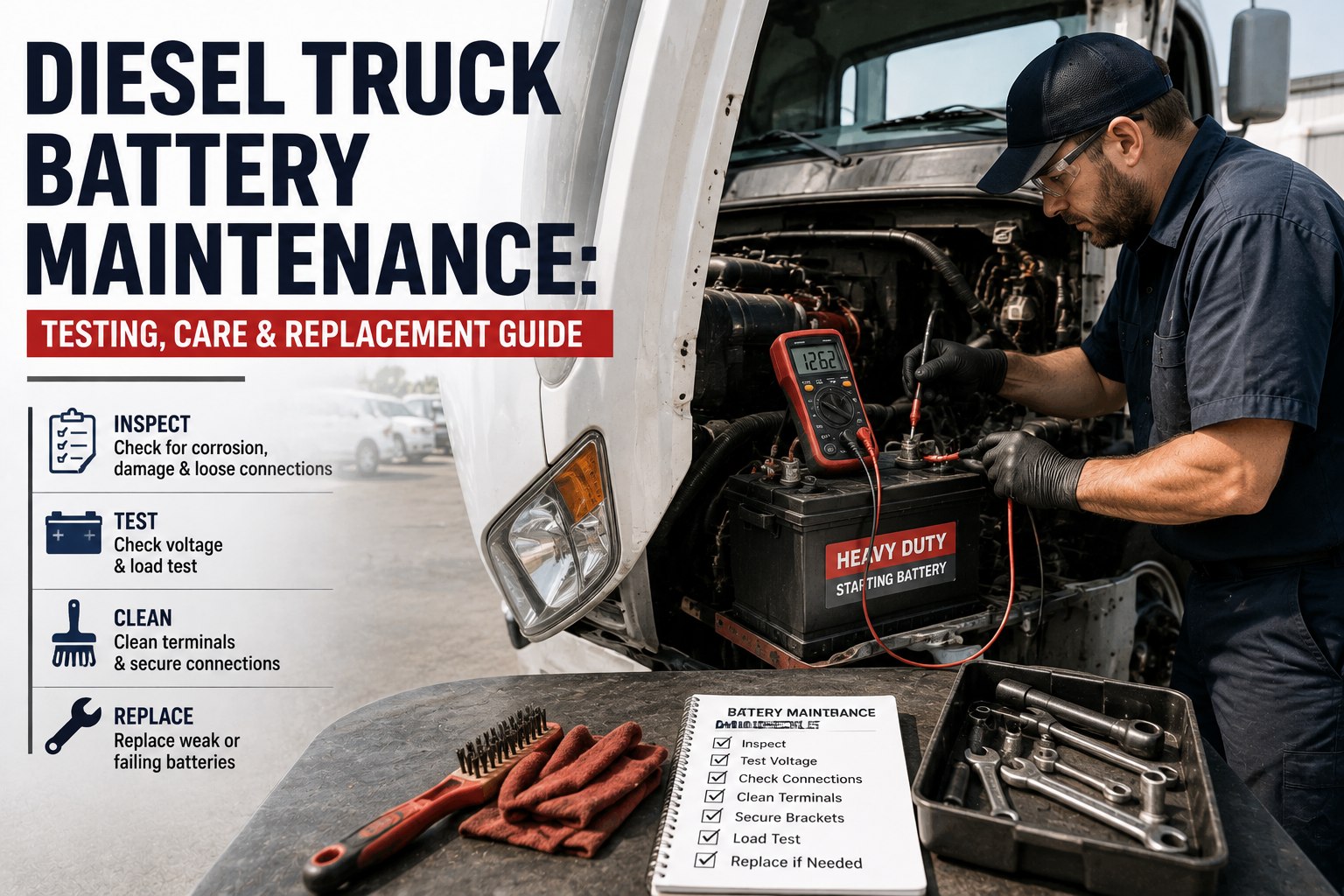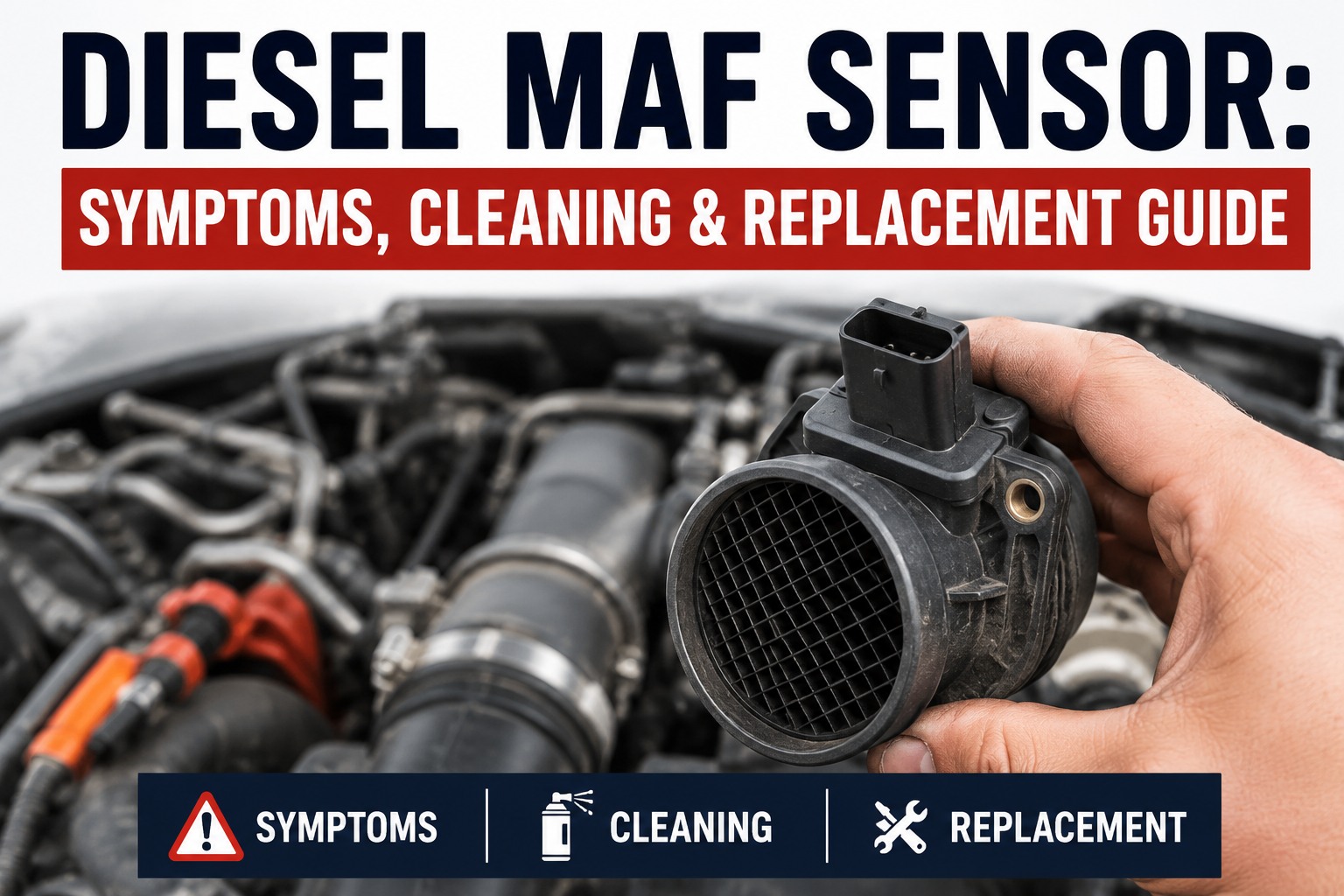
The Mass Air Flow (MAF) sensor is a tiny hot-wire component sitting between your air filter and the turbo, and it does one of the most important jobs on your entire diesel engine — measuring exactly how much air enters combustion. That number goes to the ECU, which uses it to calculate the exact fuel injection quantity for perfect air-to-fuel ratio. When it fails or gets dirty, everything downstream goes wrong: rough idle, hesitation, poor fuel economy, black smoke, and a cascade of P0100-series codes. The good news: master techs who have replaced 500+ MAF sensors report that in 30–40% of cases, the sensor isn't failed — it's just dirty, coated with oil residue and fine dust that slipped past the air filter. A $15 can of specialty cleaner and 15 minutes of work can restore full function. But once the hot-wire element is electrically damaged, no amount of cleaning brings it back — and running on a bad MAF for weeks risks $1,200 catalytic converter damage from an incorrect air-fuel mixture. This guide walks through exactly how to identify the symptoms, decode the OBD-II codes, decide between cleaning and replacement, and how Truck Inspection & Maintenance turns performance complaints into tracked defects before they become catalyst-killing problems.
Diesel MAF Sensor: Symptoms, Cleaning & Replacement Guide
The $15 fix that solves 30–40% of MAF problems — and when replacement is the only option.
What the MAF Sensor Actually Does
Before diving into symptoms, understand the job. The MAF sensor uses a heated wire (typically 200°C+) suspended in the intake air stream. As air flows past, it cools the wire — the amount of current needed to keep it at temperature tells the ECU exactly how much air mass is entering the engine. That measurement is the foundation for every fuel injection decision. When the reading is wrong, everything downstream fails:
The 6 Symptoms of a Failing MAF Sensor
MAF problems announce themselves clearly — but the symptoms overlap with clogged air filters, vacuum leaks, and dirty injectors. Recognizing the pattern is the first step to diagnosing correctly instead of throwing parts at a symptom:
Rough Idle
Engine shakes, RPM fluctuates, may nearly stall at stoplights. The ECU is receiving wrong airflow data and injecting the wrong fuel quantity — combustion becomes erratic.
Hesitation on Acceleration
Truck stumbles when you push the throttle. The ECU can't calculate fuel fast enough with bad airflow data. Feels like a moment of "nothing" before power arrives.
Poor Fuel Economy
MPG drops 5–20% depending on severity. Dirty MAF typically under-reads airflow, causing lean condition, ECU compensates with extra fuel through long-term fuel trim adjustments.
Black Smoke From Exhaust
Diesel-specific symptom. Rich mixture from over-fueling produces visible black smoke on acceleration. If turbo-equipped, watch for smoke plumes when pulling grades.
Check Engine Light
Almost always accompanies MAF issues. Common codes: P0100–P0104 (airflow circuit issues), P0171 (system too lean). Codes appear intermittently at first, become persistent as failure worsens.
Hard Starts & Stalling
Cold starts take multiple attempts. Engine may fire and immediately stall. Warm restart is easier — the ECU has learned around the wrong readings. This is late-stage MAF failure.
OBD-II Codes — The MAF Sensor Cheat Sheet
Every MAF-related trouble code sits in a specific range — memorize them. If your scan tool shows any of these, MAF is the first suspect. If you see them alongside cooling or fuel codes, MAF may just be a symptom of a larger issue:
Clean or Replace? The Decision Framework
This is the single most important question. Cleaning is a $15 fix that takes 15 minutes; replacement is a $150–$550 job. But cleaning won't restore an electrically failed sensor — and running on a bad MAF wastes fuel and risks catalyst damage. Here's how professional techs decide:
When cleaning is the right first step
When cleaning won't save you
Log MPG drops on every DVIR — catch MAF failure before it kills the catalyst
A 15% MPG drop is a MAF sensor warning. Nobody remembers to write it down until a P0101 code triggers weeks later — by then, the catalytic converter may have taken damage worth thousands. Truck Inspection & Maintenance turns every fuel economy observation and performance complaint into a documented DVIR item — timestamped, GPS-tagged, routed to your shop. Sign up free for up to 3 vehicles.
How to Clean a MAF Sensor — Step by Step
Cleaning takes 15 minutes and one specific tool — the correct MAF sensor cleaner spray (CRC 05110 is the industry standard). Anything else risks damaging the hot-wire element. Here's the exact process:
Buy Specialty MAF Cleaner
CRC 05110 or equivalent. Evaporates completely with zero residue. Never use brake cleaner, carb cleaner, throttle body cleaner, or WD-40 — any of these will destroy the sensor within minutes.
Disconnect Battery & Locate Sensor
Sits in the intake tube between air filter box and turbo. Disconnect negative battery cable. Unplug the electrical connector by pushing tab and pulling gently — never yank on wires.
Remove Sensor Carefully
Usually held by 2 Torx or Phillips screws. Remove sensor without touching the internal hot-wire element — a fingerprint can throw off readings. Handle only by the housing.
Spray Cleaner Into Sensor
Point the sensor housing downward. Spray 10–15 short bursts directly at the hot-wire element. Do NOT touch it with anything — no rags, no cotton swabs. Let gravity carry contaminants out.
Air Dry Completely
Set sensor aside for 20 minutes minimum. Solvent must fully evaporate before reinstalling. Rushing this step means unburned solvent enters the intake — bad news.
Reinstall, Reconnect, Test Drive
Reinstall in original orientation, plug in connector, reconnect battery. Clear codes with scan tool. Test drive 10+ miles — some ECUs need multiple drive cycles to relearn correct fuel trim.
Real Repair Cost Breakdown
Replacement costs vary widely by truck brand, sensor type, and whether OEM vs aftermarket. Here's the honest cost picture — plus why the cheapest option often costs more in the long run:
DIY Cleaning Route
CRC 05110 or equivalent specialty cleaner. 15 minutes labor. Success rate: 30–40% for genuinely dirty sensors. Try this first before anything else.
Typical Professional Repair
Aftermarket sensor $60–$150, OEM $120–$300. Labor 30–60 minutes at $80–$150/hr. Some ECUs require idle relearn procedure after installation.
Housing + ECU Recalibration
Some designs require replacing the entire MAF housing assembly. German-built diesels can hit $400+. Add ECU recalibration if needed.
Prevention — Make Your MAF Last
MAF sensors are designed to last the life of the engine — but they need clean air to survive. Five practices dramatically extend sensor life and prevent premature cleaning cycles:
Change Air Filter On Schedule
A dirty air filter forces more dust past the MAF. Follow manufacturer intervals — typically 15K–30K miles for diesel. Every mile past that is MAF wear.
Avoid Over-Oiled Filters
K&N-style oiled performance filters are the #1 MAF killer when over-oiled. Oil transfers to the hot-wire and coats it permanently. Use exactly the oil amount specified — no "extra insurance."
Fix Intake Leaks Immediately
Cracked intake boots, loose clamps, or damaged intercooler piping let dirty unfiltered air reach the MAF. A $10 boot replacement prevents $400 sensor damage.
Address MPG Drops Fast
A sudden 5–15% MPG drop is your earliest MAF warning. Log it. Diagnose it. Don't wait for the check engine light — by then, catalytic converter damage may have started.
Use OEM Replacements When Possible
Off-brand aftermarket MAF sensors are often poorly calibrated and fail within months. Save $100 on the part, pay $400 to replace it again. OEM or reputable premium brands only.
Clean Preventively at 100K
Factory schedules don't include MAF cleaning, but at 100K miles most sensors benefit from a cleaning even without symptoms. 15 minutes + $15 = catch buildup early.
Frequently Asked Questions
Can I drive with a bad MAF sensor?
Technically yes — the ECU enters failsafe mode and guesses airflow based on RPM and throttle position. But you shouldn't for long. Expect terrible fuel economy, rough performance, and real risk of catalytic converter damage from running rich or lean. Replacing a catalyst can cost $1,200+ compared to a $150–$400 MAF sensor. Fix it as soon as possible.
How much does MAF sensor replacement cost?
Typical range is $150–$400 for professional replacement. The sensor itself costs $60–$300 (aftermarket lower, OEM higher), plus 30–60 minutes labor at $80–$150/hr. Some diesel trucks with integrated MAF housings can hit $400–$600+. Some vehicles require ECU recalibration after installation. Cleaning first costs $15–$25 and solves the issue 30–40% of the time.
What are the most common MAF sensor codes?
P0100–P0104 all relate to the MAF sensor circuit — general fault, out-of-range signal, low voltage, high voltage, and intermittent signal. P0171 (system too lean) is a downstream code often caused by an under-reading MAF. If your scan tool shows any of these, MAF is the first place to check. P0101 is the most common and usually cleanable; P0102/P0103/P0104 typically require replacement.
Should I clean or replace my MAF sensor?
Clean first. It's $15, takes 15 minutes, and works 30–40% of the time on genuinely dirty sensors. Replace if: cleaning doesn't fix symptoms, symptoms return within days, you see P0102/P0103/P0104 codes (electrical failure), or you've already cleaned twice. Never use brake cleaner or throttle body cleaner — only specialty MAF cleaner (CRC 05110 is the industry standard). Talk to our team about tracking MPG trends.
How often should I clean my MAF sensor?
Factory maintenance schedules don't include MAF cleaning — do it only when diagnostics support it. That said, at 100K miles most sensors benefit from a preventive cleaning even without visible symptoms. Beyond that, clean when you see symptoms: rough idle, hesitation, MPG drop, or P0101/P0171 codes. Cleaning as routine maintenance more than once per 100K is unnecessary.
How does Truck Inspection & Maintenance help catch MAF problems early?
Every MPG observation, hesitation complaint, black-smoke report, and check-engine incident belongs on the daily DVIR — captured, timestamped, GPS-tagged, and routed to your shop as a defect work order. A 15% MPG drop over two weeks is a MAF warning invisible to any one driver but obvious in a fuel log. Catch it early and cleaning solves it; catch it late and you're replacing the catalytic converter. Sign up free to see the workflow.
A $15 cleaner or a $1,200 catalytic converter — the difference is when you catch it.
Every rough idle, hesitation complaint, and MPG anomaly is a data point that either sits in a driver's memory or on a digital DVIR. Truck Inspection & Maintenance captures them GPS-tagged, timestamped, and routed to your shop as defect work orders before your MAF failure damages downstream components. Free for up to 3 vehicles with no hardware and no contracts. Set it up in 10 minutes.