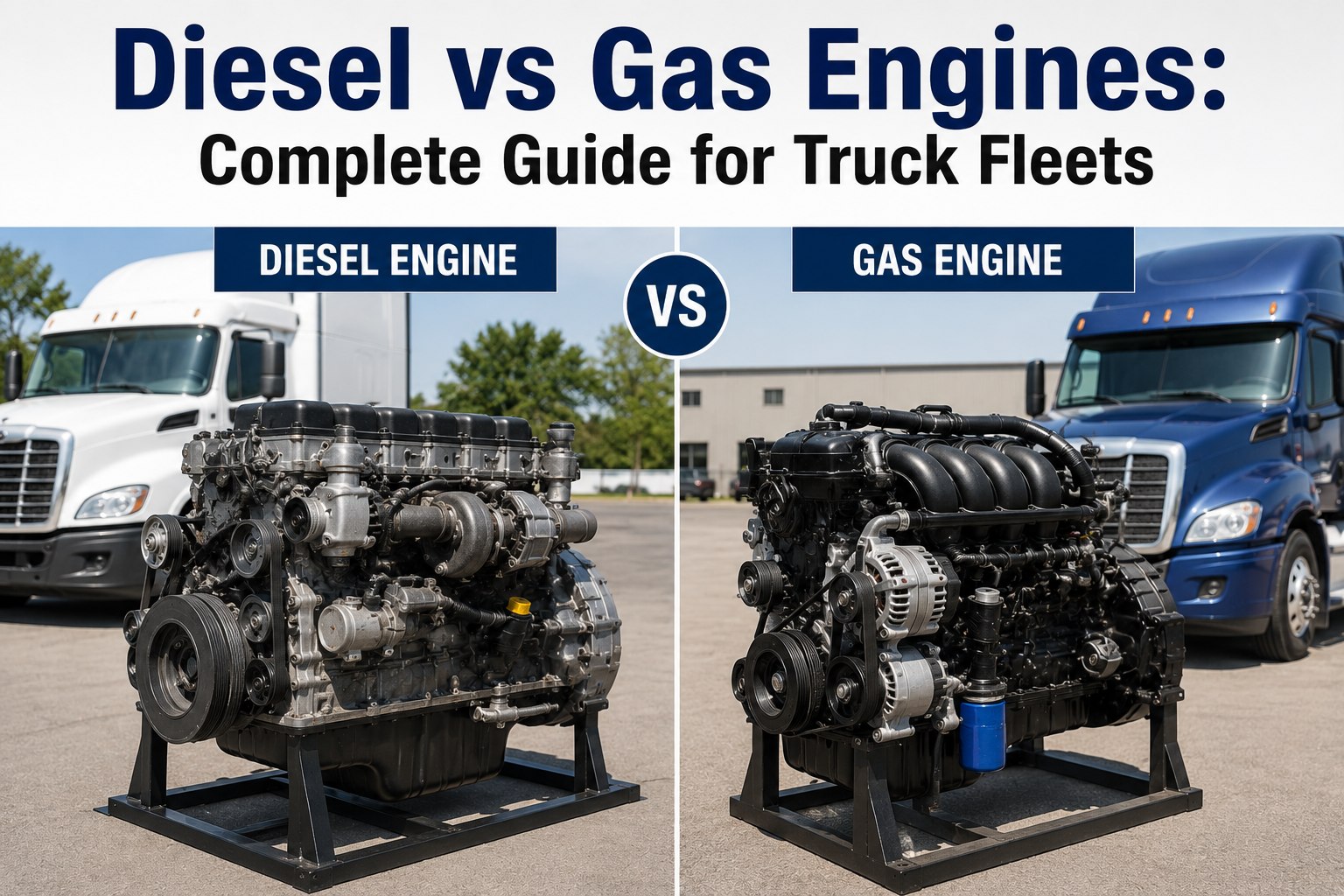
The diesel-versus-gas question really comes down to a single trade-off: diesel wins on work, gas wins on simplicity. A diesel engine is built to pull heavy loads efficiently for hundreds of thousands of miles, and it costs more to buy and more to service to do it. A gas engine costs less upfront, is cheaper and easier to maintain, and feels quicker in daily driving — but it burns more fuel and wears out sooner under heavy work. Neither is simply "better." The right answer depends on what the truck actually does: how much it tows, how many miles it runs a year, and how long you plan to keep it. This guide breaks down the fundamental difference in how the two engines burn fuel, why that makes diesel the towing champion, the category-by-category comparison, the break-even math, and the modern emissions factor that's making some fleets reconsider — plus how fleet maintenance software tracks the real per-mile cost of whichever you run.
Fleet Engine Guide · Diesel vs Gas · 2026
Diesel vs Gas Engines for Truck Fleets
How the two engines differ, why diesel dominates towing, what each really costs to run, and how to match the engine to the job.
20-30%
Better fuel economy from diesel, especially under load
2-3×
Diesel engine lifespan versus a comparable gas engine
$5-11K
Typical diesel price premium at purchase
150-200K
Miles where diesel usually breaks even
The Fundamental Difference
Everything else in this comparison flows from one design choice: how each engine ignites its fuel. That single difference shapes the torque, the economy, the durability, and the cost:
Compression ignition
Diesel squeezes air to an extreme ratio — roughly 15:1 to 25:1 — heating it past 1,000°F. Fuel injected into that superheated air ignites on contact, with no spark plug needed. That high-compression burn peaks at low RPM, which is where diesel's signature torque comes from.
Spark ignition
A gas engine pre-mixes fuel and air at a much lower compression ratio — around 8:1 to 12:1 — and a spark plug lights it. Power comes from revving higher rather than from low-end grunt, which delivers quicker acceleration and higher horsepower.
Why this matters downstream: the high compression that lets diesel ignite without a spark also forces it to be built heavier — larger crankshafts, thicker cylinder walls, stronger bearings. That heavier construction is the root of diesel's durability, its torque, and its higher cost, all at once. Gas engines, built lighter and revving faster, trade some of that longevity for lower cost and smoother everyday manners.
Torque vs Horsepower
The most practical difference on a work truck is what happens when you ask it to pull. Torque and horsepower aren't the same thing, and the distinction decides towing:
Torque pulls from a standstill
Torque is the twisting force that gets a heavy load moving. Diesel makes strong torque at low engine speed, so it pulls confidently from a dead stop without needing to rev — which is exactly what towing demands.
Horsepower is speed at the top
Horsepower moves the truck fast once it's already going. Gas engines make more of it by revving high, which is why they feel quick and light in daily driving and stop-and-go traffic.
The towing verdict: because diesel produces its power low in the rev range — often 50 to 100% more torque than a comparable gas engine — it pulls a heavy trailer without the constant downshifting and high revs a gas truck needs for the same load. Many diesels also include an integrated exhaust brake for controlled descents on grades. Use a gas truck for heavy towing and you'll see reduced engine life and much higher fuel burn.
The Category-by-Category Scorecard
Across the dimensions a fleet actually weighs, here's where each engine wins — and it's genuinely split:
Diesel fuel is roughly 15% more energy-dense, and diesels return 20-30% better mileage — the U.S. Department of Energy cites 30-35% over comparable gas engines, widening further under load.
Low-RPM torque makes heavy pulling efficient and less stressful on the drivetrain, with engine-braking capability on grades. No contest under real load.
Heavier construction, self-lubricating fuel, and roughly half the operating RPM mean diesels commonly exceed 300,000 miles where gas engines run shorter.
The market sees more remaining life in a high-mileage diesel, so it holds value and commands a higher used price than a comparable gas truck.
A gas truck costs several thousand dollars less to buy, improving cash flow and lowering the bar to put a unit into service.
Gas parts are cheaper, service is available everywhere, and there's no turbo, injectors, or emissions aftertreatment to maintain — just simpler routine upkeep.
Gas engines skip the DPF, SCR, and DEF systems that add cost and complexity to every modern diesel — a growing factor in the decision.
Quicker throttle response and lighter feel make gas the more pleasant choice for unloaded, stop-and-go, and short-trip duty.
The Break-Even Math
The diesel premium isn't a loss — it's an investment that pays back through fuel, but only past a certain mileage. Here's how the money moves:
$5,000-$11,000 more upfront
Diesel's heavier engine, turbo, and emissions hardware raise the purchase price before the truck turns a wheel.
$3,000-$5,000 saved per 100,000 miles
Better economy — especially under load — steadily returns the premium in fuel, faster the more you drive.
Break-even at 150,000-200,000 miles
For most fleet applications, that's where the fuel savings overtake the premium and diesel pulls ahead for the rest of the truck's life.
Mileage is the deciding variable: a truck that runs high miles under load crosses into diesel's favor quickly and stays there, helped by stronger resale at trade-in. A moderate-mileage truck may never reach the crossover — which is why gas can save $3,000-$6,000 per vehicle over a five-year lifecycle for lighter-duty roles. Diesel fuel has also averaged around 14 cents more per gallon than gasoline over the past decade, so run the numbers on your actual duty cycle, not a rule of thumb.
Free · Up to 3 Vehicles
Know the real cost per mile of each engine
Fleet maintenance software tracks fuel, service, and downtime per vehicle — so you can see the actual per-mile cost of your diesels and gas trucks side by side instead of trusting a rule of thumb. Watch the break-even arrive in your own numbers and match the next purchase to the duty cycle it'll actually run. Sign up free for up to 3 vehicles and put real data behind the diesel-or-gas decision.
The modern diesel emissions factor
Every diesel built since roughly 2010 carries emissions hardware that didn't exist a generation ago — and it's the single biggest reason some fleets are reconsidering diesel. The diesel particulate filter captures soot and burns it off in regeneration, costing around $1,000-$3,000 to clean or $3,000-$8,000 to replace. On top of that sit the SCR catalyst and the diesel exhaust fluid it consumes. These systems genuinely lower emissions, but they add cost, complexity, and failure points that a gas engine simply doesn't have. Factor them into any total-cost comparison, especially on used diesels from the 2011-onward era.
Which Wins for Your Use Case
Strip away the specs and the decision is really about the job. Match the engine to how the truck earns its keep:
You tow heavy regularly and want confident pulling without downshifting
You run long, high-mileage routes where fuel economy compounds
You keep trucks long-term, past 200,000 miles
You do heavy hauling or work in demanding conditions
You want the lowest per-mile cost under load, and can absorb higher service
Your mileage is moderate and rarely justifies the diesel premium
Loads are light and towing is occasional rather than constant
Lower upfront cost and cash flow matter to the budget
You value simple, widely available, lower-cost service
The truck lives in stop-and-go and short-trip duty
Frequently Asked Questions
What's the core difference between diesel and gas engines?
How they ignite fuel. Diesel uses compression ignition — it squeezes air to a 15:1 to 25:1 ratio until it's hot enough to ignite injected fuel with no spark plug. Gas uses spark ignition, firing a pre-mixed fuel-air charge at a lower 8:1 to 12:1 compression. That single difference is why diesel makes strong low-RPM torque and lasts longer, while gas revs higher for horsepower and costs less to build and maintain.
Why is diesel better for towing?
Torque. Towing a heavy load from a standstill takes twisting force, not top-end speed, and diesel produces its torque low in the rev range — often 50 to 100% more than a comparable gas engine. That means a diesel pulls a heavy trailer steadily without the constant downshifting and high revs a gas truck needs for the same weight, and many diesels add an exhaust brake for grade control. Contact our team about tracking your fleet's costs by duty cycle.
How much better is diesel fuel economy?
Diesels typically return 20-30% better fuel economy, and the U.S. Department of Energy cites 30-35% over comparable gas engines. Diesel fuel is about 15% more energy-dense, and the efficiency advantage widens under load and at highway speed. A heavy-duty diesel towing can hold mid-to-high teens in MPG where a comparable gas truck drops into single digits. The gap narrows when running empty but diesel still leads.
At what point does diesel pay for itself?
For most fleet applications, break-even lands around 150,000 to 200,000 miles. Diesel costs roughly $5,000 to $11,000 more upfront but saves about $3,000 to $5,000 in fuel per 100,000 miles, so the higher the mileage, the sooner it pays back — and stronger diesel resale helps at trade-in. A moderate-mileage truck may never reach that crossover, which is where gas keeps the advantage.
Why are some fleets moving away from diesel?
Emissions systems. Diesels built since about 2010 carry a diesel particulate filter, an SCR catalyst, and a DEF system — none of which a gas engine needs. A DPF can cost $1,000-$3,000 to clean or $3,000-$8,000 to replace, and these components add complexity and failure points that raise total maintenance cost. For fleets whose duty cycle doesn't demand diesel's towing and longevity, that added burden increasingly tips the math toward gas.
Which engine is cheaper to maintain?
Gas, generally. Gas parts cost less, service is available at virtually any shop, and there's no turbocharger, high-pressure injection, or emissions aftertreatment to maintain — routine upkeep is mostly spark plugs and fluids. Diesel has fewer ignition wear items, but its parts are pricier and the turbo, injectors, and emissions hardware make repairs more expensive when they come due. The trade-off is that diesel's durability spreads those costs over far more miles. Sign up free to track maintenance cost per vehicle.
Match the Engine to the Job
Let real per-mile data make the call.
Fleet maintenance software tracks fuel, service, and downtime for every truck, so the diesel-or-gas decision rests on your actual numbers instead of a rule of thumb. See where break-even really lands for your routes, spot which engines cost what per mile, and buy the next unit for the work it'll do. Free for up to 3 vehicles. Works with your existing fleet, no contracts.