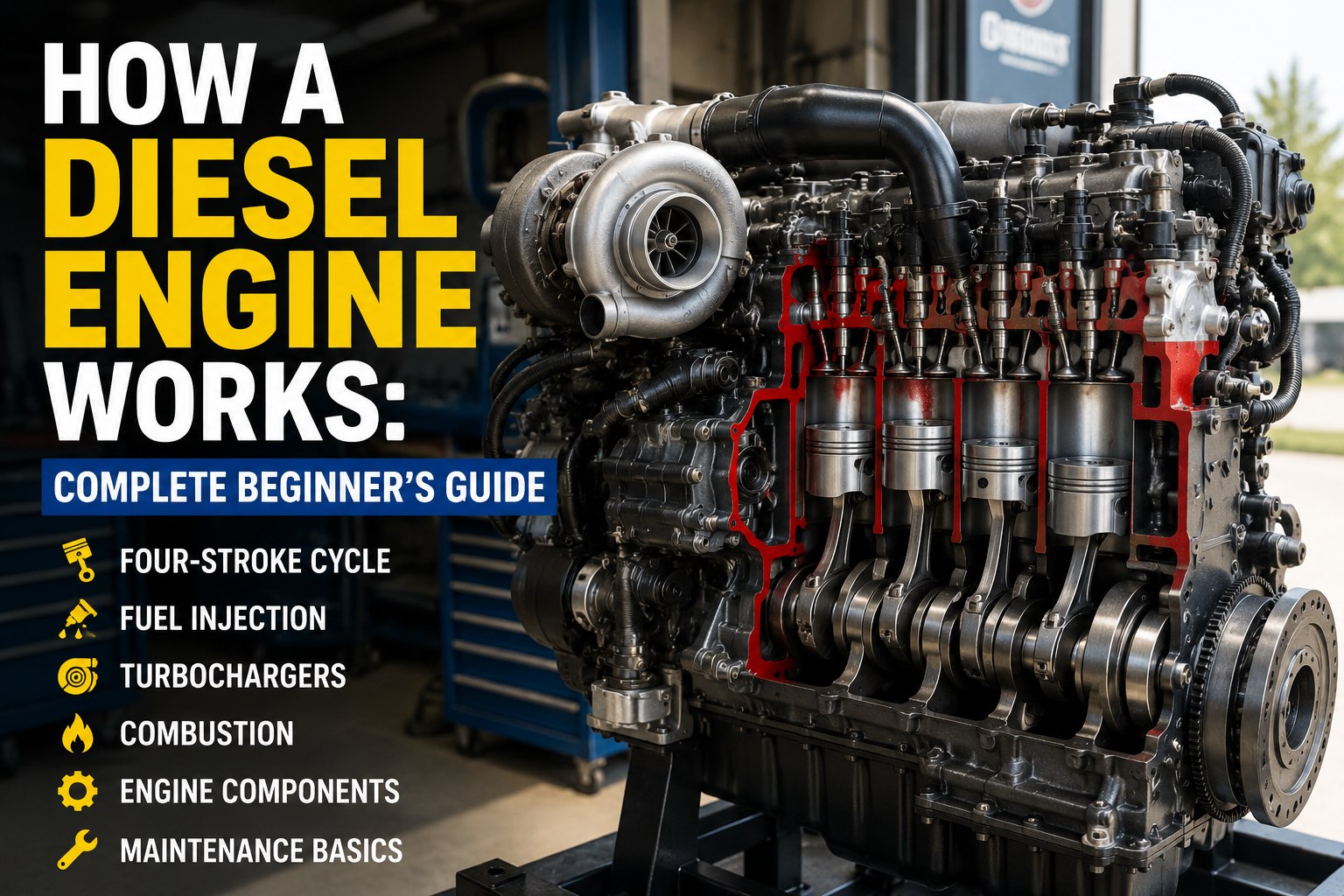
Every commercial truck on the road today runs on a diesel engine designed around a single principle Rudolf Diesel patented in 1892: compress air until it's hot enough to ignite fuel on contact, no spark plug required. That compression-ignition approach is why diesel engines produce more torque, get better fuel economy under load, last 500,000+ miles between rebuilds, and run at roughly 40–45% thermal efficiency versus 25–30% for a gasoline engine of similar size. Understanding what happens inside the cylinder — through all four strokes, across the fuel injection system, past the turbocharger, and out through the emission after-treatment — is the foundation for every conversation about diesel maintenance, fuel efficiency, and failure diagnosis. This guide walks through the complete diesel engine operation for anyone who needs the mechanical picture: the four-stroke cycle explained visually, the major components and what they do, how fuel injection and turbocharging work, the combustion process, and the maintenance basics that keep it running. Need to track engine health on your fleet? Start a free trial or reach out to our support team.
How a Diesel Engine Works: The Complete Guide
Compression ignites fuel. No spark plug required. Four strokes, thousands of times per minute — the mechanical process behind every commercial truck on the road.
The One Idea Behind Every Diesel Engine
Before the four strokes, before the components, before anything else — the core principle. Everything a diesel engine does is built on this single physical fact.
Air compressed to 17:1 ratio heats to around 1,000°F (538°C) — well above diesel fuel's autoignition temperature of 410°F (210°C). Fuel injected into that hot, dense air ignites on contact. No electrical spark needed.
The 4-Stroke Cycle: What Happens Inside the Cylinder
The heart of a diesel engine is the 4-stroke cycle, repeated thousands of times per minute per cylinder. Here's exactly what happens on each stroke.
The Major Components and What They Do
A diesel engine has hundreds of parts, but 8 major systems do the essential work. Understanding what each does makes engine diagnostics and maintenance dramatically easier.
How Fuel Injection Actually Works
The injection system is what separates modern diesel engines from their 1980s ancestors. Understanding it explains why fuel economy, power output, and emissions performance have all improved dramatically.
Track engine health across your fleet
ECM fault codes, oil analysis trends, fuel economy per truck, injector performance flags. Everything an engine tells you, aggregated per vehicle.
The Turbocharger: More Power Without More Displacement
Nearly every modern diesel is turbocharged. Here's how the turbo works and why it changes everything about engine performance.
Combustion: The 3 Phases
Combustion inside a diesel cylinder isn't instantaneous. It happens in three distinct phases, each with its own contribution to engine performance.
Diesel vs Gasoline: The Real Differences
Both are internal combustion engines. But they operate on fundamentally different principles — and it shows up in every performance number that matters for commercial use.
Diesel Engine Maintenance Fundamentals
A diesel engine that gets its basic maintenance runs for a million miles. One that doesn't fails at 300,000. The differences all come down to five fundamentals.
Oil & oil filter changes
Every 15,000–50,000 miles depending on application and oil grade. Contaminated oil is the #1 preventable cause of engine wear. Sample and analyze oil to catch problems 20,000 miles early.
Fuel filter changes
Every 15,000–25,000 miles for primary, longer for secondary. Modern injection systems have zero tolerance for dirty fuel — a clogged filter starves injectors, a failed filter destroys them.
Cooling system service
Coolant flush every 300,000–500,000 miles. Test coolant strength annually. Failed cooling means warped heads, blown gaskets, or seized engines. All catastrophic, all preventable.
Air filter service
Every 30,000–50,000 miles or when restriction gauge indicates. Dirty air filter chokes the turbo, reduces boost, and forces the engine to over-fuel — cascade of consequences.
DPF regeneration monitoring
Track passive vs active regen cycles. Blocked DPF is the fastest way to unplanned downtime on modern diesels. ECM fault codes give 500+ miles of warning if watched.
Valve adjustments
Every 150,000–300,000 miles depending on manufacturer. Out-of-spec valves reduce fuel economy, cost power, and eventually damage seats and guides. Fast to check, cheap to correct.
Frequently Asked Questions
Compression alone. Air is compressed to about 1/17th of its original volume, which raises its temperature to roughly 1,000°F — well above diesel fuel's autoignition temperature of 410°F. When fuel is sprayed into that hot, dense air, it ignites on contact. This is why diesel engines are called compression-ignition engines. Track injection health per vehicle with our fleet software.
Two reasons. First, higher compression ratio (17:1 vs 10:1) extracts more work from each combustion cycle — thermodynamic efficiency is directly linked to compression. Second, diesel fuel has about 10% more energy per gallon than gasoline. Combined, diesel engines achieve 40–45% thermal efficiency versus 25–30% for gasoline.
The 4-stroke cycle consists of intake (piston down, air enters), compression (piston up, air compressed and heated), power (fuel injected, ignites, drives piston down), and exhaust (piston up, spent gases pushed out). The full cycle takes 2 crankshaft revolutions — at 2,000 RPM cruise, each cylinder fires 1,000 times per minute.
A turbocharger uses exhaust gases to spin a turbine wheel connected via shaft to a compressor wheel on the intake side. The compressor forces more air into the engine — denser air means more oxygen, which allows more fuel to burn, producing 30–100% more power from the same displacement without adding cylinders or size.
A well-maintained commercial diesel engine typically reaches 500,000–1,000,000+ miles before major rebuild. Longevity comes from the engine's overbuilt construction (heavier internals to handle higher compression pressures) and diesel fuel's inherent lubricity. Skipped maintenance can cut that in half. For fleet-wide engine health tracking, talk to our team.
Clean oil, on schedule. Contaminated or degraded oil is the number-one cause of preventable engine wear — bearing wear, injector coking, turbo failure all trace back to oil condition. Modern practice pairs interval-based changes with oil analysis to catch developing issues 15,000–20,000 miles before failure.
Keep every diesel engine in your fleet running to its full life
ECM fault-code tracking. Oil analysis trending. Fuel economy per vehicle. Injector performance monitoring. DPF regen alerts. PM cadence automation. The complete engine-health picture — one platform, one workflow, purpose-built for commercial diesel operations.