If you manage a fleet in 2026, DOT compliance is no longer the once-a-year scramble it used to be. The FMCSA overhauled its CSA Safety Measurement System this year so that violations from the most recent six months now carry the heaviest weight — meaning one bad quarter can push your carrier profile past an intervention threshold faster than ever. Electronic DVIRs became explicitly legal under the March 23, 2026 final rule, paper medical certificates stopped being accepted on January 10, 2026, and a single Hours-of-Service violation still carries a civil penalty of up to $16,000. The carriers that thrive treat compliance as a daily operating discipline, not a checkbox — and they run it on software instead of spreadsheets. This guide breaks down every major FMCSA requirement — driver qualification files, HOS, DVIRs, vehicle inspections, record retention, CSA scores, and audit prep — in plain language, then shows how Truck Inspection & Maintenance automates each one so nothing slips through. Talk to our compliance team for a walkthrough tailored to your fleet.
DOT Compliance Explained — The Complete Fleet Manager's Guide
Six pillars. One audit-ready system. Everything that changed in 2026.
What DOT Compliance Actually Means
DOT compliance isn't a single rule — it's a framework of federal regulations enforced primarily by the Federal Motor Carrier Safety Administration (FMCSA) that governs who can drive, how long they can drive, the condition of the vehicle, and the records that prove it all. Get any one of the six pillars wrong and it surfaces at the worst possible moment: a roadside inspection, a compliance review, or a post-crash investigation. The good news is that every pillar follows the same logic — document the right thing, keep it the right length of time, and produce it on demand. Truck Inspection & Maintenance is built around exactly that pattern, automating the capture, expiry tracking, and one-click retrieval for all six pillars so the whole framework runs itself.
Driver Qualification
Proof every driver is legally and medically fit to operate a CMV.
Hours of Service
Fatigue limits on driving and on-duty time, logged via ELD.
Vehicle Inspections
Daily DVIRs plus annual periodic inspections under 49 CFR 396.
Maintenance Records
Defect-to-repair chains that link every issue to a certified fix.
Record Retention
Each document type kept for its own federally mandated period.
CSA Scores
Your public safety profile, scored from inspection and crash data.
What Changed in 2026 — Read This First
Before diving into each pillar, know what shifted this year. These changes are why even compliant fleets are getting caught off guard. If you build your program around last year's assumptions, you'll have gaps you can't see until an auditor finds them. Truck Inspection & Maintenance ships pre-configured for the 2026 ruleset — eDVIR formats, the new medical-cert verification flow, and the reweighted CSA categories are already baked in. Start a free account and your inspection and document tracking are aligned to the current rules from day one.
Paper medical certificates no longer accepted
Medical certification must now be verified through the state MVR via the National Registry electronic submission. A self-carried paper Med Card no longer counts.
Electronic DVIRs explicitly legal
FMCSA's final rule removed all ambiguity around paper-based DVIRs. Digital driver and mechanic sign-off are valid with no wet ink — records must be producible within minutes.
Recent violations now weighted heaviest
The SMS percentile model assigns greater impact to violations from the last six months. Only the past 12 months count toward scores, and severity weights simplified to 1 or 2.
BASICs became "compliance categories"
Vehicle Maintenance split into Driver Observed and Inspector Detected. Controlled Substances merged into Unsafe Driving. Over 950 violations consolidated into 116 groups.
Pillar 1 — Driver Qualification Files
Under 49 CFR 391.51, every motor carrier must keep a complete, current Driver Qualification (DQ) file for each driver — for the entire period of employment plus three years after. When an auditor arrives, these are the first documents they pull, and a single missing item can trigger a violation. The most common findings are expired medical certificates, missing motor vehicle records, and incomplete applications. For a 20-driver fleet, scattered incomplete files can stack into six-figure penalties fast — which is why Truck Inspection & Maintenance stores every DQ document in one driver profile and fires automatic alerts before any med card, MVR, or annual review expires.
Pillar 2 — Hours of Service
HOS rules under 49 CFR Part 395 cap how long a driver can operate before resting, and they're the single largest source of citations. Memorize the four core limits for property-carrying CMVs — they build on each other, and the most severe violations can trigger an immediate out-of-service order at roadside. The 2026 SMS overhaul doubled the severity weight of out-of-service findings, so an HOS-driven OOS now hits your score twice as hard as it did before.
Most drivers must log duty status on an FMCSA-registered ELD. If your device gets removed from the registered list, you have 60 days to replace it. Worth knowing: the five most-cited HOS violations carry hard CSA point costs, and false logs or ELD tampering are the most severe of all. Truck Inspection & Maintenance surfaces HOS status alongside your inspection and maintenance data, so a driver approaching a limit shows up before it becomes a roadside violation. Reach our support team to map live HOS visibility into your daily workflow.
The 5 most common HOS violations & CSA cost
Turn compliance from a scramble into a system
Truck Inspection & Maintenance unifies eDVIRs, defect-to-repair tracking, and document expiry alerts in one place — audit-ready from the moment a record is created. No hardware, no contracts. Sign up free and configure your fleet in ten minutes.
Pillar 3 — Vehicle Inspections & DVIRs
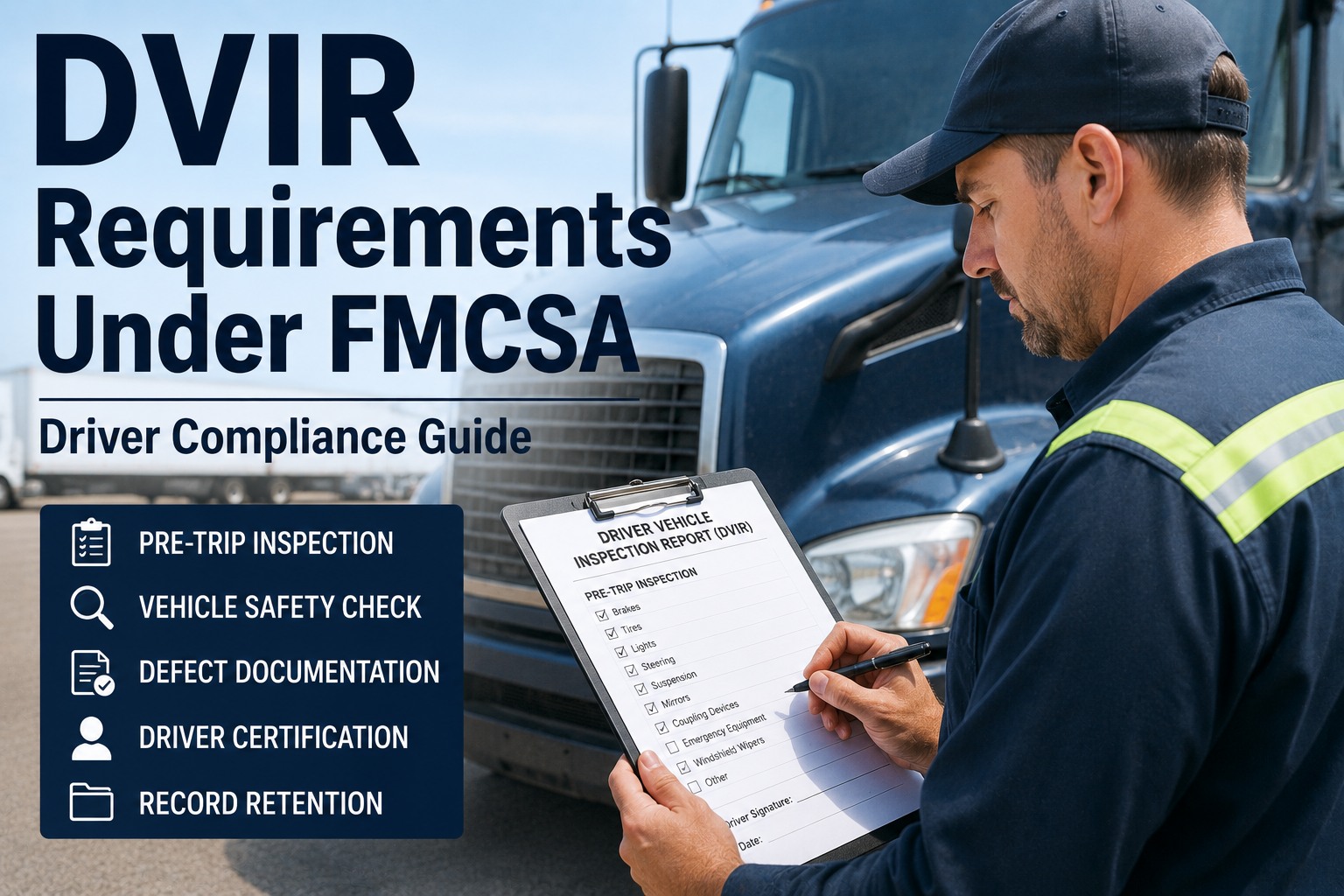
DVIRs document the physical condition of every vehicle operated under your DOT number, and FMCSA estimates they help prevent roughly 14,000 accidents a year through early defect detection. The 2026 rule made electronic DVIRs explicitly legal — a major win, since an eDVIR takes 2–5 minutes versus 10–15 for paper, saving a daily driver 40–60 hours a year. But the rules around what you keep didn't loosen: defect-noted DVIRs must always be filed, and any defect must show a certified repair before the vehicle re-enters service. Truck Inspection & Maintenance runs GPS-stamped, photo-verified eDVIRs that auto-route every defect into a work order and won't let the loop close until a mechanic certifies the fix.
Daily Driver Inspection
Pre-trip and post-trip DVIR completed by the driver each day. Note any defect or certify "no defects found." Defect-free DVIRs aren't required for property CMVs under the 2014 rescission — but defect-noted ones always are.
Defect-to-Repair Chain
Every defect must link to corrective action proof. A driver defect DVIR must show mechanic repair certification before the vehicle goes back into service. Break this chain and auditors cite it under 49 CFR 396.13.
Annual Periodic Inspection
Every CMV needs a periodic inspection at least once every 12 months, covering all items in 49 CFR 396 Appendix A — brakes, coupling devices, tires, lights, steering, and more.
Pillar 4 — Maintenance & Record Retention
Vehicle Maintenance is the largest violation category by volume — which is exactly why FMCSA split it into two compliance categories in 2026. The fix isn't more paperwork; it's making sure every record is instantly retrievable with a clear chain of custody. The critical 2026 standard: paper files scattered across offices won't survive a modern audit. Here's how long you must keep each record type — and Truck Inspection & Maintenance holds all of them in one searchable archive with automatic expiry alerts and one-click export. Open a free account to replace the filing cabinet entirely.
| Record Type | Retention Period | Regulation |
|---|---|---|
| Driver qualification files | Employment + 3 years | 49 CFR 391.51 |
| HOS / ELD RODS logs | 6 months (+ backup) | 49 CFR Part 395 |
| DVIR records + repair docs | 3 months minimum | 49 CFR 396.11 |
| Drug/alcohol — positive results | 5 years | 49 CFR Part 382 |
| Annual periodic inspection | 14 months | 49 CFR 396.21 |
| Supporting docs (BOL, fuel, toll) | 6 months | ELD supporting records |
Mismatches between supporting documents and ELD data signal possible falsification — a severe audit finding and a 2026 Roadcheck focus area.
Pillar 5 & 6 — CSA Scores and What They Cost You
Your CSA score is a public safety profile built from roadside inspections and crashes, scored across compliance categories (formerly BASICs). Scores above the intervention threshold in any category trigger FMCSA attention. The reason this matters far beyond fines: direct penalties are only 30–40% of a compliance failure's true cost. The rest arrives as insurance premium hikes of 18–24% and disqualification from shipper networks that now routinely screen carrier scores before awarding freight. Catching violations before they're ever logged is the whole game — and that's exactly what a system that tracks inspections, defects, and document expiry in real time is designed to do.
The Audit Prep Playbook
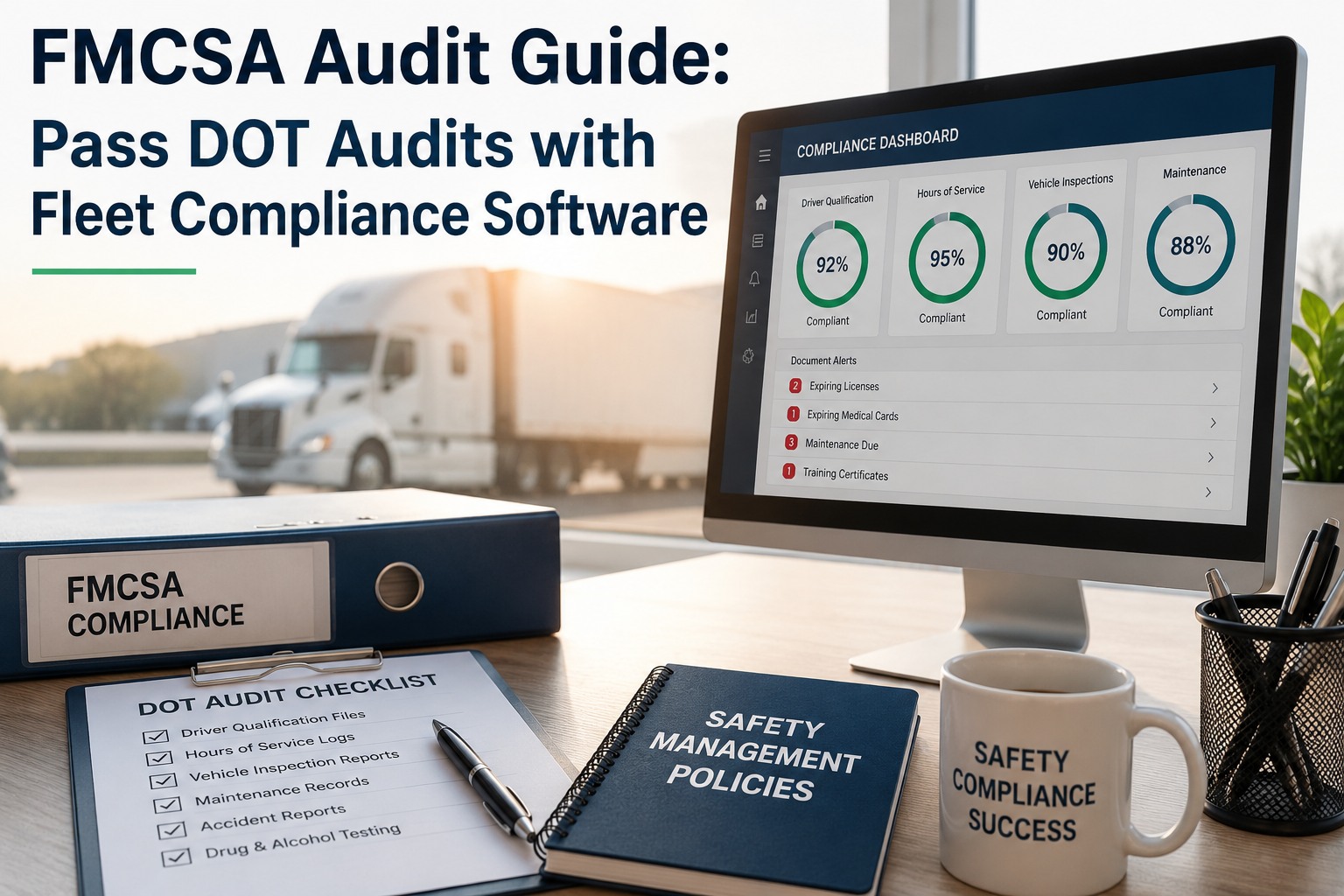
Only about 7% of carriers pass a DOT audit with zero violations. The difference between a green light and a 46-hour shutdown is usually one thing: can you produce the right record in under two minutes? A compliance review will sample 10–20% of your driver roster's DQ files plus six months of ELD records and unassigned-driving resolution docs. Here's the prep that keeps you in the 7% — and where Truck Inspection & Maintenance does the heavy lifting, since the self-audit, document checks, and instant retrieval all run from a single dashboard. Contact our specialists to pressure-test your records before an auditor does.
Run a self-audit on a 20% sample
Pull a random fifth of your DQ files. Check for expired med cards, missing MVRs, and skipped Clearinghouse queries — the three most-cited gaps.
Reconcile ELD vs supporting docs
Match six months of RODS against BOLs, fuel receipts, and toll records. Any mismatch is a falsification flag — fix the source before an auditor sees it.
Verify every defect closed the loop
Each defect-noted DVIR must show a certified repair. An open chain under 396.13 is a favorite of both auditors and plaintiff attorneys.
Time your retrieval
Have someone request a specific record cold. Under 2 minutes is good. Over 5 means your filing system fails the modern "instant retrievability" standard.
Monitor CSA monthly
Check your scores at csa.fmcsa.dot.gov. Because recent violations now weigh heaviest, monthly review catches problems before they cross a threshold.
Frequently Asked Questions
What's the single biggest 2026 change for fleet managers?
The CSA SMS reweighting. Violations from the most recent six months now carry the greatest impact on your score, and only the past 12 months count at all. That means a single bad quarter escalates toward an intervention threshold much faster than before — but it also means a clean recent stretch repairs your profile faster. Monthly monitoring matters more than ever.
Are electronic DVIRs actually required now?
Not required, but explicitly legal as of the March 23, 2026 final rule — and dramatically faster. An eDVIR takes 2–5 minutes versus 10–15 for paper, saving a daily driver 40–60 hours a year. Records must be stored electronically and producible within minutes for an auditor. Since 2026 rules treat illegible paper as a "missing document," digital is the safer path. Sign up free to run GPS-stamped, photo-verified eDVIRs on up to 3 vehicles.
How long do I keep each type of record?
DQ files: employment plus 3 years. HOS/ELD logs: 6 months. DVIRs and repair docs: 3 months minimum. Positive drug/alcohol results: 5 years. Annual periodic inspections: 14 months. The 2026 standard adds a layer — records must be instantly retrievable with a clear chain of custody, so keeping them isn't enough if you can't produce them fast.
What happens if a driver's medical certificate lapses?
The driver is no longer physically qualified and must be removed from safety-sensitive duties immediately until a new valid certificate is on file. As of January 10, 2026, paper Med Cards aren't accepted — certification is verified through the state MVR via the National Registry. A lapse at roadside can result in an immediate out-of-service order.
How much do DOT violations really cost?
A single HOS violation runs up to $16,000, and DQ file violations start around $1,000 per driver. But direct fines are only 30–40% of the real cost — the rest comes through 18–24% insurance increases and losing shippers who screen CSA scores. The first prevented breakdown often pays for compliance software many times over. Talk to our team about cutting your administrative compliance load.
Can I manage compliance with spreadsheets and paper folders?
Legally yes, practically no — at least not past a handful of trucks. Manual tracking creates invisible gaps that only surface at a roadside inspection or post-crash investigation. Truck Inspection & Maintenance automates the expiry tracking, defect routing, and audit-ready export that spreadsheets can't, and for fleets with five or more drivers it pays for itself on the first prevented violation. Start a free account to replace the folders.
Stay audit-ready every single day — not just at renewal.
Truck Inspection & Maintenance keeps eDVIRs, defect-to-repair chains, document expiry, and audit export in one purple-simple platform. Free for up to 3 vehicles, no hardware, no contracts. See how fast "produce that record" becomes a two-second answer.