Most fleets think the DVIR is finished when the mechanic fixes the truck. Legally, that's wrong — and it's the single most common way carriers fail this regulation during an audit. When a driver reports a defect, FMCSA requires a chain of three signatures: the driver who found it, the mechanic or carrier certifying the repair was made or wasn't necessary, and the next driver acknowledging the vehicle before operating it. Break any link and you have a citable violation for both the driver and the carrier — even when the repair genuinely happened and the truck is perfectly safe. The paperwork isn't bureaucracy around the safety process; under §396.11 and §396.13, the paperwork is the safety process, because it's what proves a defect traveled from discovery to correction to the next person behind the wheel. Keep every DVIR chain intact free. This guide covers when a DVIR is actually required, the three-signature cycle, the eleven components, where chains break, and how long you must keep everything.
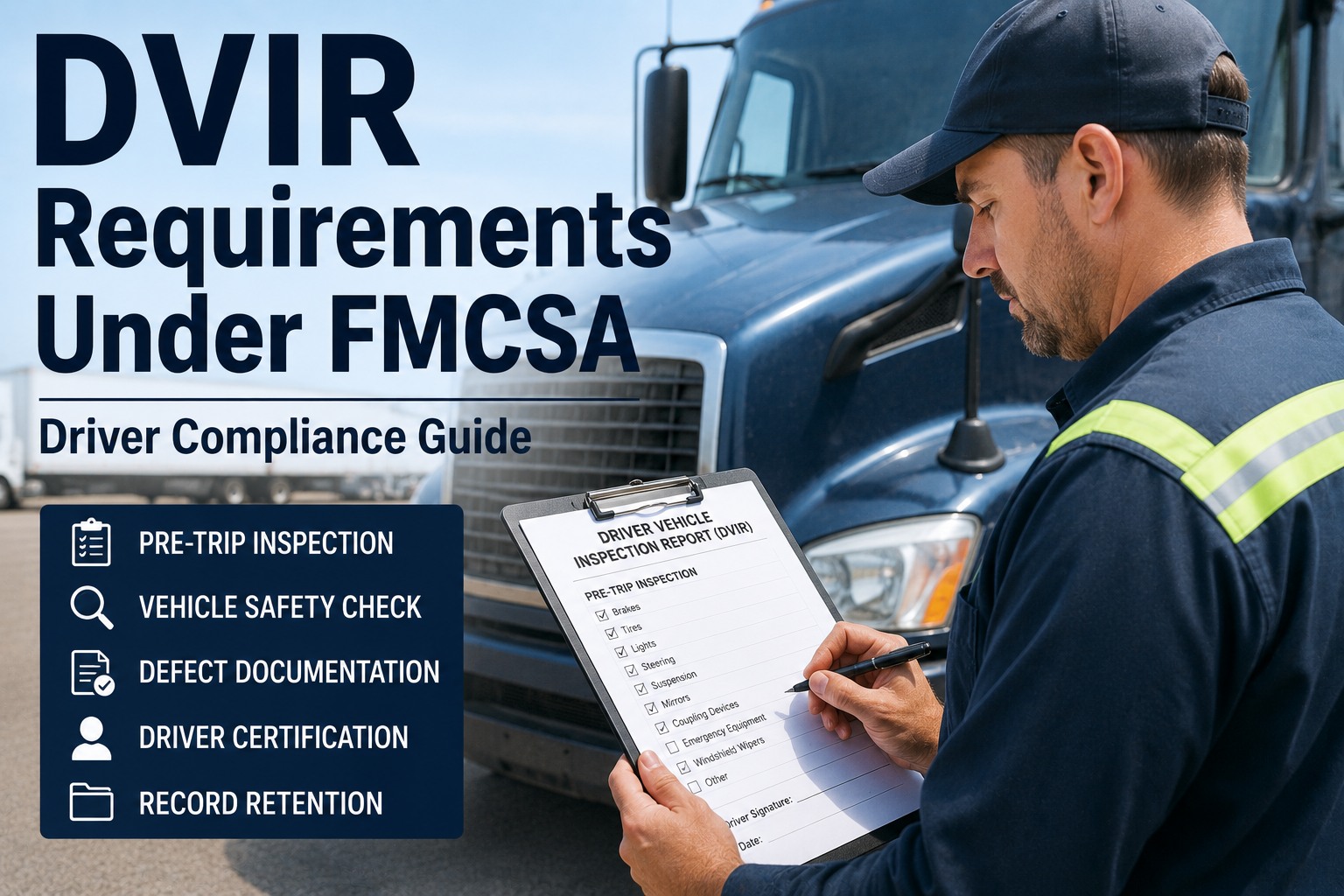
DVIR Requirements Under FMCSA: The Driver Compliance Guide
A repaired truck isn't a compliant one. FMCSA's DVIR rules turn on a three-signature chain of custody — driver, mechanic, next driver — and breaking a link is a violation on its own. Here's how the whole cycle works.
New in 2026: Electronic DVIRs Are Explicitly Authorized
The biggest recent development removes any lingering doubt about going digital. Electronic records were already permitted, but FMCSA has now written eDVIRs directly into the DVIR rules themselves.
Three Rules, Three Different Moments
Much of the confusion around DVIRs comes from conflating three separate regulations that apply at different times. They work together, but they're not the same obligation.
The driver must be satisfied the vehicle is in safe operating condition before setting out. This is an inspection duty — no paperwork is generated by this rule itself.
The driver reports the vehicle's condition, documenting any defects discovered during that day's operation. This is the report that starts the chain.
The next driver must review the most recent DVIR and, if defects were noted, sign acknowledging repairs were made or deemed unnecessary.
The Three-Signature Chain
This is the heart of the regulation and the part fleets most often break. When a defect is reported, three separate people must sign — and the vehicle can't be legitimately dispatched until the loop closes.
Documents the defect on the DVIR and signs it. This creates the record that the vehicle has a known condition affecting safe operation.
Certifies in writing that the defect was repaired — or that repair wasn't necessary for safe operation. Fixing it without signing leaves the chain broken.
Reviews the prior DVIR before operating and signs acknowledging the repair certification. This is the most commonly missed signature of the three.
When Is a DVIR Actually Required?
Here's the nuance most carriers get wrong in one direction or the other. The written report requirement depends on what you haul — and on whether anything was found.
Since 2014, if the driver finds no defects or deficiencies affecting safe operation, no written DVIR is federally required — and the report doesn't need to be retained. The inspection duty still stands; the paperwork is conditional.
Buses and other passenger-carrying commercial vehicles require a DVIR at the end of each day regardless of whether any defects were found. There's no no-defect exemption.
The Eleven Components
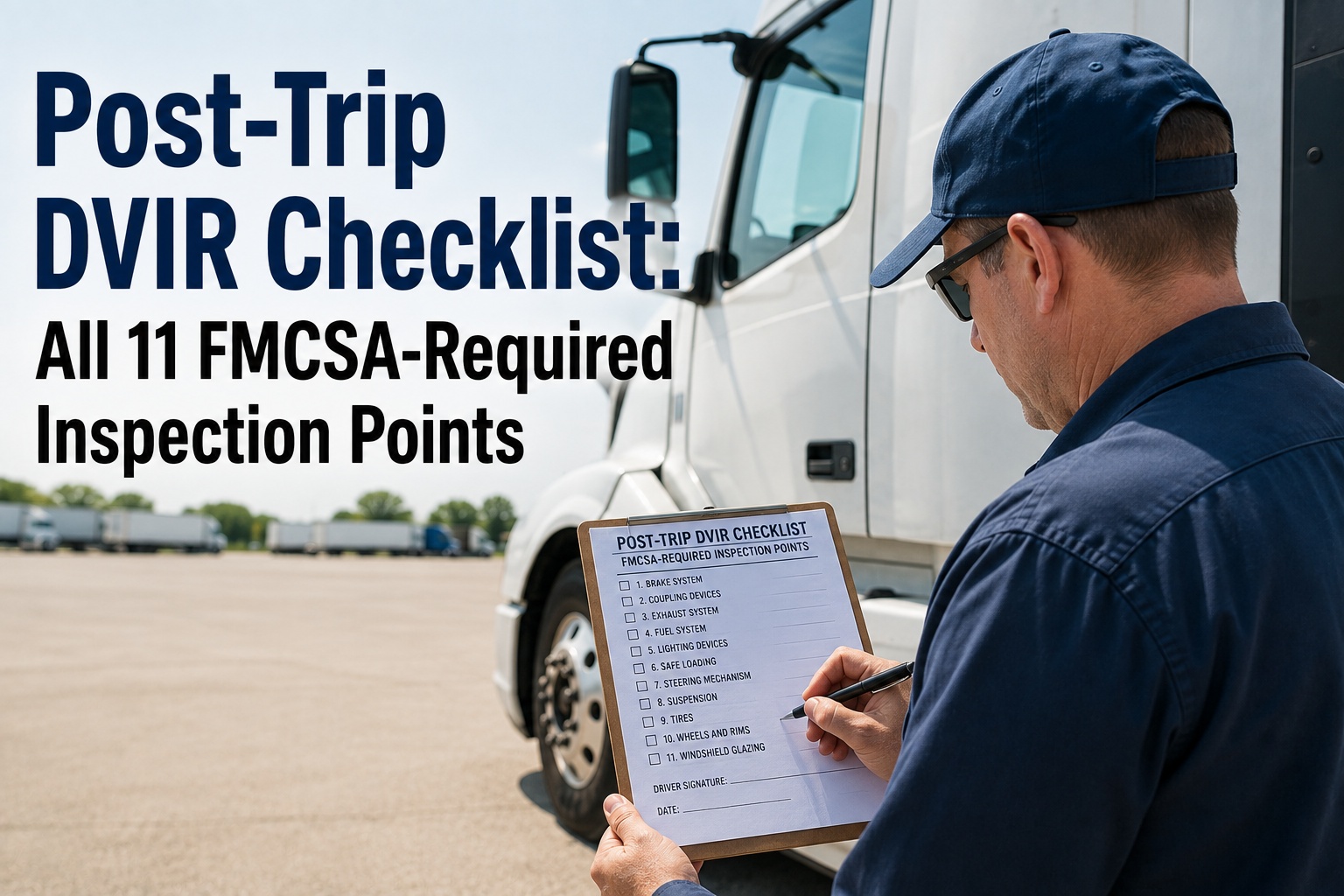
A DVIR covers eleven FMCSA-mandated component categories. Every one should be assessed, with the vehicle identified and the report dated and signed.
The Chain Should Enforce Itself
Every broken DVIR chain traces to the same root cause: the signature depended on a human remembering a piece of paper. Keys get handed over, the DVIR sits in a folder, the truck leaves. Truck Inspection & Maintenance closes the loop structurally — a reported defect routes straight to a work order, the mechanic's certification is captured against that specific defect, and the next driver is prompted to review and acknowledge before the vehicle can be dispatched. The chain holds because the system won't let it break.
Where the Chain Breaks
Auditors see the same failures repeatedly, and almost none of them involve an unsafe truck. They involve a missing signature or a report that was never made.
Maintenance fixed the defect but never signed the DVIR. The work happened; the proof didn't. A very common citation.
The most frequently missed signature. Keys get handed off and the truck leaves without anyone acknowledging the prior report.
A roadside inspection finds a defect that clearly predated the trip, with no DVIR reporting it — evidence the inspection wasn't real.
If a driver operates more than one vehicle in a workday, each vehicle needs its own DVIR. Relay operations and yard moves trip this constantly.
A defect was reported but the vehicle went out before the repair and certification. This breaks the chain at its most consequential point.
Auditors expect records within about 48 hours, sometimes sooner. Paper files scattered across terminals fail this test on their own.
How Long to Keep Everything
Retention covers the whole package, not just the driver's report — and the clock runs from the date the report was prepared.
The Quality Problem Nobody Mentions
There's an uncomfortable statistic behind DVIR compliance: industry data indicates roughly 95% of all DVIRs report no defects at all. On a fleet of aging equipment inspected daily, that number strains belief — and it points at pencil-whipping rather than genuine inspection. A DVIR chain that's perfectly documented but built on a thirty-second glance protects nobody, and it won't help when a roadside inspector finds the brake defect your driver "didn't see." Guided digital checklists with photo capture are the practical fix, because they make each step explicit and each finding provable.
Frequently Asked Questions
It depends on what you carry. For property-carrying commercial motor vehicles, a written DVIR is federally required only when the driver finds defects or deficiencies that would affect safe operation — a rule in place since 2014. If nothing is found, no report needs to be prepared or retained, though the underlying duty to inspect the vehicle absolutely still applies. For passenger-carrying CMVs, the rule is stricter: a DVIR is required at the end of each day's work regardless of whether defects were found, with no no-defect exemption. That said, most compliance professionals recommend that property carriers require no-defect DVIRs as company policy anyway, because a continuous daily record is what proves inspections actually happened when an auditor or an attorney asks — and with digital systems that proof costs almost nothing to generate. Start a free trial to build the record.
When a defect is reported on a DVIR, §396.11 and §396.13 require three separate sign-offs to close the loop. First, the driver who discovered the defect documents and signs the report. Second, the mechanic or carrier certifies in writing that the defect was repaired, or that repair wasn't necessary for safe operation. Third, the next driver reviews that prior DVIR before operating the vehicle and signs acknowledging the certification. All three are mandatory, and this is where most carriers fail — a very common misconception is that once maintenance fixes the problem the compliance process is done. It isn't. An unsigned repair certification is a violation even though the repair happened, and a missing next-driver acknowledgment breaks the chain of custody and creates a separate citable violation for both the driver and the carrier. Note that a no-defect report requires only the single reporting driver's signature. Ask how to automate the chain.
Yes, fully — and the legal position is now explicit. Electronic records and signatures have been permitted since 2018 under 49 CFR 390.32, but FMCSA published a final rule on February 19, 2026 (Docket FMCSA-2025-0115, effective March 23, 2026) that added explicit electronic DVIR authorization directly into 49 CFR 396.11 and 396.13, removing any remaining ambiguity about the practice. Digital signatures, mobile submission, and cloud storage are all compliant, and all three chain-of-custody signatures can be captured electronically with timestamps. FMCSA actively encourages carriers to transition to electronic methods, and the rulemaking was supported by the American Trucking Associations, OOIDA, and NTTC. Practically, digital DVIRs also produce timestamped, photo-documented audit trails that paper simply can't match — which matters a great deal when an auditor asks for 90 days of records on short notice. Start free with digital DVIRs.
The minimum is three months — 90 days — from the date the report was prepared, under 49 CFR 396.11(a)(4). Critically, that requirement covers all three parts of the record: the original DVIR, the certification of repairs, and the certification of the next driver's review. Keeping the driver's report but losing the repair certification leaves you non-compliant. Other related records run on different clocks: annual periodic inspection reports require 14-month retention, and maintenance and repair records must generally be kept throughout the vehicle's service life plus six months after it leaves your control. Many safety-conscious carriers retain DVIRs for a year or more rather than the 90-day floor, since litigation and insurance disputes often look back further than a compliance audit would. With digital storage, extended retention is effectively free. Start free and automate retention.
That's a serious break in the chain and a citable violation. Once a defect affecting safe operation is documented on a DVIR, the carrier must repair it — or certify that repair isn't necessary for safe operation — and that certification must exist before the vehicle goes back out. Sending the truck out with a documented, uncertified defect exposes both the driver and the carrier, and because the defect is now in writing, there's no ambiguity about whether the carrier knew. That written knowledge is exactly why this failure is so damaging in litigation following a crash: the record proves the condition was reported and the vehicle was dispatched anyway. The practical safeguard is a system that links a reported defect directly to a work order and blocks dispatch until the repair certification and next-driver acknowledgment are both captured, rather than relying on someone remembering to walk a piece of paper to the shop. Start free and block unsafe dispatch.
Never Break the Chain Again
DVIR violations rarely mean an unsafe truck — they mean a missing signature. Truck Inspection & Maintenance runs the full cycle as a guided digital workflow: eleven components with photo capture, defects routed instantly to work orders, mechanic certification captured against the specific defect, next-driver acknowledgment prompted before dispatch, and every record cloud-stored and producible in seconds when an auditor gives you 48 hours.