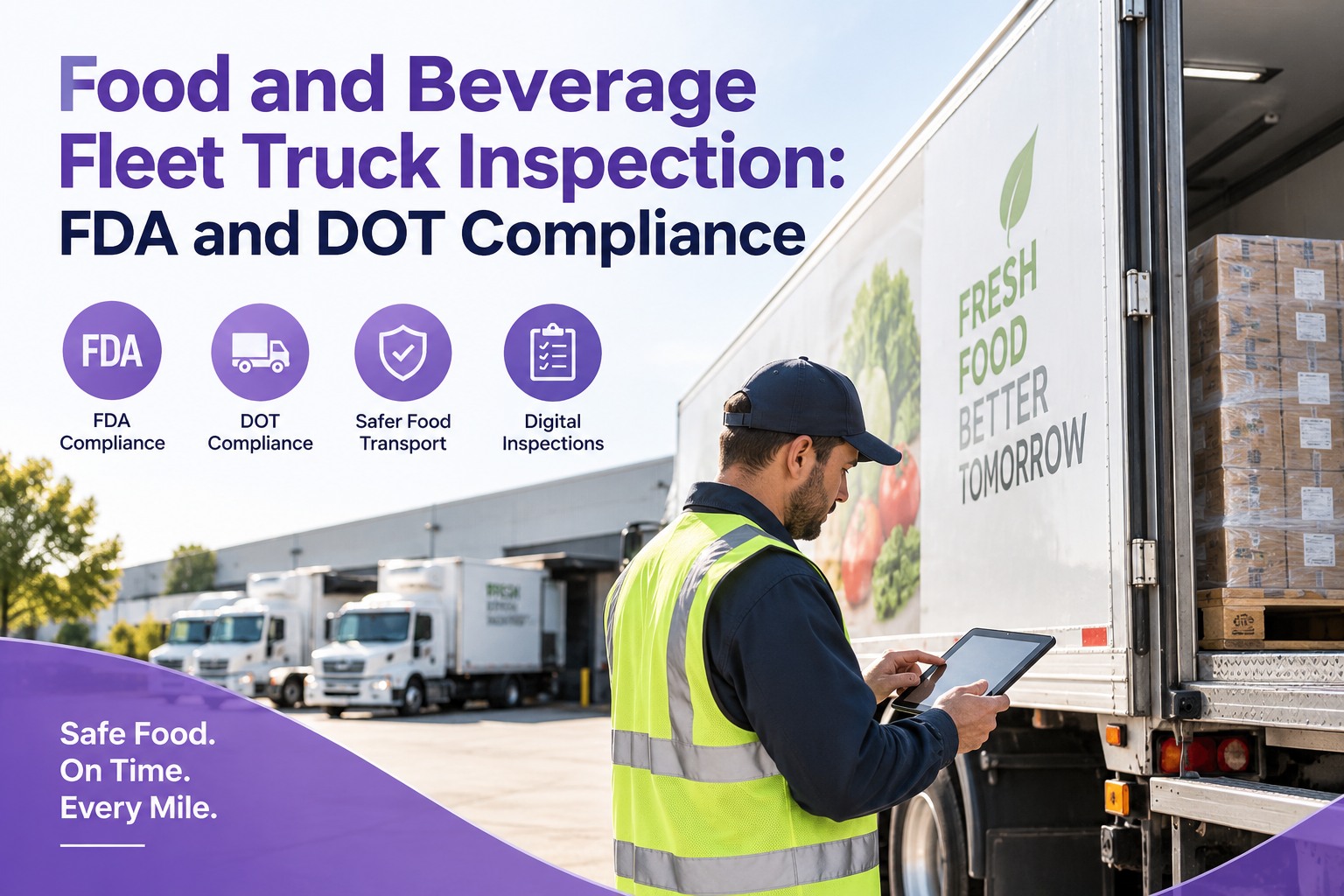
A food or beverage fleet doesn't have the luxury of one rulebook. The chassis answers to DOT — §396.11 DVIR, §396.17 annual, the same CSA scoreboard as any Class 8 carrier. The load answers to FDA under FSMA's Sanitary Transportation of Human and Animal Food rule (21 CFR Part 1, Subpart O) — pre-cool verification, continuous temperature control, sanitation between loads, driver food-safety training, and 12 months of records the FDA can request in 24 hours. The two rulebooks don't overlap much, which is exactly the problem — most fleets run parallel paperwork stacks that nobody actually reconciles. This guide is the inspection program that covers both under one workflow. Start free and put FDA + DOT compliance on one platform.
The Chassis Answers to DOT — the Load Answers to FDA. Run One Program That Satisfies Both.
A generic pre-trip DVIR won't prove the reefer pre-cooled before loading, and a temperature log won't satisfy §396.11. Truck Inspection & Maintenance Management Software runs the sanitary and safety inspections on one workflow: FSMA-compliant pre-cool + sanitation checklist on the reefer side, DOT-compliant DVIR on the chassis side, and a 12-month retrievable record ready for either an FDA request or a DOT roadside.
The Two Rulebooks — Where FDA Ends and DOT Begins
The FSMA Sanitary Transportation rule and the DOT/FMCSA safety regime govern completely different aspects of the same trip. FDA cares about the load — pre-cool state, temperature continuity, cross-contact prevention, driver training. DOT cares about the truck — brakes, tires, lights, driver hours, defects. Both apply to every food-transport shipment simultaneously. Below is which rule covers which item, so nothing falls into the seam between the two paperwork stacks.
The FSMA Four-Pillar Framework — What Sanitary Transport Actually Requires
The FSMA Sanitary Transportation of Human and Animal Food rule breaks down into four operational pillars. Miss any one and the whole compliance chain breaks — a spotless truck with untrained drivers fails as clearly as a trained-driver operation with no temperature records. The four pillars, and what a compliant fleet has to prove for each:
Trailers designed and maintained so they don't cause food to become unsafe. Cleanable surfaces, working temperature control, pest-free storage, no residues from prior loads. Sanitation records prove the trailer was clean before it was loaded.
Pre-cool verified before loading begins — not after departure. Continuous temperature control through transit. Cross-contact prevention on multi-commodity loads. Bulkhead settings, product-temp checks, and pulp-temp readings at load and delivery.
Every driver moving food under the rule must be trained on sanitary transportation practices before dispatch. Training records tied to each driver's file, credentials verifiable, renewal alerts before certifications lapse.
12 months of records minimum — pre-cool, temperature logs, sanitation, training. The FDA can request them and expects retrieval inside 24 hours. Missing records are treated as non-compliance whether the practice happened or not.
The Reefer vs Dry-Van Split — Same Rulebook, Different Templates
A refrigerated trailer answers to every FSMA pillar. A dry van moving shelf-stable food answers to fewer — no continuous temperature log, no pre-cool — but still has to satisfy the sanitation and cross-contact rules. Running the same DVIR template on both is how the reefer-specific items (pre-cool, temperature continuity, alarm response) get dropped from the walkaround. The right structure is two templates writing to one asset record.
- Pre-cool verified at set-point before loading
- Continuous temperature log through transit
- Product & pulp temp check at load + delivery
- Reefer alarm response protocol trained
- Wash-out between allergen & non-allergen loads
- Sanitation record signed at every wash
- Trailer interior clean, dry, pest-free at load
- No residues from prior load visible
- Cross-contact prevention on mixed loads
- Sanitation record for wash-out between allergen loads
- Floor & wall condition inspected for damage
- Load-securement checked to §393.100
Two Templates, One Asset Record — FSMA & DOT on One Workflow
Our software runs asset-class-aware templates: the reefer opens with a pre-cool + temperature + sanitation checklist plus the DOT DVIR; the dry van opens with sanitation + cross-contact plus the DOT DVIR. Both write to the same per-trailer record, retention set to the longer of the two rules (12 months for FSMA). Two rulebooks, one workflow, one paper trail.
The Continuous Temperature Log — The Audit Trail That Actually Matters
A reefer that leaves the yard at 34°F and delivers at 34°F still fails FSMA if the log shows an unexplained hour-long excursion at a rest stop somewhere in between. FSMA doesn't ask for spot checks — it asks for continuous monitoring, with alerts on excursion and a documented response when one happens. Below is what a compliant temperature-log workflow looks like end-to-end.
Frequently Asked Questions
Two Rulebooks, One Inspection Program — Built for Food & Beverage Fleets
Pre-cool + sanitation + continuous temperature log on the reefer side. DOT DVIR + annual on the chassis side. One per-asset record, one driver file, one 12-month retention window — retrievable in seconds for FDA or DOT.