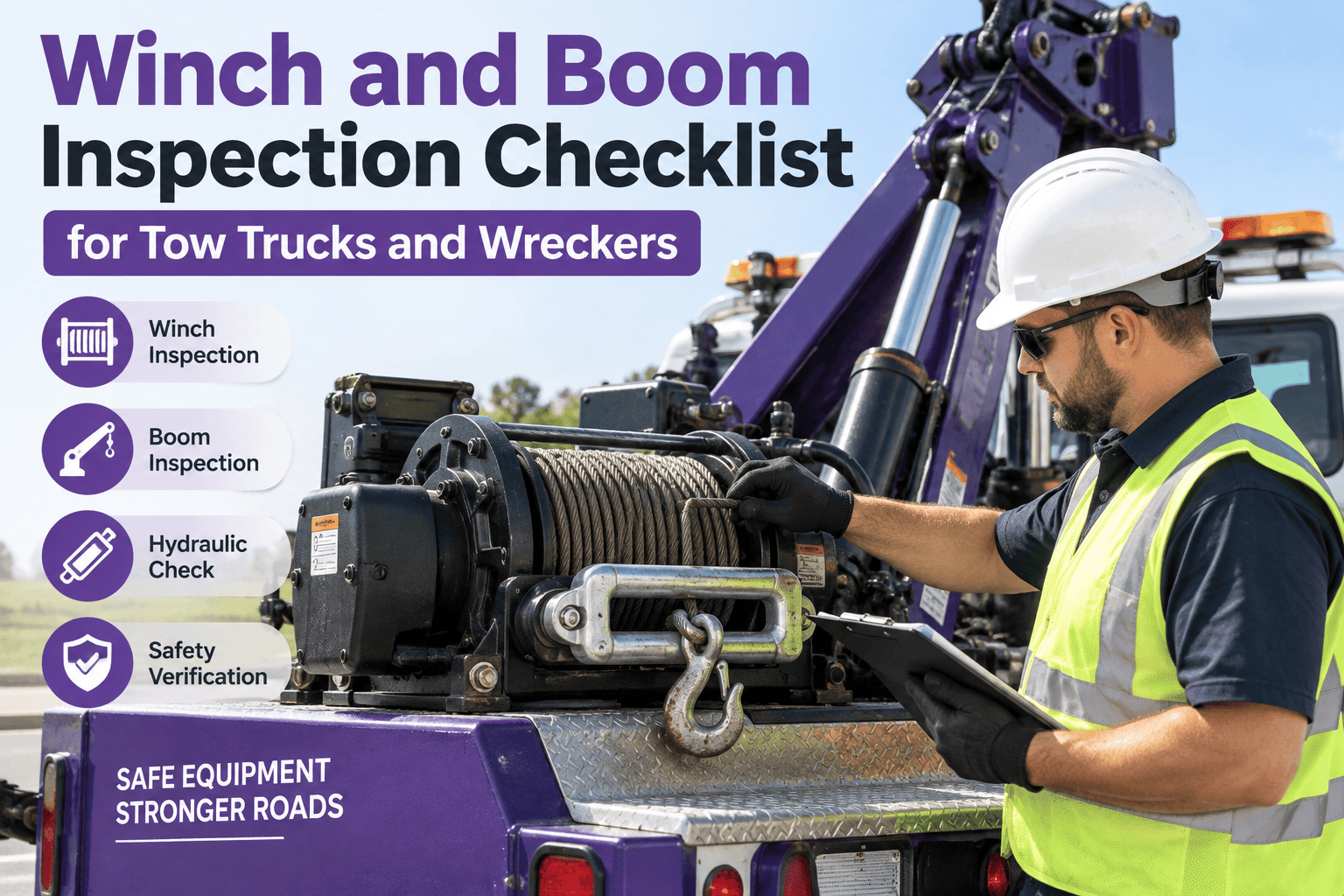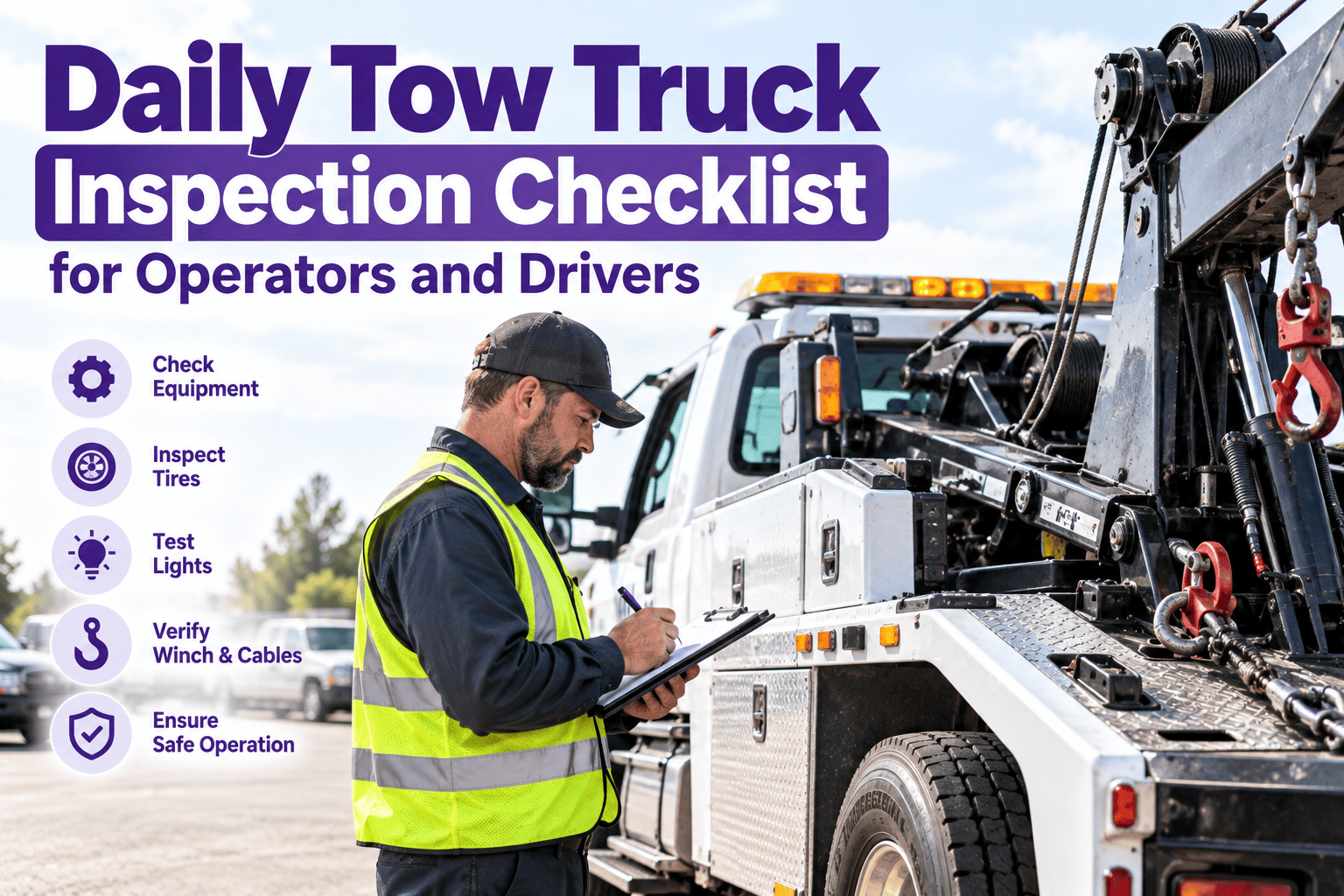
A tow operator works the most dangerous environment in commercial trucking active highways, accident scenes, and roadside shoulders — and does it with equipment that lifts and drags multi-ton loads on a cable. A winch line with a hidden fishhook, a carrier bed that drifts on a worn seal, a loose mounting bolt betrayed only by a rust streak: each one is a pre-shift catch or a highway catastrophe. This daily checklist walks the truck the way a careful operator does — chassis to rigging — before the first recovery call. And because a completed inspection is also a DVIR, logging it in Truck Inspection & Maintenance Management Software (TIM) turns each check into a dated, photo-backed record and routes any defect straight to the shop. Start free and run your daily tow checklist on any phone.
The Fishhook You Miss at the Yard Is the One That Slices a Glove on the Shoulder
You want to roll out knowing the brakes, the boom, the winch line, and the tie-downs are all sound — not find out mid-recovery. This checklist covers every system an operator touches before the first call, and TIM makes it stick: run it on a phone, photograph a frayed cable or a drifting bed on the spot, and it becomes a DVIR record plus a work order routed to the shop. Every defect logged in TIM gets a first response within 4 hours — acknowledged, graded, and assigned — so a red-tagged truck never quietly goes back on dispatch.
Walk the Truck in Order — Six Zones, One Pass
A good pre-shift isn't random poking — it's a route around and through the truck so nothing gets skipped. Work the six zones below in order, and the recovery-specific gear (winch, boom, rigging) gets the same discipline as the chassis. The catches that matter most on a tow truck are the quiet ones: a rust streak around a bolt head, a shiny spot at a hinge pin, a hose left hanging where a load will tear it off.
- Oil, coolant, hydraulic, and DEF levels
- Belts and hoses — no cracks, no chafing
- Leaks under the truck and at the PTO
- Warning lights clear at start-up
- Tread depth, pressure, sidewalls — all positions
- Air brakes: build-up, no leaks, parking brake holds
- Steering play within spec, no binding
- Dual/tandem duals matched and seated
- Amber warning/strobe beacons all firing
- Head, tail, brake, turn, marker lamps
- Auxiliary work lights for night recoveries
- Towed-vehicle light kit and cabling
- Cycle every function through full range — smooth, no odd noise
- Rams, hoses, valves, and cable sheaves for leaks/wear
- Winch drum, PTO engagement, and free-spool
- Wire rope run through gloved hands — see cable rule below
- Boom sections, welds, and pivot pins — no cracks/rust streaks
- Carrier bed for cracks; hinge pins and bed safety lock
- Wheel-lift L-arms, locks, and slides operate freely
- Bed-drift test — hold tilted 30 sec, watch for movement
- Chains, straps, and safety hooks at correct WLL
- Snatch block, sling pads, tow slings — no bent tubes
- Reflective attire, cones/triangles, fire extinguisher
- Mounting & body bolts — rust streak = loose bolt
Three Checks Where "Looks Fine" Isn't Good Enough
Most of the list is pass/fail visual. But three items on a tow truck carry the whole load — literally — and each has a specific test with a specific threshold. Skip the threshold and "it looked okay" becomes the incident report.
Run the full length through gloved hands every shift. Broken strands create fishhooks that slice through gloves. More than 3 broken strands in one lay length — replace immediately. Order the cable at the first fray, not after it fails on a call.
Worn cylinder seals let the bed creep down — a 4,000-lb vehicle sliding off on a shoulder is catastrophic. Tilt to working angle and hold 30 seconds; any visible movement = seal failure. Do not operate until repaired.
A rust streak or shiny halo around a bolt head signals a loose bolt; rust weeping from a pivot or hinge pin signals a seized pin that can break under recovery load. Investigate every streak — don't wipe it and move on.
Why the Daily Check Is Also Your Legal Cover
The pre-shift isn't only about safety — it's about proof. FMCSA requires documented pre-trip inspections for all commercial vehicles, and towing adds state-level rules on lighting, winch capacity, and tie-down standards. A completed inspection satisfies the DVIR requirement and becomes liability protection when an accident or dispute lands.
A completed daily check is the Driver Vehicle Inspection Report — the record FMCSA expects for every CMV.
Detailed, dated inspection records are evidence in accident or damage disputes — they show the truck was sound at dispatch.
Documented pre-trips protect against citations and roadside-violation damage to your carrier safety rating.
Towing carries extra lighting, winch-rating, and tie-down requirements beyond the base CMV standard.
A Paper Checklist Can't Photograph a Fishhook. TIM Can.
TIM assigns the right tow checklist to the right unit and puts it on the operator's phone in the yard. A frayed cable, a drifting bed, or a rust-streaked bolt gets photographed on the spot, attached to the inspection, and converted to a work order with tow-ready priority — while the record lands in a searchable archive an auditor can pull in seconds. The daily check stops being a binder and becomes a system.
Frequently Asked Questions
Roll Out Knowing the Truck Is Sound — and Prove It
Six zones, three critical-threshold checks, and a DVIR that writes itself. Run the daily on a phone, photograph the defect, route it to the shop, and keep a record that stands up at an audit or a dispute. That's a pre-shift that protects the operator, the customer, and the company.