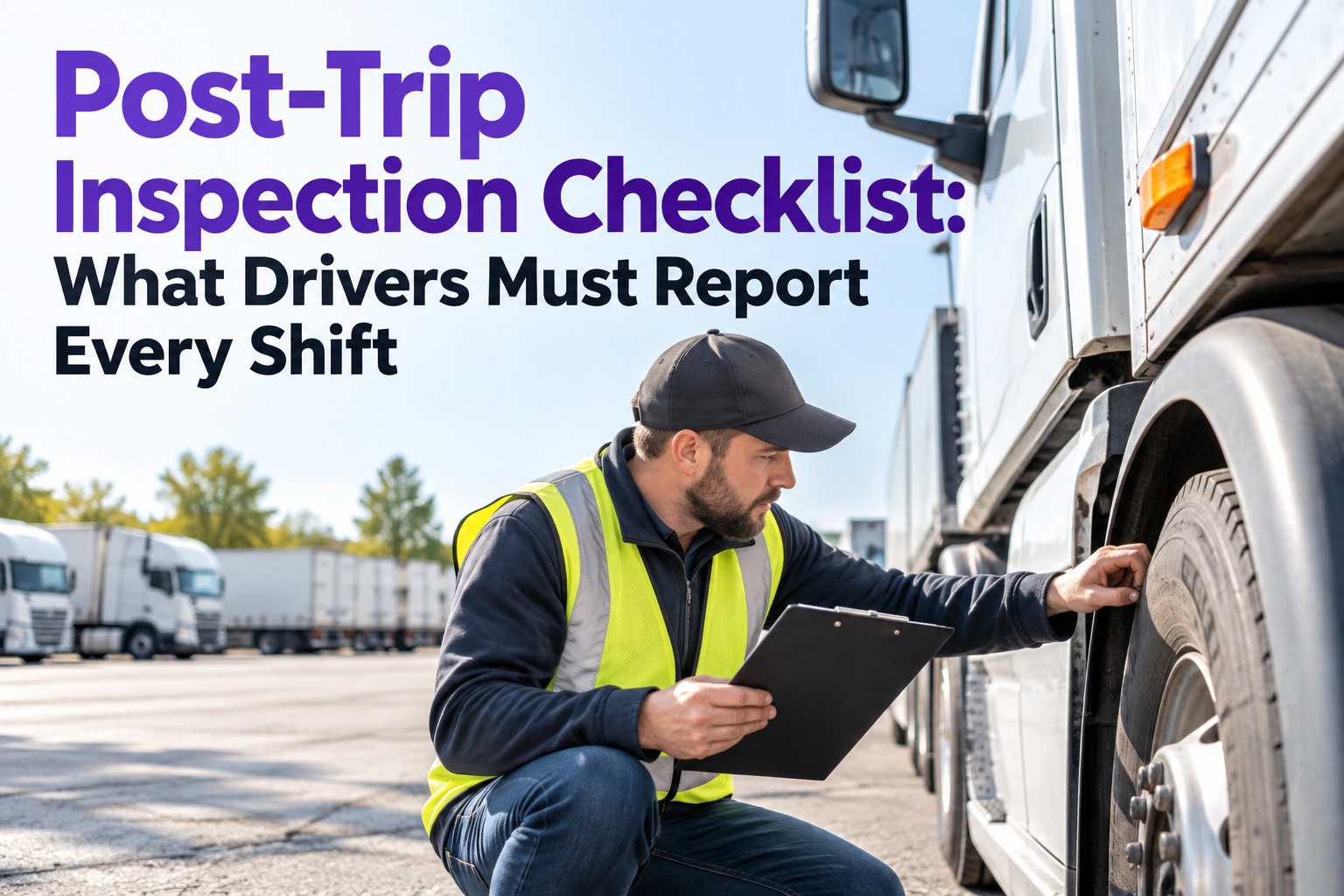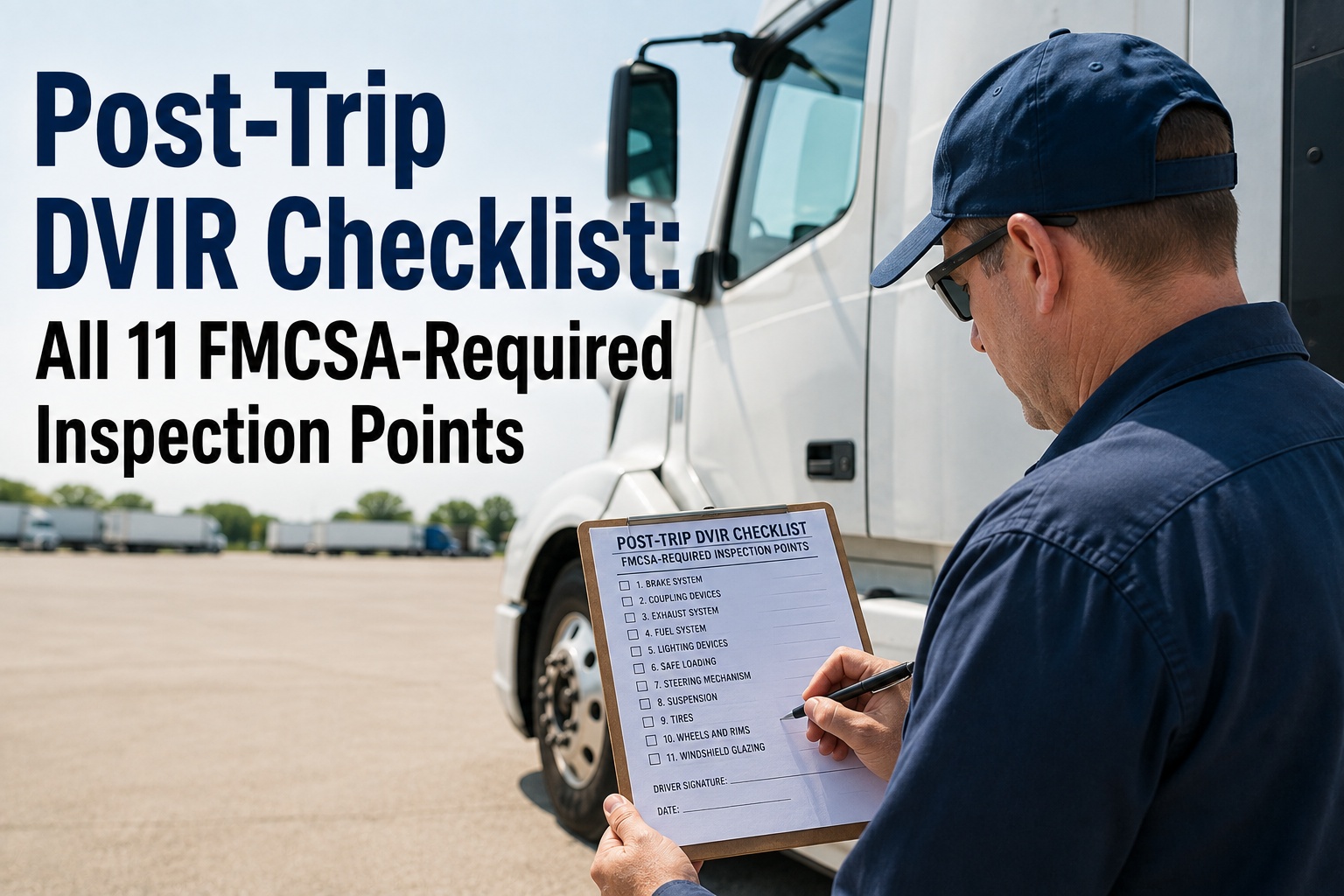
Under 49 CFR §396.11, every driver operating a commercial motor vehicle must submit a written post-trip inspection report at the end of each driving day covering 11 specific components. Skip any one of them, and the DVIR is technically incomplete. Fake the report (many drivers do — clean paper every day, every truck, no defects ever) and an FMCSA auditor will spot the pattern in 30 seconds. This checklist walks all 11 required points in the order a driver should physically walk the truck, with what to look for on each, what makes it fail, and how to document it correctly. Print it, tape it to the visor, or run it inside Truck Inspection & Maintenance where every point becomes a photo-verified checkbox on the driver's phone. Sign up free or contact our team.
Post-Trip DVIR Checklist — All 11 FMCSA-Required Inspection Points
Miss one point and the DVIR is incomplete. Fake the report and the auditor knows in 30 seconds.
Why the Post-Trip Matters More Than the Pre-Trip
Pre-trip catches yesterday's defects. Post-trip catches today's — while the driver still remembers what happened on the route. Three numbers show why post-trip discipline separates fleets that pass audits from fleets that don't:
A complete post-trip walkaround runs 10 minutes on a straight truck, 15 on a tractor-trailer. Skipping it saves 10 minutes; missing a defect can cost $2,800 in tow, service call, and missed delivery.
Paper DVIRs miss roughly 4 out of 10 defects that a photo-verified digital DVIR catches. The pen was found, the box was checked, but the tire that lost 12 psi during the route never got a second look.
Every post-trip DVIR must be retained for 3 months under §396.11(c)(2). Missing DVIRs in an audit sample = documentation violation before the auditor examines a single truck.
Fleets running paper DVIRs lose 4 out of 10 defects and the 3-month audit archive falls apart under review — start a free account and put every driver on photo-verified digital DVIRs this week.
The 11 Points — Complete Walk-Around Guide
Walk the truck in this order. Each point includes what to check, what makes it fail, and what to document. Every point requires a documented pass/fail — no exceptions, no assumptions:
Want this 11-point checklist as a laminated card for the truck? Contact our team and we'll ship one per truck, free.
The One Rule That Passes Every DVIR Audit — Photo Every Defect, Even the Small Ones
Auditors don't just check whether a DVIR was submitted — they check whether the defect noted matches what the truck actually shows. A defect written as "small crack" on a mirror with no photo is a defect the auditor cannot verify was ever addressed. A defect written as "3-inch crack lower left" with a photo attached is an audit-proof record. Photo verification on every fail item eliminates the entire category of "documentation gap" violations, and pays for itself on the first prevented roadside inspection. Start a free account and require a photo on every fail item automatically.
Every fail photo attaches to the DVIR record and stays searchable for the full 3-month FMCSA window — create your free account in 10 minutes.
What "Defect" Means — Severity Coding for the DVIR
Not every defect grounds the truck. FMCSA distinguishes safety-critical from non-critical items. Code every defect at time of DVIR submission:
Examples: Any brake defect, steering failure, coupling failure, tire below tread minimum, wheel/lug failure, missing emergency equipment.
Examples: Single bulb out (not brake/turn), cracked mirror glass (not obstructing), streaking wiper blade, weak horn, minor light-lens crack.
Examples: Slight tire wear pattern, low washer fluid, minor reflector fading, hub oil at lower normal range.
Severity coding auto-fires the right work order priority when the DVIR submits — sign up free and let safety-critical items ground the truck automatically.
Run the full 11-point DVIR on driver phones with photo-required on every fail item.
Photo-verified DVIRs, auto-routed defects to shop, 3-month audit archive per truck. Free forever for up to 3 vehicles — create your free account or talk to our team.
The 5 Most Common Post-Trip Mistakes
Even fleets with good drivers make these five mistakes on post-trip DVIRs. Fix them and audit exposure drops immediately:
Clean DVIR Every Day
The pattern: Driver checks every box "OK" every night for a year. Statistically impossible on any real fleet — auditors flag pattern-based fraud in 30 seconds by reviewing 30 consecutive DVIRs.
Skipping the Trailer
The pattern: Tractor gets a full 11-point but the trailer gets a quick glance. Trailer brakes, coupling, lights all count as part of the post-trip on tractor-trailer combinations.
No Photo on Fails
The pattern: Defect noted in text only. Auditor has no way to verify what the defect looked like or that it was properly repaired. Photo requirement eliminates this failure mode.
Late Submission
The pattern: Driver submits DVIRs three days late in a stack. FMCSA requires end-of-driving-day submission. Digital timestamps prove or disprove same-day submission.
No Handoff to Shop
The pattern: DVIR submitted with defects, paper goes in a folder, truck goes out on next shift unrepaired. The single biggest cost driver on paper DVIR fleets.
Recognize your fleet in any of these five patterns? Get in touch for a free 15-minute DVIR compliance review.
Frequently Asked Questions
What are the 11 required items on an FMCSA post-trip DVIR?
Under 49 CFR §396.11, every driver must submit a written post-trip inspection report covering: (1) service brakes including trailer brake connections, (2) parking brake, (3) steering mechanism, (4) lighting devices and reflectors, (5) tires, (6) horn, (7) windshield wipers, (8) rear vision mirrors, (9) coupling devices, (10) wheels and rims, and (11) emergency equipment. All 11 must be inspected and documented for every commercial motor vehicle operated on public roads.
How long must post-trip DVIRs be kept for FMCSA compliance?
Post-trip DVIRs must be retained for 3 months under 49 CFR §396.11(c)(2). This is the shortest retention window in the FMCSA record family — the DVIR itself expires quickly, but any defect that resulted in a repair becomes part of the vehicle maintenance record under §396.3, which requires 1 year on-file plus 6 months after the vehicle leaves the carrier's control.
Is a post-trip DVIR required if the driver found no defects?
Yes. FMCSA requires a written post-trip inspection report every day a driver operates a commercial motor vehicle, regardless of whether defects are found. A "no defects" DVIR is still a submitted DVIR — the record proves the inspection happened. Missing DVIRs in an audit sample are a documentation violation independent of whether the trucks were actually safe.
Can a driver do a combined pre-trip and post-trip DVIR?
No. Pre-trip and post-trip are separate FMCSA requirements with different purposes. Pre-trip verifies the truck is safe to operate before starting the driving day. Post-trip identifies defects that developed during the day so they can be repaired before the next dispatch. Combining them defeats the purpose and creates a documentation gap — auditors will flag any DVIR that appears to serve both functions.
What happens if a defect is found on the post-trip inspection?
Under §396.11, any defect that would affect safe operation must be repaired before the vehicle is dispatched again. Safety-critical defects — brakes, steering, coupling, tires below minimum tread, missing emergency equipment — ground the truck immediately. Non-critical defects can be scheduled within 24 hours but must be logged, tracked, and closed. The repair must be documented, and the closed defect signed off by a qualified mechanic before the truck returns to service.
How does Truck Inspection & Maintenance handle post-trip DVIRs?
Truck Inspection & Maintenance runs the full 11-point post-trip DVIR on driver phones. Every point is a required checkbox; every fail item requires a photo before the DVIR can submit. Submitted DVIRs auto-route to the shop foreman's work-order queue with severity coding — safety-critical items ground the truck automatically. Full 3-month archive per driver and per truck, searchable for FMCSA audit response. Free forever for up to 3 vehicles. Sign up in 10 minutes or contact our team for larger fleets.
Paper DVIRs miss 4 out of 10 defects. Digital DVIRs with photo verification miss zero.
Full 11-point checklist on driver phones with photo-required fails. Free forever for up to 3 vehicles — no hardware, no contract, no credit card.