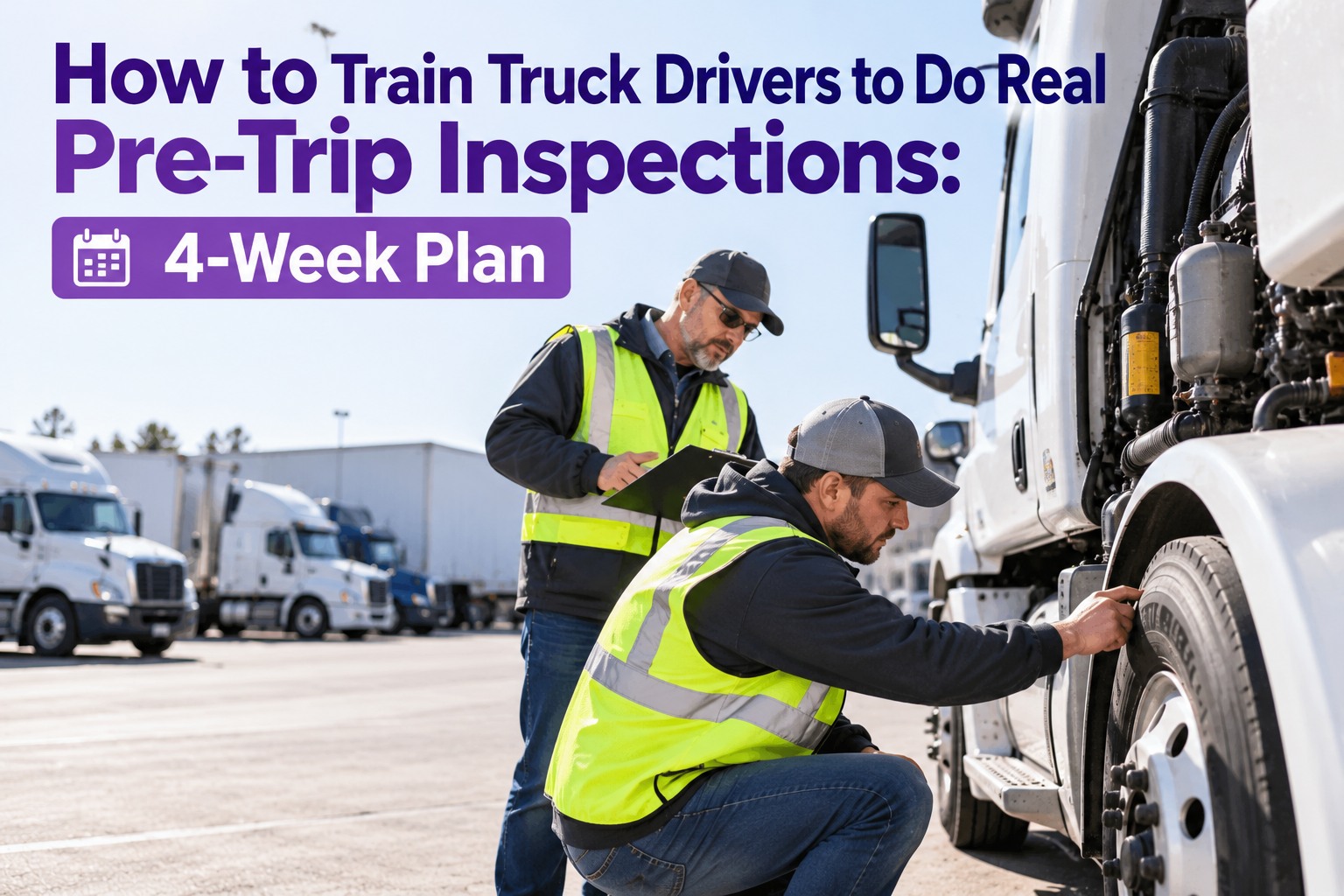
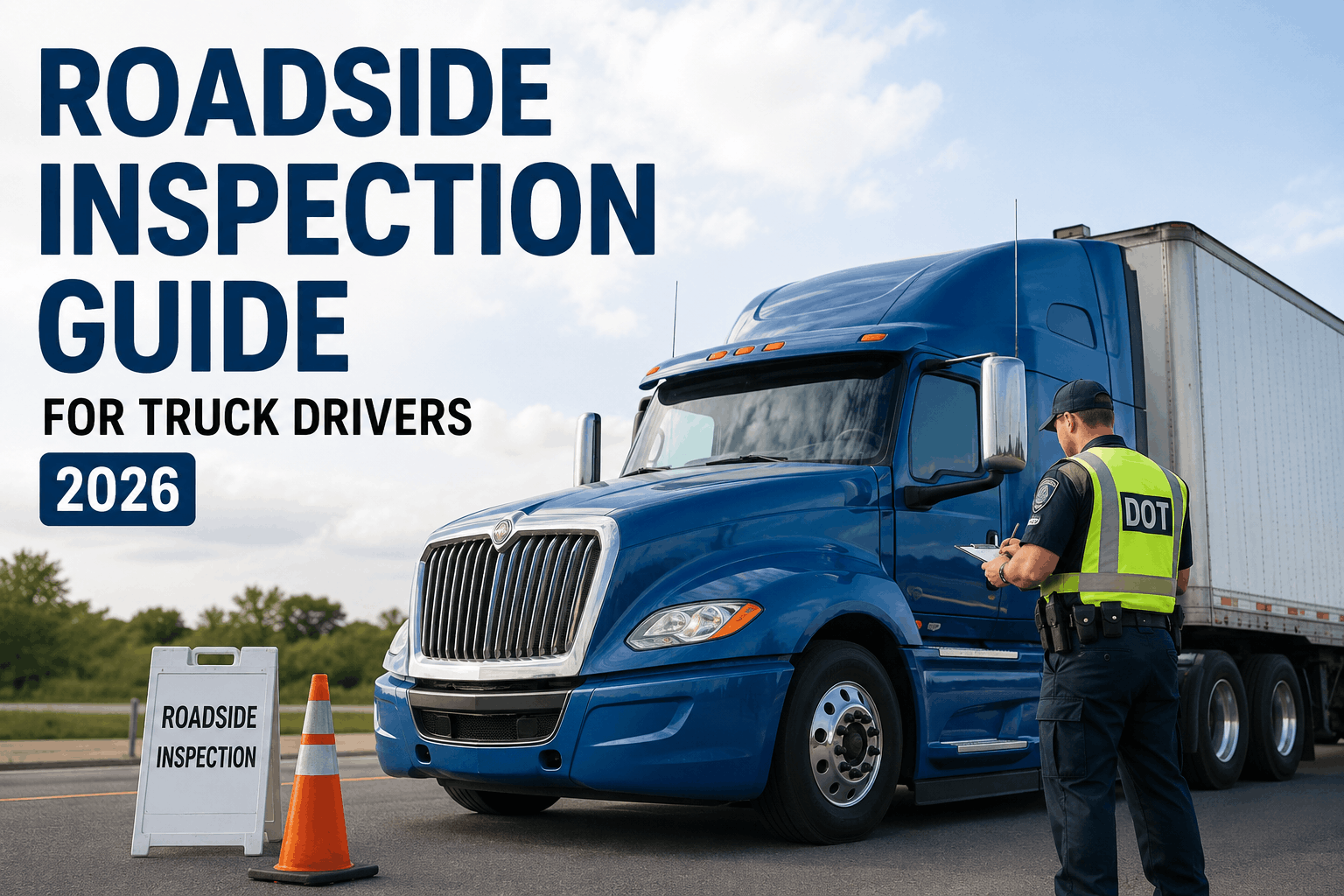
Most drivers were "trained" on the pre-trip once — a supervisor walked them around a truck on day one, and they've been improvising ever since. That's how a walkaround shrinks to a lap and a glance, and how a 4/32" steer tire or a leaking chamber ends up discovered by a roadside inspector instead of a driver. Training real pre-trips isn't a memo; it's a program with a curriculum, practice, and a pass/fail bar. Here's a 4-week plan that turns a rushed lap into a genuine inspection every driver runs the same way. Start free and give every trainee a guided inspection to learn on.
Learn → Practice → Prove → Sustain
Turn a Rushed Walkaround Into a Real Pre-Trip in 4 Weeks.
A driver who "checks the tires and lights and goes" isn't inspecting — they're guessing, and the fleet wears the CSA points and the downtime. Truck Inspection & Maintenance Management Software gives training a spine: every trainee runs the same guided inspection on their phone, each check is captured, and every defect they log becomes a graded work order a mentor can review. The program below builds the habit; the app makes it stick after graduation.
4 weekslearn, practice, prove, sustain
~41% / ~21%brakes / tires — top roadside OOS causes
1 standardevery driver runs the same walkaround
Why One-Time Training Doesn't Hold
The pre-trip is a legal requirement under 49 CFR 392.7 and 396.13 — the driver must personally verify the truck is safe before every trip. But a rule doesn't build a skill. A driver shown the walkaround once, with no practice and no check on whether they actually learned it, reverts to the fastest version that avoids getting caught. Training holds when it's staged over weeks, practiced under a mentor, and graded against a rubric — the same way the CDL skills test is scored.
The lap-and-glance
- Learned once on day one, never checked again
- No fixed order — different every truck, every day
- Defects noticed but never written down
- "Looks fine" instead of a measured reading
- Skipped entirely when running late
→
The trained pre-trip
- Built over 4 weeks, then reinforced daily
- Same 7-zone order, every truck, every shift
- Every defect logged and routed to a work order
- Tread and pushrod measured, not eyeballed
- Guided flow makes the full check the fast option
The 4-Week Plan at a Glance
Each week has one job and builds on the last: understand the why, practice the how, prove competence, then lock in the habit. Run it for new hires as onboarding, or for existing drivers as a refresher cycle. The point is progression — you can't grade a driver on a walkaround they've never practiced.
Week 1Learn
The why and the standard
Regulations, out-of-service criteria, the 7-zone order, and what a defect actually looks like. Classroom plus a demonstrated walkaround by a mentor.
Week 2Practice
Hands on the truck
The driver runs the walkaround with a mentor watching, calling each check out loud. Focus on measurement — tread depth, pushrod stroke, fluid levels — not just looking.
Week 3Prove
Graded solo runs
The driver inspects unsupervised, then is scored against the rubric on a surprise-defect truck. They must find the planted defects to pass.
Week 4Sustain
Habit and accountability
The guided digital inspection becomes the daily standard. Mentor spot-checks taper off; the app's records show whether the habit is holding.
Week 1 — Learn: The Why and the Standard
Drivers skip steps they don't understand the point of. Week 1 makes the case first, then teaches the map. By the end, a trainee should be able to say why the walkaround runs in a fixed order and what turns a defect into an out-of-service condition.
1The regulations, plainly49 CFR 392.7 and 396.13 in driver language — you verify the truck is safe before every trip, and a written report follows any defect.
2What fails a truckOut-of-service basics. Brakes and tires drive the largest share of roadside OOS orders — around 41% and 21% — so that's where attention goes.
3The 7-zone orderApproach, engine, driver side, rear, coupling, trailer, cab. The fixed path that touches every safety-critical part once.
4Mentor demonstrationAn experienced driver walks the truck start to finish, calling each check aloud — the model the trainee will copy in Week 2.
End-of-week check A short written quiz on the zones, the thresholds, and the difference between a note-and-continue defect and a ground-the-truck defect. It doesn't need to be hard — it needs to prove the driver has the map in their head before they touch a truck.
Week 2 — Practice: Hands on the Truck
This is where looking becomes measuring. A driver who says "tires look good" hasn't inspected them; a driver who reads 4/32" on the steer tire and caps the valve stem has. Week 2 is repetition under a mentor's eye, with the callout method borrowed straight from the CDL skills test.
Call it out loudThe driver verbalizes every check — "steer tire, 4/32nds or better, no cuts, valve capped." Silent checks can't be coached or verified.
Measure, don't guessTread depth with a gauge, pushrod stroke on a full apply, fluids on the dipstick. Numbers, not impressions.
Same order every timeRun the 7 zones in sequence until the path is muscle memory and nothing gets skipped under time pressure.
Log what you findEvery defect goes into the inspection on the phone, so the trainee learns that finding it and recording it are one action.
Week 3 — Prove: Graded Solo Runs
Practice without a pass/fail moment never becomes competence. Week 3 is assessment: the driver runs the pre-trip alone, then is scored against a rubric on a truck with planted defects. Miss a safety-critical one and they repeat the week — the same standard a roadside inspector would hold.
| Assessment area | What "pass" looks like | Weight |
| Sequence & completeness |
All 7 zones, in order, nothing skipped |
High |
| Measurement accuracy |
Tread, pushrod, fluids read correctly with tools |
High |
| Defect detection |
Finds every planted safety-critical defect |
Critical |
| Correct grading |
Calls each defect ground-truck vs schedule correctly |
High |
| Documentation |
Every defect logged with a clear description |
Medium |
| Verbal callout |
States each check aloud, examiner-style |
Medium |
Set your own pass threshold, but treat any missed safety-critical defect as an automatic retake. A driver who misses a cracked chamber on a graded run will miss it on the road.
The App Is the Standard After Graduation
Training that ends at graduation fades in a month. Truck Inspection & Maintenance Management Software keeps the trained pre-trip in place: the driver runs the same guided 7-zone flow on their phone every shift, defects route straight to graded work orders, and PM reminders keep the truck ahead of failures. A mentor — or a manager — can see who's completing full inspections and who's slipping, so the habit you built in four weeks doesn't quietly unravel.
Week 4 — Sustain: Habit and Accountability
The hardest part of pre-trip training isn't teaching it — it's keeping it after the trainer walks away. Week 4 hands the standard to the tool the driver will use forever, and shifts the mentor from teacher to spot-checker. The goal is that the full inspection is simply how this driver starts every day.
1
Guided flow becomes daily defaultThe phone walks the driver through all 7 zones in order, so the trained sequence and the daily routine are the same thing.
2
Defects to work orders, automaticallyAnything the driver logs routes to a graded work order — finding a problem and acting on it stay linked.
3
Tapering spot-checksThe mentor reviews a random inspection each week, less often over time, until the driver is trusted solo.
4
Records show if it's holdingCompletion and defect-find rates reveal whether the habit stuck — before a roadside inspection reveals it for you.
Sample Quiz Questions for Week 1
Use these to close out the classroom week. They're deliberately simple — the aim is to confirm the map is in place, not to trick anyone.
Q. Which two systems account for the largest share of roadside out-of-service orders? A. Brakes and tires.
Q. Under 49 CFR 392.7, when must a driver verify the truck is in safe operating condition? A. Before every trip.
Q. Why is the walkaround done in a fixed order? A. So every safety-critical component is checked once and nothing gets skipped.
Q. A fuel drip of any size at any location — note-and-continue, or ground the truck? A. Ground the truck.
Q. Is "the tires look fine" an acceptable inspection result? A. No — tread must be measured with a gauge.
Frequently Asked Questions
Does this program replace CDL training?
No. A CDL proves a driver can perform a pre-trip for an examiner on one day; this program builds the habit of doing a real one every day on your equipment. The two complement each other — the plan uses the same callout method and defect standards the CDL skills test scores, so a CDL-holder will recognize the structure while learning to apply it consistently to your trucks and your workflow. Think of it as turning a test that was passed once into a daily working standard.
Start free and give new hires a consistent inspection to train on.
Can I run this for experienced drivers, not just new hires?
Yes, and you probably should. Experienced drivers are the ones most likely to have drifted into the lap-and-glance, because no one has watched their walkaround in years. Run the full four weeks for new hires, and a compressed version — Weeks 3 and 4, the graded run plus the habit reset — as a periodic refresher for your existing team. The graded run alone often surfaces who's been shortcutting.
How long does the pre-trip actually take once a driver is trained?
A thorough walkaround runs about 15 minutes on paper and under 10 on a guided digital flow, because the app moves the driver through the zones without hunting for the next step. The training-day version with full verbal callouts takes longer, closer to the CDL skills-test pace, but that's the practice speed, not the daily speed. The goal of Week 4 is a complete inspection that's fast because it's practiced — not a fast inspection that's incomplete.
What's the single biggest driver of a failed pre-trip habit?
Time pressure with no accountability. A driver running late will cut the walkaround if nothing records whether they did it — and if no one ever looks. That's why Weeks 3 and 4 matter more than Weeks 1 and 2: the grade proves competence, and the digital record plus mentor spot-checks keep the habit honest after training ends. Knowledge fades fast without a reason to keep applying it.
How does the software fit into training?
Trainees learn on the exact tool they'll use for real, so there's no gap between training and the job. The guided inspection walks them through all 7 zones in order, captures each check, and turns any logged defect into a graded work order — which means the habit the program builds is the same habit the app reinforces every shift. Managers can see completion and defect-find rates to confirm the training held, and PM reminders keep trucks ahead of failures the drivers are now trained to catch.
Learn · Practice · Prove · Sustain
Build the Pre-Trip Habit, Then Make It Stick
A four-week plan turns a rushed walkaround into a real inspection — and Truck Inspection & Maintenance Management Software keeps it there. Trainees learn on a guided 7-zone flow, every defect they log becomes a graded work order, and completion records show managers whether the habit is holding long after graduation. That's how fleets move from "we trained them once" to a consistent, audit-ready inspection on every truck, every shift.
No credit card required. Free for up to 3 trucks. Built for FMCSA-compliant fleets.