The range number on the spec sheet is a lie — not a malicious one, but a laboratory one. EPA and manufacturer ratings are measured in mild temperatures, at moderate speeds, with an empty vehicle, and real commercial operations meet almost none of those conditions. Load the truck, run it in winter, send it up a grade at highway speed, and usable range can fall 20 to 40% below the sticker. That gap is where EV fleets get into trouble: a route that looks safe on paper strands a truck at 2% charge in the cold, blows a delivery window, and hardens every dispatcher's range anxiety into over-cautious under-utilization. The fix isn't a bigger battery — it's planning around real range instead of rated range, and assigning the right truck to the right route before it ever leaves the depot. Plan routes on real range free. This guide breaks down exactly what erodes rated range and by how much, how to build a per-route energy budget with a safety reserve, and how to match each truck to a route it can actually finish.
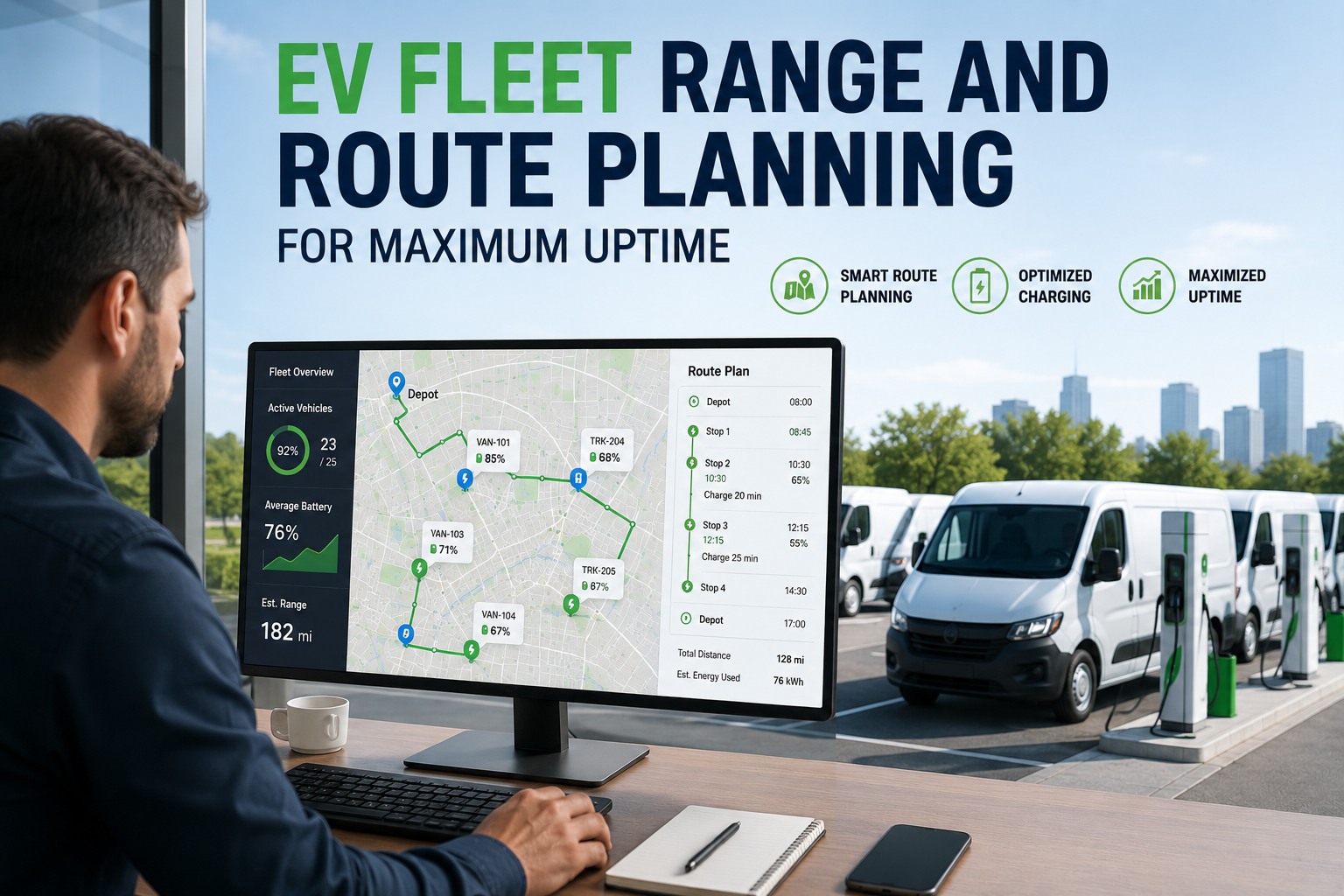
EV Fleet Range and Route Planning for Maximum Uptime
Rated range is a lab number. Real range is 20–40% lower once you load the truck and add cold, terrain, and speed. Learn to plan around usable range, budget energy per route, and assign every truck to a route it can finish — with charge to spare.
Why the Sticker Range Fails in the Field
EPA ratings come from controlled lab conditions — mild temperature, gentle speeds, no cargo — that commercial fleets rarely see. The result is a number that routinely overestimates what a working truck actually delivers.
What Eats Your Range
Real range is rated range minus a stack of deductions, each one taking a measurable bite. Understanding the size of each bite is what turns a guess into a plan — here's how a 100% starting point erodes.
Temperature: The Factor That Dominates
Of every deduction, temperature is the one that wrecks the most routes — because cold hits range two ways at once, and the effect is severe enough to demand its own seasonal plan.
Cold slows the battery's chemistry, cutting available capacity, and forces cabin heating that draws straight from the pack. DOE guidance cites range dropping around 41% in cold mixed driving.
Don't plan on an annual average. Model summer and winter performance as different operations, and reassign routes for the cold months rather than discovering the shortfall mid-shift.
Warm the battery and cabin while the truck is still plugged in. Preconditioning uses grid energy instead of range and recovers 5–10% of the cold-weather penalty.
See the Real Number Before the Truck Leaves
The whole game is knowing usable range before dispatch, not discovering it on the road. Truck Inspection & Maintenance pulls each truck's live state of charge and applies temperature, payload, terrain, and battery-health adjustments to project real range for the assigned route — so a dispatcher sees "this truck finishes with 26% to spare" or "reassign it" before it ever pulls out, turning range anxiety into a data-backed go/no-go.
Building a Route Energy Budget
Confident dispatching comes from treating every route like a budget: start with the energy you have, subtract what the route will really cost, and keep a reserve you never spend. Here's the sequence.
Match the Truck to the Route
Range planning isn't only per-trip — it's structural. The biggest wins come from assigning each EV to routes it comfortably handles and keeping the trucks that can't on the routes that fit, using your own operating data.
Vehicles consistently running under 150 miles a day, on predictable routes, are strong EV candidates that finish comfortably within real range.
Routes exceeding 200 miles with limited charging need careful mid-route planning — or belong in a later transition phase.
Pull about 90 days of GPS history to find each vehicle's average daily mileage and match trucks to routes on evidence, not assumption.
The Charging Network Is Part of the Route
A route is only as reliable as the charging behind it. Range planning and charging planning are the same problem — where and when a truck can add energy defines what routes are even possible.
Every route begins with available charge. If overnight charging is inconsistent, trucks start short — visibility into charge status before assignment is essential.
Know how many trucks must charge at once, how long each needs, and whether any require midday top-ups — the depot's power sets the ceiling.
For longer routes, factor charger locations, availability, and speed into the plan. A single well-placed fast-charge stop transforms a route's reach.
Align charging with utility rate structures to cut cost per kWh — smart scheduling saves money without touching a single route.
Turn Telematics Into Dispatch Confidence
The data to plan around real range already streams from your trucks — the trick is putting it in front of the dispatcher at the moment of assignment. Truck Inspection & Maintenance gives live battery visibility across the fleet, correlates energy use with route segments and payload, projects range leg by leg, and flags any truck starting a route below its threshold — so you can reassign a stop to another vehicle before a range problem becomes a stranded truck and a missed delivery.
Frequently Asked Questions
Because the rated figure is measured under lab conditions that commercial operations almost never match — mild temperatures around 68 to 86°F, moderate average speeds near 48 mph, minimal HVAC, and no cargo. Real fleet driving involves highway speeds, temperature extremes, heating and cooling, real payloads, wind, and terrain, all of which consume more energy, so actual range typically runs 20 to 40% below the EPA estimate. The main deductions are cold weather (a 20 to 30% loss below 40°F, more in deep cold), payload (15 to 25% for a fully loaded vehicle), terrain (3 to 5% per 1,000 feet of net climb), sustained highway speed (10 to 15% from aerodynamic drag), and HVAC use (10 to 15%). These factors also compound, so a loaded truck in winter climbing at highway speed loses more than any single factor implies. Planning around real range instead of the sticker is the core discipline of EV fleet operations. Start a free trial to project real range.
Cold is the single largest real-world range factor, and it hits two ways at once. First, low temperatures slow the lithium-ion battery's internal chemistry, which reduces available capacity and power even before any accessories run. Second, cabin heating draws energy directly from the same battery. Below about 40°F you can expect a 20 to 30% range reduction, and in deep cold — below roughly −10°C — losses of 20 to 40% are common, with DOE guidance citing around 41% in some cold mixed-driving conditions. The practical responses are to model winter performance as a separate operation from summer rather than using an annual average, to reassign routes for the cold months, and to precondition vehicles while they're still plugged in — warming the battery and cabin on grid power rather than spending range, which recovers roughly 5 to 10% of the penalty. For winter trip planning, a 20 to 40% buffer is a sensible default unless your own vehicle data shows otherwise. Ask about temperature-adjusted planning.
A charge reserve buffer is the portion of battery you deliberately plan never to use — a safety margin between the energy a route demands and the energy the truck carries. Crucially, it's a planning choice you control, not a fixed physics number: you decide how much cushion the operation needs. For everyday routes in mild conditions, a reserve of around 15 to 20% is common, meaning you plan the route to finish with at least that much charge remaining. In winter or on routes with more uncertainty — detours, traffic, unfamiliar terrain — a larger 20 to 40% buffer is prudent, since cold and variability can eat into range unexpectedly. The math is simple: your safe planning range equals your real (already condition-adjusted) range multiplied by one minus the buffer. The goal is always to arrive at the next charge with margin to spare rather than nursing a truck in on 2%, which is where missed deliveries and stranded vehicles happen. Start free and set your reserve policy.
Use your own operating history rather than guessing. Pull roughly 90 days of GPS data to establish each vehicle's average daily mileage, then match trucks to routes on that evidence. Vehicles consistently driving under 150 miles a day on predictable routes are strong EV candidates that will finish comfortably within real range. Routes exceeding 200 miles a day with limited charging access require careful planning — mid-route charging, or scheduling them into a later phase of your transition. Beyond distance, you also have to account for payload: an electric truck's battery adds roughly 800 to 1,400 pounds versus a diesel equivalent, which reduces how much cargo it can carry on weight-limited routes, and heavier loads cost more range, so a good match confirms both that the truck can carry the load and complete the distance under it. Modeling the minimum, maximum, and average payload across the whole route — not just an average — keeps you from assigning a truck that handles the distance empty but not loaded. Start free and match routes on data.
Partially, but never fully — which is an important planning distinction. When an electric truck climbs, it places a sustained heavy load on the battery, and while regenerative braking does recover energy on the descent, the amount recovered rarely matches what was spent going up. So a route with significant net elevation gain costs range even if it returns to its starting altitude, and you should plan on a net loss of roughly 3 to 5% per 1,000 feet of net climb. This also means two routes of identical distance can have very different energy demands depending on their terrain, and that routes starting from different depots or running in different directions can behave differently. The takeaway for dispatch is that terrain has to be modeled as part of the route's energy cost rather than assumed to wash out — the hills take more than the descents give back. This is exactly why energy-based route planning beats distance-based planning for EV fleets. Start free and model terrain in your routes.
Assign Every Truck to a Route It Can Finish
Range anxiety is a data problem, and data solves it. Truck Inspection & Maintenance projects real usable range from live state of charge, temperature, payload, terrain, and battery health — builds an energy budget with the reserve buffer you choose, matches trucks to routes on 90 days of history, and flags any vehicle starting a route short before it leaves. Plan on real range, not the sticker, and turn every dispatch into a confident go.