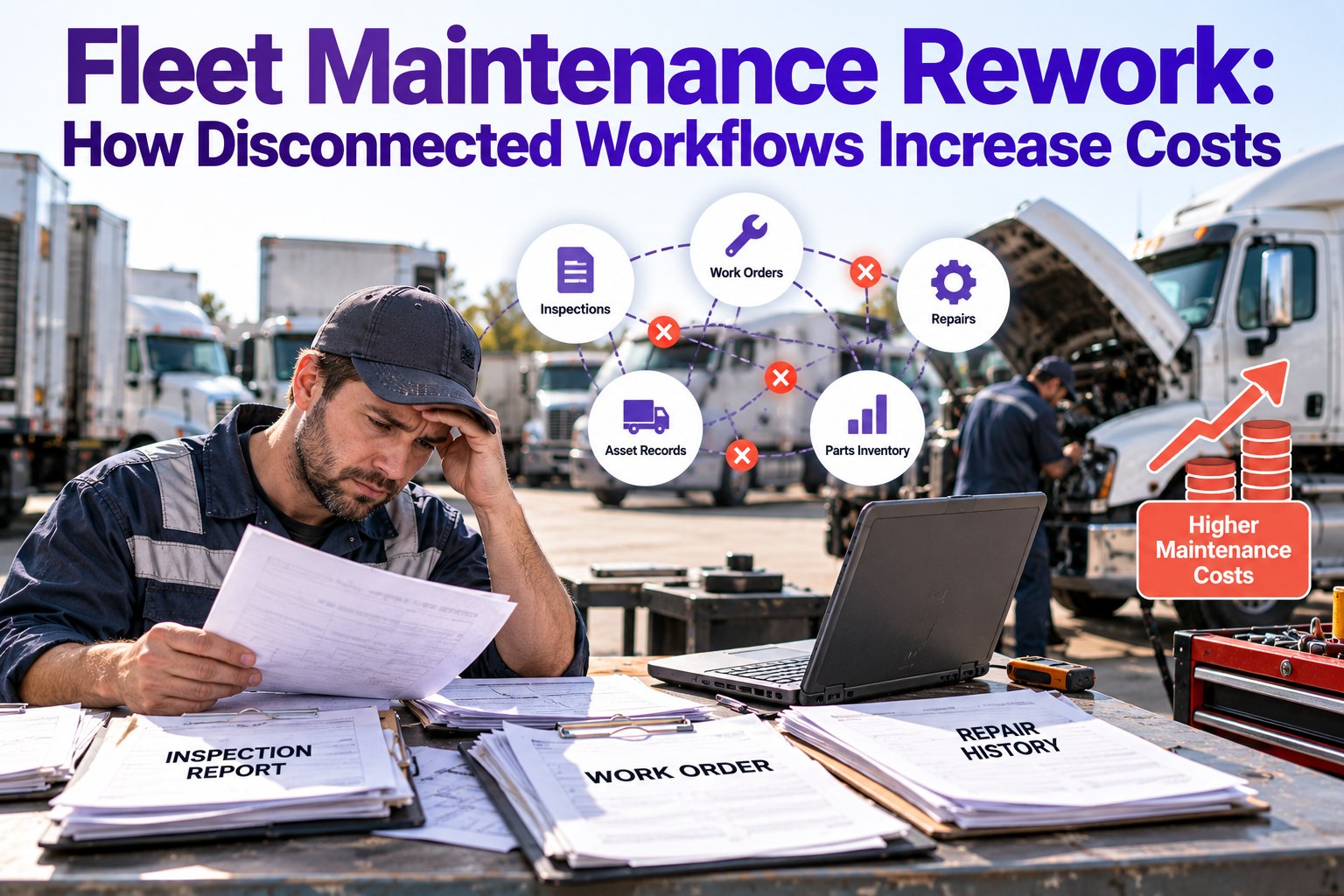
Rework is the repair you pay for twice — and it rarely shows up as its own line on an invoice. It hides inside "extra" labor hours, a part bought again, a truck down a second day for a fault someone already diagnosed. Almost always, the root cause isn't a bad technician; it's a workflow broken into disconnected pieces, where information falls through the gap between one step and the next. Here's where those gaps open, what they cost, and how one connected record closes them. Start free and put every inspection, defect, and repair on one shared record.
When the Workflow Is Disconnected, the Work Gets Done Twice.
A fault reported by text, a diagnosis scribbled on paper, a work order in another tool, parts tracked in a third — and the next person starts from scratch because nothing carried over. Truck Inspection & Maintenance Management Software keeps the whole loop on one record: guided inspections and defects on the driver's phone, each routed to a work order, parts and PM tied to the same unit. Nothing gets re-diagnosed, re-ordered, or re-done because someone couldn't see what already happened.
Rework Is a Workflow Problem, Not a Technician Problem
When a repair comes back, the instinct is to blame whoever did it. But study the cases and a pattern appears: the technician was working without the full picture — no access to the prior diagnosis, the vague symptom the driver actually reported, or which parts were already tried. Every one of those is an information handoff that failed. Fix the handoffs and most rework disappears on its own, because people stop making decisions from half the facts.
Where the Workflow Actually Breaks
Rework is born at the seams — the moments one person hands the job to the next. There are four of them in a typical fleet, and each one quietly loses a specific piece of information that someone later has to rebuild from memory.
A driver mentions a warning light in passing, or texts a vague "runs rough." No formal record is logged, so the symptom reaches the shop blurred — or not at all.
A repair spans two shifts. The incoming technician inherits a half-finished job with no notes, so the diagnostics start over instead of continuing.
One technician starts a job, another picks it up hours later with only a verbal note that never happened. The result is repeated inspection and duplicate troubleshooting on a truck that was already half-solved.
A truck goes to an external vendor and returns with thin paperwork and vague service notes — leaving a blind spot in its history and a compliance gap at the next audit.
Disconnected vs. Connected — Same Job, Two Outcomes
The difference isn't effort or skill. It's whether the information travels with the truck. Here's the same defect moving through a scattered toolset versus one shared record.
- Defect reported by text, never formally logged
- Diagnosis lives on paper or in one tech's head
- Work order in a separate system nobody cross-checks
- Parts tracked in a spreadsheet, status unclear
- PM due date missed because it sat in a different calendar
- Next person rebuilds the picture — and often redoes the work
- Defect logged on the phone with photos, tied to the unit
- Diagnosis and notes attached to that same defect
- Work order opens from the defect — one continuous thread
- Parts and status live on the record everyone can see
- PM scheduled against the same unit, nothing slips the gap
- The next person sees everything and continues, not restarts
What Rework Actually Costs You
The repair bill is the smallest part. Rework spends money and capacity in five places at once, and only one of them ever reaches an invoice — which is exactly why it goes unmanaged for so long.
One Record, Start to Finish
Truck Inspection & Maintenance Management Software was built so information travels with the truck, not with whoever happens to remember it. A defect logged at inspection carries its photos, diagnosis, work order, parts, and repair history on one record — visible to the driver, the shop, the next shift, and the manager. The handoffs stop losing things, and the work stops getting done twice.
How Truck Inspection & Maintenance Software Closes the Gaps
Each seam where rework is born maps to a specific thing the software keeps on the shared record — so the information is simply there when the next person needs it.
Frequently Asked Questions
What is maintenance rework, and why is it so expensive?
How do disconnected workflows cause duplicate work?
Where does information get lost most often in a fleet?
Does better documentation really reduce rework?
How does integrated software fit an existing fleet workflow?
Do the Work Once. Keep the Record Forever.
Rework doesn't come from bad technicians — it comes from broken handoffs that lose what already happened. Truck Inspection & Maintenance Management Software puts every inspection, defect, work order, part, and PM task on one shared record that travels with the truck, so no one re-diagnoses, re-orders, or re-does a thing. Connect the workflow, and the hidden cost of doing it twice simply goes away.