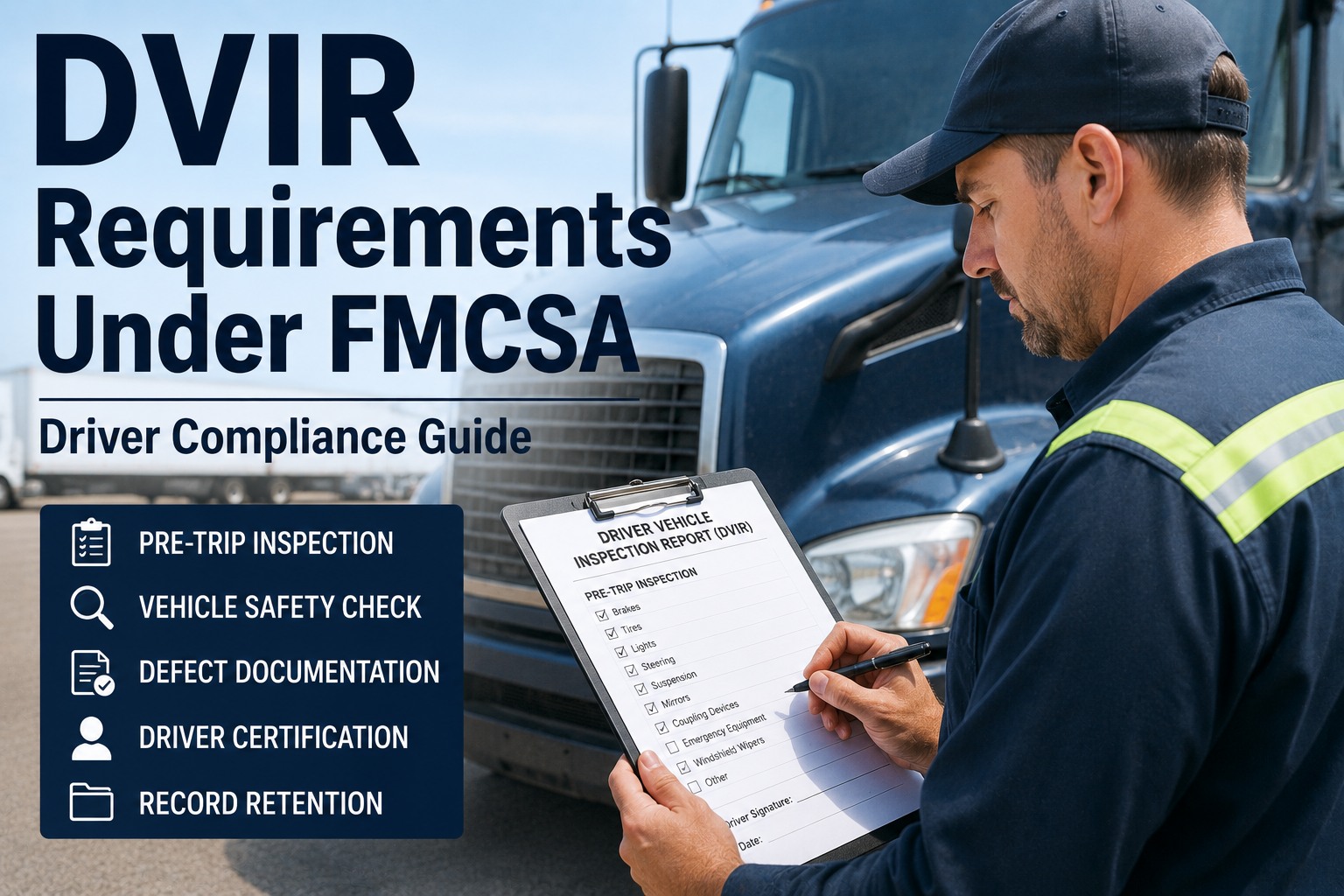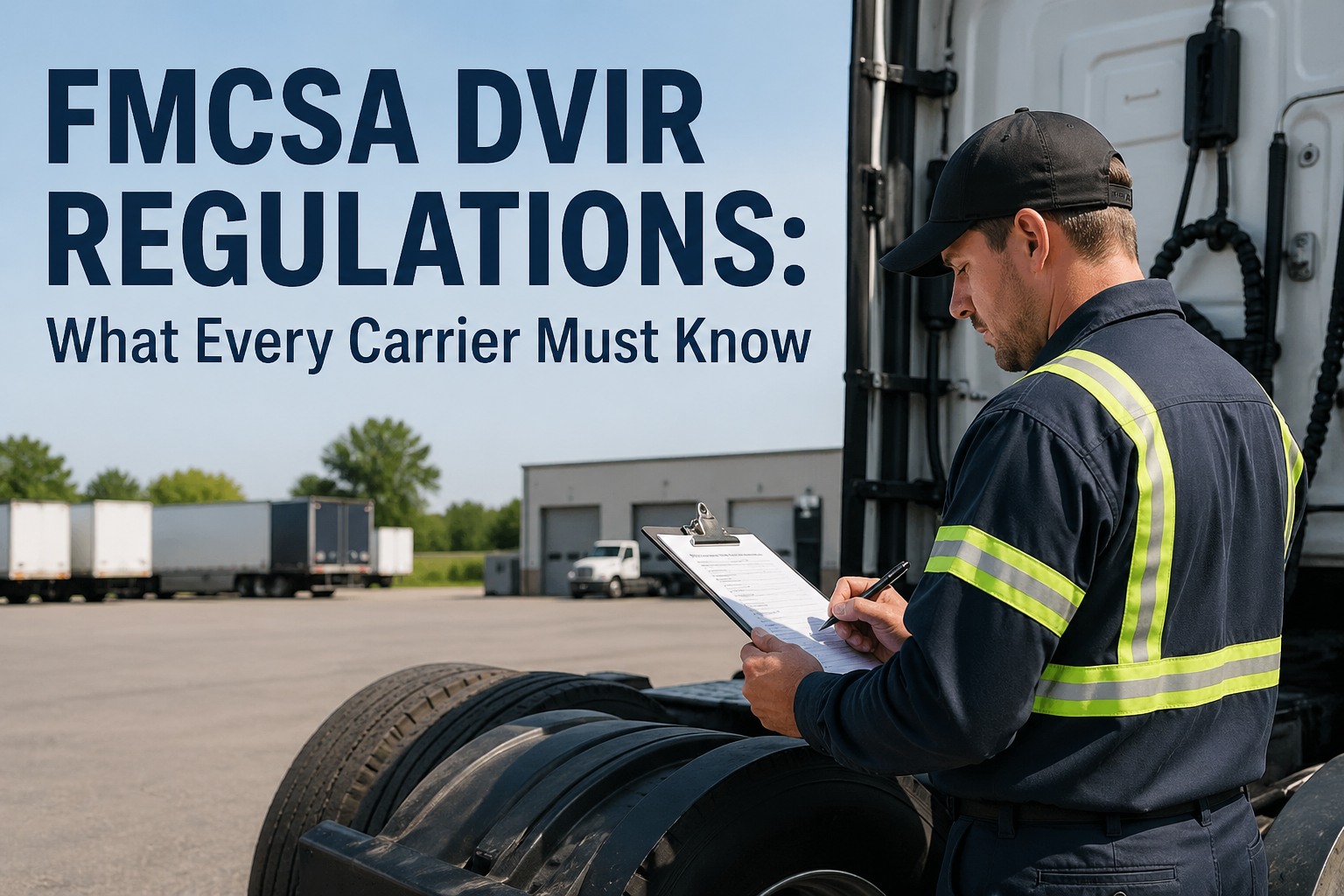
The Driver Vehicle Inspection Report is the federal rule that fleets break most often without realizing it. 49 CFR 396.11 looks deceptively simple — driver inspects, defects logged, repairs certified — but only 7% of motor carriers pass a focused compliance review without a single DVIR violation. The penalties aren't theoretical: civil fines run from $1,270 to over $16,000 per occurrence, and DVIR violations directly inflate your Vehicle Maintenance BASIC score. The good news is that as of March 23, 2026, FMCSA has explicitly authorized electronic DVIRs (eDVIRs), giving fleets a regulatory green light to digitize the chain of custody that paper-based systems consistently fumble. This guide breaks down exactly what 49 CFR 396.11 requires, the 11-item inspection list, the chain-of-custody loop, retention rules, and the violations that catch carriers off guard. Talk to our team for a DVIR compliance assessment.
The DVIR Chain of Custody — How 49 CFR 396.11 Actually Works
The regulation isn't just "fill out a form." It's a three-link accountability chain. Each link must close before the next can begin. When auditors find DVIR violations, it's almost always because one link in this chain wasn't completed:
Driver Inspects & Reports
At the end of each workday, the driver inspects all 11 FMCSA-required components and documents any defect or deficiency that affects safe operation or could cause mechanical breakdown.
Carrier Repairs & Certifies
A motor carrier official or qualified mechanic repairs each reported defect and certifies the repair on the original DVIR — before the vehicle is dispatched again.
Next Driver Reviews & Signs
Before operating the vehicle, the next driver reviews the previous DVIR, confirms repair certification, and signs to acknowledge — completing the custody chain.
The 11 Required Inspection Items
49 CFR 396.11(a) explicitly lists the parts and accessories that must be covered. Driver inspection rounds that skip any of these items are non-compliant by definition. Here's the federal floor:
Service Brakes
Including trailer brake connections. Most-cited DVIR component during roadside inspections.
Parking Brake
Engagement, holding capacity, and warning indicators must be verified each post-trip.
Steering Mechanism
Steering wheel free play, column integrity, power steering operation and fluid level.
Lighting Devices & Reflectors
Head, tail, brake, turn, marker, and reflector functionality on tractor and trailer.
Tires
Tread depth, sidewall condition, inflation pressure, and absence of cuts or bulges.
Horn
Audible from inside cab and meets manufacturer-specified performance.
Windshield Wipers
Both wipers operational. Critical for adverse-weather safety compliance.
Rear Vision Mirrors
Both side mirrors present, secure, undamaged, and properly adjustable.
Coupling Devices
Fifth wheel, kingpin, safety chains, glad hands, electrical connections.
Wheels & Rims
Cracks, missing lug nuts, hub damage, tracking issues. Cross-checked against tire condition.
Emergency Equipment
Triangles, fire extinguisher, spare fuses. Must be present and serviceable.
The 2026 Electronic DVIR Rule — What Just Changed
On February 19, 2026, FMCSA published the final rule explicitly authorizing electronic DVIRs (eDVIRs), effective March 23, 2026. While paper DVIRs remain permitted, the regulatory floor has shifted decisively toward digital. Here's the timeline:
"No-Defect" Rule Rescinded
FMCSA removed requirement for property-carrying CMV drivers to submit DVIR when no defects found. Passenger CMVs still required to file daily regardless.
49 CFR 390.32 Authorizes Digital
Electronic DVIRs first permitted under general electronic signature rule. Adoption sluggish due to lingering ambiguity about specific compliance.
FMCSA Final Rule Published
Docket FMCSA-2025-0115. Adds explicit eDVIR language to 396.11 and 396.13. Backed by ATA, OOIDA, and National Tank Truck Carriers.
eDVIR Rule Effective
All ambiguity removed. Fleets can fully digitize DVIR workflows with confidence. Petitions for reconsideration must have been filed by this date.
FMCSA confirmed it will NOT reinstate the no-defect DVIR requirement, even with eDVIRs making them faster. Paper-based DVIRs remain permitted as a compliance alternative — but the regulatory direction is unambiguous: digital is the future.
Record Retention Requirements
Three different DVIR-related records have three different retention periods. Auditors look at all three. Missing any one creates compliance exposure:
DVIR Itself
Original report, repair certification, and next-driver review signature must be retained 3 months from the date of the initial report (49 CFR 396.11(a)(4)).
Periodic Annual Inspection Report
Required under 49 CFR 396.17. Most recent inspection sticker, report, or decal must remain on the vehicle. Carrier holds the report for 14 months.
Inspector Qualifications
Evidence of inspector qualifications (training, certifications, experience documentation) must be retained 1 year after the inspector ceases performing inspections for the carrier.
Digitize your DVIR workflow before your next audit
Truck Inspection & Maintenance delivers FMCSA-compliant eDVIRs aligned with the March 23, 2026 final rule. Drivers complete inspections on mobile in 5 minutes, defects auto-route to maintenance, and the full chain of custody is timestamped for audit defense. Sign up free to deploy on 3 vehicles immediately.
Where Carriers Get Caught — The 6 Most Common DVIR Violations
FMCSA audit data shows the same compliance failures appear across thousands of carriers. Each one has a specific fix — but only if you know to look for it:
Missing Driver Signature
The most common violation. Even a "clean" no-defect DVIR (when company policy requires submission) needs a signature linkable to the driver. Missing signature = recordkeeping violation.
Repair Not Certified
Defect logged, mechanic fixed it, but no formal repair certification on the original DVIR. Auditor sees an unrepaired defect. Triggers heavy fines.
Next-Driver Loop Not Closed
Driver B operates the vehicle without signing the DVIR that contained the previous defect. To FMCSA, the truck is operating un-repaired — severe OOS risk.
"Pencil Whipping"
Driver ticks "No Defect" down the entire line in 45 seconds. ELD timestamp cross-reference exposes the falsification. Considered a falsification of records — far worse than missing a defect.
Vague Defect Descriptions
"Brake issue" or "feels off" — too vague to drive a real repair. Train drivers to describe the condition, not the symptom: "left steer brake pulling, audible squeal at low speed."
Records Not Retrievable
DVIR exists somewhere — in a binder, a cab, a desk drawer — but can't be produced when the auditor asks. Retention requirement isn't met if you can't find it on demand.
Paper DVIR vs Electronic DVIR — The Operational Difference
Both formats are legally permitted. The operational difference is night and day. Here's what each delivers in real audit scenarios:
Frequently Asked Questions
Are DVIRs required when no defects are found?
For property-carrying CMVs: only when defects are found (since 2014 rule change). For passenger-carrying CMVs: yes, every day regardless. However, many carriers require daily DVIRs as company policy because it creates better documentation, catches defects earlier, and aligns with state-specific programs like California's CHP BIT. The federal floor is the minimum — best practice typically exceeds it.
Are electronic DVIRs legal under FMCSA?
Yes — and as of March 23, 2026, explicitly authorized in 49 CFR 396.11 and 396.13. Electronic DVIRs were already permitted under 49 CFR 390.32 since 2018, but the new final rule removes all ambiguity. FMCSA actively encourages adoption of electronic, cost-saving methods. Contact our specialists to migrate from paper before your next compliance review.
How long must DVIRs be retained?
3 months minimum from the date of the initial report — including the original DVIR, the repair certification, and the next-driver review signature. Annual periodic inspection reports under 49 CFR 396.17 must be retained 14 months. Inspector qualification records must be kept 1 year after the inspector stops performing inspections for the carrier.
What's the penalty for DVIR violations?
Civil fines range from $1,270 per occurrence at the low end to over $16,000 per violation for severe or pattern violations. DVIR violations also feed directly into the Vehicle Maintenance BASIC under FMCSA's CSA scoring — so the financial impact compounds through insurance premium increases and audit attention.
What's the most common DVIR audit failure?
The "three-step signature loop" — defect logged, repair completed, but next driver fails to sign the DVIR before operating the vehicle. To FMCSA, an unsigned post-repair review means the vehicle is operating un-repaired, regardless of whether the actual mechanical work was done. Carries severe out-of-service risk. Sign up free to automate this signature loop entirely.
Does pre-trip inspection count as a DVIR?
No. 49 CFR 396.11 is technically a post-trip inspection report. Drivers must still perform pre-trip inspections under 49 CFR 392.7 before operating any CMV — including reviewing the previous DVIR for unrepaired defects. The pre-trip catches issues that developed since post-trip; the post-trip DVIR documents conditions for the next driver. Both are legally required.
Stop the audit chain from breaking.
Truck Inspection & Maintenance delivers FMCSA-compliant eDVIRs with automated chain-of-custody tracking. All 11 inspection items pre-built. Auto-routed defects to maintenance. Timestamped signatures. Audit-ready retention. Free for up to 3 vehicles. Aligned with the March 23, 2026 final rule.